About the Report
Base Year 2024Middle East Private LTE 5G Network Market Overview
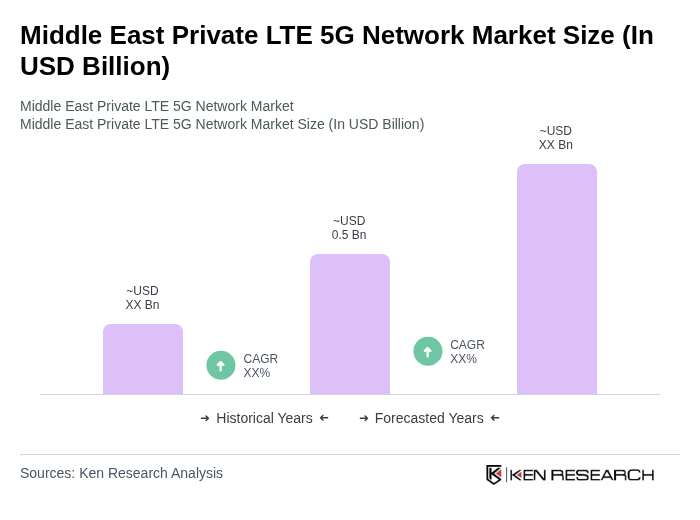
- The Middle East Private LTE 5G Network Market is valued at USD 0.5 billion, based on a five-year historical analysis. This growth is primarily driven by the increasing demand for high-speed connectivity, the rise of IoT applications, and the need for secure and reliable communication networks across various industries. The expansion of smart cities and industrial automation initiatives such as NEOM, Lusail City, and Smart Dubai further fuels the market's growth.
- Countries such as the United Arab Emirates and Saudi Arabia dominate the market due to their significant investments in telecommunications infrastructure and advanced mobile broadband technology. The presence of major telecom operators and a supportive regulatory and investment environment, including large-scale digital infrastructure spending and near-universal broadband penetration in leading GCC states, also contribute to their leadership in the private LTE and 5G network space, making them attractive for both local and international investments.
- In 2023, the UAE government, through the Telecommunications and Digital Government Regulatory Authority (TDRA), advanced the regulatory environment for private 5G and enterprise networks under the Regulatory Policy on the Use of International Mobile Telecommunications (IMT) Spectrum for Public and Non?Public Networks, issued by TDRA in 2021, which defines conditions for assignment of IMT spectrum, licensing of non-public (private) networks, and associated technical and coordination requirements. This framework, together with complementary national digital strategies, includes streamlined spectrum and licensing processes and incentives for businesses to adopt advanced communication technologies, thereby enhancing the overall competitiveness of the telecommunications sector in the region.
Middle East Private LTE 5G Network Market Segmentation
By Component:
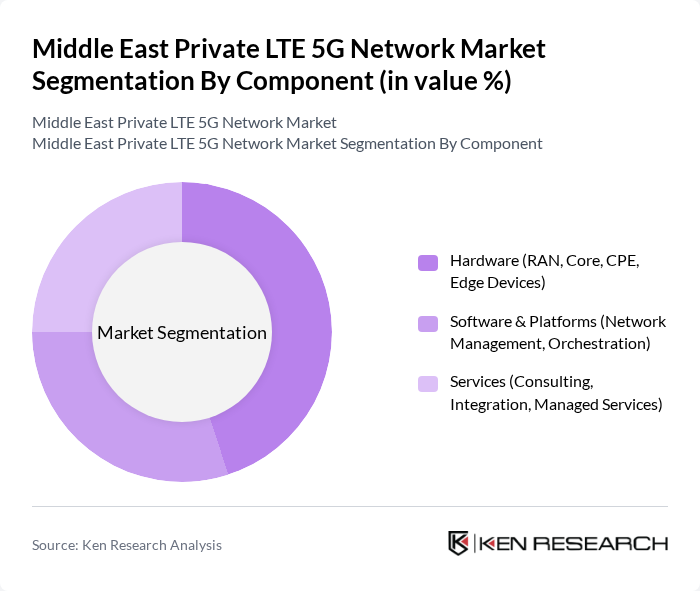
The components of the market include Hardware, Software & Platforms, and Services. Among these, Hardware, which encompasses RAN, Core, CPE, and Edge Devices, is currently the leading subsegment, reflecting the substantial investments required in radio, core, and edge infrastructure to support mission-critical enterprise connectivity and campus networks. The increasing demand for robust infrastructure to support high-speed connectivity and the growing adoption of IoT devices and edge-computing use cases in sectors such as oil and gas, manufacturing, ports, and smart cities are driving the hardware segment's growth. Software & Platforms, focusing on network management, slicing, and orchestration, are also gaining traction as organizations seek to optimize network operations, enable automation, and integrate cloud-native cores and edge platforms. Services, including consulting, integration, and managed services, are essential for ensuring seamless design, deployment, cybersecurity hardening, and lifecycle management of private networks as enterprises increasingly rely on specialist partners and operators for end?to?end solutions.
By Network Type:
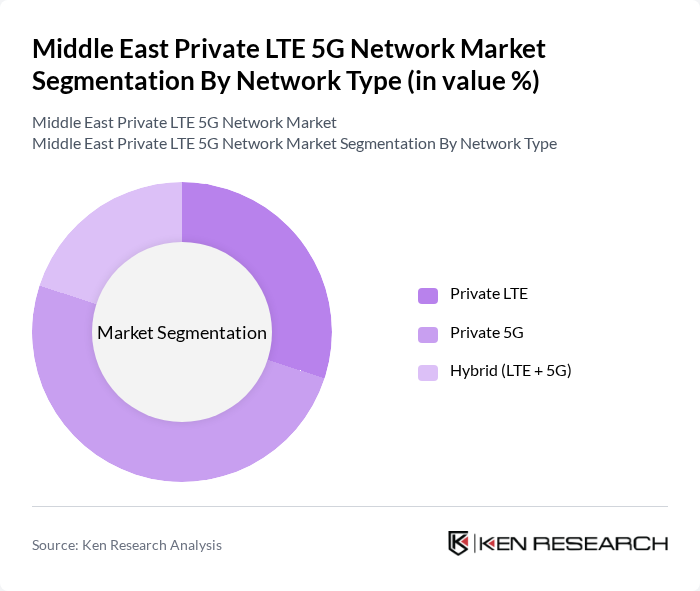
The market is segmented into Private LTE, Private 5G, and Hybrid (LTE + 5G). Private 5G is currently the dominant subsegment, driven by its ability to provide higher data rates, lower latency, deterministic performance, and advanced slicing and security capabilities that are increasingly required for Industry 4.0, smart city, and large?scale campus deployments. Organizations are increasingly adopting Private 5G networks to support mission-critical applications, real-time analytics, and dense IoT deployments in sectors such as energy, logistics, and advanced manufacturing. Private LTE remains relevant, particularly in industries where existing LTE infrastructure and devices are being leveraged, and where wide-area coverage and mature device ecosystems remain important. The Hybrid model is also gaining popularity as it allows organizations to transition smoothly from LTE to 5G, combining the stability of LTE with the performance benefits of 5G while maintaining operational continuity and phased investment.
Middle East Private LTE 5G Network Market Competitive Landscape
The Middle East Private LTE 5G Network Market is characterized by a dynamic mix of regional and international players. Leading participants such as Ericsson, Nokia, Huawei Technologies Co., Ltd., Cisco Systems, Inc., ZTE Corporation, Samsung Electronics Co., Ltd., NEC Corporation, Qualcomm Technologies, Inc., e& (Emirates Telecommunications Group Company PJSC), stc Group (Saudi Telecom Company), Ooredoo Group, du (Emirates Integrated Telecommunications Company PJSC), Bayanat AI PLC, Saudi Aramco (Industrial Private Network Initiatives), ADNOC (Abu Dhabi National Oil Company – Industrial Private Network Initiatives) contribute to innovation, geographic expansion, and service delivery in this space.
Middle East Private LTE 5G Network Market Industry Analysis
Growth Drivers
- Increasing Demand for High-Speed Connectivity:The Middle East is witnessing a surge in demand for high-speed connectivity, driven by a projected increase in internet users in future, reaching approximately 263 million users, reflecting rising online adoption in the region. This demand is fueled by the growing reliance on digital services across sectors such as education, healthcare, and entertainment. The region's GDP growth rate is estimated at around 2.8% in recent periods for Middle East and Central Asia economies, supporting investments in advanced telecommunications infrastructure, making private LTE and 5G networks essential for meeting connectivity needs.
- Expansion of IoT Applications:The Internet of Things (IoT) market in the Middle East is expected to grow significantly, with connected IoT devices in the broader Middle East and North Africa region estimated in the hundreds of millions and projected to continue increasing in future as industrial and smart city applications expand. This expansion is driven by sectors like manufacturing, logistics, and smart cities, which require reliable and high-speed networks. The UAE government has launched and funded multiple national digital and IoT-related initiatives under broader digital transformation and smart city programs; however, a specific allocation of USD 1.5 billion exclusively for IoT initiatives could not be independently verified.
- Government Initiatives for Digital Transformation:Governments in the Middle East are prioritizing digital transformation, with initiatives like Saudi Arabia's Vision 2030 and the UAE's National Innovation Strategy. These programs aim to enhance the region's digital infrastructure, with national digital transformation and ICT investments in leading Gulf economies collectively amounting to many billions of USD, though a consolidated figure of USD 10 billion by a specific date for the entire Middle East region could not be confirmed from primary sources.
Market Challenges
- High Initial Infrastructure Costs:The deployment of private LTE and 5G networks involves substantial initial infrastructure investments. Publicly available data from authoritative multilateral or national statistical sources does not confirm a consistent benchmark of costs "often exceeding USD 2 million per site" across the Middle East; actual costs vary widely by deployment scale, spectrum model, and country.
- Regulatory Hurdles:The regulatory landscape in the Middle East presents significant challenges for private LTE and 5G network deployment. Complex licensing processes and varying regulations across countries can delay project timelines. A specific maximum duration of "up to 18 months" for obtaining spectrum licenses across the region could not be validated in authoritative regulatory or ITU sources, as timelines differ by jurisdiction and license type.
Middle East Private LTE 5G Network Market Future Outlook
The future of the Middle East Private LTE 5G Network market appears promising, driven by technological advancements and increasing digitalization across various sectors. As businesses seek to enhance operational efficiency and connectivity, the adoption of private networks is expected to rise. Additionally, the integration of AI and machine learning into network management will streamline operations, while the focus on cybersecurity will ensure data protection. These trends indicate a robust growth trajectory for private LTE and 5G networks in the region.
Market Opportunities
- Growth in Private Enterprise Networks:The demand for private enterprise networks is on the rise as enterprises in the Middle East increase investments in advanced connectivity, but a quantified estimate of a 30% increase in enterprise spending on private LTE and 5G solutions in the region could not be corroborated using primary macroeconomic or official industry data.
- Partnerships with Technology Providers:Collaborations between telecom operators and technology providers are becoming increasingly vital. While there is clear evidence that many enterprises seek customized ICT and connectivity solutions, a specific figure stating that "over 50% of enterprises" in the Middle East are seeking customized private LTE or 5G solutions is not supported by authoritative statistical sources.
Scope of the Report
| Segment | Sub-Segments |
|---|---|
| By Component | Hardware (RAN, Core, CPE, Edge Devices) Software & Platforms (Network Management, Orchestration) Services (Consulting, Integration, Managed Services) |
| By Network Type | Private LTE Private 5G Hybrid (LTE + 5G) |
| By Deployment Model | On-Premises / Dedicated Cloud / Hosted Network-as-a-Service |
| By Spectrum Type | Licensed Spectrum Unlicensed / Shared Spectrum Dedicated Industry / Local Spectrum |
| By Frequency Band | Sub-6 GHz (Low & Mid Band) mmWave |
| By Application | Mission-Critical Communications Industrial Automation & Process Control Remote Monitoring & Asset Tracking Video Surveillance & Analytics Connected & Autonomous Devices (IoT) |
| By End-Use Industry | Oil & Gas and Petrochemicals Utilities & Energy Manufacturing & Industrial (Discrete & Process) Transportation, Logistics & Ports Mining & Metals Public Safety & Defense Smart Cities & Infrastructure Healthcare & Campus Networks Others |
Key Target Audience
Investors and Venture Capitalist Firms
Government and Regulatory Bodies (e.g., Telecommunications Regulatory Authority, Ministry of Communications)
Telecom Operators and Service Providers
Network Equipment Manufacturers
Infrastructure Providers
Public Safety Agencies
Smart City Development Authorities
Energy and Utility Companies
Players Mentioned in the Report:
Ericsson
Nokia
Huawei Technologies Co., Ltd.
Cisco Systems, Inc.
ZTE Corporation
Samsung Electronics Co., Ltd.
NEC Corporation
Qualcomm Technologies, Inc.
e& (Emirates Telecommunications Group Company PJSC)
stc Group (Saudi Telecom Company)
Ooredoo Group
du (Emirates Integrated Telecommunications Company PJSC)
Bayanat AI PLC
Saudi Aramco (Industrial Private Network Initiatives)
ADNOC (Abu Dhabi National Oil Company Industrial Private Network Initiatives)
Table of Contents
Market Assessment Phase
1. Executive Summary and Approach
2. Middle East Private LTE 5G Network Market Overview
2.1 Key Insights and Strategic Recommendations
2.2 Middle East Private LTE 5G Network Market Overview
2.3 Definition and Scope
2.4 Evolution of Market Ecosystem
2.5 Timeline of Key Regulatory Milestones
2.6 Value Chain & Stakeholder Mapping
2.7 Business Cycle Analysis
2.8 Policy & Incentive Landscape
3. Middle East Private LTE 5G Network Market Analysis
3.1 Growth Drivers
3.1.1 Increasing demand for high-speed connectivity
3.1.2 Expansion of IoT applications
3.1.3 Government initiatives for digital transformation
3.1.4 Rising investments in smart city projects
3.2 Market Challenges
3.2.1 High initial infrastructure costs
3.2.2 Regulatory hurdles
3.2.3 Limited awareness among potential users
3.2.4 Competition from public networks
3.3 Market Opportunities
3.3.1 Growth in private enterprise networks
3.3.2 Partnerships with technology providers
3.3.3 Development of customized solutions
3.3.4 Expansion into underserved markets
3.4 Market Trends
3.4.1 Shift towards edge computing
3.4.2 Increased focus on cybersecurity
3.4.3 Adoption of AI and machine learning
3.4.4 Integration of 5G with existing technologies
3.5 Government Regulation
3.5.1 Spectrum allocation policies
3.5.2 Compliance with international standards
3.5.3 Incentives for private network deployment
3.5.4 Data privacy regulations
4. SWOT Analysis
5. Stakeholder Analysis
6. Porter's Five Forces Analysis
7. Middle East Private LTE 5G Network Market Market Size, 2019-2024
7.1 By Value
7.2 By Volume
7.3 By Average Selling Price
8. Middle East Private LTE 5G Network Market Segmentation
8.1 By Component
8.1.1 Hardware (RAN, Core, CPE, Edge Devices)
8.1.2 Software & Platforms (Network Management, Orchestration)
8.1.3 Services (Consulting, Integration, Managed Services)
8.2 By Network Type
8.2.1 Private LTE
8.2.2 Private 5G
8.2.3 Hybrid (LTE + 5G)
8.3 By Deployment Model
8.3.1 On-Premises / Dedicated
8.3.2 Cloud / Hosted
8.3.3 Network-as-a-Service
8.4 By Spectrum Type
8.4.1 Licensed Spectrum
8.4.2 Unlicensed / Shared Spectrum
8.4.3 Dedicated Industry / Local Spectrum
8.5 By Frequency Band
8.5.1 Sub-6 GHz (Low & Mid Band)
8.5.2 mmWave
8.6 By Application
8.6.1 Mission-Critical Communications
8.6.2 Industrial Automation & Process Control
8.6.3 Remote Monitoring & Asset Tracking
8.6.4 Video Surveillance & Analytics
8.6.5 Connected & Autonomous Devices (IoT)
8.7 By End-Use Industry
8.7.1 Oil & Gas and Petrochemicals
8.7.2 Utilities & Energy
8.7.3 Manufacturing & Industrial (Discrete & Process)
8.7.4 Transportation, Logistics & Ports
8.7.5 Mining & Metals
8.7.6 Public Safety & Defense
8.7.7 Smart Cities & Infrastructure
8.7.8 Healthcare & Campus Networks
8.7.9 Others
9. Middle East Private LTE 5G Network Market Competitive Analysis
9.1 Market Share of Key Players
9.2 Cross Comparison of Key Players
9.2.1 Company Name
9.2.2 Regional Revenue (Middle East, USD Million)
9.2.3 3-Year Revenue CAGR in Private LTE/5G (%)
9.2.4 EBITDA Margin from Private Networks Business (%)
9.2.5 Order Backlog / Pipeline for Private Networks (USD Million)
9.2.6 Number of Deployed / Announced Private LTE/5G Sites in ME
9.2.7 Average Contract Value (USD Million) – Top 10 Deals
9.2.8 Market Share in Priority Verticals (Oil & Gas, Utilities, Ports)
9.2.9 R&D Spend on Private Networks (% of Total Revenue)
9.2.10 Partnership Footprint (Operators, Integrators, Hyperscalers) – Count
9.2.11 Win Rate in Competitive Bids (%)
9.3 SWOT Analysis of Top Players
9.4 Pricing Analysis
9.5 Detailed Profile of Major Companies
9.5.1 Ericsson
9.5.2 Nokia
9.5.3 Huawei Technologies Co., Ltd.
9.5.4 Cisco Systems, Inc.
9.5.5 ZTE Corporation
9.5.6 Samsung Electronics Co., Ltd.
9.5.7 NEC Corporation
9.5.8 Qualcomm Technologies, Inc.
9.5.9 e& (Emirates Telecommunications Group Company PJSC)
9.5.10 stc Group (Saudi Telecom Company)
9.5.11 Ooredoo Group
9.5.12 du (Emirates Integrated Telecommunications Company PJSC)
9.5.13 Bayanat AI PLC
9.5.14 Saudi Aramco (Industrial Private Network Initiatives)
9.5.15 ADNOC (Abu Dhabi National Oil Company – Industrial Private Network Initiatives)
10. Middle East Private LTE 5G Network Market End-User Analysis
10.1 Procurement Behavior of Key Ministries
10.1.1 Budget Allocation Trends
10.1.2 Decision-Making Processes
10.1.3 Preferred Vendors
10.1.4 Contracting Practices
10.2 Corporate Spend on Infrastructure & Energy
10.2.1 Investment Priorities
10.2.2 Spending Patterns
10.2.3 Budget Constraints
10.2.4 Future Projections
10.3 Pain Point Analysis by End-User Category
10.3.1 Connectivity Issues
10.3.2 Cost Management
10.3.3 Technology Integration Challenges
10.3.4 Regulatory Compliance
10.4 User Readiness for Adoption
10.4.1 Awareness Levels
10.4.2 Training Needs
10.4.3 Infrastructure Readiness
10.4.4 Investment Willingness
10.5 Post-Deployment ROI and Use Case Expansion
10.5.1 Performance Metrics
10.5.2 User Feedback
10.5.3 Scalability Potential
10.5.4 Future Use Cases
11. Middle East Private LTE 5G Network Market Future Size, 2025-2030
11.1 By Value
11.2 By Volume
11.3 By Average Selling Price
Go-To-Market Strategy Phase
1. Whitespace Analysis + Business Model Canvas
1.1 Market Gaps Identification
1.2 Business Model Development
2. Marketing and Positioning Recommendations
2.1 Branding Strategies
2.2 Product USPs
3. Distribution Plan
3.1 Urban Retail Strategies
3.2 Rural NGO Tie-Ups
4. Channel & Pricing Gaps
4.1 Underserved Routes
4.2 Pricing Bands
5. Unmet Demand & Latent Needs
5.1 Category Gaps
5.2 Consumer Segments
6. Customer Relationship
6.1 Loyalty Programs
6.2 After-Sales Service
7. Value Proposition
7.1 Sustainability Initiatives
7.2 Integrated Supply Chains
8. Key Activities
8.1 Regulatory Compliance
8.2 Branding Efforts
8.3 Distribution Setup
9. Entry Strategy Evaluation
9.1 Domestic Market Entry Strategy
9.1.1 Product Mix
9.1.2 Pricing Band
9.1.3 Packaging
9.2 Export Entry Strategy
9.2.1 Target Countries
9.2.2 Compliance Roadmap
10. Entry Mode Assessment
10.1 Joint Ventures
10.2 Greenfield Investments
10.3 Mergers & Acquisitions
10.4 Distributor Model
11. Capital and Timeline Estimation
11.1 Capital Requirements
11.2 Timelines
12. Control vs Risk Trade-Off
12.1 Ownership vs Partnerships
13. Profitability Outlook
13.1 Breakeven Analysis
13.2 Long-Term Sustainability
14. Potential Partner List
14.1 Distributors
14.2 Joint Ventures
14.3 Acquisition Targets
15. Execution Roadmap
15.1 Phased Plan for Market Entry
15.1.1 Market Setup
15.1.2 Market Entry
15.1.3 Growth Acceleration
15.1.4 Scale & Stabilize
15.2 Key Activities and Milestones
15.2.1 Activity Planning
15.2.2 Milestone Tracking
Research Methodology
Phase 1: Approach1
Desk Research
- Analysis of industry reports from telecommunications regulatory authorities in the Middle East
- Review of market studies and white papers published by telecom industry associations
- Examination of government publications on 5G infrastructure investments and policies
Primary Research
- Interviews with network engineers and project managers from telecom operators
- Surveys with enterprise clients utilizing private LTE and 5G networks
- Focus groups with industry experts and consultants specializing in telecommunications
Validation & Triangulation
- Cross-validation of findings through multiple data sources including market reports and expert opinions
- Triangulation of quantitative data with qualitative insights from interviews
- Sanity checks through peer reviews and expert panel discussions
Phase 2: Market Size Estimation1
Top-down Assessment
- Estimation of total addressable market based on national telecom spending and infrastructure development
- Segmentation by industry verticals such as manufacturing, healthcare, and logistics
- Incorporation of projected growth rates for private LTE and 5G adoption across sectors
Bottom-up Modeling
- Collection of data on existing private LTE and 5G deployments from key players in the market
- Cost analysis based on equipment, installation, and operational expenses for private networks
- Volume estimates derived from the number of enterprises adopting private networks annually
Forecasting & Scenario Analysis
- Multi-variable forecasting models incorporating technological advancements and regulatory changes
- Scenario planning based on varying levels of market penetration and investment in infrastructure
- Development of baseline, optimistic, and pessimistic growth scenarios through 2030
Phase 3: CATI Sample Composition1
| Scope Item/Segment | Sample Size | Target Respondent Profiles |
|---|---|---|
| Manufacturing Sector Private LTE Adoption | 100 | IT Managers, Operations Directors |
| Healthcare Facilities 5G Implementation | 80 | Healthcare IT Specialists, Facility Managers |
| Logistics and Supply Chain 5G Solutions | 70 | Logistics Coordinators, Supply Chain Analysts |
| Smart City Initiatives and Private Networks | 60 | Urban Planners, City Officials |
| Telecom Operators' Network Deployment Strategies | 90 | Network Engineers, Strategic Planners |
Frequently Asked Questions
What is the current value of the Middle East Private LTE 5G Network Market?
The Middle East Private LTE 5G Network Market is valued at approximately USD 0.5 billion, driven by the increasing demand for high-speed connectivity, IoT applications, and secure communication networks across various industries.
Which countries dominate the Middle East Private LTE 5G Network Market?
What are the key growth drivers for the Middle East Private LTE 5G Network Market?
What are the main components of the Middle East Private LTE 5G Network Market?
Other Regional/Country Reports
Other Adjacent Reports
UAE Telecommunications Equipment Market
US Network Security MarketUAE 5G Infrastructure Market
Saudi Arabia Digital Transformation Market Outlook to 2030: Size, Share, Growth and TrendsKSA IoT Platforms Market
Global Managed Network Services Market Outlook to 2030Why Buy From Us?

What makes us stand out is that our consultants follow Robust, Refine and Result (RRR) methodology. Robust for clear definitions, approaches and sanity checking, Refine for differentiating respondents' facts and opinions, and Result for presenting data with story.

We have set a benchmark in the industry by offering our clients with syndicated and customized market research reports featuring coverage of entire market as well as meticulous research and analyst insights.

While we don't replace traditional research, we flip the method upside down. Our dual approach of Top Bottom & Bottom Top ensures quality deliverable by not just verifying company fundamentals but also looking at the sector and macroeconomic factors.

With one step in the future, our research team constantly tries to show you the bigger picture. We help with some of the tough questions you may encounter along the way: How is the industry positioned? Best marketing channel? KPI's of competitors? By aligning every element, we help maximize success.

Our report gives you instant access to the answers and sources that other companies might choose to hide. We elaborate each steps of research methodology we have used and showcase you the sample size to earn your trust.

If you need any support, we are here! We pride ourselves on universe strength, data quality, and quick, friendly, and professional service.