About the Report
Base Year 2024Listen to the audio summary
Middle East Ride Hailing Taxi Market Overview
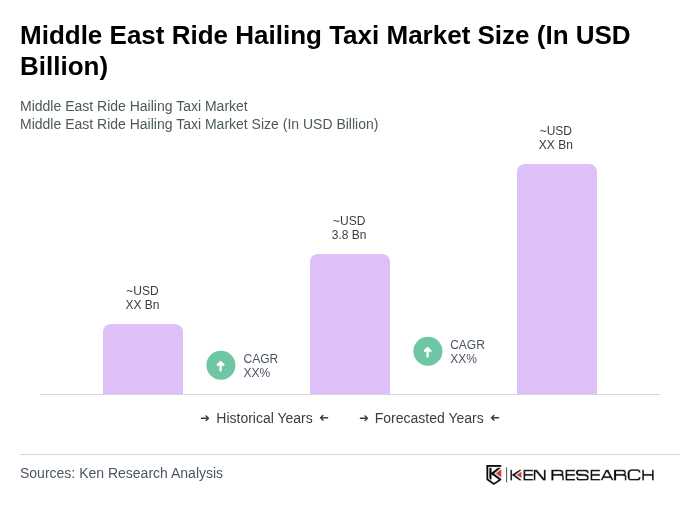
- The Middle East Ride Hailing Taxi Market is valued at USD 3.8 billion, based on a five-year historical analysis. This growth is primarily driven by increasing urbanization, rising smartphone penetration, and a shift in consumer preferences towards convenient, on-demand transportation options. The rise in disposable income, rapid digital adoption, and the growing trend of shared mobility have further fueled the demand for ride-hailing services across the region. Expansion of smart city initiatives and government support for digital mobility platforms are also accelerating market growth .
- Key players in this market include major cities such as Dubai, Riyadh, and Cairo, which dominate due to their high population density, robust tourism sectors, and significant investments in smart city initiatives. The presence of international companies like Uber and local players like Careem has also contributed to the competitive landscape, enhancing service availability and customer choice. The market is witnessing increased competition from regional and global entrants, with a focus on technology integration and service innovation .
- In 2023, the Saudi Arabian government implemented the Ride-Hailing Services Regulations, issued by the Transport General Authority (TGA), to enhance the safety and reliability of ride-hailing services. This includes mandatory background checks for drivers, vehicle inspection requirements, and the establishment of a regulatory framework to ensure compliance with safety standards. These measures have fostered consumer trust and encouraged the growth of the ride-hailing sector in the Kingdom .
Middle East Ride Hailing Taxi Market Segmentation
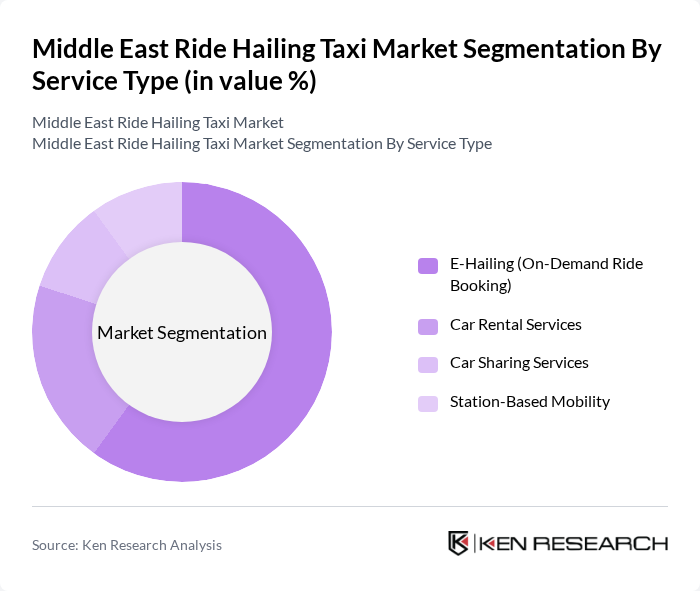
By Service Type:The service type segmentation includes various offerings that cater to different consumer needs. The primary subsegments are E-Hailing (On-Demand Ride Booking), Car Rental Services, Car Sharing Services, and Station-Based Mobility. Among these, E-Hailing has emerged as the dominant service type, driven by the convenience of app-based booking and the growing preference for on-demand transportation. The rapid adoption of smartphones and mobile applications has significantly influenced consumer behavior, leading to a surge in demand for E-Hailing services.
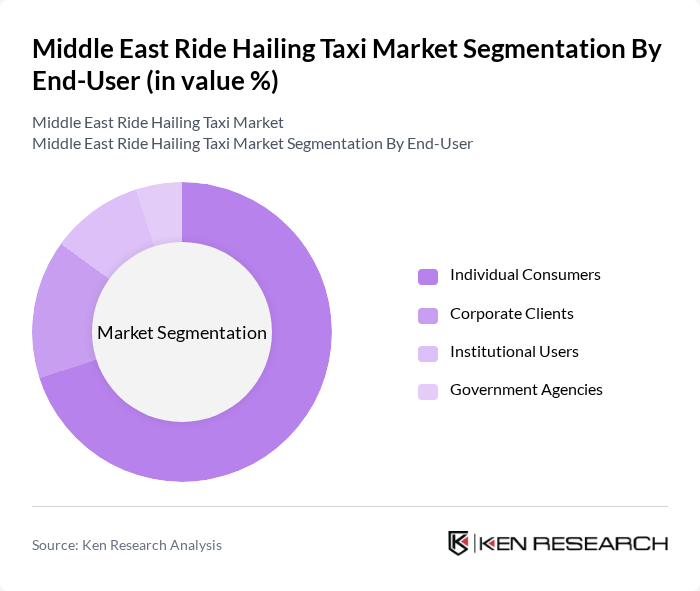
By End-User:The end-user segmentation encompasses Individual Consumers, Corporate Clients, Institutional Users, and Government Agencies. Individual Consumers represent the largest segment, as the majority of ride-hailing users are everyday commuters seeking convenient and cost-effective transportation solutions. The increasing trend of urban mobility and the need for flexible transport options have further solidified the dominance of this segment, while corporate clients and government agencies are also leveraging ride-hailing services for business travel and public transport solutions.
Middle East Ride Hailing Taxi Market Competitive Landscape
The Middle East Ride Hailing Taxi Market is characterized by a dynamic mix of regional and international players. Leading participants such as Careem Networks FZ LLC, Uber Middle East FZ LLC, Bolt Technology OU, inDrive (Soul Innovations Ltd), Didi Global Inc, Kaiian (Kayan Rehla Information Technology Company), KOI Ride, Sixt Ride GmbH & Co. KG, OTaxi (Cloud World Trading LLC), XXRIDE For Electronic Transport Services, Yango, Hala contribute to innovation, geographic expansion, and service delivery in this space.
Middle East Ride Hailing Taxi Market Industry Analysis
Growth Drivers
- Increasing Urbanization:The Middle East is experiencing rapid urbanization, with urban populations projected to reach 85% in the future, according to the World Bank. This shift is driving demand for efficient transportation solutions, as urban areas often face congestion and limited parking. Cities like Dubai and Riyadh are expanding their infrastructure to accommodate this growth, leading to a higher reliance on ride-hailing services. The urban population growth translates to an increased customer base for ride-hailing platforms, enhancing their market presence.
- Rising Smartphone Penetration:As of the future, smartphone penetration in the Middle East is expected to exceed 80%, according to Statista. This widespread adoption of smartphones facilitates the use of ride-hailing applications, making it easier for users to book rides. The convenience of mobile technology is reshaping consumer behavior, with more individuals opting for app-based transportation solutions. This trend is particularly pronounced among younger demographics, who are more inclined to utilize digital platforms for their commuting needs.
- Government Support for Ride Hailing Services:Governments across the Middle East are increasingly recognizing the importance of ride-hailing services in urban mobility. For instance, the UAE government has implemented regulations to support ride-hailing operations, including licensing frameworks and safety standards. In the future, the UAE is expected to invest approximately USD 1 billion in smart transportation initiatives, further bolstering the ride-hailing sector. This supportive regulatory environment encourages investment and innovation, fostering growth in the market.
Market Challenges
- Regulatory Hurdles:The ride-hailing industry in the Middle East faces significant regulatory challenges, with varying laws across different countries. For example, Saudi Arabia has stringent licensing requirements that can hinder market entry for new players. In the future, it is estimated that compliance costs for ride-hailing companies could reach USD 200 million annually due to these regulations. This complex regulatory landscape can deter investment and slow down the growth of ride-hailing services in the region.
- Safety and Security Concerns:Safety remains a critical concern for both drivers and passengers in the ride-hailing market. Reports indicate that incidents of harassment and accidents have increased, leading to a decline in user trust. In the future, it is projected that ride-hailing companies will spend over USD 150 million on safety measures, including driver background checks and in-app safety features. Addressing these concerns is essential for maintaining customer loyalty and ensuring sustainable growth in the market.
Middle East Ride Hailing Taxi Market Future Outlook
The future of the Middle East ride-hailing market appears promising, driven by technological advancements and evolving consumer preferences. As urbanization continues, ride-hailing services are likely to expand their reach, particularly in underserved areas. Additionally, the integration of electric vehicles and sustainable practices will become increasingly important, aligning with global trends toward environmental responsibility. Companies that adapt to these changes and prioritize safety and convenience will likely thrive in this dynamic landscape, capturing a larger share of the market.
Market Opportunities
- Expansion into Underserved Areas:There is a significant opportunity for ride-hailing services to expand into rural and underserved regions. With approximately 30% of the population in the Middle East living in remote areas, companies can tap into this market by providing reliable transportation solutions. This expansion can enhance accessibility and improve mobility for residents, creating a win-win situation for both consumers and service providers.
- Integration of Electric Vehicles:The shift towards electric vehicles (EVs) presents a lucrative opportunity for ride-hailing companies. With the Middle East aiming to reduce carbon emissions by 30% by 2030, integrating EVs into fleets can align with government sustainability goals. This transition not only enhances the brand image of ride-hailing services but also reduces operational costs in the long run, making it a strategic move for future growth.
Scope of the Report
| Segment | Sub-Segments |
|---|---|
| By Service Type | E-Hailing (On-Demand Ride Booking) Car Rental Services Car Sharing Services Station-Based Mobility |
| By End-User | Individual Consumers Corporate Clients Institutional Users Government Agencies |
| By Region | Saudi Arabia United Arab Emirates Egypt Qatar Oman Turkey South Africa Nigeria Rest of Middle East & Africa |
| By Vehicle Type | Internal Combustion Engine (ICE) Vehicles Electric Vehicles Hybrid Vehicles |
| By Fare Type | Economy Rides Premium Rides Luxury Rides |
| By Payment Method | Digital Payments (Credit/Debit Cards) Mobile Wallets Cash Payments Subscription-Based Payments |
| By Location | Urban Areas Rural Areas |
Key Target Audience
Investors and Venture Capitalist Firms
Government and Regulatory Bodies (e.g., Ministry of Transport, Public Transport Authority)
Ride Hailing Service Operators
Automobile Manufacturers
Telecommunications Providers
Insurance Companies
Payment Processing Companies
Local Municipalities and Urban Planning Authorities
Players Mentioned in the Report:
Careem Networks FZ LLC
Uber Middle East FZ LLC
Bolt Technology OU
inDrive (Soul Innovations Ltd)
Didi Global Inc
Kaiian (Kayan Rehla Information Technology Company)
KOI Ride
Sixt Ride GmbH & Co. KG
OTaxi (Cloud World Trading LLC)
XXRIDE For Electronic Transport Services
Yango
Hala
Table of Contents
Market Assessment Phase
1. Executive Summary and Approach
2. Middle East Ride Hailing Taxi Market Overview
2.1 Key Insights and Strategic Recommendations
2.2 Middle East Ride Hailing Taxi Market Overview
2.3 Definition and Scope
2.4 Evolution of Market Ecosystem
2.5 Timeline of Key Regulatory Milestones
2.6 Value Chain & Stakeholder Mapping
2.7 Business Cycle Analysis
2.8 Policy & Incentive Landscape
3. Middle East Ride Hailing Taxi Market Analysis
3.1 Growth Drivers
3.1.1 Increasing Urbanization
3.1.2 Rising Smartphone Penetration
3.1.3 Demand for Convenient Transportation
3.1.4 Government Support for Ride Hailing Services
3.2 Market Challenges
3.2.1 Regulatory Hurdles
3.2.2 Intense Competition
3.2.3 Safety and Security Concerns
3.2.4 Fluctuating Fuel Prices
3.3 Market Opportunities
3.3.1 Expansion into Underserved Areas
3.3.2 Integration of Electric Vehicles
3.3.3 Partnerships with Local Businesses
3.3.4 Development of Subscription Models
3.4 Market Trends
3.4.1 Adoption of AI and Machine Learning
3.4.2 Growth of Micro-Mobility Solutions
3.4.3 Increasing Focus on Sustainability
3.4.4 Rise of Contactless Payment Solutions
3.5 Government Regulation
3.5.1 Licensing Requirements for Drivers
3.5.2 Safety Standards for Ride Hailing Services
3.5.3 Data Privacy Regulations
3.5.4 Taxation Policies on Ride Hailing Services
4. SWOT Analysis
5. Stakeholder Analysis
6. Porter's Five Forces Analysis
7. Middle East Ride Hailing Taxi Market Market Size, 2019-2024
7.1 By Value
7.2 By Volume
7.3 By Average Selling Price
8. Middle East Ride Hailing Taxi Market Segmentation
8.1 By Service Type
8.1.1 E-Hailing (On-Demand Ride Booking)
8.1.2 Car Rental Services
8.1.3 Car Sharing Services
8.1.4 Station-Based Mobility
8.2 By End-User
8.2.1 Individual Consumers
8.2.2 Corporate Clients
8.2.3 Institutional Users
8.2.4 Government Agencies
8.3 By Region
8.3.1 Saudi Arabia
8.3.2 United Arab Emirates
8.3.3 Egypt
8.3.4 Qatar
8.3.5 Oman
8.3.6 Turkey
8.3.7 South Africa
8.3.8 Nigeria
8.3.9 Rest of Middle East & Africa
8.4 By Vehicle Type
8.4.1 Internal Combustion Engine (ICE) Vehicles
8.4.2 Electric Vehicles
8.4.3 Hybrid Vehicles
8.5 By Fare Type
8.5.1 Economy Rides
8.5.2 Premium Rides
8.5.3 Luxury Rides
8.6 By Payment Method
8.6.1 Digital Payments (Credit/Debit Cards)
8.6.2 Mobile Wallets
8.6.3 Cash Payments
8.6.4 Subscription-Based Payments
8.7 By Location
8.7.1 Urban Areas
8.7.2 Rural Areas
9. Middle East Ride Hailing Taxi Market Competitive Analysis
9.1 Market Share of Key Players
9.2 Cross Comparison of Key Players
9.2.1 Company Name
9.2.2 Market Presence (Geographic Coverage)
9.2.3 Active Driver Base
9.2.4 Annual Trip Volume
9.2.5 Customer Acquisition Cost (CAC)
9.2.6 Average Revenue Per Trip
9.2.7 Driver Retention Rate (%)
9.2.8 Customer Satisfaction Score (NPS/Rating)
9.2.9 Average Response Time (Minutes)
9.2.10 Fleet Electrification Rate (%)
9.2.11 Market Penetration Rate by Region (%)
9.2.12 Technology Capabilities (AI, Real-time Tracking, etc.)
9.3 SWOT Analysis of Top Players
9.4 Pricing Analysis
9.5 Detailed Profile of Major Companies
9.5.1 Careem Networks FZ LLC
9.5.2 Uber Middle East FZ LLC
9.5.3 Bolt Technology OU
9.5.4 inDrive (Soul Innovations Ltd)
9.5.5 Didi Global Inc
9.5.6 Kaiian (Kayan Rehla Information Technology Company)
9.5.7 KOI Ride
9.5.8 Sixt Ride GmbH & Co. KG
9.5.9 OTaxi (Cloud World Trading LLC)
9.5.10 XXRIDE For Electronic Transport Services
9.5.11 Yango
9.5.12 Hala
10. Middle East Ride Hailing Taxi Market End-User Analysis
10.1 Procurement Behavior of Key Ministries
10.1.1 Government Contracts
10.1.2 Budget Allocations
10.1.3 Evaluation Criteria
10.1.4 Preferred Service Providers
10.2 Corporate Spend on Infrastructure & Energy
10.2.1 Investment in Ride Hailing Services
10.2.2 Infrastructure Development
10.2.3 Partnerships with Ride Hailing Companies
10.3 Pain Point Analysis by End-User Category
10.3.1 Safety Concerns
10.3.2 Pricing Issues
10.3.3 Availability of Services
10.3.4 Quality of Service
10.4 User Readiness for Adoption
10.4.1 Awareness Levels
10.4.2 Technology Adoption
10.4.3 User Preferences
10.5 Post-Deployment ROI and Use Case Expansion
10.5.1 Cost Savings
10.5.2 Service Efficiency
10.5.3 User Experience Improvement
11. Middle East Ride Hailing Taxi Market Future Size, 2025-2030
11.1 By Value
11.2 By Volume
11.3 By Average Selling Price
Go-To-Market Strategy Phase
1. Whitespace Analysis + Business Model Canvas
1.1 Market Gaps Identification
1.2 Business Model Development
2. Marketing and Positioning Recommendations
2.1 Branding Strategies
2.2 Product USPs
3. Distribution Plan
3.1 Urban Retail vs Rural NGO Tie-ups
4. Channel & Pricing Gaps
4.1 Underserved Routes
4.2 Pricing Bands
5. Unmet Demand & Latent Needs
5.1 Category Gaps
5.2 Consumer Segments
6. Customer Relationship
6.1 Loyalty Programs
6.2 After-sales Service
7. Value Proposition
7.1 Sustainability
7.2 Integrated Supply Chains
8. Key Activities
8.1 Regulatory Compliance
8.2 Branding
8.3 Distribution Setup
9. Entry Strategy Evaluation
9.1 Domestic Market Entry Strategy
9.1.1 Product Mix
9.1.2 Pricing Band
9.1.3 Packaging
9.2 Export Entry Strategy
9.2.1 Target Countries
9.2.2 Compliance Roadmap
10. Entry Mode Assessment
10.1 JV
10.2 Greenfield
10.3 M&A
10.4 Distributor Model
11. Capital and Timeline Estimation
11.1 Capital Requirements
11.2 Timelines
12. Control vs Risk Trade-Off
12.1 Ownership vs Partnerships
13. Profitability Outlook
13.1 Breakeven Analysis
13.2 Long-term Sustainability
14. Potential Partner List
14.1 Distributors
14.2 JVs
14.3 Acquisition Targets
15. Execution Roadmap
15.1 Phased Plan for Market Entry
15.1.1 Market Setup
15.1.2 Market Entry
15.1.3 Growth Acceleration
15.1.4 Scale & Stabilize
15.2 Key Activities and Milestones
15.2.1 Milestone Planning
Research Methodology
Phase 1: Approach1
Desk Research
- Analysis of market reports from regional transport authorities and industry associations
- Review of academic journals and publications focusing on ride-hailing trends in the Middle East
- Examination of government regulations and policies impacting the ride-hailing sector
Primary Research
- Interviews with executives from leading ride-hailing companies operating in the Middle East
- Surveys targeting drivers and users to gather insights on service satisfaction and usage patterns
- Focus group discussions with stakeholders including urban planners and transportation experts
Validation & Triangulation
- Cross-validation of findings through multiple data sources including user reviews and financial reports
- Triangulation of qualitative insights from interviews with quantitative data from surveys
- Sanity checks conducted through expert panel reviews to ensure data reliability
Phase 2: Market Size Estimation1
Top-down Assessment
- Estimation of market size based on national transportation expenditure and urban mobility trends
- Segmentation of the market by service type, including ride-sharing, carpooling, and luxury services
- Incorporation of demographic data to assess potential user base growth in urban areas
Bottom-up Modeling
- Collection of operational data from ride-hailing platforms regarding average fares and ride frequency
- Estimation of driver earnings and their impact on overall market revenue
- Volume x pricing analysis to derive revenue projections for different service segments
Forecasting & Scenario Analysis
- Multi-variable regression analysis incorporating factors such as population growth and smartphone penetration
- Scenario modeling based on potential regulatory changes and economic conditions
- Development of baseline, optimistic, and pessimistic forecasts through 2030
Phase 3: CATI Sample Composition1
| Scope Item/Segment | Sample Size | Target Respondent Profiles |
|---|---|---|
| Ride-Hailing User Experience | 120 | Regular Users, Occasional Users |
| Driver Insights and Challenges | 90 | Active Drivers, Former Drivers |
| Regulatory Impact Assessment | 60 | Government Officials, Policy Makers |
| Market Trends and Innovations | 50 | Industry Analysts, Technology Experts |
| Urban Mobility Solutions | 70 | Urban Planners, Transportation Consultants |
Frequently Asked Questions
What is the current value of the Middle East Ride Hailing Taxi Market?
The Middle East Ride Hailing Taxi Market is valued at approximately USD 3.8 billion, driven by urbanization, smartphone penetration, and a shift towards on-demand transportation options. This growth reflects changing consumer preferences and increased disposable income in the region.
What factors are driving the growth of the ride-hailing market in the Middle East?
Which cities are the major players in the Middle East Ride Hailing Taxi Market?
What regulations have been implemented in Saudi Arabia for ride-hailing services?
Other Regional/Country Reports
Indonesia Ride Hailing Taxi Market
Malaysia Ride Hailing Taxi Market
KSA Ride Hailing Taxi Market
APAC Ride Hailing Taxi Market
SEA Ride Hailing Taxi Market
Vietnam Ride Hailing Taxi Market
Other Adjacent Reports
UAE Electric Vehicle Charging Market
Global Mobility as a Service Market Size, Share & Forecast, By Service Type, Transport Mode & Revenue Model, 2026-2031India Autonomous Vehicle Market Size, Share & Forecast, By Vehicle Type, Automation Level & Technology, 2026-2031Malaysia Public Transportation Integration Market
South Korea Logistics Delivery Services Market
Oman Ride Sharing Insurance Market
Brazil Mobile Payment Solutions Market
Qatar Urban Mobility Solutions Market
UK Fleet Management Software Market Size, Share & Forecast, By Solution Type, Deployment Model & Enterprise Size, 2026-2031Why Buy From Us?

What makes us stand out is that our consultants follow Robust, Refine and Result (RRR) methodology. Robust for clear definitions, approaches and sanity checking, Refine for differentiating respondents' facts and opinions, and Result for presenting data with story.

We have set a benchmark in the industry by offering our clients with syndicated and customized market research reports featuring coverage of entire market as well as meticulous research and analyst insights.

While we don't replace traditional research, we flip the method upside down. Our dual approach of Top Bottom & Bottom Top ensures quality deliverable by not just verifying company fundamentals but also looking at the sector and macroeconomic factors.

With one step in the future, our research team constantly tries to show you the bigger picture. We help with some of the tough questions you may encounter along the way: How is the industry positioned? Best marketing channel? KPI's of competitors? By aligning every element, we help maximize success.

Our report gives you instant access to the answers and sources that other companies might choose to hide. We elaborate each steps of research methodology we have used and showcase you the sample size to earn your trust.

If you need any support, we are here! We pride ourselves on universe strength, data quality, and quick, friendly, and professional service.