Middle East South Korea Industrial Institutional Cleaning Chemicals Market Report Size Share Growth Drivers Trends Opportunities & Forecast 2025–2030

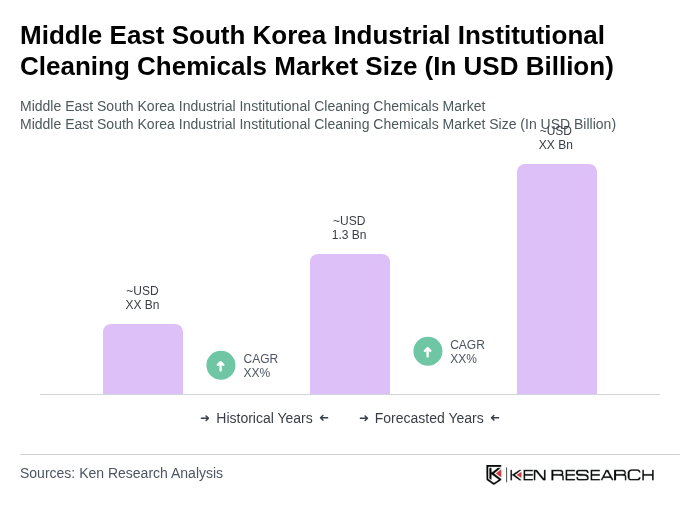
The Middle East South Korea Industrial Institutional Cleaning Chemicals Market, worth USD 1.3 Bn, grows due to rising hygiene needs, hospitality expansion, and industrial activities in South Korea, UAE, and Saudi Arabia.

Region:Middle East

Author(s):Dev

Product Code:KRAC5056

Pages:81

Published On:January 2026
About the Report

Base Year 2024

Middle East South Korea Industrial Institutional Cleaning Chemicals Market Overview

  • The Middle East South Korea Industrial Institutional Cleaning Chemicals Market is valued at USD 1.3 billion, based on a five-year historical analysis, taking into account the combined contribution of South Korea and key Middle Eastern economies within the broader industrial and institutional cleaning chemicals market. This growth is primarily driven by increasing demand for hygiene and sanitation products across manufacturing, healthcare, food processing, commercial, and institutional sectors, supported by stricter infection-control and workplace hygiene protocols. The market is also influenced by the expansion of the hospitality and healthcare industries in the Gulf region and South Korea, which require effective cleaning solutions to maintain cleanliness, comply with health regulations, and prevent healthcare-associated and foodborne infections.
  • Key demand hubs in this market include South Korea, the United Arab Emirates, and Saudi Arabia, which together account for a substantial share of industrial and institutional cleaning chemicals consumption in Asia Pacific and Middle East and Africa. These countries benefit from robust industrial bases, high urbanization rates, large commercial real-estate footprints, and significant investments in healthcare, food processing, and tourism infrastructure. The presence of major manufacturing hubs, ongoing construction of hotels, malls, and hospitals, and a growing focus on sustainability, low-VOC formulations, and bio-based or eco-labelled cleaning solutions further contribute to their leadership in regional demand.
  • In South Korea, the regulatory framework for cleaning and other chemical products is anchored in instruments such as the Act on the Registration and Evaluation of Chemicals (K?REACH) and the Chemicals Control Act, both administered by the Ministry of Environment, which require registration, hazard assessment, and safe management of chemical substances used in industrial and institutional cleaning. In addition, Korea Eco-Label and related green public procurement guidelines issued by the Ministry of Environment promote the use of low-hazard, environmentally preferable cleaning agents in public institutions by setting criteria on biodegradability, toxicity, and volatile organic compound content, thereby encouraging adoption of environmentally friendly cleaning chemicals and supporting broader public health, worker safety, and environmental objectives.
Middle East South Korea Industrial Institutional Cleaning Chemicals Market Size

Middle East South Korea Industrial Institutional Cleaning Chemicals Market Segmentation

By Product Type:The product type segmentation includes various categories of cleaning chemicals that cater to different cleaning needs across industrial plants, food processing facilities, healthcare institutions, commercial buildings, and transportation infrastructure. The dominant sub-segment in this category is disinfectants and sanitizers, which have gained significant traction due to the increased focus on infection prevention, surface disinfection, and hand hygiene protocols in healthcare, hospitality, foodservice, and retail environments. General purpose cleaners and laundry care products also hold substantial market shares, driven by their versatility for routine cleaning of floors, hard surfaces, linens, and workwear, and by the shift toward concentrated, low-residue, and energy-efficient formulations.
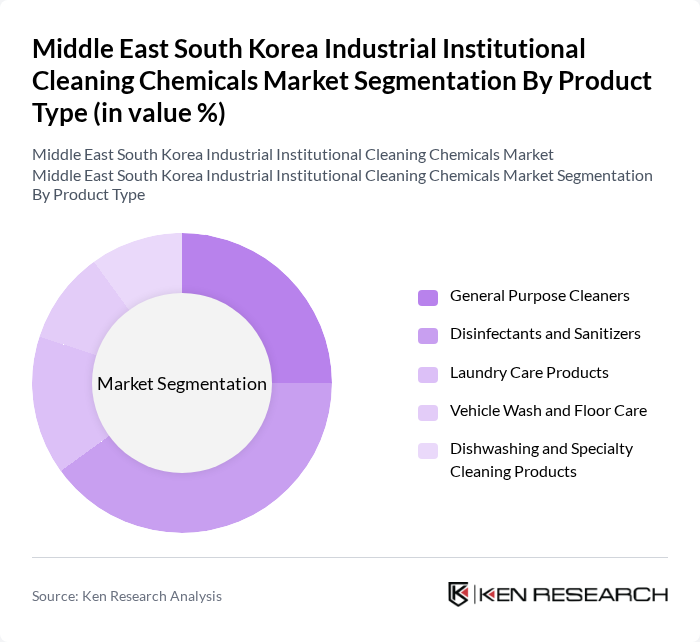
Middle East South Korea Industrial Institutional Cleaning Chemicals Market segmentation by Product Type.

By End-Use Sector:The end-use sector segmentation highlights the various industries utilizing cleaning chemicals for hygiene management, asset protection, and regulatory compliance. The healthcare facilities segment is the leading sub-segment, driven by stringent disinfection standards in hospitals, clinics, and long-term care facilities and by infection-control protocols that have intensified demand for high-efficacy disinfectants and sanitizers. Commercial sectors, including hospitality, offices, and retail, also contribute significantly to the market, as they require frequent surface cleaning, restroom hygiene, air-quality related cleaning, and housekeeping solutions to maintain customer satisfaction, brand reputation, and occupational health standards. Institutional buildings, such as schools, universities, and government facilities, are increasingly adopting advanced and super-concentrated cleaning solutions compatible with automated cleaning equipment to improve cost-efficiency, sustainability, and cleaning consistency.
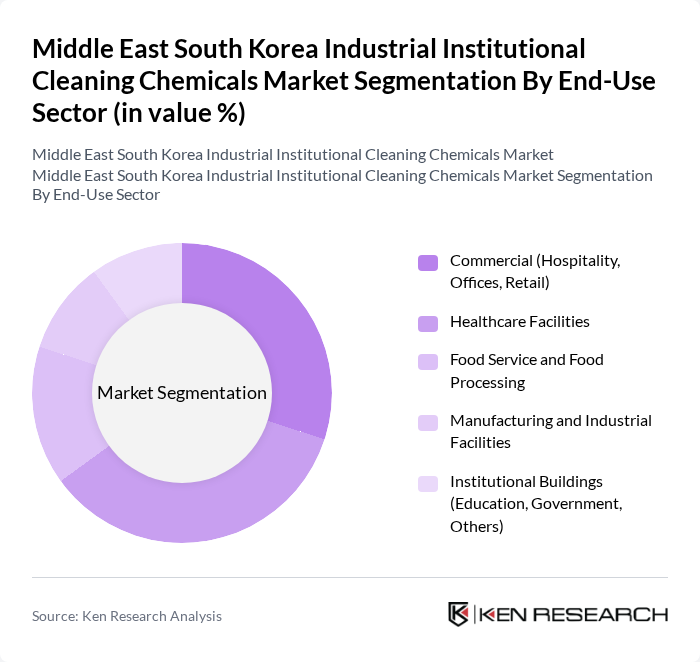
Middle East South Korea Industrial Institutional Cleaning Chemicals Market segmentation by End-Use Sector.

Middle East South Korea Industrial Institutional Cleaning Chemicals Market Competitive Landscape

The Middle East South Korea Industrial Institutional Cleaning Chemicals Market is characterized by a dynamic mix of regional and international players. Leading participants such as Ecolab Inc., Diversey Holdings, Ltd., SC Johnson Professional, Reckitt Benckiser Group plc, Unilever PLC, Procter & Gamble Co., Henkel AG & Co. KGaA, BASF SE, The Clorox Company, 3M Company, Kimberly-Clark Corporation, S.C. Johnson & Son, Inc., Christeyns NV, Zep Inc., Spartan Chemical Company, Inc. contribute to innovation, geographic expansion, and service delivery in this space, particularly through integrated hygiene programs, dosing and dispensing technologies, and continuous development of safer, more sustainable cleaning formulations tailored to healthcare, foodservice, industrial, and commercial customers.

Ecolab Inc.

1923

St. Paul, Minnesota, USA

Diversey Holdings, Ltd.

1923

Fort Mill, South Carolina, USA

SC Johnson Professional

1886

Racine, Wisconsin, USA

Reckitt Benckiser Group plc

1813

Slough, United Kingdom

Unilever PLC

1929

London, United Kingdom

Company

Establishment Year

Headquarters

Regional Revenue (USD Million)

3-year Revenue CAGR (%) in Target Market

EBITDA Margin (%)

Market Share (%) – Industrial & Institutional Segment

Average Realized Price Index vs Peer Set

Product Portfolio Breadth (Number of SKUs / Categories)

Middle East South Korea Industrial Institutional Cleaning Chemicals Market Industry Analysis

Growth Drivers

  • Increasing Demand for Hygiene and Sanitation:The Middle East and South Korea are witnessing a surge in hygiene awareness, particularly post-pandemic. The World Health Organization reported a 30% increase in demand for cleaning products in institutional settings. This heightened focus on cleanliness is driving the industrial cleaning chemicals market, with an estimated value of USD 1.5 billion in future. The growing population and urbanization further amplify this demand, necessitating robust cleaning solutions across various sectors.
  • Expansion of the Hospitality and Tourism Sector:The hospitality sector in the Middle East is projected to grow by 6% annually, reaching USD 45 billion in future, according to the World Travel & Tourism Council. This growth fuels the demand for industrial cleaning chemicals, as hotels and restaurants prioritize cleanliness to enhance guest experiences. The influx of international tourists, expected to exceed 120 million in future, further necessitates stringent hygiene standards, driving market growth in cleaning chemicals.
  • Rising Industrial Activities and Manufacturing:The industrial sector in South Korea is anticipated to grow by 4% in future, contributing significantly to the demand for cleaning chemicals. The manufacturing output is projected to reach USD 550 billion, necessitating effective cleaning solutions to maintain operational efficiency and safety. This growth is supported by government initiatives promoting industrialization, which further drives the need for institutional cleaning chemicals across various manufacturing facilities.

Market Challenges

  • Stringent Regulatory Compliance:The industrial cleaning chemicals market faces challenges due to stringent regulations imposed by governments in the Middle East and South Korea. Compliance with safety and environmental standards requires significant investment, with companies spending approximately USD 250 million annually on regulatory adherence. This can hinder market entry for new players and increase operational costs for existing firms, impacting overall profitability in the sector.
  • High Competition Among Local and International Players:The market is characterized by intense competition, with over 160 companies operating in the region. This competitive landscape leads to price wars and reduced profit margins, with average profit margins dropping to 9% in future. Established brands dominate the market, making it challenging for new entrants to gain market share. This competitive pressure necessitates innovation and differentiation strategies to succeed.

Middle East South Korea Industrial Institutional Cleaning Chemicals Market Future Outlook

The future of the industrial institutional cleaning chemicals market in the Middle East and South Korea appears promising, driven by increasing health awareness and sustainability trends. The shift towards eco-friendly products is expected to reshape consumer preferences, with a projected 30% of the market focusing on biodegradable solutions in future. Additionally, advancements in automation technologies are likely to enhance cleaning efficiency, reducing labor costs and improving service delivery across various sectors, including hospitality and manufacturing.

Market Opportunities

  • Growth in E-commerce for Cleaning Products:The e-commerce sector for cleaning products is projected to grow by 35% in future, driven by increased online shopping trends. This shift presents a significant opportunity for companies to expand their reach and cater to a broader customer base, enhancing sales and brand visibility in the competitive market landscape.
  • Development of Eco-friendly Cleaning Solutions:With rising environmental concerns, the demand for eco-friendly cleaning solutions is expected to increase significantly. Companies investing in sustainable product development can capture a growing market segment, with an estimated 25% of consumers willing to pay a premium for environmentally friendly options, thus enhancing brand loyalty and market share.

Scope of the Report

SegmentSub-Segments
By Product Type

General Purpose Cleaners

Disinfectants and Sanitizers

Laundry Care Products

Vehicle Wash and Floor Care

Dishwashing and Specialty Cleaning Products

By End-Use Sector

Commercial (Hospitality, Offices, Retail)

Healthcare Facilities

Food Service and Food Processing

Manufacturing and Industrial Facilities

Institutional Buildings (Education, Government, Others)

By Distribution Channel

Direct Institutional Sales

Distributors and Wholesalers

E-commerce and Online B2B Platforms

Cash & Carry / Professional Supply Stores

Others

By Packaging Format

Bulk and Drum Packaging

Canisters and Intermediate Containers

Ready-to-use Bottles and Sachets

Concentrates and Refill Systems

Eco-friendly and Recyclable Packaging

By Raw Material / Chemical Composition

Surfactants

Chlor-Alkali

Solvents

Phosphates

Biocides and Preservatives

Others

By Application Area

Surface and Hard Floor Cleaning

Equipment and Machinery Cleaning

Laundry and Textile Care

Kitchen and Food-contact Surface Cleaning

Sanitation and Disinfection

Others

By Geography

South Korea

GCC Countries

Rest of Middle East

Cross-border / Export-oriented Demand

Key Target Audience

Investors and Venture Capitalist Firms

Government and Regulatory Bodies (e.g., Ministry of Environment, South Korea; Ministry of Health, Saudi Arabia)

Manufacturers and Producers

Distributors and Retailers

Facility Management Companies

Hospitality and Cleaning Service Providers

Industrial and Commercial End Users

Trade Associations and Industry Groups

Players Mentioned in the Report:

Ecolab Inc.

Diversey Holdings, Ltd.

SC Johnson Professional

Reckitt Benckiser Group plc

Unilever PLC

Procter & Gamble Co.

Henkel AG & Co. KGaA

BASF SE

The Clorox Company

3M Company

Kimberly-Clark Corporation

S.C. Johnson & Son, Inc.

Christeyns NV

Zep Inc.

Spartan Chemical Company, Inc.

Table of Contents

Market Assessment Phase

1. Executive Summary and Approach


2. Middle East South Korea Industrial Institutional Cleaning Chemicals Market Overview

2.1 Key Insights and Strategic Recommendations

2.2 Middle East South Korea Industrial Institutional Cleaning Chemicals Market Overview

2.3 Definition and Scope

2.4 Evolution of Market Ecosystem

2.5 Timeline of Key Regulatory Milestones

2.6 Value Chain & Stakeholder Mapping

2.7 Business Cycle Analysis

2.8 Policy & Incentive Landscape


3. Middle East South Korea Industrial Institutional Cleaning Chemicals Market Analysis

3.1 Growth Drivers

3.1.1 Increasing demand for hygiene and sanitation
3.1.2 Expansion of the hospitality and tourism sector
3.1.3 Rising industrial activities and manufacturing
3.1.4 Government initiatives for cleanliness and public health

3.2 Market Challenges

3.2.1 Stringent regulatory compliance
3.2.2 High competition among local and international players
3.2.3 Fluctuating raw material prices
3.2.4 Environmental concerns regarding chemical usage

3.3 Market Opportunities

3.3.1 Growth in e-commerce for cleaning products
3.3.2 Development of eco-friendly cleaning solutions
3.3.3 Increasing awareness of health and safety standards
3.3.4 Potential for product innovation and customization

3.4 Market Trends

3.4.1 Shift towards sustainable and biodegradable products
3.4.2 Adoption of automation in cleaning processes
3.4.3 Rising demand for multi-purpose cleaning solutions
3.4.4 Growth of private label brands in the market

3.5 Government Regulation

3.5.1 Compliance with safety and health standards
3.5.2 Regulations on chemical usage and disposal
3.5.3 Incentives for using eco-friendly products
3.5.4 Import/export regulations for cleaning chemicals

4. SWOT Analysis


5. Stakeholder Analysis


6. Porter's Five Forces Analysis


7. Middle East South Korea Industrial Institutional Cleaning Chemicals Market Market Size, 2019-2024

7.1 By Value

7.2 By Volume

7.3 By Average Selling Price


8. Middle East South Korea Industrial Institutional Cleaning Chemicals Market Segmentation

8.1 By Product Type

8.1.1 General Purpose Cleaners
8.1.2 Disinfectants and Sanitizers
8.1.3 Laundry Care Products
8.1.4 Vehicle Wash and Floor Care
8.1.5 Dishwashing and Specialty Cleaning Products

8.2 By End-Use Sector

8.2.1 Commercial (Hospitality, Offices, Retail)
8.2.2 Healthcare Facilities
8.2.3 Food Service and Food Processing
8.2.4 Manufacturing and Industrial Facilities
8.2.5 Institutional Buildings (Education, Government, Others)

8.3 By Distribution Channel

8.3.1 Direct Institutional Sales
8.3.2 Distributors and Wholesalers
8.3.3 E-commerce and Online B2B Platforms
8.3.4 Cash & Carry / Professional Supply Stores
8.3.5 Others

8.4 By Packaging Format

8.4.1 Bulk and Drum Packaging
8.4.2 Canisters and Intermediate Containers
8.4.3 Ready-to-use Bottles and Sachets
8.4.4 Concentrates and Refill Systems
8.4.5 Eco-friendly and Recyclable Packaging

8.5 By Raw Material / Chemical Composition

8.5.1 Surfactants
8.5.2 Chlor-Alkali
8.5.3 Solvents
8.5.4 Phosphates
8.5.5 Biocides and Preservatives
8.5.6 Others

8.6 By Application Area

8.6.1 Surface and Hard Floor Cleaning
8.6.2 Equipment and Machinery Cleaning
8.6.3 Laundry and Textile Care
8.6.4 Kitchen and Food-contact Surface Cleaning
8.6.5 Sanitation and Disinfection
8.6.6 Others

8.7 By Geography

8.7.1 South Korea
8.7.2 GCC Countries
8.7.3 Rest of Middle East
8.7.4 Cross-border / Export-oriented Demand

9. Middle East South Korea Industrial Institutional Cleaning Chemicals Market Competitive Analysis

9.1 Market Share of Key Players

9.2 Cross Comparison of Key Players

9.2.1 Company Name
9.2.2 Regional Revenue (USD Million)
9.2.3 3-year Revenue CAGR (%) in Target Market
9.2.4 EBITDA Margin (%)
9.2.5 Market Share (%) – Industrial & Institutional Segment
9.2.6 Average Realized Price Index vs Peer Set
9.2.7 Product Portfolio Breadth (Number of SKUs / Categories)
9.2.8 R&D Intensity (% of Revenue)
9.2.9 Capex-to-Sales Ratio (%) in the Region
9.2.10 Contract Retention / Renewal Rate (%)
9.2.11 Distribution Coverage (Number of Countries / Key Cities Served)
9.2.12 ESG / Green Portfolio Share (% of Sales)

9.3 SWOT Analysis of Top Players

9.4 Pricing Analysis

9.5 Detailed Profile of Major Companies

9.5.1 Ecolab Inc.
9.5.2 Diversey Holdings, Ltd.
9.5.3 SC Johnson Professional
9.5.4 Reckitt Benckiser Group plc
9.5.5 Unilever PLC
9.5.6 Procter & Gamble Co.
9.5.7 Henkel AG & Co. KGaA
9.5.8 BASF SE
9.5.9 The Clorox Company
9.5.10 3M Company
9.5.11 Kimberly-Clark Corporation
9.5.12 S.C. Johnson & Son, Inc.
9.5.13 Christeyns NV
9.5.14 Zep Inc.
9.5.15 Spartan Chemical Company, Inc.

10. Middle East South Korea Industrial Institutional Cleaning Chemicals Market End-User Analysis

10.1 Procurement Behavior of Key Ministries

10.1.1 Budget Allocation Trends
10.1.2 Preferred Suppliers
10.1.3 Procurement Processes
10.1.4 Compliance Requirements

10.2 Corporate Spend on Infrastructure & Energy

10.2.1 Investment Trends
10.2.2 Key Projects
10.2.3 Spending Priorities
10.2.4 Impact on Cleaning Chemicals

10.3 Pain Point Analysis by End-User Category

10.3.1 Healthcare Sector Challenges
10.3.2 Educational Institutions Issues
10.3.3 Industrial Sector Concerns
10.3.4 Government Facilities Needs

10.4 User Readiness for Adoption

10.4.1 Training and Support Needs
10.4.2 Technology Adoption Rates
10.4.3 Feedback Mechanisms
10.4.4 User Experience Insights

10.5 Post-Deployment ROI and Use Case Expansion

10.5.1 Measurement of Success
10.5.2 Case Studies
10.5.3 Future Use Cases
10.5.4 Customer Satisfaction Metrics

11. Middle East South Korea Industrial Institutional Cleaning Chemicals Market Future Size, 2025-2030

11.1 By Value

11.2 By Volume

11.3 By Average Selling Price


Go-To-Market Strategy Phase

1. Whitespace Analysis + Business Model Canvas

1.1 Market Gaps Identification

1.2 Business Model Components

1.3 Value Proposition Canvas

1.4 Competitive Landscape Overview

1.5 Customer Segmentation Analysis


2. Marketing and Positioning Recommendations

2.1 Branding Strategies

2.2 Product USPs

2.3 Target Audience Identification

2.4 Communication Strategy

2.5 Digital Marketing Tactics


3. Distribution Plan

3.1 Urban Retail Strategies

3.2 Rural NGO Tie-ups

3.3 E-commerce Integration

3.4 Logistics and Supply Chain Management

3.5 Distribution Partnerships


4. Channel & Pricing Gaps

4.1 Underserved Routes

4.2 Pricing Bands Analysis

4.3 Competitor Pricing Strategies

4.4 Customer Willingness to Pay

4.5 Pricing Optimization Techniques


5. Unmet Demand & Latent Needs

5.1 Category Gaps Identification

5.2 Consumer Segments Analysis

5.3 Emerging Trends and Needs

5.4 Product Development Opportunities

5.5 Market Entry Strategies


6. Customer Relationship

6.1 Loyalty Programs

6.2 After-sales Service

6.3 Customer Feedback Mechanisms

6.4 Relationship Management Strategies

6.5 Retention Strategies


7. Value Proposition

7.1 Sustainability Initiatives

7.2 Integrated Supply Chains

7.3 Customer-Centric Innovations

7.4 Competitive Advantages

7.5 Long-term Value Creation


8. Key Activities

8.1 Regulatory Compliance

8.2 Branding Initiatives

8.3 Distribution Setup

8.4 Marketing Campaigns

8.5 Performance Monitoring


9. Entry Strategy Evaluation

9.1 Domestic Market Entry Strategy

9.1.1 Product Mix Considerations
9.1.2 Pricing Band Analysis
9.1.3 Packaging Strategies

9.2 Export Entry Strategy

9.2.1 Target Countries Identification
9.2.2 Compliance Roadmap Development

10. Entry Mode Assessment

10.1 Joint Ventures

10.2 Greenfield Investments

10.3 Mergers & Acquisitions

10.4 Distributor Model Evaluation

10.5 Risk Assessment


11. Capital and Timeline Estimation

11.1 Capital Requirements

11.2 Timelines for Implementation

11.3 Financial Projections

11.4 Funding Sources

11.5 Budget Allocation


12. Control vs Risk Trade-Off

12.1 Ownership Considerations

12.2 Partnership Dynamics

12.3 Risk Mitigation Strategies

12.4 Control Mechanisms

12.5 Long-term Strategic Planning


13. Profitability Outlook

13.1 Breakeven Analysis

13.2 Long-term Sustainability

13.3 Profit Margin Projections

13.4 Cost Management Strategies

13.5 Revenue Growth Forecasts


14. Potential Partner List

14.1 Distributors

14.2 Joint Ventures

14.3 Acquisition Targets

14.4 Strategic Alliances

14.5 Partnership Opportunities


15. Execution Roadmap

15.1 Phased Plan for Market Entry

15.1.1 Market Setup
15.1.2 Market Entry
15.1.3 Growth Acceleration
15.1.4 Scale & Stabilize

15.2 Key Activities and Milestones

15.2.1 Timeline of Key Activities
15.2.2 Milestone Tracking
15.2.3 Performance Metrics
15.2.4 Resource Allocation

Research Methodology

ApproachModellingSample

Phase 1: Approach1

Desk Research

  • Industry reports from chemical associations in the Middle East and South Korea
  • Market analysis publications focusing on industrial cleaning chemicals
  • Government publications and trade statistics related to chemical imports and exports

Primary Research

  • Interviews with facility managers in large industrial sectors such as manufacturing and hospitality
  • Surveys with procurement specialists in cleaning service companies
  • Focus groups with end-users to understand preferences and usage patterns

Validation & Triangulation

  • Cross-validation of findings with industry expert opinions and market trends
  • Triangulation of data from multiple sources including trade associations and market players
  • Sanity checks through comparative analysis with historical market data

Phase 2: Market Size Estimation1

Top-down Assessment

  • Analysis of total market size based on national chemical consumption statistics
  • Segmentation by end-user industries such as healthcare, hospitality, and manufacturing
  • Incorporation of growth rates from regional economic forecasts

Bottom-up Modeling

  • Estimation of market size based on sales data from leading cleaning chemical manufacturers
  • Operational cost analysis derived from pricing models of cleaning services
  • Volume estimates based on usage rates in various industrial applications

Forecasting & Scenario Analysis

  • Multi-variable forecasting using economic indicators and industry growth drivers
  • Scenario planning based on potential regulatory changes and environmental policies
  • Development of baseline, optimistic, and pessimistic market growth scenarios through 2030

Phase 3: CATI Sample Composition1

Scope Item/SegmentSample SizeTarget Respondent Profiles
Manufacturing Sector Cleaning Practices120Facility Managers, Operations Directors
Healthcare Facility Cleaning Standards90Healthcare Administrators, Infection Prevention Managers
Hospitality Industry Cleaning Protocols80Housekeeping Managers, Quality Assurance Managers
Commercial Cleaning Service Providers100Business Development Managers, Service Operations Managers
Environmental Compliance in Cleaning Chemicals75Sustainability Managers, Regulatory Affairs Managers

Frequently Asked Questions

What is the current value of the Middle East South Korea Industrial Institutional Cleaning Chemicals Market?

The Middle East South Korea Industrial Institutional Cleaning Chemicals Market is valued at approximately USD 1.3 billion, reflecting a five-year historical analysis of the combined contributions from South Korea and key Middle Eastern economies.

What factors are driving the growth of the industrial cleaning chemicals market in this region?

Which countries are the main demand hubs for industrial cleaning chemicals in the Middle East and South Korea?

What are the primary product types in the industrial cleaning chemicals market?

Other Adjacent Reports

Qatar Industrial Cleaning Equipment Market

Global janitorial supplies market report size, share, growth drivers, trends, opportunities & forecast 2025–2030

Singapore Disinfection Equipment Market

KSA Eco-Friendly Cleaning Products Market

Kuwait Laundry Equipment Market

Brazil Food Processing Chemicals Market

Indonesia Healthcare Hygiene Products Market

Germany Hospitality Supplies Market

United Arab Emirates Water Treatment Chemicals Market Report Size Share Growth Drivers Trends Opportunities & Forecast 2025–2030Germany Facility Management Services Market

Why Buy From Us?

Refine Robust Result (RRR) Framework

What makes us stand out is that our consultants follow Robust, Refine and Result (RRR) methodology. Robust for clear definitions, approaches and sanity checking, Refine for differentiating respondents' facts and opinions, and Result for presenting data with story.

Our Reach Is Unmatched

We have set a benchmark in the industry by offering our clients with syndicated and customized market research reports featuring coverage of entire market as well as meticulous research and analyst insights.

Shifting the Research Paradigm

While we don't replace traditional research, we flip the method upside down. Our dual approach of Top Bottom & Bottom Top ensures quality deliverable by not just verifying company fundamentals but also looking at the sector and macroeconomic factors.

More Insights-Better Decisions

With one step in the future, our research team constantly tries to show you the bigger picture. We help with some of the tough questions you may encounter along the way: How is the industry positioned? Best marketing channel? KPI's of competitors? By aligning every element, we help maximize success.

Transparency and Trust

Our report gives you instant access to the answers and sources that other companies might choose to hide. We elaborate each steps of research methodology we have used and showcase you the sample size to earn your trust.

Round the Clock Support

If you need any support, we are here! We pride ourselves on universe strength, data quality, and quick, friendly, and professional service.

Why Clients Choose Us?

400000+
Reports in repository
150+
Consulting projects a year
100+
Analysts
8000+
Client Queries in 2022








