Region:Middle East
Author(s):Geetanshi
Product Code:KRAD3835
Pages:82
Published On:November 2025
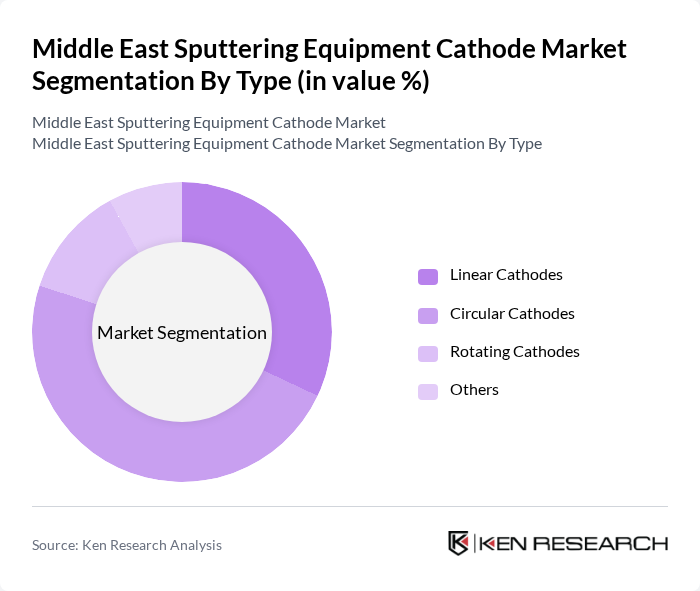
By Type:The market is segmented into various types of cathodes, including Linear Cathodes, Circular Cathodes, Rotating Cathodes, and Others. Among these, Circular Cathodes currently hold the largest market share globally due to their efficiency in high-vacuum and high-throughput applications, particularly in electronics and semiconductor manufacturing. Linear Cathodes are experiencing rapid adoption in large-area coating applications such as architectural and automotive glass, while Rotating Cathodes are gaining traction for their enhanced performance and longer operational lifespans in specialized sectors .
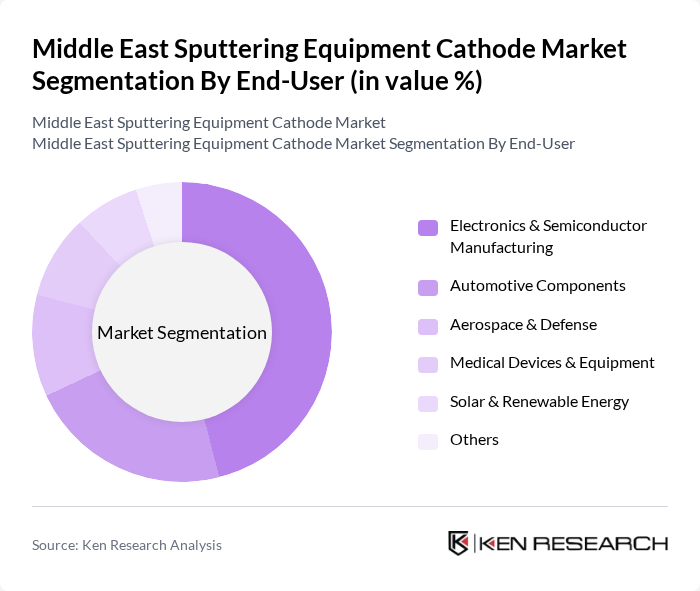
By End-User:The end-user segmentation includes Electronics & Semiconductor Manufacturing, Automotive Components, Aerospace & Defense, Medical Devices & Equipment, Solar & Renewable Energy, and Others. Electronics & Semiconductor Manufacturing remains the dominant end-user, driven by the region’s growing electronics assembly and chip packaging sectors. The Automotive Components segment is expanding with the adoption of advanced coatings for electric vehicles and lightweight materials. Aerospace & Defense is gradually increasing its share, focusing on high-durability coatings and precision components. The Solar & Renewable Energy sector is also witnessing increased adoption of sputtering technologies for thin-film photovoltaic modules .
The Middle East Sputtering Equipment Cathode Market is characterized by a dynamic mix of regional and international players. Leading participants such as Applied Materials, Inc., ULVAC, Inc., Tokyo Electron Limited, Veeco Instruments Inc., SPTS Technologies Ltd., Oerlikon Balzers, AJA International, Inc., Denton Vacuum LLC, Kurt J. Lesker Company, Chuangxin Technology Co., Ltd., MKS Instruments, Inc., CVD Equipment Corporation, Plasma-Therm LLC, Nisshinbo Micro Devices Inc., Semicore Equipment, Inc., Sputtering Components, Inc., Angstrom Sciences, Inc., and Impact Coatings AB contribute to innovation, geographic expansion, and service delivery in this space .
The Middle East sputtering equipment cathode market is poised for significant transformation, driven by technological advancements and increasing demand for sustainable manufacturing practices. As industries pivot towards greener technologies, the integration of AI in sputtering processes is expected to enhance efficiency and reduce waste. Furthermore, the expansion of semiconductor manufacturing and electric vehicle production will create new avenues for growth, positioning the region as a key player in the global market landscape.
| Segment | Sub-Segments |
|---|---|
| By Type | Linear Cathodes Circular Cathodes Rotating Cathodes Others |
| By End-User | Electronics & Semiconductor Manufacturing Automotive Components Aerospace & Defense Medical Devices & Equipment Solar & Renewable Energy Others |
| By Application | Thin Film Coatings Semiconductor Fabrication Optical Coatings Decorative & Functional Coatings Others |
| By Material Used | Copper Aluminum Titanium Molybdenum Others |
| By Technology | DC Sputtering RF Sputtering Magnetron Sputtering Reactive Sputtering Others |
| By Region | GCC Countries Levant Region North Africa Others |
| By Market Maturity | Emerging Markets Established Markets Others |
| Scope Item/Segment | Sample Size | Target Respondent Profiles |
|---|---|---|
| Semiconductor Manufacturing Facilities | 100 | Process Engineers, Facility Managers |
| Research Institutions and Universities | 60 | Academic Researchers, Lab Directors |
| Electronics Component Manufacturers | 80 | Product Development Managers, Quality Assurance Leads |
| Renewable Energy Equipment Producers | 50 | Operations Managers, Supply Chain Analysts |
| Government Regulatory Bodies | 40 | Policy Makers, Industry Analysts |
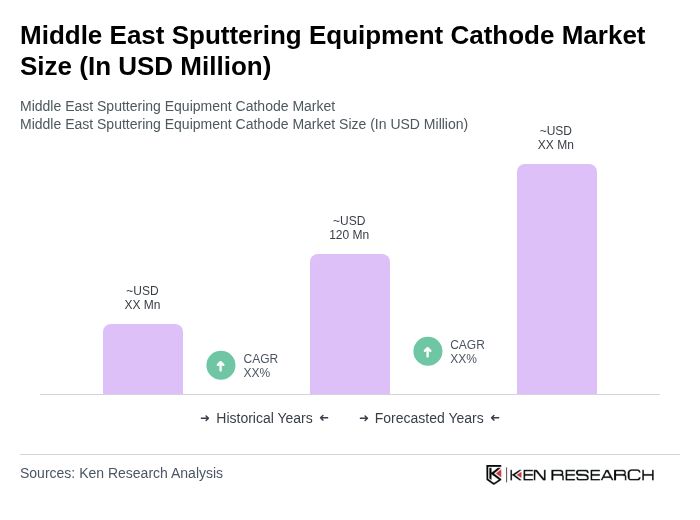
The Middle East Sputtering Equipment Cathode Market is valued at approximately USD 120 million, reflecting its growing share of the global market, which exceeds USD 1.2 billion. This growth is driven by demand in electronics, semiconductor manufacturing, and renewable energy sectors.

What makes us stand out is that our consultants follow Robust, Refine and Result (RRR) methodology. Robust for clear definitions, approaches and sanity checking, Refine for differentiating respondents' facts and opinions, and Result for presenting data with story.

We have set a benchmark in the industry by offering our clients with syndicated and customized market research reports featuring coverage of entire market as well as meticulous research and analyst insights.

While we don't replace traditional research, we flip the method upside down. Our dual approach of Top Bottom & Bottom Top ensures quality deliverable by not just verifying company fundamentals but also looking at the sector and macroeconomic factors.

With one step in the future, our research team constantly tries to show you the bigger picture. We help with some of the tough questions you may encounter along the way: How is the industry positioned? Best marketing channel? KPI's of competitors? By aligning every element, we help maximize success.

Our report gives you instant access to the answers and sources that other companies might choose to hide. We elaborate each steps of research methodology we have used and showcase you the sample size to earn your trust.

If you need any support, we are here! We pride ourselves on universe strength, data quality, and quick, friendly, and professional service.













