Ken Research Logo

Middle East Vegan Sauces Dressings Spread Market Size, Share, Growth Drivers, Trends, Opportunities & Forecast 2025–2030

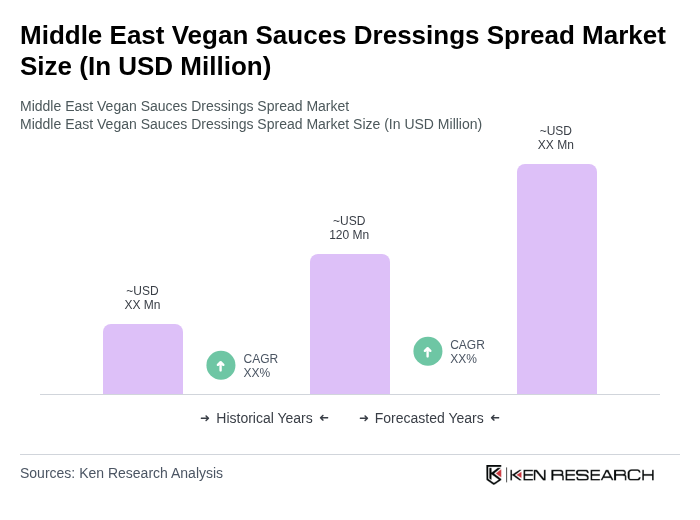
Middle East Vegan Sauces Dressings Spread Market, valued at USD 120 million, grows with rising vegan adoption, health trends, and innovations in retail channels.

Region:Middle East

Author(s):Shubham

Product Code:KRAD5408

Pages:98

Published On:December 2025
About the Report

Base Year 2024

Middle East Vegan Sauces Dressings Spread Market Overview

  • The Middle East Vegan Sauces Dressings Spread Market is valued at USD 120 million, based on a five-year historical analysis. This growth is primarily driven by the increasing consumer shift towards plant-based diets, rising health consciousness, and the growing demand for vegan products among millennials and Gen Z. The market is also supported by the expansion of retail channels and the introduction of innovative vegan products.
  • Key players in this market include Saudi Arabia, the United Arab Emirates, and Qatar. These countries dominate the market due to their high disposable incomes, increasing awareness of health and wellness, and a growing trend towards veganism. The urban population in these regions is also more inclined to adopt plant-based diets, further driving the demand for vegan sauces, dressings, and spreads.
  • The UAE Food Safety Regulations, 2022 issued by the Ministry of Climate Change and Environment (MOCCAE), establish standards for plant-based food products, including vegan sauces and dressings. These regulations require compliance with labeling standards for vegan claims, ingredient sourcing thresholds for plant-based certification, and mandatory nutritional profiling to ensure safety and authenticity for all imported and locally produced items.
Middle East Vegan Sauces Dressings Spread Market Size

Middle East Vegan Sauces Dressings Spread Market Segmentation

By Product Type:The product type segmentation includes various categories such as vegan sauces, vegan dressings, vegan spreads, and other vegan condiments. Among these, vegan sauces are currently leading the market due to their versatility and widespread use in both household and commercial kitchens. The increasing popularity of plant-based diets has led to a surge in demand for sauces that complement vegan meals, making this sub-segment particularly dominant.
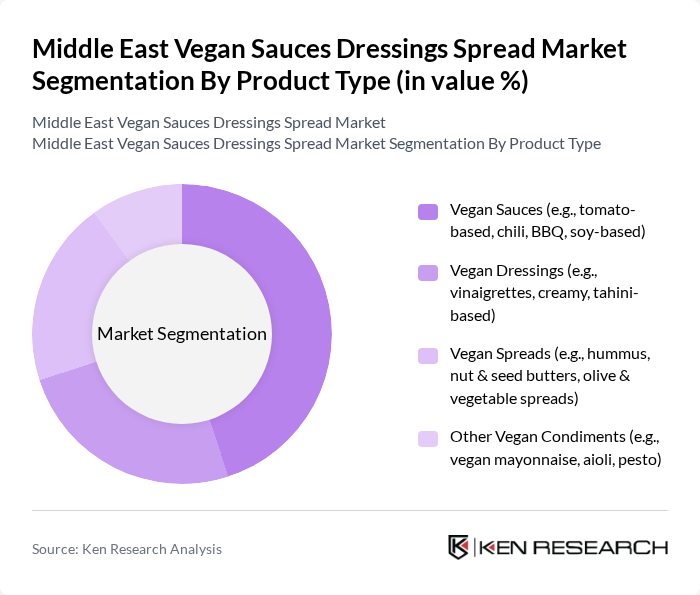
Middle East Vegan Sauces Dressings Spread Market segmentation by Product Type.

By End-User:The end-user segmentation encompasses household/retail consumers, HoReCa (Hotels, Restaurants & Catering), food & beverage manufacturers, and institutional buyers. The household/retail consumer segment is currently the largest, driven by the increasing number of individuals adopting vegan diets and the growing availability of vegan products in supermarkets and online platforms. This trend is further supported by the rising health consciousness among consumers.
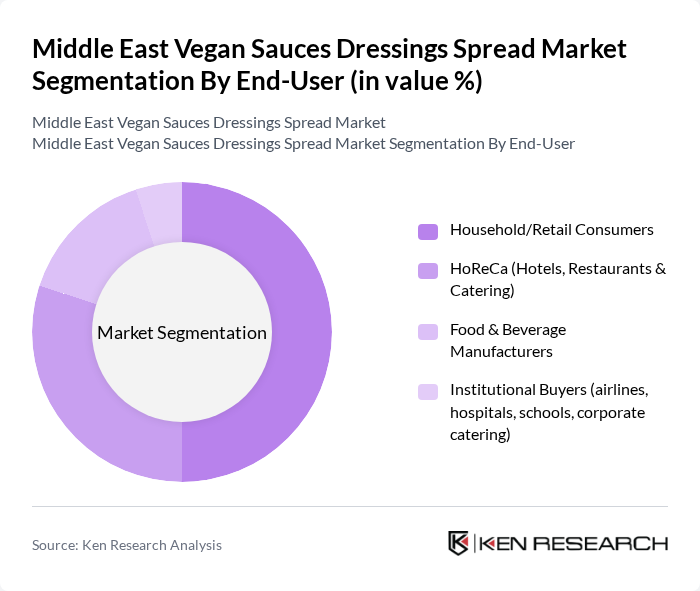
Middle East Vegan Sauces Dressings Spread Market segmentation by End-User.

Middle East Vegan Sauces Dressings Spread Market Competitive Landscape

The Middle East Vegan Sauces Dressings Spread Market is characterized by a dynamic mix of regional and international players. Leading participants such as Unilever plc (Hellmann’s Vegan, Sir Kensington’s, Maille), The Kraft Heinz Company (Heinz Vegan Mayonnaise & Sauces), Nestlé S.A. (Garden Gourmet, plant-based cooking solutions), Upfield Holdings B.V. (Flora Plant, Becel, Rama plant-based spreads), Al Islami Foods (UAE – plant-based and vegan-ready sauces & condiments), Americana Group (Kuwait/Saudi Arabia – foodservice sauces & vegan menu solutions), Almarai Company (Saudi Arabia – dairy-free and plant-based spreads & dressings), IFFCO Group (Noor and other brands – plant-based mayonnaise & sauces), Hunter Foods LLC (UAE – clean-label, vegan sauces and dip accompaniments), Biona Organic (vegan organic sauces, ketchups and spreads), Dr. Oetker (vegan pizza sauces, dessert sauces and toppings), Violife (plant-based spreads and cooking creams used as bases for sauces), Oatly Group AB (oat-based spreads and culinary creams for vegan sauces), Al Ain Farms (UAE – emerging plant-based and vegan-friendly products), Regional & Private Label Brands (Lulu, Carrefour, Spinneys, Choithrams house brands) contribute to innovation, geographic expansion, and service delivery in this space.

Unilever plc

1929

London, UK

The Kraft Heinz Company

2015

Pittsburgh, USA

Nestlé S.A.

1866

Vevey, Switzerland

Upfield Holdings B.V.

2018

Amsterdam, Netherlands

Al Islami Foods

1981

Dubai, UAE

Company

Establishment Year

Headquarters

Group Size (Multinational, Regional, or Local)

Middle East Vegan Sauces/Dressings/Spreads Revenue (USD, latest FY)

Share of Vegan Portfolio in Total Sauces & Condiments Revenue (%)

3-Year Revenue CAGR in Vegan Sauces/Dressings/Spreads (%)

Market Penetration (Number of Middle East Countries Served)

Weighted Distribution in Modern Trade (Supermarkets/Hypermarkets % ACV)

Middle East Vegan Sauces Dressings Spread Market Industry Analysis

Growth Drivers

  • Increasing Health Consciousness:The Middle East has seen a significant rise in health awareness, with 60% of consumers actively seeking healthier food options. This trend is supported by the World Health Organization's report indicating that 30% of the population is now prioritizing nutrition. As a result, vegan sauces and dressings, perceived as healthier alternatives, are gaining traction, with sales expected to reach 1.6 million units in future, reflecting a growing preference for plant-based diets.
  • Rising Vegan Population:The vegan population in the Middle East has increased by 30% over the past five years, driven by cultural shifts and increased awareness of animal welfare. According to the Vegan Society, there are approximately 1.3 million vegans in the region as of in future. This demographic shift is creating a robust demand for vegan sauces and dressings, with an estimated market growth of 20% annually, indicating a strong consumer base for these products.
  • Demand for Plant-Based Alternatives:The demand for plant-based alternatives is surging, with the market for vegan sauces projected to grow to 600 million USD in future. This growth is fueled by a 45% increase in consumers opting for plant-based diets, as reported by the Food and Agriculture Organization. The shift towards sustainable eating habits is prompting manufacturers to innovate and expand their product lines, catering to the evolving preferences of health-conscious consumers.

Market Challenges

  • Limited Awareness of Vegan Products:Despite the growth in the vegan market, awareness remains a challenge, with only 35% of consumers familiar with vegan sauces and dressings. This lack of knowledge is a barrier to market penetration, as highlighted by a recent survey from the Middle East Food Association. Efforts to educate consumers about the benefits of vegan products are essential to overcoming this challenge and expanding market reach.
  • High Competition from Traditional Sauces:The market faces intense competition from traditional sauces, which dominate 70% of the overall sauces market in the Middle East. Established brands have strong customer loyalty and extensive distribution networks, making it difficult for vegan products to gain shelf space. This competitive landscape necessitates strategic marketing and differentiation to capture consumer interest and market share effectively.

Middle East Vegan Sauces Dressings Spread Market Future Outlook

The future of the Middle East vegan sauces and dressings market appears promising, driven by increasing health consciousness and a growing vegan population. Innovations in product development, particularly in flavor profiles and organic ingredients, are expected to enhance consumer appeal. Additionally, the rise of e-commerce platforms is facilitating easier access to vegan products, allowing brands to reach a broader audience. As these trends continue, the market is likely to experience sustained growth and diversification in offerings.

Market Opportunities

  • Growth in E-commerce Platforms:The expansion of e-commerce in the Middle East presents a significant opportunity for vegan sauces and dressings. With online grocery sales projected to reach 2.5 billion USD in future, brands can leverage digital channels to enhance visibility and accessibility, catering to the growing number of consumers preferring online shopping for convenience and variety.
  • Innovations in Product Development:There is a notable opportunity for innovation in product development, particularly in creating unique flavors and organic options. As consumer preferences shift towards clean label products, companies that invest in research and development to introduce innovative vegan sauces can capture market share and meet the increasing demand for high-quality, health-oriented alternatives.

Scope of the Report

SegmentSub-Segments
By Product Type

Vegan Sauces (e.g., tomato-based, chili, BBQ, soy-based)

Vegan Dressings (e.g., vinaigrettes, creamy, tahini-based)

Vegan Spreads (e.g., hummus, nut & seed butters, olive & vegetable spreads)

Other Vegan Condiments (e.g., vegan mayonnaise, aioli, pesto)

By End-User

Household/Retail Consumers

HoReCa (Hotels, Restaurants & Catering)

Food & Beverage Manufacturers

Institutional Buyers (airlines, hospitals, schools, corporate catering)

By Distribution Channel

Supermarkets/Hypermarkets

Convenience Stores & Groceries

Specialty & Health Food Stores

Online Retail & E-commerce Platforms

HoReCa & Foodservice Distributors

By Flavor Profile

Middle Eastern & Arabic (e.g., tahini, garlic, harissa, za’atar)

Western (e.g., Italian, American-style BBQ, ranch-style)

Asian & Fusion (e.g., soy-ginger, sriracha, curry-based)

Sweet & Dessert-Oriented (e.g., chocolate, date, nut-based spreads)

By Packaging Type

Bottles (glass & PET)

Jars

Squeeze Packs & Pouches

Single-Serve Sachets

Bulk Foodservice Packs

By Ingredient & Claim

Organic & Clean-Label

Conventional

Gluten-Free

Allergen-Free (soy-free, nut-free, etc.)

Fortified/Functional (e.g., high-protein, reduced sodium, added fiber)

By Country

Saudi Arabia

United Arab Emirates

Qatar

Kuwait

Oman & Bahrain

Rest of Middle East

Key Target Audience

Investors and Venture Capitalist Firms

Government and Regulatory Bodies (e.g., Ministry of Health, Food Safety Authority)

Manufacturers and Producers

Distributors and Retailers

Food Service Providers (e.g., Restaurants, Cafés)

Health and Wellness Organizations

Importers and Exporters

Food Industry Trade Associations

Players Mentioned in the Report:

Unilever plc (Hellmanns Vegan, Sir Kensingtons, Maille)

The Kraft Heinz Company (Heinz Vegan Mayonnaise & Sauces)

Nestle S.A. (Garden Gourmet, plant-based cooking solutions)

Upfield Holdings B.V. (Flora Plant, Becel, Rama plant-based spreads)

Al Islami Foods (UAE plant-based and vegan-ready sauces & condiments)

Americana Group (Kuwait/Saudi Arabia foodservice sauces & vegan menu solutions)

Almarai Company (Saudi Arabia dairy-free and plant-based spreads & dressings)

IFFCO Group (Noor and other brands plant-based mayonnaise & sauces)

Hunter Foods LLC (UAE clean-label, vegan sauces and dip accompaniments)

Biona Organic (vegan organic sauces, ketchups and spreads)

Dr. Oetker (vegan pizza sauces, dessert sauces and toppings)

Violife (plant-based spreads and cooking creams used as bases for sauces)

Oatly Group AB (oat-based spreads and culinary creams for vegan sauces)

Al Ain Farms (UAE emerging plant-based and vegan-friendly products)

Regional & Private Label Brands (Lulu, Carrefour, Spinneys, Choithrams house brands)

Table of Contents

Market Assessment Phase

1. Executive Summary and Approach


2. Middle East Vegan Sauces Dressings Spread Market Overview

2.1 Key Insights and Strategic Recommendations

2.3 Definition and Scope

2.4 Evolution of Market Ecosystem

2.5 Timeline of Key Regulatory Milestones

2.6 Value Chain & Stakeholder Mapping

2.7 Business Cycle Analysis

2.8 Policy & Incentive Landscape


3. Middle East Vegan Sauces Dressings Spread Market Analysis

3.1 Growth Drivers

3.1.1 Increasing Health Consciousness
3.1.2 Rising Vegan Population
3.1.3 Demand for Plant-Based Alternatives
3.1.4 Expansion of Retail Channels

3.2 Market Challenges

3.2.1 Limited Awareness of Vegan Products
3.2.2 High Competition from Traditional Sauces
3.2.3 Supply Chain Constraints
3.2.4 Price Sensitivity Among Consumers

3.3 Market Opportunities

3.3.1 Growth in E-commerce Platforms
3.3.2 Innovations in Product Development
3.3.3 Collaborations with Health Food Stores
3.3.4 Increasing Demand for Organic Ingredients

3.4 Market Trends

3.4.1 Rise of Clean Label Products
3.4.2 Popularity of Ethnic Flavors
3.4.3 Sustainable Packaging Solutions
3.4.4 Growth of Subscription Services

3.5 Government Regulation

3.5.1 Food Safety Standards
3.5.2 Labeling Requirements for Vegan Products
3.5.3 Import Regulations on Plant-Based Ingredients
3.5.4 Incentives for Sustainable Practices

4. SWOT Analysis


5. Stakeholder Analysis


6. Porter's Five Forces Analysis


7. Middle East Vegan Sauces Dressings Spread Market Size, 2019-2024

7.1 By Value

7.2 By Volume

7.3 By Average Selling Price


8. Middle East Vegan Sauces Dressings Spread Market Segmentation

8.1 By Product Type

8.1.1 Vegan Sauces (e.g., tomato-based, chili, BBQ, soy-based)
8.1.2 Vegan Dressings (e.g., vinaigrettes, creamy, tahini-based)
8.1.3 Vegan Spreads (e.g., hummus, nut & seed butters, olive & vegetable spreads)
8.1.4 Other Vegan Condiments (e.g., vegan mayonnaise, aioli, pesto)

8.2 By End-User

8.2.1 Household/Retail Consumers
8.2.2 HoReCa (Hotels, Restaurants & Catering)
8.2.3 Food & Beverage Manufacturers
8.2.4 Institutional Buyers (airlines, hospitals, schools, corporate catering)

8.3 By Distribution Channel

8.3.1 Supermarkets/Hypermarkets
8.3.2 Convenience Stores & Groceries
8.3.3 Specialty & Health Food Stores
8.3.4 Online Retail & E-commerce Platforms
8.3.5 HoReCa & Foodservice Distributors

8.4 By Flavor Profile

8.4.1 Middle Eastern & Arabic (e.g., tahini, garlic, harissa, za’atar)
8.4.2 Western (e.g., Italian, American-style BBQ, ranch-style)
8.4.3 Asian & Fusion (e.g., soy-ginger, sriracha, curry-based)
8.4.4 Sweet & Dessert-Oriented (e.g., chocolate, date, nut-based spreads)

8.5 By Packaging Type

8.5.1 Bottles (glass & PET)
8.5.2 Jars
8.5.3 Squeeze Packs & Pouches
8.5.4 Single-Serve Sachets
8.5.5 Bulk Foodservice Packs

8.6 By Ingredient & Claim

8.6.1 Organic & Clean-Label
8.6.2 Conventional
8.6.3 Gluten-Free
8.6.4 Allergen-Free (soy-free, nut-free, etc.)
8.6.5 Fortified/Functional (e.g., high-protein, reduced sodium, added fiber)

8.7 By Country

8.7.1 Saudi Arabia
8.7.2 United Arab Emirates
8.7.3 Qatar
8.7.4 Kuwait
8.7.5 Oman & Bahrain
8.7.6 Rest of Middle East

9. Middle East Vegan Sauces Dressings Spread Market Competitive Analysis

9.1 Market Share of Key Players

9.2 Cross Comparison of Key Players

9.2.1 Company Name
9.2.2 Group Size (Multinational, Regional, or Local)
9.2.3 Middle East Vegan Sauces/Dressings/Spreads Revenue (USD, latest FY)
9.2.4 Share of Vegan Portfolio in Total Sauces & Condiments Revenue (%)
9.2.5 3-Year Revenue CAGR in Vegan Sauces/Dressings/Spreads (%)
9.2.6 Market Penetration (Number of Middle East Countries Served)
9.2.7 Weighted Distribution in Modern Trade (Supermarkets/Hypermarkets % ACV)
9.2.8 E-commerce Sales Contribution to Total Regional Sales (%)
9.2.9 HoReCa vs Retail Sales Mix (%)
9.2.10 Average Price Positioning vs Category Index (Premium/Mass Index)
9.2.11 Number of Vegan SKUs in Sauces/Dressings/Spreads Portfolio
9.2.12 Rate of New Vegan Product Launches in Middle East (SKUs per year)
9.2.13 Marketing & Promotion Spend on Vegan Products (as % of Sales)
9.2.14 Certifications & Claims Coverage (e.g., vegan, halal, organic, gluten-free)
9.2.15 Private Label & Co-Manufacturing Partnerships in the Region

9.3 SWOT Analysis of Top Players

9.4 Pricing Analysis

9.5 Detailed Profile of Major Companies

9.5.1 Unilever plc (Hellmann’s Vegan, Sir Kensington’s, Maille)
9.5.2 The Kraft Heinz Company (Heinz Vegan Mayonnaise & Sauces)
9.5.3 Nestlé S.A. (Garden Gourmet, plant-based cooking solutions)
9.5.4 Upfield Holdings B.V. (Flora Plant, Becel, Rama plant-based spreads)
9.5.5 Al Islami Foods (UAE – plant-based and vegan-ready sauces & condiments)
9.5.6 Americana Group (Kuwait/Saudi Arabia – foodservice sauces & vegan menu solutions)
9.5.7 Almarai Company (Saudi Arabia – dairy-free and plant-based spreads & dressings)
9.5.8 IFFCO Group (Noor and other brands – plant-based mayonnaise & sauces)
9.5.9 Hunter Foods LLC (UAE – clean-label, vegan sauces and dip accompaniments)
9.5.10 Biona Organic (vegan organic sauces, ketchups and spreads)
9.5.11 Dr. Oetker (vegan pizza sauces, dessert sauces and toppings)
9.5.12 Violife (plant-based spreads and cooking creams used as bases for sauces)
9.5.13 Oatly Group AB (oat-based spreads and culinary creams for vegan sauces)
9.5.14 Al Ain Farms (UAE – emerging plant-based and vegan-friendly products)
9.5.15 Regional & Private Label Brands (Lulu, Carrefour, Spinneys, Choithrams house brands)

10. Middle East Vegan Sauces Dressings Spread Market End-User Analysis

10.1 Procurement Behavior of Key Ministries

10.1.1 Budget Allocation for Vegan Products
10.1.2 Supplier Selection Criteria
10.1.3 Contract Management Practices
10.1.4 Sustainability Considerations

10.2 Corporate Spend on Infrastructure & Energy

10.2.1 Investment in Vegan Product Development
10.2.2 Expenditure on Marketing and Promotion
10.2.3 Funding for Research and Development
10.2.4 Partnerships with Health Organizations

10.3 Pain Point Analysis by End-User Category

10.3.1 Quality Concerns
10.3.2 Availability of Products
10.3.3 Price Sensitivity
10.3.4 Lack of Variety

10.4 User Readiness for Adoption

10.4.1 Awareness Levels
10.4.2 Willingness to Pay
10.4.3 Accessibility of Products
10.4.4 Perceived Benefits of Vegan Products

10.5 Post-Deployment ROI and Use Case Expansion

10.5.1 Measurement of Customer Satisfaction
10.5.2 Analysis of Repeat Purchases
10.5.3 Expansion into New Markets
10.5.4 Long-term Customer Engagement Strategies

11. Middle East Vegan Sauces Dressings Spread Market Future Size, 2025-2030

11.1 By Value

11.2 By Volume

11.3 By Average Selling Price


Go-To-Market Strategy Phase

1. Whitespace Analysis + Business Model Canvas

1.1 Market Gaps Identification

1.2 Value Proposition Development

1.3 Revenue Streams Analysis

1.4 Cost Structure Evaluation

1.5 Key Partnerships Exploration

1.6 Customer Segmentation

1.7 Channels of Distribution


2. Marketing and Positioning Recommendations

2.1 Branding Strategies

2.2 Product USPs

2.3 Target Audience Identification

2.4 Communication Strategy

2.5 Digital Marketing Approaches

2.6 Influencer Collaborations

2.7 Event Sponsorship Opportunities


3. Distribution Plan

3.1 Urban Retail Strategies

3.2 Rural NGO Tie-ups

3.3 E-commerce Integration

3.4 Direct-to-Consumer Models

3.5 Logistics and Supply Chain Management

3.6 Inventory Management Solutions

3.7 Partnership with Distributors


4. Channel & Pricing Gaps

4.1 Underserved Routes

4.2 Pricing Bands Analysis

4.3 Competitor Pricing Strategies

4.4 Consumer Price Sensitivity

4.5 Discounting Strategies

4.6 Bundling Opportunities

4.7 Seasonal Pricing Adjustments


5. Unmet Demand & Latent Needs

5.1 Category Gaps Identification

5.2 Consumer Segments Analysis

5.3 Product Development Opportunities

5.4 Market Entry Strategies

5.5 Feedback Mechanisms

5.6 Trend Analysis

5.7 Future Demand Projections


6. Customer Relationship

6.1 Loyalty Programs

6.2 After-sales Service

6.3 Customer Feedback Systems

6.4 Community Engagement Initiatives

6.5 Customer Education Programs

6.6 Personalization Strategies

6.7 Retention Strategies


7. Value Proposition

7.1 Sustainability Initiatives

7.2 Integrated Supply Chains

7.3 Unique Selling Points

7.4 Customer-Centric Innovations

7.5 Competitive Advantages

7.6 Brand Storytelling

7.7 Market Differentiation Strategies


8. Key Activities

8.1 Regulatory Compliance

8.2 Branding Initiatives

8.3 Distribution Setup

8.4 Marketing Campaigns

8.5 Training and Development

8.6 Performance Monitoring

8.7 Stakeholder Engagement


9. Entry Strategy Evaluation

9.1 Domestic Market Entry Strategy

9.1.1 Product Mix Considerations
9.1.2 Pricing Band Analysis
9.1.3 Packaging Innovations

9.2 Export Entry Strategy

9.2.1 Target Countries Identification
9.2.2 Compliance Roadmap Development

10. Entry Mode Assessment

10.1 Joint Ventures

10.2 Greenfield Investments

10.3 Mergers & Acquisitions

10.4 Distributor Model Evaluation


11. Capital and Timeline Estimation

11.1 Capital Requirements Analysis

11.2 Timelines for Market Entry


12. Control vs Risk Trade-Off

12.1 Ownership vs Partnerships


13. Profitability Outlook

13.1 Breakeven Analysis

13.2 Long-ter


Research Methodology

ApproachModellingSample

Phase 1: Approach1

Desk Research

  • Market reports from industry associations focused on vegan products in the Middle East
  • Analysis of consumer behavior studies related to plant-based diets and preferences
  • Review of trade publications and market analysis articles on vegan sauces, dressings, and spreads

Primary Research

  • Interviews with product development managers at leading vegan food manufacturers
  • Surveys with retail buyers and category managers in health food stores and supermarkets
  • Focus groups with consumers who regularly purchase vegan sauces and dressings

Validation & Triangulation

  • Cross-validation of findings through multiple consumer surveys and expert interviews
  • Triangulation of data from sales figures, market trends, and consumer insights
  • Sanity checks through feedback from industry experts and market analysts

Phase 2: Market Size Estimation1

Top-down Assessment

  • Estimation of market size based on overall food and beverage spending in the Middle East
  • Segmentation of the market by product type, including sauces, dressings, and spreads
  • Incorporation of growth rates from related sectors, such as organic and health foods

Bottom-up Modeling

  • Volume estimates based on sales data from major retailers and e-commerce platforms
  • Cost analysis of production and distribution for vegan sauces and dressings
  • Calculation of market size using unit sales multiplied by average selling prices

Forecasting & Scenario Analysis

  • Multi-variable forecasting using trends in veganism and health consciousness
  • Scenario analysis based on potential regulatory changes and market entry of new brands
  • Development of baseline, optimistic, and pessimistic market growth projections through 2030

Phase 3: CATI Sample Composition1

Scope Item/SegmentSample SizeTarget Respondent Profiles
Vegan Sauce Retailers100Store Managers, Product Buyers
Health Food Distributors80Distribution Managers, Sales Representatives
Consumer Focus Groups60Health-Conscious Consumers, Vegan Diet Adopters
Food Service Operators70Restaurant Owners, Menu Planners
Market Analysts40Industry Experts, Market Researchers

Frequently Asked Questions

What is the current value of the Middle East Vegan Sauces Dressings Spread Market?

The Middle East Vegan Sauces Dressings Spread Market is valued at approximately USD 120 million, reflecting a significant growth trend driven by the increasing consumer shift towards plant-based diets and rising health consciousness among millennials and Gen Z.

Which countries dominate the Middle East Vegan Sauces Dressings Spread Market?

What are the key drivers of growth in the Middle East Vegan Sauces Dressings Spread Market?

What challenges does the Middle East Vegan Sauces Dressings Spread Market face?

Other Regional/Country Reports

Indonesia Vegan Sauces Dressings Spread Market

Malaysia Vegan Sauces Dressings Spread Market

KSA Vegan Sauces Dressings Spread Market

APAC Vegan Sauces Dressings Spread Market

SEA Vegan Sauces Dressings Spread Market

Vietnam Vegan Sauces Dressings Spread Market

Other Adjacent Reports

Thailand Vegan Dairy Alternatives Market

Belgium Plant-Based Meat Substitutes Market

Vietnam Organic Condiments Market

Mexico Health Food Supplements Market

Philippines Vegan Snacks Market

UAE Plant-Based Beverages Market

Indonesia Gluten-Free Products Market

Belgium Natural Sweeteners Market

Oman Functional Foods Market

Qatar Sustainable Food Packaging Market

Why Buy From Us?

Refine Robust Result (RRR) Framework

What makes us stand out is that our consultants follow Robust, Refine and Result (RRR) methodology. Robust for clear definitions, approaches and sanity checking, Refine for differentiating respondents' facts and opinions, and Result for presenting data with story.

Our Reach Is Unmatched

We have set a benchmark in the industry by offering our clients with syndicated and customized market research reports featuring coverage of entire market as well as meticulous research and analyst insights.

Shifting the Research Paradigm

While we don't replace traditional research, we flip the method upside down. Our dual approach of Top Bottom & Bottom Top ensures quality deliverable by not just verifying company fundamentals but also looking at the sector and macroeconomic factors.

More Insights-Better Decisions

With one step in the future, our research team constantly tries to show you the bigger picture. We help with some of the tough questions you may encounter along the way: How is the industry positioned? Best marketing channel? KPI's of competitors? By aligning every element, we help maximize success.

Transparency and Trust

Our report gives you instant access to the answers and sources that other companies might choose to hide. We elaborate each steps of research methodology we have used and showcase you the sample size to earn your trust.

Round the Clock Support

If you need any support, we are here! We pride ourselves on universe strength, data quality, and quick, friendly, and professional service.

Why Clients Choose Us?

400000+
Reports in repository
150+
Consulting projects a year
100+
Analysts
8000+
Client Queries in 2022








