Netherlands Shared Mobility EV Leasing Market

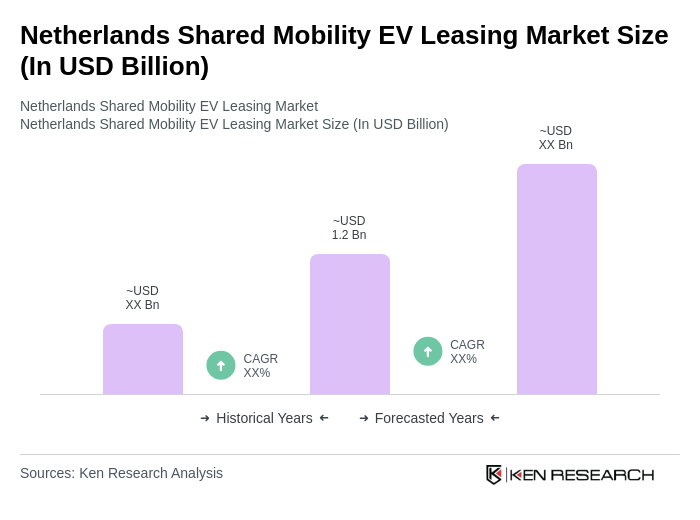
The Netherlands Shared Mobility EV Leasing Market, valued at USD 1.2 Bn, grows due to EV adoption incentives and urban mobility needs, with strong presence in Amsterdam and Rotterdam.

Region:Europe

Author(s):Dev

Product Code:KRAB5492

Pages:93

Published On:October 2025
About the Report

Base Year 2024

Netherlands Shared Mobility EV Leasing Market Overview

  • The Netherlands Shared Mobility EV Leasing Market is valued at USD 1.2 billion, based on a five-year historical analysis. This growth is primarily driven by increasing urbanization, government incentives for electric vehicles, and a growing consumer preference for sustainable transportation options. The rise in environmental awareness and the need for cost-effective mobility solutions have further propelled the market.
  • Key cities such as Amsterdam, Rotterdam, and The Hague dominate the market due to their advanced infrastructure, high population density, and strong governmental support for electric mobility initiatives. These urban centers have implemented various policies to promote electric vehicle usage, making them attractive locations for shared mobility services.
  • In 2023, the Dutch government introduced a regulation mandating that all new public transport vehicles must be zero-emission by 2025. This initiative aims to accelerate the transition to electric mobility and reduce greenhouse gas emissions, thereby enhancing the overall sustainability of the transportation sector in the Netherlands.
Netherlands Shared Mobility EV Leasing Market Size

Netherlands Shared Mobility EV Leasing Market Segmentation

By Type:The market is segmented into various types of leasing options, including short-term leasing, long-term leasing, fleet leasing, and others. Each of these segments caters to different consumer needs and preferences, with varying lease durations and payment models. The demand for short-term leasing has surged due to the increasing popularity of flexible mobility solutions, while long-term leasing remains a preferred choice for businesses looking to maintain a sustainable fleet.
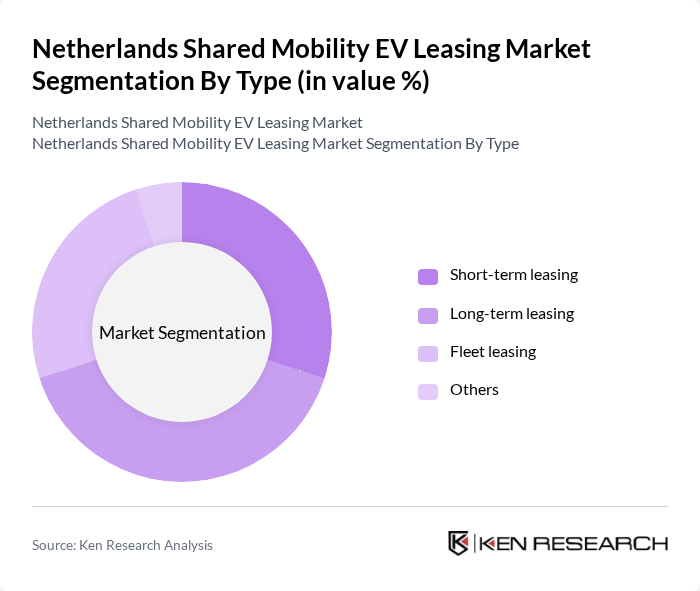
Netherlands Shared Mobility EV Leasing Market segmentation by Type.

By End-User:The end-user segmentation includes individual consumers, corporates, government agencies, and ride-sharing companies. Individual consumers are increasingly opting for shared mobility solutions due to their convenience and cost-effectiveness. Corporates are also leveraging these services to enhance their sustainability initiatives, while government agencies are promoting shared mobility as part of their urban transport strategies.
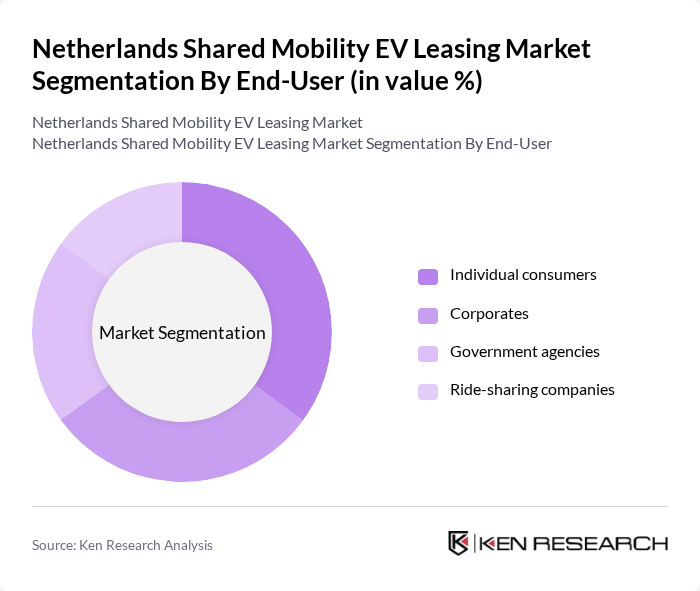
Netherlands Shared Mobility EV Leasing Market segmentation by End-User.

Netherlands Shared Mobility EV Leasing Market Competitive Landscape

The Netherlands Shared Mobility EV Leasing Market is characterized by a dynamic mix of regional and international players. Leading participants such as LeasePlan Corporation N.V., ALD Automotive, Arval, Greenwheels, Sixt SE, Europcar Mobility Group, TCR Group, Share Now, Zipcar, Getaround, MyWheels, SnappCar, Q8A, Vattenfall, Tesla Leasing contribute to innovation, geographic expansion, and service delivery in this space.

LeasePlan Corporation N.V.

1963

Amsterdam, Netherlands

ALD Automotive

2000

Amsterdam, Netherlands

Arval

1989

Amsterdam, Netherlands

Greenwheels

1995

Rotterdam, Netherlands

Sixt SE

1912

Pullach, Germany

Company

Establishment Year

Headquarters

Group Size (Large, Medium, or Small as per industry convention)

Revenue Growth Rate

Customer Acquisition Cost

Customer Retention Rate

Market Penetration Rate

Pricing Strategy

Netherlands Shared Mobility EV Leasing Market Industry Analysis

Growth Drivers

  • Increasing Demand for Sustainable Transportation:The Netherlands has seen a significant rise in the demand for sustainable transportation, with electric vehicle (EV) registrations increasing by 40,000 units in the current year alone, reaching a total of 300,000 EVs on the road. This shift is driven by heightened environmental awareness among consumers and businesses, as well as a commitment to reducing carbon emissions. The Dutch government aims for 1.9 million EVs in the future, further propelling the market for shared mobility EV leasing.
  • Government Incentives for EV Adoption:The Dutch government has implemented various incentives to promote EV adoption, including a budget of €600 million for EV purchase subsidies in the upcoming year. These incentives have led to a 25% increase in EV sales year-on-year. Additionally, tax benefits for EV leasing, such as reduced VAT rates, encourage businesses to adopt electric fleets, thereby boosting the shared mobility EV leasing market significantly.
  • Rising Urbanization and Congestion:Urbanization in the Netherlands is accelerating, with projections indicating that 90% of the population will reside in urban areas in the near future. This trend has resulted in increased traffic congestion, prompting a shift towards shared mobility solutions. The demand for shared EV leasing is expected to rise as urban dwellers seek efficient, eco-friendly transportation options, with shared mobility services projected to grow by 30% in urban centers over the next two years.

Market Challenges

  • High Initial Costs of EVs:Despite the growing interest in EVs, the high initial purchase price remains a significant barrier. The average cost of an electric vehicle in the Netherlands is approximately €40,000, which can deter potential lessees. This challenge is compounded by the fact that many consumers are still unfamiliar with the long-term savings associated with EV ownership, leading to hesitance in transitioning from traditional vehicles to electric alternatives.
  • Limited Charging Infrastructure:The current charging infrastructure in the Netherlands, while expanding, still faces limitations. As of the current year, there are around 80,000 public charging points, which is insufficient to meet the growing demand from the increasing number of EVs. This inadequacy can lead to range anxiety among potential users, hindering the adoption of shared mobility EV leasing solutions and creating a bottleneck in market growth.

Netherlands Shared Mobility EV Leasing Market Future Outlook

The future of the Netherlands shared mobility EV leasing market appears promising, driven by ongoing technological advancements and a strong governmental push towards sustainability. As urbanization continues to rise, the demand for shared mobility solutions is expected to increase, with a focus on integrating smart technologies into EVs. Additionally, the expansion of charging infrastructure will likely alleviate current limitations, making EV leasing more attractive to consumers and businesses alike, fostering a more sustainable transportation ecosystem.

Market Opportunities

  • Expansion of Charging Networks:The Dutch government plans to invest €200 million in expanding the charging network in the near future, aiming to increase the number of charging stations to 100,000. This expansion will enhance accessibility for EV users, making shared mobility leasing more appealing and facilitating a smoother transition to electric transportation.
  • Partnerships with Tech Companies:Collaborations between EV leasing companies and technology firms are on the rise, with investments in smart mobility solutions projected to reach €150 million in the upcoming year. These partnerships can lead to innovative leasing models and enhanced user experiences, positioning companies to capitalize on the growing demand for integrated mobility services.

Scope of the Report

SegmentSub-Segments
By Type

Short-term leasing

Long-term leasing

Fleet leasing

Others

By End-User

Individual consumers

Corporates

Government agencies

Ride-sharing companies

By Vehicle Category

Compact cars

SUVs

Vans

Others

By Lease Duration

Monthly leases

Annual leases

Multi-year leases

By Payment Model

Fixed monthly payments

Pay-per-use

Subscription models

By Charging Options

Home charging

Public charging

Fast charging

By Policy Support

Subsidies

Tax exemptions

Grants for infrastructure

Key Target Audience

Investors and Venture Capitalist Firms

Government and Regulatory Bodies (e.g., Ministry of Infrastructure and Water Management, Netherlands Enterprise Agency)

Electric Vehicle Manufacturers

Shared Mobility Service Providers

Charging Infrastructure Providers

Fleet Management Companies

Insurance Companies

Local Municipalities and City Planners

Players Mentioned in the Report:

LeasePlan Corporation N.V.

ALD Automotive

Arval

Greenwheels

Sixt SE

Europcar Mobility Group

TCR Group

Share Now

Zipcar

Getaround

MyWheels

SnappCar

Q8A

Vattenfall

Tesla Leasing

Table of Contents

Market Assessment Phase

1. Executive Summary and Approach


2. Netherlands Shared Mobility EV Leasing Market Overview

2.1 Key Insights and Strategic Recommendations

2.2 Netherlands Shared Mobility EV Leasing Market Overview

2.3 Definition and Scope

2.4 Evolution of Market Ecosystem

2.5 Timeline of Key Regulatory Milestones

2.6 Value Chain & Stakeholder Mapping

2.7 Business Cycle Analysis

2.8 Policy & Incentive Landscape


3. Netherlands Shared Mobility EV Leasing Market Analysis

3.1 Growth Drivers

3.1.1 Increasing demand for sustainable transportation
3.1.2 Government incentives for EV adoption
3.1.3 Rising urbanization and congestion
3.1.4 Technological advancements in EVs

3.2 Market Challenges

3.2.1 High initial costs of EVs
3.2.2 Limited charging infrastructure
3.2.3 Consumer skepticism towards EV performance
3.2.4 Regulatory compliance complexities

3.3 Market Opportunities

3.3.1 Expansion of charging networks
3.3.2 Partnerships with tech companies
3.3.3 Growth in corporate leasing
3.3.4 Development of battery recycling programs

3.4 Market Trends

3.4.1 Shift towards subscription-based leasing models
3.4.2 Integration of smart technology in EVs
3.4.3 Increasing focus on sustainability
3.4.4 Rise of shared mobility services

3.5 Government Regulation

3.5.1 Emission reduction targets
3.5.2 EV purchase subsidies
3.5.3 Charging infrastructure mandates
3.5.4 Tax incentives for EV leasing

4. SWOT Analysis


5. Stakeholder Analysis


6. Porter's Five Forces Analysis


7. Netherlands Shared Mobility EV Leasing Market Market Size, 2019-2024

7.1 By Value

7.2 By Volume

7.3 By Average Selling Price


8. Netherlands Shared Mobility EV Leasing Market Segmentation

8.1 By Type

8.1.1 Short-term leasing
8.1.2 Long-term leasing
8.1.3 Fleet leasing
8.1.4 Others

8.2 By End-User

8.2.1 Individual consumers
8.2.2 Corporates
8.2.3 Government agencies
8.2.4 Ride-sharing companies

8.3 By Vehicle Category

8.3.1 Compact cars
8.3.2 SUVs
8.3.3 Vans
8.3.4 Others

8.4 By Lease Duration

8.4.1 Monthly leases
8.4.2 Annual leases
8.4.3 Multi-year leases

8.5 By Payment Model

8.5.1 Fixed monthly payments
8.5.2 Pay-per-use
8.5.3 Subscription models

8.6 By Charging Options

8.6.1 Home charging
8.6.2 Public charging
8.6.3 Fast charging

8.7 By Policy Support

8.7.1 Subsidies
8.7.2 Tax exemptions
8.7.3 Grants for infrastructure

9. Netherlands Shared Mobility EV Leasing Market Competitive Analysis

9.1 Market Share of Key Players

9.2 Cross Comparison of Key Players

9.2.1 Company Name
9.2.2 Group Size (Large, Medium, or Small as per industry convention)
9.2.3 Revenue Growth Rate
9.2.4 Customer Acquisition Cost
9.2.5 Customer Retention Rate
9.2.6 Market Penetration Rate
9.2.7 Pricing Strategy
9.2.8 Average Lease Duration
9.2.9 Fleet Utilization Rate
9.2.10 Customer Satisfaction Score

9.3 SWOT Analysis of Top Players

9.4 Pricing Analysis

9.5 Detailed Profile of Major Companies

9.5.1 LeasePlan Corporation N.V.
9.5.2 ALD Automotive
9.5.3 Arval
9.5.4 Greenwheels
9.5.5 Sixt SE
9.5.6 Europcar Mobility Group
9.5.7 TCR Group
9.5.8 Share Now
9.5.9 Zipcar
9.5.10 Getaround
9.5.11 MyWheels
9.5.12 SnappCar
9.5.13 Q8A
9.5.14 Vattenfall
9.5.15 Tesla Leasing

10. Netherlands Shared Mobility EV Leasing Market End-User Analysis

10.1 Procurement Behavior of Key Ministries

10.1.1 Government fleet requirements
10.1.2 Budget allocation for EVs
10.1.3 Sustainability mandates

10.2 Corporate Spend on Infrastructure & Energy

10.2.1 Investment in charging stations
10.2.2 Budget for EV leasing
10.2.3 Energy consumption analysis

10.3 Pain Point Analysis by End-User Category

10.3.1 Cost concerns
10.3.2 Availability of charging infrastructure
10.3.3 Vehicle performance issues

10.4 User Readiness for Adoption

10.4.1 Awareness of EV benefits
10.4.2 Perceived barriers to entry
10.4.3 Willingness to switch from traditional vehicles

10.5 Post-Deployment ROI and Use Case Expansion

10.5.1 Cost savings analysis
10.5.2 Expansion of use cases
10.5.3 Long-term sustainability benefits

11. Netherlands Shared Mobility EV Leasing Market Future Size, 2025-2030

11.1 By Value

11.2 By Volume

11.3 By Average Selling Price


Go-To-Market Strategy Phase

1. Whitespace Analysis + Business Model Canvas

1.1 Market gaps identification

1.2 Value proposition development

1.3 Revenue model exploration

1.4 Customer segment analysis

1.5 Competitive landscape overview

1.6 Key partnerships identification

1.7 Risk assessment


2. Marketing and Positioning Recommendations

2.1 Branding strategies

2.2 Product USPs

2.3 Target audience segmentation

2.4 Communication channels

2.5 Promotional tactics


3. Distribution Plan

3.1 Urban retail strategies

3.2 Rural NGO tie-ups

3.3 Online vs offline distribution

3.4 Partnerships with local businesses


4. Channel & Pricing Gaps

4.1 Underserved routes

4.2 Pricing bands analysis

4.3 Competitor pricing comparison

4.4 Customer feedback on pricing


5. Unmet Demand & Latent Needs

5.1 Category gaps identification

5.2 Consumer segments analysis

5.3 Emerging trends exploration


6. Customer Relationship

6.1 Loyalty programs

6.2 After-sales service

6.3 Customer engagement strategies


7. Value Proposition

7.1 Sustainability initiatives

7.2 Integrated supply chains

7.3 Customer-centric offerings


8. Key Activities

8.1 Regulatory compliance

8.2 Branding efforts

8.3 Distribution setup


9. Entry Strategy Evaluation

9.1 Domestic Market Entry Strategy

9.1.1 Product mix considerations
9.1.2 Pricing band analysis
9.1.3 Packaging strategies

9.2 Export Entry Strategy

9.2.1 Target countries identification
9.2.2 Compliance roadmap development

10. Entry Mode Assessment

10.1 Joint Ventures

10.2 Greenfield investments

10.3 Mergers & Acquisitions

10.4 Distributor Model


11. Capital and Timeline Estimation

11.1 Capital requirements

11.2 Timelines for market entry


12. Control vs Risk Trade-Off

12.1 Ownership considerations

12.2 Partnerships evaluation


13. Profitability Outlook

13.1 Breakeven analysis

13.2 Long-term sustainability strategies


14. Potential Partner List

14.1 Distributors

14.2 Joint Ventures

14.3 Acquisition targets


15. Execution Roadmap

15.1 Phased Plan for Market Entry

15.1.1 Market Setup
15.1.2 Market Entry
15.1.3 Growth Acceleration
15.1.4 Scale & Stabilize

15.2 Key Activities and Milestones

15.2.1 Milestone tracking
15.2.2 Activity scheduling

Research Methodology

ApproachModellingSample

Phase 1: Approach1

Desk Research

  • Analysis of government reports on electric vehicle adoption and shared mobility trends in the Netherlands
  • Review of industry publications and white papers focusing on EV leasing models and market dynamics
  • Examination of statistical data from the Netherlands Bureau for Economic Policy Analysis (CPB) and other relevant agencies

Primary Research

  • Interviews with executives from leading EV leasing companies and shared mobility platforms
  • Surveys targeting fleet managers and corporate sustainability officers regarding their leasing preferences
  • Focus groups with consumers to understand attitudes towards shared mobility and electric vehicles

Validation & Triangulation

  • Cross-validation of findings through comparison with international EV leasing trends and case studies
  • Triangulation of data from primary interviews, secondary research, and market reports
  • Sanity checks conducted through expert panel reviews comprising industry veterans and academic researchers

Phase 2: Market Size Estimation1

Top-down Assessment

  • Estimation of the total addressable market for EV leasing based on national vehicle registration statistics
  • Segmentation of the market by consumer demographics, corporate fleets, and public transport initiatives
  • Incorporation of government incentives and subsidies for electric vehicle adoption into market projections

Bottom-up Modeling

  • Collection of data on leasing rates and terms from major EV leasing companies operating in the Netherlands
  • Analysis of operational costs associated with EV maintenance and charging infrastructure
  • Volume x cost calculations to derive revenue estimates for different leasing models

Forecasting & Scenario Analysis

  • Multi-factor regression analysis incorporating variables such as urbanization rates, environmental policies, and consumer preferences
  • Scenario modeling based on potential changes in government regulations and technological advancements in EVs
  • Development of baseline, optimistic, and pessimistic forecasts for the EV leasing market through 2030

Phase 3: CATI Sample Composition1

Scope Item/SegmentSample SizeTarget Respondent Profiles
Corporate Fleet Managers100Fleet Operations Managers, Sustainability Officers
Shared Mobility Service Providers80Business Development Managers, Operations Directors
Consumers Interested in EV Leasing150Potential EV Users, Environmentally Conscious Consumers
Government Policy Makers50Transport Policy Analysts, Environmental Regulators
Charging Infrastructure Providers70Business Development Executives, Technical Managers

Frequently Asked Questions

What is the current value of the Netherlands Shared Mobility EV Leasing Market?

The Netherlands Shared Mobility EV Leasing Market is valued at approximately USD 1.2 billion, reflecting a significant growth driven by urbanization, government incentives for electric vehicles, and a rising consumer preference for sustainable transportation options.

What factors are driving the growth of the EV leasing market in the Netherlands?

Which cities in the Netherlands are leading in the shared mobility EV leasing market?

What government regulations are impacting the EV leasing market in the Netherlands?

Other Regional/Country Reports

Indonesia Shared Mobility EV Leasing Market

Malaysia Shared Mobility EV Leasing Market

KSA Shared Mobility EV Leasing Market

APAC Shared Mobility EV Leasing Market

SEA Shared Mobility EV Leasing Market

Vietnam Shared Mobility EV Leasing Market

Other Adjacent Reports

Singapore Electric Vehicle Charging Infrastructure Market

Belgium Ride-Sharing Services Market

Oman Fleet Management Software Market

Philippines Sustainable Transportation Solutions Market

Germany Automotive Battery Technology Market

Oman Urban Mobility Platforms Market

KSA Renewable Energy Integration Market

Thailand Smart City Transportation Market

Qatar Vehicle Leasing Services Market

Kuwait Eco-Friendly Logistics Market

Why Buy From Us?

Refine Robust Result (RRR) Framework

What makes us stand out is that our consultants follow Robust, Refine and Result (RRR) methodology. Robust for clear definitions, approaches and sanity checking, Refine for differentiating respondents' facts and opinions, and Result for presenting data with story.

Our Reach Is Unmatched

We have set a benchmark in the industry by offering our clients with syndicated and customized market research reports featuring coverage of entire market as well as meticulous research and analyst insights.

Shifting the Research Paradigm

While we don't replace traditional research, we flip the method upside down. Our dual approach of Top Bottom & Bottom Top ensures quality deliverable by not just verifying company fundamentals but also looking at the sector and macroeconomic factors.

More Insights-Better Decisions

With one step in the future, our research team constantly tries to show you the bigger picture. We help with some of the tough questions you may encounter along the way: How is the industry positioned? Best marketing channel? KPI's of competitors? By aligning every element, we help maximize success.

Transparency and Trust

Our report gives you instant access to the answers and sources that other companies might choose to hide. We elaborate each steps of research methodology we have used and showcase you the sample size to earn your trust.

Round the Clock Support

If you need any support, we are here! We pride ourselves on universe strength, data quality, and quick, friendly, and professional service.

Why Clients Choose Us?

400000+
Reports in repository
150+
Consulting projects a year
100+
Analysts
8000+
Client Queries in 2022








