About the Report
Base Year 2024Listen to the audio summary
New Zealand Voice Over New Radio Market Overview
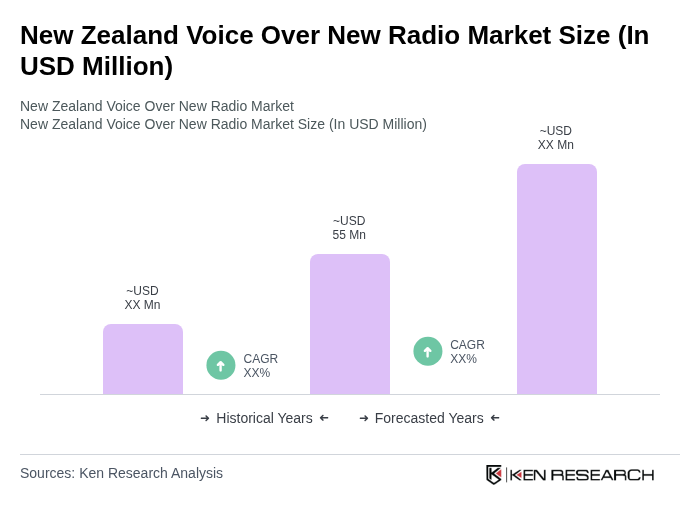
- The New Zealand Voice Over New Radio Market is valued at USD 55 million, based on a five-year historical analysis of New Zealand’s share within the global voice over new radio market and the overall telecom mobile network operator revenue base in the country. This growth is primarily driven by the increasing adoption of 5G technology, particularly 5G Standalone (SA) and advanced 5G core upgrades that enhance voice quality, reduce latency, and enable native IP-based voice over new radio (VoNR) services. Rising consumption of mobile data services, growth in rich communication services (RCS), and the shift from legacy circuit-switched voice to packet-based voice over 5G further support market expansion. The rise in remote work, cloud-based collaboration tools, and unified communications has accelerated the need for advanced, low-latency voice solutions integrated into 5G networks.
- Auckland, Wellington, and Christchurch are the dominant cities in the New Zealand Voice Over New Radio Market. Auckland, being the largest city, serves as a commercial and technology hub with a high concentration of telecom operators, data centres, and 5G infrastructure deployments by major mobile network operators. Wellington, as the capital, has significant government and public sector engagement, with digital transformation initiatives and public cloud adoption supporting advanced voice and 5G use cases. Christchurch is rapidly developing its tech ecosystem and smart-city applications, with continued investment in connectivity and resilient infrastructure that supports next-generation voice and data services, contributing to the overall market growth.
- In 2023, the New Zealand government strengthened the regulatory framework governing mobile and 5G-based voice services through instruments such as the Telecommunications (Fiber Fixed Line Access Services) Regulations 2021 issued by the New Zealand Government and administered by the Ministry of Business, Innovation and Employment and the Commerce Commission, alongside the ongoing Telecommunications Act 2001 obligations on service quality and consumer protection. These frameworks, together with technical requirements aligned to 3GPP and ITU standards that operators implement for 5G and VoNR, require providers to meet defined performance, reliability, security, and disclosure obligations, helping protect consumer interests and promote fair competition among service providers.
New Zealand Voice Over New Radio Market Segmentation
By Component:
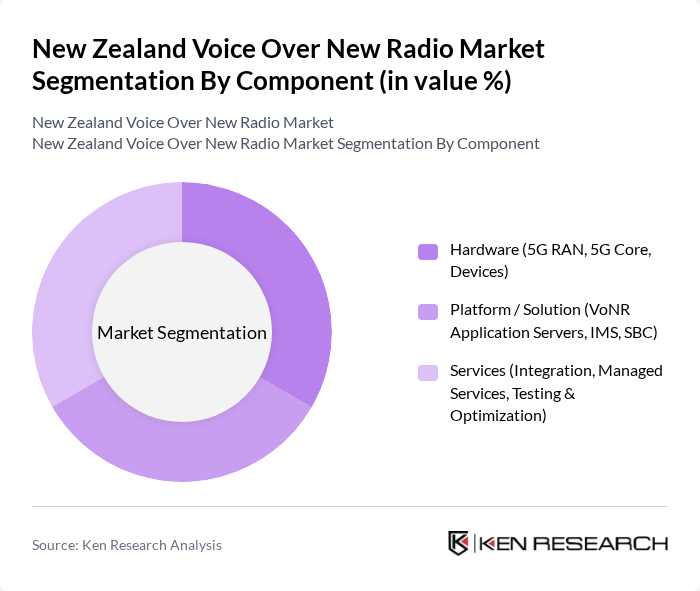
The components of the New Zealand Voice Over New Radio Market include Hardware, Platform/Solution, and Services. Among these, the Hardware segment, which encompasses 5G RAN, 5G Core, and Devices, is currently dominating the market, in line with global trends where hardware accounts for the largest share of voice over new radio spending. This is largely due to the rapid deployment of 5G infrastructure, spectrum utilisation by mobile network operators, and the need for upgraded radios, baseband units, and 5G core functions to support VoNR. The increasing penetration of 5G smartphones and enterprise customer premises equipment that support VoNR capabilities is also driving growth in this segment, as consumers and businesses seek enhanced communication solutions with high-definition voice, seamless handover, and integration with data and application services.
By Deployment Model:
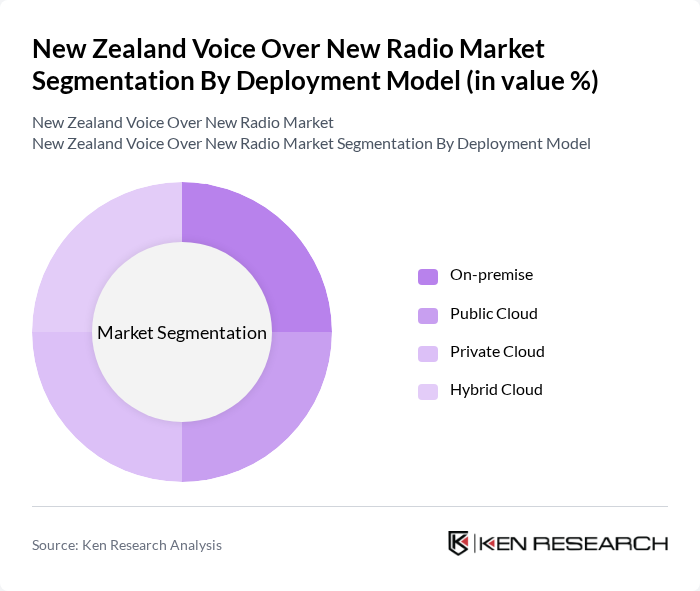
The deployment models in the New Zealand Voice Over New Radio Market include On-premise, Public Cloud, Private Cloud, and Hybrid Cloud. The Public Cloud segment is leading the market due to its scalability, operational flexibility, and pay-as-you-go economics, which align with global adoption patterns where public cloud accounts for the largest share of VoNR and cloud-native telecom deployments. This model allows operators and enterprises to deploy cloud-native IMS, SBC, and application servers without significant upfront capital expenditure, while benefiting from automation and rapid feature rollout. The flexibility offered by cloud-based services is particularly appealing to small and medium enterprises, which are increasingly migrating unified communications, collaboration platforms, and customer engagement solutions to cloud environments for their communication needs.
New Zealand Voice Over New Radio Market Competitive Landscape
The New Zealand Voice Over New Radio Market is characterized by a dynamic mix of regional and international players. Leading participants such as Spark New Zealand Limited, One New Zealand Group Limited (formerly Vodafone New Zealand), 2degrees Network Limited, Chorus Limited, Dense Air New Zealand, Crown Infrastructure Partners, Nokia Corporation, Ericsson AB, Samsung Electronics Co., Ltd., Huawei Technologies Co., Ltd., Mavenir Systems, Inc., Cisco Systems, Inc., Oracle Corporation, Netcracker Technology Corporation, Local MVNOs and Niche 5G Service Providers contribute to innovation, geographic expansion, and service delivery in this space.
New Zealand Voice Over New Radio Market Industry Analysis
Growth Drivers
- Increasing Demand for Localized Content:The New Zealand voice-over radio market is experiencing a surge in demand for localized content, driven by a population of approximately 5.3 million people. In future, the local content production is projected to reach NZD 165 million, reflecting a 10% increase from the previous year. This growth is fueled by listeners' preferences for culturally relevant programming, which enhances audience engagement and loyalty, thereby supporting local talent and businesses.
- Rise of Digital Streaming Platforms:The proliferation of digital streaming platforms has transformed the New Zealand voice-over radio landscape. In future, it is estimated that over 2.6 million Kiwis will utilize streaming services, contributing to a 15% increase in overall listenership. This shift allows for greater accessibility and convenience, enabling listeners to engage with diverse content anytime, thus driving demand for high-quality voice-over services tailored to digital formats.
- Growth in Advertising Expenditure:Advertising expenditure in New Zealand is projected to reach NZD 1.5 billion in future, marking a 12% increase from the previous year. This growth is particularly evident in the radio sector, where advertisers are increasingly recognizing the value of voice-over talent in creating compelling ads. As businesses seek to enhance brand visibility, the demand for professional voice-over services is expected to rise, benefiting the local radio market significantly.
Market Challenges
- Competition from Global Streaming Services:The New Zealand voice-over radio market faces significant challenges from global streaming services like Spotify and Apple Music, which have captured a substantial share of the audience. In future, these platforms are expected to account for 40% of total audio consumption in New Zealand, limiting the reach of local radio stations. This competition pressures local providers to innovate and enhance their offerings to retain listeners and advertisers.
- Regulatory Compliance Costs:Regulatory compliance remains a significant challenge for the New Zealand voice-over radio market, with costs projected to exceed NZD 25 million in future. These expenses arise from adhering to content localization requirements and advertising standards. As regulations evolve, local broadcasters must allocate resources to ensure compliance, which can strain budgets and limit investment in content development and technology upgrades.
New Zealand Voice Over New Radio Market Future Outlook
The future of the New Zealand voice-over radio market appears promising, driven by technological advancements and evolving consumer preferences. As the industry adapts to the rise of digital platforms, there will be a notable shift towards interactive content that engages listeners more effectively. Additionally, the integration of artificial intelligence in content creation is expected to streamline production processes, enhancing the quality and diversity of offerings while attracting a broader audience base.
Market Opportunities
- Expansion of Podcasting and On-Demand Services:The podcasting sector in New Zealand is projected to grow significantly, with an estimated 1.5 million active listeners in future. This presents a lucrative opportunity for voice-over artists to create tailored content, catering to niche audiences and enhancing listener engagement through personalized storytelling and expert insights.
- Collaborations with Local Artists and Influencers:Collaborating with local artists and influencers can enhance the visibility of voice-over services in New Zealand. With over 600,000 active social media influencers in the country, partnerships can drive audience engagement and create unique content that resonates with local communities, ultimately boosting brand loyalty and market presence.
Scope of the Report
| Segment | Sub-Segments |
|---|---|
| By Component | Hardware (5G RAN, 5G Core, Devices) Platform / Solution (VoNR Application Servers, IMS, SBC) Services (Integration, Managed Services, Testing & Optimization) |
| By Deployment Model | On-premise Public Cloud Private Cloud Hybrid Cloud |
| By Network Type | Standalone 5G (SA) Non-Standalone 5G (NSA) with EPC Interworking Multi-Operator / Network Sharing Deployments |
| By End-Use Industry | Telecom Operators / MNOs Enterprises (Manufacturing, Utilities, Transport, etc.) Public Sector and Critical Communications Media & Entertainment Others |
| By End-Use Device | Smartphones Indoor CPE Outdoor CPE IoT / M2M Devices Others |
| By Application | Consumer Enhanced Mobile Voice (HD Voice, Video Calling) Enterprise Voice and Collaboration Mission-Critical and Low-Latency Voice Fixed Wireless Access Voice Others |
| By Organization Size | Small & Medium Enterprises (SMEs) Large Enterprises |
Key Target Audience
Investors and Venture Capitalist Firms
Government and Regulatory Bodies (e.g., New Zealand Broadcasting Standards Authority, Ministry of Culture and Heritage)
Advertising Agencies
Media Production Companies
Radio Station Owners and Operators
Content Creators and Voice Talent Agencies
Telecommunications Providers
Marketing and Promotion Firms
Players Mentioned in the Report:
Spark New Zealand Limited
One New Zealand Group Limited (formerly Vodafone New Zealand)
2degrees Network Limited
Chorus Limited
Dense Air New Zealand
Crown Infrastructure Partners
Nokia Corporation
Ericsson AB
Samsung Electronics Co., Ltd.
Huawei Technologies Co., Ltd.
Mavenir Systems, Inc.
Cisco Systems, Inc.
Oracle Corporation
Netcracker Technology Corporation
Local MVNOs and Niche 5G Service Providers
Table of Contents
Market Assessment Phase
1. Executive Summary and Approach
2. New Zealand Voice Over New Radio Market Overview
2.1 Key Insights and Strategic Recommendations
2.2 New Zealand Voice Over New Radio Market Overview
2.3 Definition and Scope
2.4 Evolution of Market Ecosystem
2.5 Timeline of Key Regulatory Milestones
2.6 Value Chain & Stakeholder Mapping
2.7 Business Cycle Analysis
2.8 Policy & Incentive Landscape
3. New Zealand Voice Over New Radio Market Analysis
3.1 Growth Drivers
3.1.1 Increasing Demand for Localized Content
3.1.2 Rise of Digital Streaming Platforms
3.1.3 Growth in Advertising Expenditure
3.1.4 Technological Advancements in Broadcasting
3.2 Market Challenges
3.2.1 Competition from Global Streaming Services
3.2.2 Regulatory Compliance Costs
3.2.3 Limited Audience Reach in Rural Areas
3.2.4 Fluctuating Advertising Budgets
3.3 Market Opportunities
3.3.1 Expansion of Podcasting and On-Demand Services
3.3.2 Collaborations with Local Artists and Influencers
3.3.3 Development of Niche Content Channels
3.3.4 Investment in Advanced Broadcasting Technologies
3.4 Market Trends
3.4.1 Shift Towards Interactive and Engaging Content
3.4.2 Increased Focus on Sustainability in Broadcasting
3.4.3 Growth of Mobile Listening Habits
3.4.4 Integration of AI in Content Creation
3.5 Government Regulation
3.5.1 Content Localization Requirements
3.5.2 Advertising Standards and Guidelines
3.5.3 Licensing and Broadcasting Rights
3.5.4 Data Protection and Privacy Regulations
4. SWOT Analysis
5. Stakeholder Analysis
6. Porter's Five Forces Analysis
7. New Zealand Voice Over New Radio Market Market Size, 2019-2024
7.1 By Value
7.2 By Volume
7.3 By Average Selling Price
8. New Zealand Voice Over New Radio Market Segmentation
8.1 By Component
8.1.1 Hardware (5G RAN, 5G Core, Devices)
8.1.2 Platform / Solution (VoNR Application Servers, IMS, SBC)
8.1.3 Services (Integration, Managed Services, Testing & Optimization)
8.2 By Deployment Model
8.2.1 On-premise
8.2.2 Public Cloud
8.2.3 Private Cloud
8.2.4 Hybrid Cloud
8.3 By Network Type
8.3.1 Standalone 5G (SA)
8.3.2 Non-Standalone 5G (NSA) with EPC Interworking
8.3.3 Multi-Operator / Network Sharing Deployments
8.4 By End-Use Industry
8.4.1 Telecom Operators / MNOs
8.4.2 Enterprises (Manufacturing, Utilities, Transport, etc.)
8.4.3 Public Sector and Critical Communications
8.4.4 Media & Entertainment
8.4.5 Others
8.5 By End-Use Device
8.5.1 Smartphones
8.5.2 Indoor CPE
8.5.3 Outdoor CPE
8.5.4 IoT / M2M Devices
8.5.5 Others
8.6 By Application
8.6.1 Consumer Enhanced Mobile Voice (HD Voice, Video Calling)
8.6.2 Enterprise Voice and Collaboration
8.6.3 Mission-Critical and Low-Latency Voice
8.6.4 Fixed Wireless Access Voice
8.6.5 Others
8.7 By Organization Size
8.7.1 Small & Medium Enterprises (SMEs)
8.7.2 Large Enterprises
9. New Zealand Voice Over New Radio Market Competitive Analysis
9.1 Market Share of Key Players
9.2 Cross Comparison of Key Players
9.2.1 Company Name
9.2.2 Group Size (Large, Medium, or Small as per industry convention)
9.2.3 New Zealand VoNR Revenue (NZD Million)
9.2.4 VoNR Revenue CAGR (Historical & Forecast)
9.2.5 Share of 5G Subscribers Enabled for VoNR (%)
9.2.6 Average Revenue per User – VoNR (ARPU, NZD/Month)
9.2.7 Network Coverage (5G / VoNR Population Coverage, %)
9.2.8 VoNR Call Setup Success Rate (%)
9.2.9 VoNR Call Drop Rate (%)
9.2.10 VoNR Traffic as % of Total Mobile Voice Traffic
9.2.11 Capital Intensity (Capex-to-Revenue Ratio for 5G/VoNR, %)
9.2.12 EBITDA Margin for Mobile / VoNR Services (%)
9.2.13 Digital Engagement Metrics (VoNR-enabled App MAUs, Usage Minutes)
9.2.14 Brand Recognition / NPS Score
9.3 SWOT Analysis of Top Players
9.4 Pricing Analysis
9.5 Detailed Profile of Major Companies
9.5.1 Spark New Zealand Limited
9.5.2 One New Zealand Group Limited (formerly Vodafone New Zealand)
9.5.3 2degrees Network Limited
9.5.4 Chorus Limited
9.5.5 Dense Air New Zealand
9.5.6 Crown Infrastructure Partners
9.5.7 Nokia Corporation
9.5.8 Ericsson AB
9.5.9 Samsung Electronics Co., Ltd.
9.5.10 Huawei Technologies Co., Ltd.
9.5.11 Mavenir Systems, Inc.
9.5.12 Cisco Systems, Inc.
9.5.13 Oracle Corporation
9.5.14 Netcracker Technology Corporation
9.5.15 Local MVNOs and Niche 5G Service Providers
10. New Zealand Voice Over New Radio Market End-User Analysis
10.1 Procurement Behavior of Key Ministries
10.1.1 Budget Allocation for Media Services
10.1.2 Preference for Local Content
10.1.3 Evaluation Criteria for Service Providers
10.1.4 Contract Duration and Renewal Practices
10.2 Corporate Spend on Infrastructure & Energy
10.2.1 Investment in Broadcasting Technology
10.2.2 Expenditure on Content Creation
10.2.3 Marketing and Advertising Budgets
10.2.4 Training and Development Costs
10.3 Pain Point Analysis by End-User Category
10.3.1 Content Quality Concerns
10.3.2 Accessibility Issues
10.3.3 Cost of Advertising
10.3.4 Competition from Other Media
10.4 User Readiness for Adoption
10.4.1 Awareness of New Technologies
10.4.2 Willingness to Pay for Quality Content
10.4.3 Feedback Mechanisms
10.4.4 Training Needs for Staff
10.5 Post-Deployment ROI and Use Case Expansion
10.5.1 Measurement of Listener Engagement
10.5.2 Analysis of Revenue Growth
10.5.3 Opportunities for Content Diversification
10.5.4 Long-term Partnerships with Advertisers
11. New Zealand Voice Over New Radio Market Future Size, 2025-2030
11.1 By Value
11.2 By Volume
11.3 By Average Selling Price
Go-To-Market Strategy Phase
1. Whitespace Analysis + Business Model Canvas
1.1 Market Gaps Identification
1.2 Value Proposition Development
1.3 Revenue Streams Analysis
1.4 Cost Structure Evaluation
1.5 Key Partnerships Exploration
1.6 Customer Segmentation
1.7 Channels of Distribution
2. Marketing and Positioning Recommendations
2.1 Branding Strategies
2.2 Product USPs
2.3 Target Audience Engagement
2.4 Digital Marketing Tactics
2.5 Offline Marketing Strategies
3. Distribution Plan
3.1 Urban Retail Strategies
3.2 Rural NGO Tie-ups
3.3 Online Distribution Channels
3.4 Partnerships with Local Businesses
4. Channel & Pricing Gaps
4.1 Underserved Routes
4.2 Pricing Bands Analysis
4.3 Competitor Pricing Strategies
4.4 Consumer Price Sensitivity
5. Unmet Demand & Latent Needs
5.1 Category Gaps Identification
5.2 Consumer Segments Analysis
5.3 Emerging Trends Exploration
5.4 Feedback Collection Mechanisms
6. Customer Relationship
6.1 Loyalty Programs Development
6.2 After-sales Service Strategies
6.3 Customer Feedback Integration
6.4 Community Engagement Initiatives
7. Value Proposition
7.1 Sustainability Initiatives
7.2 Integrated Supply Chains
7.3 Unique Selling Points
7.4 Customer-Centric Approaches
8. Key Activities
8.1 Regulatory Compliance
8.2 Branding Initiatives
8.3 Distribution Setup
8.4 Content Development
9. Entry Strategy Evaluation
9.1 Domestic Market Entry Strategy
9.1.1 Product Mix Considerations
9.1.2 Pricing Band Strategy
9.1.3 Packaging Innovations
9.2 Export Entry Strategy
9.2.1 Target Countries Identification
9.2.2 Compliance Roadmap Development
10. Entry Mode Assessment
10.1 Joint Ventures
10.2 Greenfield Investments
10.3 Mergers & Acquisitions
10.4 Distributor Model Evaluation
11. Capital and Timeline Estimation
11.1 Capital Requirements Analysis
11.2 Timelines for Market Entry
12. Control vs Risk Trade-Off
12.1 Ownership vs Partnerships
12.2 Risk Mitigation Strategies
13. Profitability Outlook
13.1 Breakeven Analysis
13.2 Long-term Sustainability Strategies
14. Potential Partner List
14.1 Distributors Identification
14.2 Joint Ventures Opportunities
14.3 Acquisition Targets
15. Execution Roadmap
15.1 Phased Plan for Market Entry
15.1.1 Market Setup
15.1.2 Market Entry
15.1.3 Growth Acceleration
15.1.4 Scale & Stabilize
15.2 Key Activities and Milestones
15.2.1 Milestone Planning
15.2.2 Activity Tracking
Research Methodology
Phase 1: Approach1
Desk Research
- Analysis of industry reports from New Zealand's broadcasting authorities
- Review of market trends and consumer behavior studies published by local media organizations
- Examination of regulatory frameworks and guidelines from the New Zealand Broadcasting Standards Authority
Primary Research
- Interviews with voice-over artists and producers in the New Zealand radio sector
- Surveys targeting radio station managers and content directors
- Focus groups with listeners to gather insights on preferences and trends
Validation & Triangulation
- Cross-validation of findings through multiple data sources, including audience ratings and advertising revenue
- Triangulation of qualitative insights from interviews with quantitative data from surveys
- Sanity checks conducted through expert panel reviews comprising industry veterans
Phase 2: Market Size Estimation1
Top-down Assessment
- Estimation of total advertising spend in the New Zealand radio market
- Segmentation of market size by genre, including news, entertainment, and educational programming
- Incorporation of demographic data to assess listener reach and engagement
Bottom-up Modeling
- Collection of revenue data from leading radio stations and networks
- Analysis of average pricing models for voice-over services in radio production
- Volume estimates based on the number of radio broadcasts and average listenership
Forecasting & Scenario Analysis
- Multi-factor regression analysis incorporating technological advancements and changing consumer habits
- Scenario planning based on potential regulatory changes and market disruptions
- Development of baseline, optimistic, and pessimistic forecasts through 2028
Phase 3: CATI Sample Composition1
| Scope Item/Segment | Sample Size | Target Respondent Profiles |
|---|---|---|
| Voice-over Artists | 90 | Freelancers, Studio Owners |
| Radio Station Managers | 70 | Content Directors, Operations Managers |
| Advertising Agencies | 60 | Creative Directors, Media Buyers |
| Listeners' Focus Groups | 50 | Regular Radio Listeners, Podcast Consumers |
| Industry Experts | 40 | Media Analysts, Academic Researchers |
Frequently Asked Questions
What is the current value of the New Zealand Voice Over New Radio Market?
The New Zealand Voice Over New Radio Market is valued at approximately USD 55 million, reflecting a five-year historical analysis of the country's share within the global voice-over market and its telecom mobile network operator revenue base.
What factors are driving growth in the New Zealand Voice Over New Radio Market?
Which cities are the main hubs for the New Zealand Voice Over New Radio Market?
How has the New Zealand government influenced the Voice Over New Radio Market?
Other Regional/Country Reports
Other Adjacent Reports
Philippines 5G Infrastructure Market
Belgium Telecommunications Equipment Market
Vietnam Cloud Computing Market Outlook to 2030: Size, Share, Growth and TrendsEurope Unified Communications Market Outlook to 2030: Size, Share, Growth and TrendsQatar Rich Communication Services Market
Mexico Mobile Device Market
Kuwait Network Hardware Market
South Korea VoIP Services Market
Japan Wireless Technology Market
Qatar Broadband Services Market Size, Share, Growth Drivers, Trends, Opportunities & Forecast 2025–2030Why Buy From Us?

What makes us stand out is that our consultants follow Robust, Refine and Result (RRR) methodology. Robust for clear definitions, approaches and sanity checking, Refine for differentiating respondents' facts and opinions, and Result for presenting data with story.

We have set a benchmark in the industry by offering our clients with syndicated and customized market research reports featuring coverage of entire market as well as meticulous research and analyst insights.

While we don't replace traditional research, we flip the method upside down. Our dual approach of Top Bottom & Bottom Top ensures quality deliverable by not just verifying company fundamentals but also looking at the sector and macroeconomic factors.

With one step in the future, our research team constantly tries to show you the bigger picture. We help with some of the tough questions you may encounter along the way: How is the industry positioned? Best marketing channel? KPI's of competitors? By aligning every element, we help maximize success.

Our report gives you instant access to the answers and sources that other companies might choose to hide. We elaborate each steps of research methodology we have used and showcase you the sample size to earn your trust.

If you need any support, we are here! We pride ourselves on universe strength, data quality, and quick, friendly, and professional service.