About the Report
Base Year 2024Listen to the audio summary
Japan Voice Over New Radio Market Overview
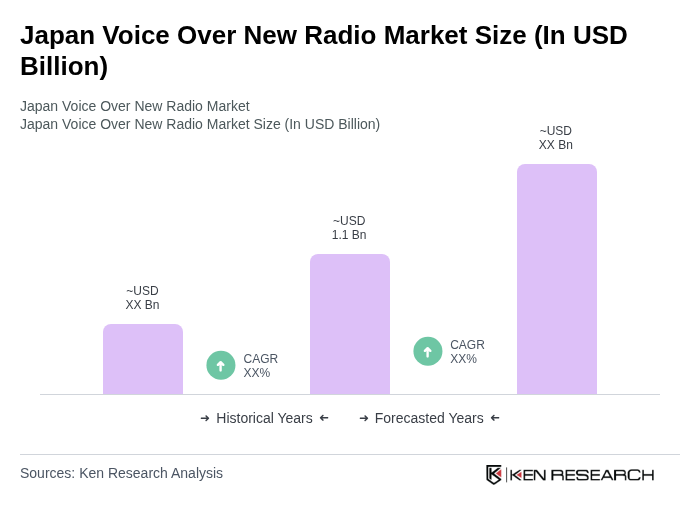
- The Japan Voice Over New Radio Market is valued at USD 1.1 billion, based on a five-year historical analysis, aligned with Japan’s position as a key hub within the Asia Pacific VoNR landscape, where the region accounts for nearly half of global revenues. This growth is primarily driven by the increasing demand for high-quality voice communication services over 5G standalone (SA) networks, rapid expansion of 5G coverage by Japanese operators, and the rising adoption of VoNR (Voice over New Radio) solutions across sectors such as telecommunications, media, and enterprise communications.
- Tokyo and Osaka are the dominant cities in the Japan Voice Over New Radio Market due to their status as major economic hubs with advanced telecommunications infrastructure and dense 5G deployment by leading operators such as NTT Docomo, KDDI, SoftBank, and Rakuten Mobile. The concentration of technology companies, data centers, and media enterprises, combined with high population density and early 5G adoption in these metropolitan areas, further contributes to the market's growth, as they facilitate the rapid deployment and testing of innovative voice communication solutions.
- In 2023, the Japanese government implemented regulations to enhance the security and reliability of voice communication services, including services delivered over 5G and IP-based platforms such as VoNR. This includes mandatory compliance with strengthened cybersecurity requirements and network reliability obligations for telecommunications carriers under the Telecommunications Business Act and related guidelines, as reflected in instruments such as the Guidelines for Ensuring the Security and Reliability of Information and Communications Networks, revised by the Ministry of Internal Affairs and Communications in 2023, which set expectations for encryption, incident reporting, supply?chain risk management, and continuity of critical communication services.
Japan Voice Over New Radio Market Segmentation
By Component:The components of the market include hardware, solutions, and services. The hardware segment encompasses the physical devices and network elements required for VoNR, such as 5G radios, core network equipment, and compatible user devices, while solutions refer to the software platforms, voice codecs, and applications that enable high-quality IP-based voice communication over 5G. Services include integration, managed services, and ongoing support and maintenance provided to operators and enterprise users to ensure consistent voice quality and reliability.
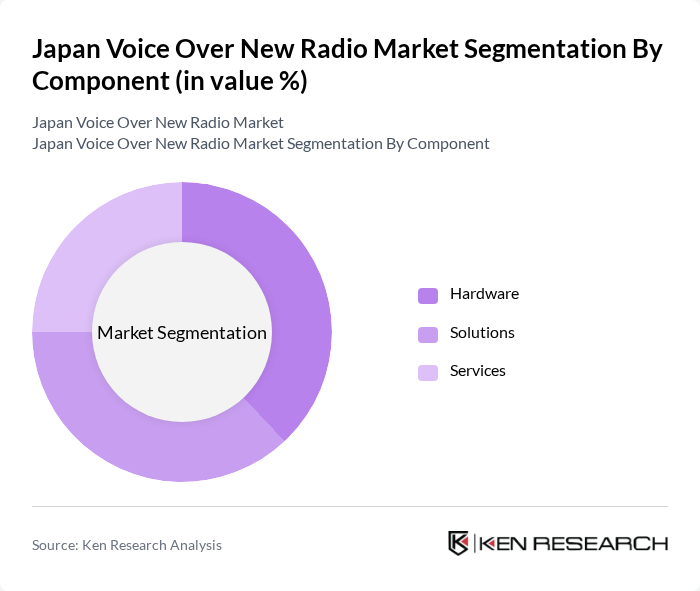
The hardware segment is currently dominating the market due to the increasing demand for advanced 5G radios, standalone cores, and compatible devices that support VoNR technology, in line with global trends where hardware still accounts for the largest revenue share in early-stage VoNR deployments. As consumers and businesses upgrade their communication systems to leverage 5G capabilities, the need for compatible hardware has surged. This trend is further fueled by the growing reliance on high-quality, low-latency voice services in both personal and professional settings, as well as the ongoing 3G switch?off and migration from legacy voice solutions to all?IP architectures, making hardware a critical component in the overall market landscape.
By Deployment:The deployment of VoNR services can be categorized into public cloud, private cloud, and hybrid cloud models. Public cloud services are widely adopted for their scalability and cost-efficiency, enabling operators and enterprises to host VoNR application servers, analytics, and orchestration platforms in shared infrastructure. Private cloud solutions offer enhanced control and security for sensitive user and signaling data, which is particularly important for telecom operators and mission?critical enterprise use cases. Hybrid cloud models combine the benefits of both, allowing core voice functions or subscriber data to remain in private environments while leveraging public cloud for non?sensitive workloads, testing, or rapid scaling to meet peak traffic.
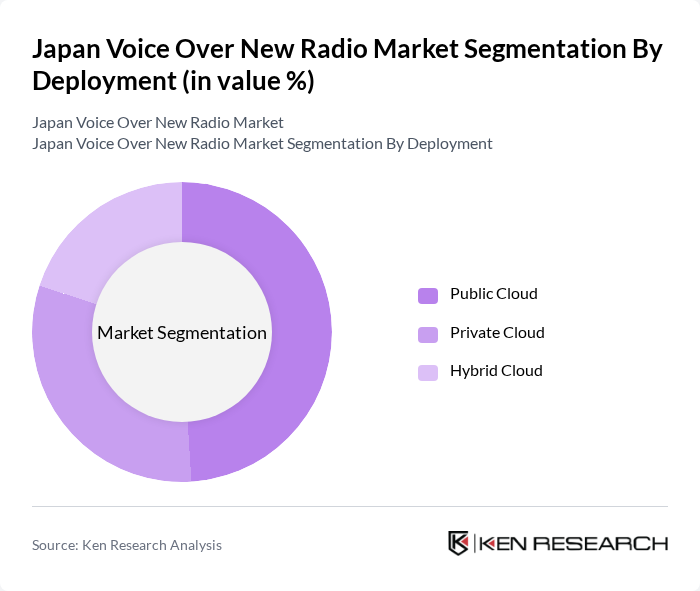
The public cloud deployment model is leading the market due to its cost-effectiveness, elasticity, and ease of access, consistent with global VoNR trends where public cloud accounts for nearly half of deployment share. Businesses are increasingly opting for public cloud solutions to reduce infrastructure costs and enhance flexibility in scaling their voice communication services, particularly for analytics, testing, and over?the?top 5G voice applications. This trend is particularly prevalent among small to medium-sized enterprises and digital-native service providers that seek to leverage advanced technologies without significant upfront investments, while larger telecom operators increasingly adopt hybrid strategies that start in private or on?premise environments and progressively extend into public cloud.
Japan Voice Over New Radio Market Competitive Landscape
The Japan Voice Over New Radio Market is characterized by a dynamic mix of regional and international players. Leading participants such as NTT Docomo, Inc., KDDI Corporation (au), SoftBank Corp., Rakuten Mobile, Inc., NEC Corporation, Fujitsu Limited, Nokia Corporation, Ericsson AB, Huawei Technologies Co., Ltd., Samsung Electronics Co., Ltd., ZTE Corporation, Qualcomm Technologies, Inc., Cisco Systems, Inc., Sony Group Corporation, Mitsubishi Electric Corporation contribute to innovation, geographic expansion, and service delivery in this space.
Japan Voice Over New Radio Market Industry Analysis
Growth Drivers
- Increasing Demand for Digital Content:The Japanese digital content market is projected to reach ¥2.5 trillion in future, driven by a surge in consumer preference for on-demand audio. This shift is fueled by the growing number of smartphone users, which reached approximately 98 million, representing a smartphone adoption rate in the range of roughly 80% of the population. As more consumers seek diverse audio experiences, the demand for voice-over services in new radio formats is expected to rise significantly, creating new opportunities for content creators and advertisers alike.
- Rise in Mobile and Internet Penetration:Japan's internet penetration rate is estimated at around 94%, with mobile internet users exceeding 90 million. This widespread access to high-speed internet facilitates the consumption of audio content across various platforms. As mobile devices become the primary medium for media consumption, the voice-over new radio market is poised to benefit from increased accessibility and engagement, allowing creators to reach broader audiences and enhance listener experiences.
- Growth of Podcasting and Streaming Services:The podcasting sector in Japan is expected to grow to ¥50 billion in future, reflecting a significant increase in listener engagement. With over 30 million podcast listeners, the demand for high-quality voice-over content is surging. Streaming services are also expanding their offerings, leading to a greater need for localized and diverse audio content, which presents a lucrative opportunity for voice-over professionals in the new radio market.
Market Challenges
- Intense Competition from Established Media:The Japanese media landscape is dominated by traditional broadcasters, which hold a significant market share. In future, the top five radio networks accounted for over 70% of the audience. This intense competition poses a challenge for new entrants in the voice-over new radio market, as they must differentiate their offerings and establish a loyal listener base amidst the dominance of established players.
- Regulatory Hurdles and Compliance Issues:The voice-over new radio market in Japan faces stringent regulatory requirements, including content licensing and broadcasting standards. In future, compliance costs are projected to exceed ¥10 billion for new entrants. Navigating these regulations can be complex and costly, potentially hindering market entry and growth for smaller voice-over companies and independent creators seeking to establish their presence in the industry.
Japan Voice Over New Radio Market Future Outlook
The future of the Japan voice-over new radio market appears promising, driven by technological advancements and evolving consumer preferences. As artificial intelligence continues to enhance content creation, the market is likely to see an increase in personalized audio experiences. Additionally, the rise of subscription-based models will provide new revenue streams for creators, allowing them to monetize their content effectively. The integration of voice technology into everyday devices will further expand the reach and accessibility of voice-over content, fostering growth in this dynamic sector.
Market Opportunities
- Expansion of Advertising Revenue Streams:With the digital advertising market in Japan projected to reach ¥1 trillion in future, voice-over new radio can capitalize on this growth. By integrating targeted advertising into audio content, creators can attract brands looking to engage with specific demographics, enhancing monetization opportunities and driving revenue growth in the sector.
- Collaborations with Influencers and Brands:The influencer marketing industry in Japan is expected to exceed ¥300 billion in future. Collaborating with influencers can provide voice-over creators access to new audiences and enhance brand visibility. By leveraging these partnerships, creators can develop unique content that resonates with listeners, driving engagement and fostering loyalty in the voice-over new radio market.
Scope of the Report
| Segment | Sub-Segments |
|---|---|
| By Component | Hardware Solutions Services |
| By Deployment | Public Cloud Private Cloud Hybrid Cloud |
| By End-Use Device | Smartphones Outdoor CPE Indoor CPE Others |
| By Network Type | G Standalone (SA) G Non-Standalone (NSA) LTE/VoLTE Interworking Others |
| By Application | Consumer Voice Services Enterprise Voice & UC (Unified Communications) Mission-Critical & Public Safety Communications HD Voice & Video Calling Others |
| By End-User Industry | Telecom Operators Enterprises Government & Public Sector Media & Entertainment Others |
| By Deployment Model (On-premise vs Cloud) | On-premise Cloud-native |
Key Target Audience
Investors and Venture Capitalist Firms
Government and Regulatory Bodies (e.g., Ministry of Internal Affairs and Communications, Japan Broadcasting Corporation)
Media Production Companies
Advertising Agencies
Content Distribution Platforms
Telecommunications Providers
Broadcasting Networks
Audio Technology Developers
Players Mentioned in the Report:
NTT Docomo, Inc.
KDDI Corporation (au)
SoftBank Corp.
Rakuten Mobile, Inc.
NEC Corporation
Fujitsu Limited
Nokia Corporation
Ericsson AB
Huawei Technologies Co., Ltd.
Samsung Electronics Co., Ltd.
ZTE Corporation
Qualcomm Technologies, Inc.
Cisco Systems, Inc.
Sony Group Corporation
Mitsubishi Electric Corporation
Table of Contents
Market Assessment Phase
1. Executive Summary and Approach
2. Japan Voice Over New Radio Market Overview
2.1 Key Insights and Strategic Recommendations
2.2 Japan Voice Over New Radio Market Overview
2.3 Definition and Scope
2.4 Evolution of Market Ecosystem
2.5 Timeline of Key Regulatory Milestones
2.6 Value Chain & Stakeholder Mapping
2.7 Business Cycle Analysis
2.8 Policy & Incentive Landscape
3. Japan Voice Over New Radio Market Analysis
3.1 Growth Drivers
3.1.1 Increasing demand for digital content
3.1.2 Rise in mobile and internet penetration
3.1.3 Growth of podcasting and streaming services
3.1.4 Technological advancements in audio production
3.2 Market Challenges
3.2.1 Intense competition from established media
3.2.2 Regulatory hurdles and compliance issues
3.2.3 Limited monetization options for creators
3.2.4 Consumer preference for free content
3.3 Market Opportunities
3.3.1 Expansion of advertising revenue streams
3.3.2 Collaborations with influencers and brands
3.3.3 Growth in niche content markets
3.3.4 Development of innovative audio formats
3.4 Market Trends
3.4.1 Increasing use of AI in content creation
3.4.2 Shift towards personalized audio experiences
3.4.3 Rise of subscription-based models
3.4.4 Integration of voice technology in everyday devices
3.5 Government Regulation
3.5.1 Content licensing requirements
3.5.2 Advertising standards and regulations
3.5.3 Data protection and privacy laws
3.5.4 Broadcasting rights and royalties
4. SWOT Analysis
5. Stakeholder Analysis
6. Porter's Five Forces Analysis
7. Japan Voice Over New Radio Market Market Size, 2019-2024
7.1 By Value
7.2 By Volume
7.3 By Average Selling Price
8. Japan Voice Over New Radio Market Segmentation
8.1 By Component
8.1.1 Hardware
8.1.2 Solutions
8.1.3 Services
8.2 By Deployment
8.2.1 Public Cloud
8.2.2 Private Cloud
8.2.3 Hybrid Cloud
8.3 By End-Use Device
8.3.1 Smartphones
8.3.2 Outdoor CPE
8.3.3 Indoor CPE
8.3.4 Others
8.4 By Network Type
8.4.1 5G Standalone (SA)
8.4.2 5G Non-Standalone (NSA)
8.4.3 LTE/VoLTE Interworking
8.4.4 Others
8.5 By Application
8.5.1 Consumer Voice Services
8.5.2 Enterprise Voice & UC (Unified Communications)
8.5.3 Mission-Critical & Public Safety Communications
8.5.4 HD Voice & Video Calling
8.5.5 Others
8.6 By End-User Industry
8.6.1 Telecom Operators
8.6.2 Enterprises
8.6.3 Government & Public Sector
8.6.4 Media & Entertainment
8.6.5 Others
8.7 By Deployment Model (On-premise vs Cloud)
8.7.1 On-premise
8.7.2 Cloud-native
9. Japan Voice Over New Radio Market Competitive Analysis
9.1 Market Share of Key Players
9.2 Cross Comparison of Key Players
9.2.1 Company Name
9.2.2 Group Size (Large, Medium, or Small as per industry convention)
9.2.3 Japan VoNR Revenue (US$ Mn)
9.2.4 3-year VoNR Revenue CAGR (%)
9.2.5 Japan VoNR Market Share (%)
9.2.6 Average Revenue per User (ARPU) – VoNR
9.2.7 EBITDA Margin from VoNR Services (%)
9.2.8 Capex Intensity for 5G/VoNR (% of Revenue)
9.2.9 Network Coverage (Population / Geographic %)
9.2.10 Active VoNR Subscribers (Million)
9.2.11 Churn Rate – VoNR Subscribers (%)
9.2.12 Average Latency / Call Setup Time (ms)
9.3 SWOT Analysis of Top Players
9.4 Pricing Analysis
9.5 Detailed Profile of Major Companies
9.5.1 NTT Docomo, Inc.
9.5.2 KDDI Corporation (au)
9.5.3 SoftBank Corp.
9.5.4 Rakuten Mobile, Inc.
9.5.5 NEC Corporation
9.5.6 Fujitsu Limited
9.5.7 Nokia Corporation
9.5.8 Ericsson AB
9.5.9 Huawei Technologies Co., Ltd.
9.5.10 Samsung Electronics Co., Ltd.
9.5.11 ZTE Corporation
9.5.12 Qualcomm Technologies, Inc.
9.5.13 Cisco Systems, Inc.
9.5.14 Sony Group Corporation
9.5.15 Mitsubishi Electric Corporation
10. Japan Voice Over New Radio Market End-User Analysis
10.1 Procurement Behavior of Key Ministries
10.1.1 Ministry of Internal Affairs and Communications
10.1.2 Ministry of Education, Culture, Sports, Science and Technology
10.1.3 Ministry of Economy, Trade and Industry
10.1.4 Others
10.2 Corporate Spend on Infrastructure & Energy
10.2.1 Media Infrastructure Investments
10.2.2 Technology Upgrades
10.2.3 Content Development Budgets
10.2.4 Others
10.3 Pain Point Analysis by End-User Category
10.3.1 Media Companies
10.3.2 Advertisers
10.3.3 Educational Institutions
10.3.4 Others
10.4 User Readiness for Adoption
10.4.1 Awareness of Voice Over Services
10.4.2 Willingness to Pay for Quality
10.4.3 Technical Capability
10.4.4 Others
10.5 Post-Deployment ROI and Use Case Expansion
10.5.1 Measurement of ROI
10.5.2 Case Studies of Successful Implementations
10.5.3 Future Use Cases
10.5.4 Others
11. Japan Voice Over New Radio Market Future Size, 2025-2030
11.1 By Value
11.2 By Volume
11.3 By Average Selling Price
Go-To-Market Strategy Phase
1. Whitespace Analysis + Business Model Canvas
1.1 Market Gaps Identification
1.2 Business Model Development
2. Marketing and Positioning Recommendations
2.1 Branding Strategies
2.2 Product USPs
3. Distribution Plan
3.1 Urban Retail Strategies
3.2 Rural NGO Tie-ups
4. Channel & Pricing Gaps
4.1 Underserved Routes
4.2 Pricing Bands
5. Unmet Demand & Latent Needs
5.1 Category Gaps
5.2 Consumer Segments
6. Customer Relationship
6.1 Loyalty Programs
6.2 After-sales Service
7. Value Proposition
7.1 Sustainability
7.2 Integrated Supply Chains
8. Key Activities
8.1 Regulatory Compliance
8.2 Branding
8.3 Distribution Setup
9. Entry Strategy Evaluation
9.1 Domestic Market Entry Strategy
9.1.1 Product Mix
9.1.2 Pricing Band
9.1.3 Packaging
9.2 Export Entry Strategy
9.2.1 Target Countries
9.2.2 Compliance Roadmap
10. Entry Mode Assessment
10.1 Joint Ventures
10.2 Greenfield Investments
10.3 Mergers & Acquisitions
10.4 Distributor Model
11. Capital and Timeline Estimation
11.1 Capital Requirements
11.2 Timelines
12. Control vs Risk Trade-Off
12.1 Ownership vs Partnerships
13. Profitability Outlook
13.1 Breakeven Analysis
13.2 Long-term Sustainability
14. Potential Partner List
14.1 Distributors
14.2 Joint Ventures
14.3 Acquisition Targets
15. Execution Roadmap
15.1 Phased Plan for Market Entry
15.1.1 Market Setup
15.1.2 Market Entry
15.1.3 Growth Acceleration
15.1.4 Scale & Stabilize
15.2 Key Activities and Milestones
15.2.1 Milestone Planning
15.2.2 Activity Tracking
Research Methodology
Phase 1: Approach1
Desk Research
- Analysis of industry reports from Japanese broadcasting authorities and media associations
- Review of market trends and forecasts from reputable market research publications
- Examination of regulatory frameworks and policies affecting the voice-over industry in Japan
Primary Research
- Interviews with voice-over artists and production companies to gather insights on market dynamics
- Surveys targeting advertising agencies and media buyers to understand demand for voice-over services
- Field interviews with executives from radio stations to assess their voice-over needs and preferences
Validation & Triangulation
- Cross-validation of findings through multiple data sources, including industry reports and expert opinions
- Triangulation of qualitative insights from interviews with quantitative data from surveys
- Sanity checks conducted through expert panel reviews to ensure data reliability
Phase 2: Market Size Estimation1
Top-down Assessment
- Estimation of total market size based on national advertising expenditure and media consumption trends
- Segmentation of the market by radio formats, including AM, FM, and digital platforms
- Incorporation of growth rates from related sectors, such as digital media and advertising
Bottom-up Modeling
- Collection of data on average pricing for voice-over services across different genres and formats
- Estimation of total volume of voice-over projects based on historical data from production companies
- Calculation of revenue potential by multiplying volume estimates with average service pricing
Forecasting & Scenario Analysis
- Multi-factor regression analysis incorporating variables such as economic growth and media consumption shifts
- Scenario planning based on potential changes in advertising budgets and consumer behavior
- Development of baseline, optimistic, and pessimistic forecasts through 2030
Phase 3: CATI Sample Composition1
| Scope Item/Segment | Sample Size | Target Respondent Profiles |
|---|---|---|
| Radio Station Executives | 120 | Program Directors, Content Managers |
| Voice-over Artists | 90 | Freelancers, Studio Professionals |
| Advertising Agencies | 80 | Creative Directors, Media Buyers |
| Production Companies | 70 | Producers, Project Managers |
| Industry Experts | 60 | Consultants, Analysts |
Frequently Asked Questions
What is the current value of the Japan Voice Over New Radio Market?
The Japan Voice Over New Radio Market is valued at approximately USD 1.1 billion, reflecting its significant role in the Asia Pacific VoNR landscape, which accounts for nearly half of global revenues in this sector.
What factors are driving the growth of the Japan Voice Over New Radio Market?
Which cities are the main hubs for the Japan Voice Over New Radio Market?
What regulatory changes have impacted the Japan Voice Over New Radio Market in 2023?
Other Regional/Country Reports
Other Adjacent Reports
Germany Telecommunications Equipment Market
Vietnam Cloud Computing Market Outlook to 2030: Size, Share, Growth and TrendsSouth Africa Voice over IP Market
Belgium Mobile Broadband Market
Saudi Arabia Digital Media Market Outlook to 2030Indonesia Podcasting Market
Mexico Streaming Services Market
US Network Security MarketBahrain Enterprise Communication Market
Why Buy From Us?

What makes us stand out is that our consultants follow Robust, Refine and Result (RRR) methodology. Robust for clear definitions, approaches and sanity checking, Refine for differentiating respondents' facts and opinions, and Result for presenting data with story.

We have set a benchmark in the industry by offering our clients with syndicated and customized market research reports featuring coverage of entire market as well as meticulous research and analyst insights.

While we don't replace traditional research, we flip the method upside down. Our dual approach of Top Bottom & Bottom Top ensures quality deliverable by not just verifying company fundamentals but also looking at the sector and macroeconomic factors.

With one step in the future, our research team constantly tries to show you the bigger picture. We help with some of the tough questions you may encounter along the way: How is the industry positioned? Best marketing channel? KPI's of competitors? By aligning every element, we help maximize success.

Our report gives you instant access to the answers and sources that other companies might choose to hide. We elaborate each steps of research methodology we have used and showcase you the sample size to earn your trust.

If you need any support, we are here! We pride ourselves on universe strength, data quality, and quick, friendly, and professional service.