About the Report
Base Year 2024New Zealand Wood Gas Generator Market Overview
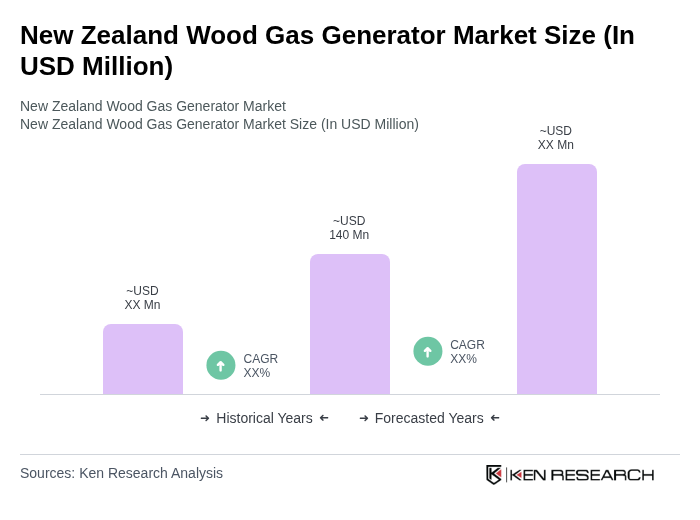
- The New Zealand Wood Gas Generator market is valued at USD 140 million, based on a five-year historical analysis. This growth is primarily driven by the increasing demand for renewable energy sources, government initiatives promoting biomass and process heat decarbonisation, and the rising awareness of environmental sustainability among consumers and industries.
- Key cities such as Auckland, Wellington, and Christchurch play a central role in the wider biomass and distributed generation market due to their significant industrial and commercial activities, higher energy demand, and commitment to sustainable energy solutions through local climate and emissions reduction plans. These urban centers have comparatively advanced energy infrastructure, access to forestry and wood-processing supply chains, and policies that support the uptake of renewable and low‑emission heat technologies, which can include wood fuel and gasification systems for suitable applications.
- New Zealand’s bioenergy development is guided by the Bioenergy Association’s “Wood Energy – A Renewable Fuel” framework and the industry-led New Zealand Bioenergy Strategy, which align with national climate policy and encourage increased use of solid biomass (including wood fuels) for heat and power through information, technical standards support, and project facilitation. In parallel, the regulatory environment for biomass and wood-fuelled plant is shaped by instruments such as the Resource Management (National Environmental Standards for Air Quality) Regulations 2004 issued by the Ministry for the Environment, which set emission limits and require resource consents or performance standards for combustion and gasification plant, influencing equipment selection, design, and operation for wood-based energy systems.
New Zealand Wood Gas Generator Market Segmentation
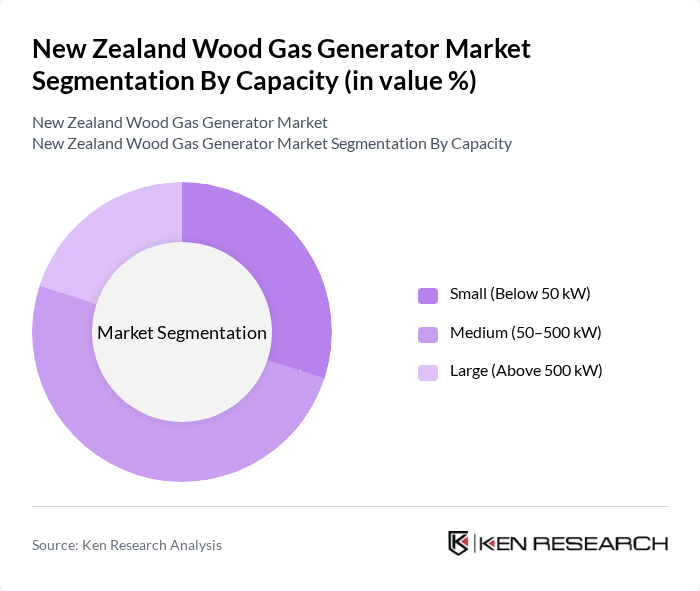
By Capacity:The capacity segmentation includes small (below 50 kW), medium (50–500 kW), and large (above 500 kW) wood gas generators, which is consistent with international market breakdowns for wood gas and small-scale biomass gasification systems. The small capacity segment is gaining traction for off‑grid, rural, and niche commercial uses where secure fuel supply and modular systems are preferred, while medium and large capacities are commonly selected for industrial sites, institutional facilities, and agricultural processing that have steady heat and power demand and on‑site woody biomass streams. The medium segment is particularly important in practice as it often offers a balance between efficiency, capital cost, and ease of integration with existing process heat, combined heat and power, or distributed generation applications.
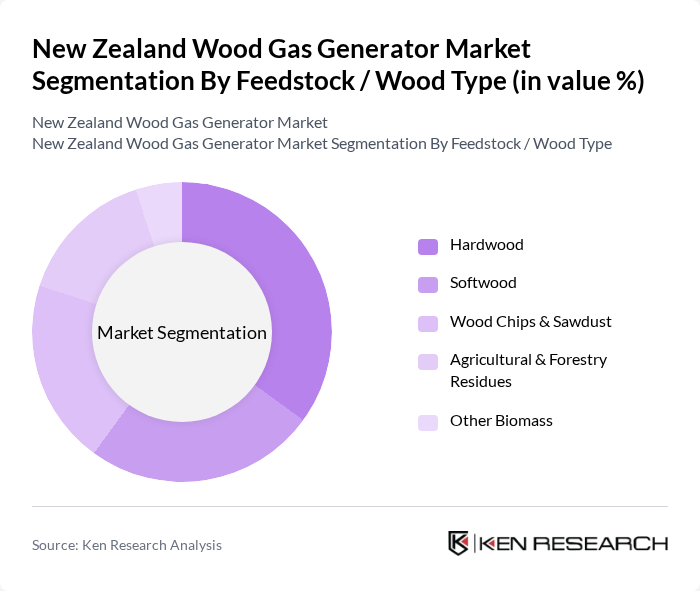
By Feedstock / Wood Type:The feedstock segmentation encompasses hardwood, softwood, wood chips & sawdust, agricultural & forestry residues, and other biomass, which reflects the standard categorisation used in global wood gas generator and biomass gasification studies. Hardwood is often favored for its comparatively high energy content and lower moisture for a given storage regime, while softwood is widely available in New Zealand due to the dominance of radiata pine plantations and the associated sawmilling and processing industry. Wood chips and sawdust are increasingly used because they are a common by‑product of sawmills and wood processing, offering cost‑effective, uniform, and easily handled fuel for automated feed systems. Agricultural and forestry residues, including pruning, thinning residues, bark, and crop by‑products, are gaining popularity as sustainable feedstock options that improve resource utilisation and support emissions reductions from process heat when substituted for fossil fuels.
New Zealand Wood Gas Generator Market Competitive Landscape
The New Zealand Wood Gas Generator Market is characterized by a dynamic mix of regional and international players within the broader biomass, distributed generation, and process heat markets. Leading participants such as Genesis Energy Limited, Contact Energy Limited, Meridian Energy Limited, Mercury NZ Limited, Vector Limited, Powerco Limited, Top Energy Limited, Unison Networks Limited, Pioneer Energy Limited, TerraPower New Zealand / Local Biomass Project Developers, Bioenergy Association of New Zealand (BANZ), Energy Efficiency and Conservation Authority (EECA), New Zealand Wood Energy Interest Group / UseWoodFuel.org Members, Regional Forestry & Wood Processing Companies (Key Feedstock Suppliers), International Wood Gas Technology Providers Active in New Zealand contribute to innovation, geographic expansion, and service delivery in this space.
New Zealand Wood Gas Generator Market Industry Analysis
Growth Drivers
- Increasing Demand for Renewable Energy Sources:The New Zealand government aims to achieve 100% renewable electricity generation in future, driving the demand for wood gas generators. In future, the renewable energy sector is projected to contribute NZD 9.8 billion to the economy, reflecting a 15% increase from previous year. This surge is fueled by rising energy costs and a global shift towards sustainable practices, positioning wood gas generators as a viable solution for energy production in both urban and rural settings.
- Government Incentives for Sustainable Energy Solutions:The New Zealand government has allocated NZD 1.5 billion in subsidies and grants for renewable energy projects in future. These incentives are designed to encourage the adoption of technologies like wood gas generators, which can significantly reduce carbon emissions. With a focus on achieving emission reduction targets, these financial supports are expected to enhance market growth and attract investments in the wood gas sector, fostering innovation and development.
- Technological Advancements in Gasification Processes:Innovations in gasification technology have improved the efficiency of wood gas generators, making them more attractive to consumers. In future, advancements are expected to increase energy conversion efficiency by 25%, reducing operational costs. This technological progress is supported by a NZD 600 million investment in clean technology research, which aims to enhance the performance and reliability of biomass energy systems, further driving market adoption.
Market Challenges
- High Initial Investment Costs:The upfront costs associated with wood gas generator installations can be prohibitive, often exceeding NZD 120,000 for small-scale systems. This financial barrier limits accessibility for many potential users, particularly in rural areas where budgets are constrained. As a result, despite the long-term savings on energy bills, the initial investment remains a significant challenge for widespread adoption of wood gas technology in New Zealand.
- Limited Consumer Awareness and Education:A significant portion of the New Zealand population remains unaware of the benefits and functionalities of wood gas generators. In future, surveys indicate that only 35% of consumers are familiar with biomass energy solutions. This lack of awareness hampers market growth, as potential users may not recognize the advantages of switching to renewable energy sources, necessitating targeted educational campaigns to inform and engage the public.
New Zealand Wood Gas Generator Market Future Outlook
The future of the New Zealand wood gas generator market appears promising, driven by increasing investments in clean technology and a strong governmental push towards renewable energy. As the country strives for energy independence, decentralized energy production is gaining traction, allowing communities to harness local biomass resources. Additionally, the integration of smart grid technologies is expected to enhance the efficiency and reliability of energy systems, further supporting the growth of wood gas generators in the coming years.
Market Opportunities
- Expansion into Rural and Remote Areas:There is a significant opportunity to deploy wood gas generators in rural regions, where access to traditional energy sources is limited. With approximately 25% of New Zealand's population living in these areas, targeted initiatives can enhance energy access and sustainability, potentially impacting over 1.2 million residents in future.
- Development of Hybrid Energy Systems:The integration of wood gas generators with other renewable technologies, such as solar and wind, presents a lucrative opportunity. Hybrid systems can optimize energy production and reliability, catering to diverse energy needs. This approach is expected to attract investments exceeding NZD 400 million in future, enhancing the overall resilience of New Zealand's energy infrastructure.
Scope of the Report
| Segment | Sub-Segments |
|---|---|
| By Capacity | Small (Below 50 kW) Medium (50–500 kW) Large (Above 500 kW) |
| By Feedstock / Wood Type | Hardwood Softwood Wood Chips & Sawdust Agricultural & Forestry Residues Other Biomass |
| By Technology | Updraft Gasifiers Downdraft Gasifiers Fluidized-bed Gasifiers Fixed-bed Gasifiers (Other) |
| By Application | Residential Commercial Industrial Farm and Rural Microgrid |
| By End-Use | Electricity Generation Heat / CHP (Combined Heat & Power) Biofuel / Syngas for Transportation & Process Use |
| By Ownership / Investment Model | Utility-owned Independent Power Producer (IPP) Community / Iwi-owned Projects Industrial Captive Plants |
| By Region (New Zealand) | North Island South Island |
Key Target Audience
Investors and Venture Capitalist Firms
Government and Regulatory Bodies (e.g., Ministry of Business, Innovation and Employment)
Manufacturers and Producers
Distributors and Retailers
Energy Sector Stakeholders
Environmental NGOs and Advocacy Groups
Utility Companies
Local Government Authorities
Players Mentioned in the Report:
Genesis Energy Limited
Contact Energy Limited
Meridian Energy Limited
Mercury NZ Limited
Vector Limited
Powerco Limited
Top Energy Limited
Unison Networks Limited
Pioneer Energy Limited
TerraPower New Zealand / Local Biomass Project Developers
Bioenergy Association of New Zealand (BANZ)
Energy Efficiency and Conservation Authority (EECA)
New Zealand Wood Energy Interest Group / UseWoodFuel.org Members
Regional Forestry & Wood Processing Companies (Key Feedstock Suppliers)
International Wood Gas Technology Providers Active in New Zealand
Table of Contents
Market Assessment Phase
1. Executive Summary and Approach
2. New Zealand Wood Gas Generator Market Overview
2.1 Key Insights and Strategic Recommendations
2.2 New Zealand Wood Gas Generator Market Overview
2.3 Definition and Scope
2.4 Evolution of Market Ecosystem
2.5 Timeline of Key Regulatory Milestones
2.6 Value Chain & Stakeholder Mapping
2.7 Business Cycle Analysis
2.8 Policy & Incentive Landscape
3. New Zealand Wood Gas Generator Market Analysis
3.1 Growth Drivers
3.1.1 Increasing demand for renewable energy sources
3.1.2 Government incentives for sustainable energy solutions
3.1.3 Rising awareness of environmental benefits
3.1.4 Technological advancements in gasification processes
3.2 Market Challenges
3.2.1 High initial investment costs
3.2.2 Limited consumer awareness and education
3.2.3 Regulatory hurdles and compliance issues
3.2.4 Competition from alternative energy sources
3.3 Market Opportunities
3.3.1 Expansion into rural and remote areas
3.3.2 Development of hybrid energy systems
3.3.3 Partnerships with local governments and NGOs
3.3.4 Innovations in biomass feedstock utilization
3.4 Market Trends
3.4.1 Growing investment in clean technology
3.4.2 Shift towards decentralized energy production
3.4.3 Increasing focus on energy independence
3.4.4 Adoption of smart grid technologies
3.5 Government Regulation
3.5.1 Emission reduction targets
3.5.2 Renewable Energy Act provisions
3.5.3 Subsidies for biomass energy projects
3.5.4 Compliance with environmental standards
4. SWOT Analysis
5. Stakeholder Analysis
6. Porter's Five Forces Analysis
7. New Zealand Wood Gas Generator Market Market Size, 2019-2024
7.1 By Value
7.2 By Volume
7.3 By Average Selling Price
8. New Zealand Wood Gas Generator Market Segmentation
8.1 By Capacity
8.1.1 Small (Below 50 kW)
8.1.2 Medium (50–500 kW)
8.1.3 Large (Above 500 kW)
8.2 By Feedstock / Wood Type
8.2.1 Hardwood
8.2.2 Softwood
8.2.3 Wood Chips & Sawdust
8.2.4 Agricultural & Forestry Residues
8.2.5 Other Biomass
8.3 By Technology
8.3.1 Updraft Gasifiers
8.3.2 Downdraft Gasifiers
8.3.3 Fluidized-bed Gasifiers
8.3.4 Fixed-bed Gasifiers (Other)
8.4 By Application
8.4.1 Residential
8.4.2 Commercial
8.4.3 Industrial
8.4.4 Farm and Rural Microgrid
8.5 By End-Use
8.5.1 Electricity Generation
8.5.2 Heat / CHP (Combined Heat & Power)
8.5.3 Biofuel / Syngas for Transportation & Process Use
8.6 By Ownership / Investment Model
8.6.1 Utility-owned
8.6.2 Independent Power Producer (IPP)
8.6.3 Community / Iwi-owned Projects
8.6.4 Industrial Captive Plants
8.7 By Region (New Zealand)
8.7.1 North Island
8.7.2 South Island
9. New Zealand Wood Gas Generator Market Competitive Analysis
9.1 Market Share of Key Players
9.2 Cross Comparison of Key Players
9.2.1 Company Name
9.2.2 Installed Wood Gas Generator Capacity (kW / MW)
9.2.3 Revenue from Wood Gas / Biomass Generation (NZD, CAGR)
9.2.4 Project Pipeline and Order Backlog (Number of Plants / MW)
9.2.5 Capacity Utilization Rate (%)
9.2.6 Levelized Cost of Energy (LCOE) from Wood Gas (NZD/kWh)
9.2.7 EBITDA Margin from Biomass / Wood Gas Assets (%)
9.2.8 Payback Period for Recent Wood Gas Projects (Years)
9.2.9 R&D and Capex Intensity (% of Revenue)
9.2.10 Share of Renewable / Biomass in Total Generation Mix (%)
9.3 SWOT Analysis of Top Players
9.4 Pricing Analysis
9.5 Detailed Profile of Major Companies
9.5.1 Genesis Energy Limited
9.5.2 Contact Energy Limited
9.5.3 Meridian Energy Limited
9.5.4 Mercury NZ Limited
9.5.5 Vector Limited
9.5.6 Powerco Limited
9.5.7 Top Energy Limited
9.5.8 Unison Networks Limited
9.5.9 Pioneer Energy Limited
9.5.10 TerraPower New Zealand / Local Biomass Project Developers
9.5.11 Bioenergy Association of New Zealand (BANZ)
9.5.12 Energy Efficiency and Conservation Authority (EECA)
9.5.13 New Zealand Wood Energy Interest Group / UseWoodFuel.org Members
9.5.14 Regional Forestry & Wood Processing Companies (Key Feedstock Suppliers)
9.5.15 International Wood Gas Technology Providers Active in New Zealand
10. New Zealand Wood Gas Generator Market End-User Analysis
10.1 Procurement Behavior of Key Ministries
10.1.1 Energy procurement strategies
10.1.2 Budget allocation for renewable projects
10.1.3 Collaboration with private sector
10.1.4 Compliance with sustainability goals
10.2 Corporate Spend on Infrastructure & Energy
10.2.1 Investment in renewable energy infrastructure
10.2.2 Budget trends for energy projects
10.2.3 Corporate sustainability initiatives
10.2.4 Energy efficiency programs
10.3 Pain Point Analysis by End-User Category
10.3.1 Cost of energy production
10.3.2 Reliability of energy supply
10.3.3 Regulatory compliance challenges
10.3.4 Access to financing
10.4 User Readiness for Adoption
10.4.1 Awareness of wood gas technology
10.4.2 Perceived benefits of adoption
10.4.3 Training and support needs
10.4.4 Financial incentives for adoption
10.5 Post-Deployment ROI and Use Case Expansion
10.5.1 Measurement of energy savings
10.5.2 Expansion into new applications
10.5.3 Long-term sustainability assessments
10.5.4 User feedback and improvement cycles
11. New Zealand Wood Gas Generator Market Future Size, 2025-2030
11.1 By Value
11.2 By Volume
11.3 By Average Selling Price
Go-To-Market Strategy Phase
1. Whitespace Analysis + Business Model Canvas
1.1 Market gaps identification
1.2 Value proposition development
1.3 Revenue model exploration
1.4 Customer segment targeting
1.5 Competitive landscape analysis
1.6 Key partnerships identification
1.7 Risk assessment
2. Marketing and Positioning Recommendations
2.1 Branding strategies
2.2 Product USPs
2.3 Target audience engagement
2.4 Digital marketing tactics
2.5 Offline marketing strategies
2.6 Customer feedback integration
2.7 Performance metrics
3. Distribution Plan
3.1 Urban retail vs rural NGO tie-ups
3.2 Distribution channel optimization
3.3 Logistics and supply chain management
3.4 Partnership with local distributors
3.5 E-commerce strategies
3.6 Inventory management
3.7 Customer service integration
4. Channel & Pricing Gaps
4.1 Underserved routes
4.2 Pricing bands
4.3 Competitor pricing analysis
4.4 Value-based pricing strategies
4.5 Discount and promotion strategies
4.6 Price elasticity assessment
4.7 Customer willingness to pay
5. Unmet Demand & Latent Needs
5.1 Category gaps
5.2 Consumer segments
5.3 Product feature enhancements
5.4 Service improvements
5.5 Market entry barriers
5.6 Customer education needs
5.7 Future trends anticipation
6. Customer Relationship
6.1 Loyalty programs
6.2 After-sales service
6.3 Customer engagement strategies
6.4 Feedback loops
6.5 Community building initiatives
6.6 Customer support systems
6.7 Relationship management tools
7. Value Proposition
7.1 Sustainability
7.2 Integrated supply chains
7.3 Cost savings
7.4 Enhanced energy security
7.5 Customer-centric solutions
7.6 Innovation-driven offerings
7.7 Long-term partnerships
8. Key Activities
8.1 Regulatory compliance
8.2 Branding
8.3 Distribution setup
8.4 Market research
8.5 Training and development
8.6 Performance monitoring
8.7 Stakeholder engagement
9. Entry Strategy Evaluation
9.1 Domestic Market Entry Strategy
9.1.1 Product mix
9.1.2 Pricing band
9.1.3 Packaging
9.2 Export Entry Strategy
9.2.1 Target countries
9.2.2 Compliance roadmap
10. Entry Mode Assessment
10.1 Joint Ventures
10.2 Greenfield Investments
10.3 Mergers & Acquisitions
10.4 Distributor Model
11. Capital and Timeline Estimation
11.1 Capital requirements
11.2 Timelines
12. Control vs Risk Trade-Off
12.1 Ownership vs Partnerships
13. Profitability Outlook
13.1 Breakeven analysis
13.2 Long-term sustainability
14. Potential Partner List
14.1 Distributors
14.2 Joint Ventures
14.3 Acquisition targets
15. Execution Roadmap
15.1 Phased Plan for Market Entry
15.1.1 Market Setup
15.1.2 Market Entry
15.1.3 Growth Acceleration
15.1.4 Scale & Stabilize
15.2 Key Activities and Milestones
15.2.1 Milestone tracking
15.2.2 Activity scheduling
15.2.3 Resource allocation
Research Methodology
Phase 1: Approach1
Desk Research
- Analysis of industry reports from New Zealand's Ministry of Business, Innovation and Employment
- Review of academic publications and case studies on wood gasification technologies
- Examination of market trends and forecasts from local environmental agencies and energy organizations
Primary Research
- Interviews with key stakeholders in the wood gas generator supply chain, including manufacturers and distributors
- Surveys conducted with end-users such as agricultural businesses and energy producers
- Field visits to operational sites utilizing wood gas generators to gather firsthand insights
Validation & Triangulation
- Cross-validation of findings through multiple data sources, including government publications and industry insights
- Triangulation of market data with expert opinions from industry conferences and workshops
- Sanity checks through feedback from a panel of experts in renewable energy and biomass technologies
Phase 2: Market Size Estimation1
Top-down Assessment
- Estimation of the total addressable market based on national energy consumption statistics
- Segmentation of the market by application areas such as residential, commercial, and industrial usage
- Incorporation of government incentives and policies promoting renewable energy adoption
Bottom-up Modeling
- Collection of sales data from leading wood gas generator manufacturers in New Zealand
- Estimation of market penetration rates based on historical sales trends and growth rates
- Calculation of revenue projections based on average selling prices and expected unit sales
Forecasting & Scenario Analysis
- Development of forecasting models using historical data and projected growth rates in renewable energy
- Scenario analysis based on varying levels of government support and market adoption rates
- Creation of baseline, optimistic, and pessimistic forecasts through 2030
Phase 3: CATI Sample Composition1
| Scope Item/Segment | Sample Size | Target Respondent Profiles |
|---|---|---|
| Residential Wood Gas Generator Users | 60 | Homeowners, Renewable Energy Enthusiasts |
| Commercial Energy Producers | 50 | Energy Managers, Facility Operators |
| Agricultural Sector Implementers | 40 | Farm Owners, Agricultural Engineers |
| Government Policy Makers | 40 | Energy Policy Analysts, Environmental Regulators |
| Industry Experts and Consultants | 40 | Renewable Energy Consultants, Market Analysts |
Frequently Asked Questions
What is the current value of the New Zealand Wood Gas Generator market?
The New Zealand Wood Gas Generator market is valued at approximately USD 140 million, reflecting a growing demand for renewable energy sources and government initiatives aimed at promoting biomass and decarbonisation of process heat.
What are the key drivers of growth in the New Zealand Wood Gas Generator market?
Which cities in New Zealand are central to the Wood Gas Generator market?
What types of wood gas generators are available in New Zealand?
Other Regional/Country Reports
Other Adjacent Reports
Kuwait Biomass Energy Market
UAE Bioenergy MarketKSA Europe Renewable Energy MarketThailand Gasification Technology Market
Egypt Forestry Products Market
Singapore Wood Processing Market
Qatar Distributed Generation Market
South Africa Combined Heat and Power Market
Indonesia Waste-to-Energy Market
Mexico Sustainable Heating Market
Why Buy From Us?

What makes us stand out is that our consultants follow Robust, Refine and Result (RRR) methodology. Robust for clear definitions, approaches and sanity checking, Refine for differentiating respondents' facts and opinions, and Result for presenting data with story.

We have set a benchmark in the industry by offering our clients with syndicated and customized market research reports featuring coverage of entire market as well as meticulous research and analyst insights.

While we don't replace traditional research, we flip the method upside down. Our dual approach of Top Bottom & Bottom Top ensures quality deliverable by not just verifying company fundamentals but also looking at the sector and macroeconomic factors.

With one step in the future, our research team constantly tries to show you the bigger picture. We help with some of the tough questions you may encounter along the way: How is the industry positioned? Best marketing channel? KPI's of competitors? By aligning every element, we help maximize success.

Our report gives you instant access to the answers and sources that other companies might choose to hide. We elaborate each steps of research methodology we have used and showcase you the sample size to earn your trust.

If you need any support, we are here! We pride ourselves on universe strength, data quality, and quick, friendly, and professional service.