About the Report
Base Year 2024Nigeria Petrol Station Market Overview
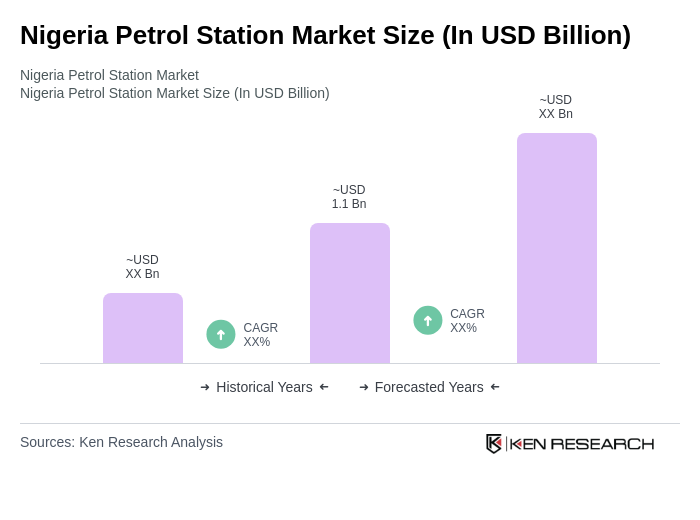
- The Nigeria Petrol Station Market is valued at USD 1.1 billion, based on a five-year historical analysis. This level aligns with third-party industry estimates that place the current market in the mid-hundreds of millions to low billions range, rather than in the tens of billions. Key demand drivers include rising vehicle ownership, urbanization, and road-network expansion that sustain retail fuel sales through major oil marketers, NNPC Retail, and independents .
- Key cities such as Lagos, Abuja, and Port Harcourt dominate retail fuel sales due to high population density, higher per-capita incomes, and their roles as commercial and logistics hubs with heavy traffic on major corridors, concentrating petrol stations and throughput in these urban markets .
- The Petroleum Industry Act (PIA) is the sector’s foundational reform, designed to enhance transparency, market efficiency, and investment across downstream operations, including retail. While implementation milestones have continued, the PIA itself is the governing framework guiding deregulation steps, licensing, and competitive dynamics that influence petrol station operations and supply security .
Nigeria Petrol Station Market Segmentation
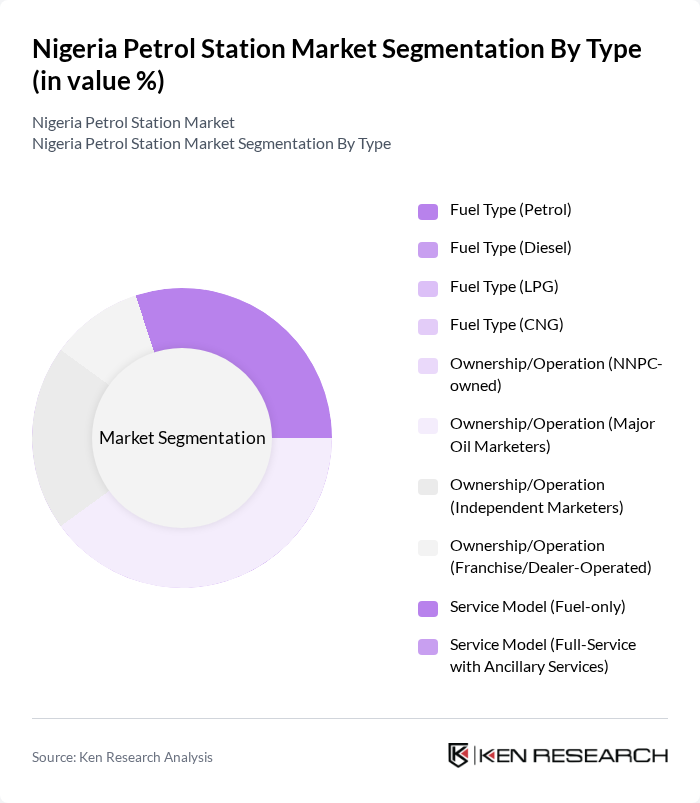
By Type:The market is segmented into fuel type, ownership/operation, and service model. Petrol (PMS) and diesel (AGO) remain the most commonly sold fuels at forecourts, with LPG and emerging CNG supplied at a smaller, growing base from select sites. Ownership/operation includes NNPC-branded outlets, major oil marketers, and a large population of independent marketers, with franchise/dealer-operated models prevalent across networks. Service models include fuel-only sites and full-service stations with convenience retail and ancillary services, increasingly important for margins and customer retention .
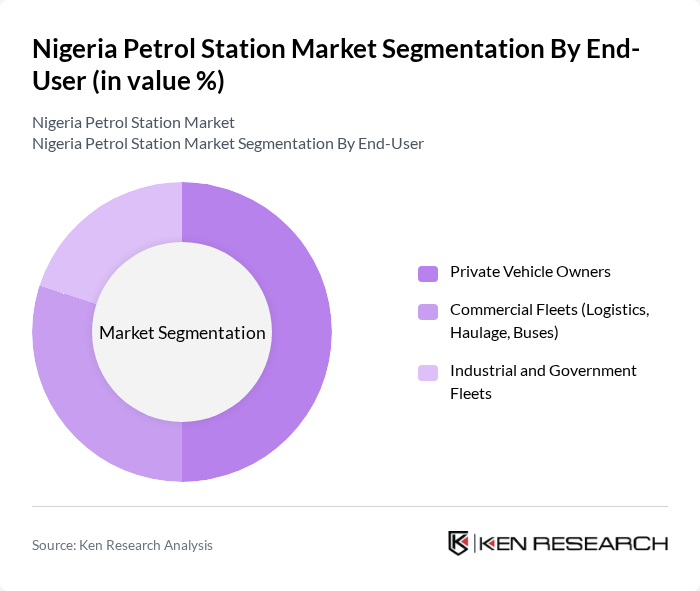
By End-User:The end-user segmentation includes private vehicle owners, commercial fleets, and industrial/government fleets. Private motorists account for a large share of PMS demand, while commercial fleets (logistics, haulage, buses) drive significant diesel sales; industrial and government users contribute materially via bulk purchases and fleet fueling, reflecting Nigeria’s road-transport–heavy energy use profile .
Nigeria Petrol Station Market Competitive Landscape
The Nigeria Petrol Station Market is characterized by a mix of international majors, NNPC-branded outlets, and strong local independents. Leading participants include TotalEnergies Marketing Nigeria Plc, 11 Plc (formerly Mobil Oil Nigeria Plc brand on forecourts), Oando Plc, Conoil Plc, NNPC Retail Limited, Ardova Plc, Eterna Plc, MRS Oil Nigeria Plc, Rainoil Limited, NIPCO Plc, Aiteo Group, Sahara Group (Asharami Synergy Plc), Matrix Energy Group, Pinnacle Oil and Gas Limited, and Northwest Petroleum & Gas Company Limited.
Nigeria Petrol Station Market Industry Analysis
Growth Drivers
- Increasing Vehicle Ownership:Nigeria's vehicle ownership has surged, with over 12 million registered vehicles as of in future, reflecting a growth rate of approximately 5% annually. This increase is driven by rising disposable incomes and urban migration, leading to greater demand for fuel. The World Bank projects that Nigeria's GDP will grow by 3.4% in future, further boosting vehicle purchases and, consequently, fuel consumption at petrol stations across the country.
- Urbanization and Infrastructure Development:Nigeria's urban population is expected to reach 60% in future, up from 50% in future. This rapid urbanization is accompanied by significant infrastructure investments, including road expansions and new transport networks. The Nigerian government allocated ?1.5 trillion (approximately $3.6 billion) for infrastructure development in future, enhancing access to petrol stations and increasing fuel demand as urban centers expand and vehicle usage rises.
- Government Investment in Energy Sector:The Nigerian government has committed over ?1 trillion (around $2.4 billion) to the energy sector in future, focusing on improving fuel supply chains and refining capacity. This investment aims to stabilize fuel availability and reduce shortages, which have plagued the market. Enhanced energy infrastructure will support petrol stations, ensuring they meet the rising fuel demand driven by increased vehicle ownership and urbanization.
Market Challenges
- Fuel Price Volatility:Fuel prices in Nigeria have fluctuated significantly, with the average price per liter reaching ?450 ($1.08) in early future, up from ?350 ($0.84) in future. This volatility is primarily due to global oil price changes and local currency depreciation. Such instability affects profit margins for petrol stations, making it challenging for operators to maintain consistent pricing and manage operational costs effectively.
- Regulatory Compliance Issues:The Nigerian petrol station market faces stringent regulatory requirements, including environmental compliance and safety standards. In future, the government plans to increase inspections, with over 1,000 compliance checks expected nationwide. Non-compliance can lead to hefty fines, operational shutdowns, and reputational damage, creating a challenging environment for petrol station operators who must navigate complex regulations while ensuring profitability.
Nigeria Petrol Station Market Future Outlook
The future of the Nigeria petrol station market appears promising, driven by increasing vehicle ownership and urbanization. As the government invests in energy infrastructure, petrol stations will likely see improved supply chains and reduced shortages. Additionally, the shift towards cleaner fuels and digital payment solutions will enhance customer experiences. Strategic partnerships with local businesses can further bolster market resilience, ensuring that petrol stations adapt to evolving consumer preferences and regulatory landscapes in the coming years.
Market Opportunities
- Expansion of Retail Fuel Outlets:With urbanization on the rise, there is a significant opportunity for expanding retail fuel outlets. The Nigerian government’s infrastructure investments will facilitate the establishment of new petrol stations in underserved areas, potentially increasing market penetration and accessibility for consumers, thereby driving sales growth.
- Adoption of Renewable Energy Solutions:The growing emphasis on sustainability presents an opportunity for petrol stations to adopt renewable energy solutions, such as solar power. By integrating solar panels, petrol stations can reduce operational costs and appeal to environmentally conscious consumers, positioning themselves favorably in a competitive market landscape.
Scope of the Report
| Segment | Sub-Segments |
|---|---|
| By Type | Fuel Type (Petrol, Diesel, LPG, CNG) Ownership/Operation (NNPC-owned, Major Oil Marketers, Independent Marketers, Franchise/Dealer-Operated) Service Model (Fuel-only, Full-Service with Ancillary Services) |
| By End-User | Private Vehicle Owners Commercial Fleets (Logistics, Haulage, Buses) Industrial and Government Fleets |
| By Location | Urban Corridors (e.g., Lagos, Abuja, Port Harcourt) Highway/Intercity Corridors Semi-urban and Rural Areas |
| By Service Offering | Convenience Retail (C-store, ATM, POS) Vehicle Services (Car Wash, Lube/Quick Service, Tyre/Battery) Foodservice/QSR Co-locations Alternative Energy Add-ons (LPG Autogas, CNG, Solar Power for Site) |
| By Brand Affiliation | Major Oil Marketers (e.g., TotalEnergies, Mobil, Conoil, MRS, Oando) NNPC Retail Independent/Unbranded Stations |
| By Transaction Method | Cash Cards/POS Mobile/USSD and Fleet Cards |
| By Market Channel | Walk-in/Retail B2B & Fleet Contracts Partnerships with Ride-Hailing/Logistics Platforms |
Key Target Audience
Investors and Venture Capitalist Firms
Government and Regulatory Bodies (e.g., Nigerian National Petroleum Corporation, Department of Petroleum Resources)
Oil and Gas Exploration Companies
Fuel Distribution Companies
Petrol Station Franchise Operators
Logistics and Supply Chain Companies
Environmental Regulatory Agencies (e.g., National Environmental Standards and Regulations Enforcement Agency)
Financial Institutions and Banks
Players Mentioned in the Report:
TotalEnergies Marketing Nigeria Plc
Mobil Oil Nigeria Plc (now 11 Plc/ExxonMobil fuels brand legacy)
Oando Plc
Conoil Plc
NNPC Retail Limited
Ardova Plc (formerly Forte Oil Plc)
Eterna Plc
MRS Oil Nigeria Plc
Rainoil Limited
NIPCO Plc
Aiteo Group
Sahara Group (Asharami Synergy Plc)
Matrix Energy Group
Pinnacle Oil and Gas Limited
Northwest Petroleum & Gas Company Limited
Table of Contents
Market Assessment Phase
1. Executive Summary and Approach
2. Nigeria Petrol Station Market Overview
2.1 Key Insights and Strategic Recommendations
2.2 Nigeria Petrol Station Market Overview
2.3 Definition and Scope
2.4 Evolution of Market Ecosystem
2.5 Timeline of Key Regulatory Milestones
2.6 Value Chain & Stakeholder Mapping
2.7 Business Cycle Analysis
2.8 Policy & Incentive Landscape
3. Nigeria Petrol Station Market Analysis
3.1 Growth Drivers
3.1.1 Increasing Vehicle Ownership
3.1.2 Urbanization and Infrastructure Development
3.1.3 Government Investment in Energy Sector
3.1.4 Rising Fuel Demand
3.2 Market Challenges
3.2.1 Fuel Price Volatility
3.2.2 Regulatory Compliance Issues
3.2.3 Infrastructure Deficiencies
3.2.4 Competition from Alternative Fuels
3.3 Market Opportunities
3.3.1 Expansion of Retail Fuel Outlets
3.3.2 Adoption of Renewable Energy Solutions
3.3.3 Technological Advancements in Fuel Distribution
3.3.4 Strategic Partnerships with Local Businesses
3.4 Market Trends
3.4.1 Shift Towards Cleaner Fuels
3.4.2 Digital Payment Solutions in Fuel Transactions
3.4.3 Enhanced Customer Experience Initiatives
3.4.4 Integration of Convenience Retailing
3.5 Government Regulation
3.5.1 Fuel Pricing Regulations
3.5.2 Environmental Compliance Standards
3.5.3 Licensing and Operational Permits
3.5.4 Safety and Quality Control Regulations
4. SWOT Analysis
5. Stakeholder Analysis
6. Porter's Five Forces Analysis
7. Nigeria Petrol Station Market Market Size, 2019-2024
7.1 By Value
7.2 By Volume
7.3 By Average Selling Price
8. Nigeria Petrol Station Market Segmentation
8.1 By Type
8.1.1 Fuel Type (Petrol, Diesel, LPG, CNG)
8.1.2 Ownership/Operation (NNPC-owned, Major Oil Marketers, Independent Marketers, Franchise/Dealer-Operated)
8.1.3 Service Model (Fuel-only, Full-Service with Ancillary Services)
8.2 By End-User
8.2.1 Private Vehicle Owners
8.2.2 Commercial Fleets (Logistics, Haulage, Buses)
8.2.3 Industrial and Government Fleets
8.3 By Location
8.3.1 Urban Corridors (e.g., Lagos, Abuja, Port Harcourt)
8.3.2 Highway/Intercity Corridors
8.3.3 Semi-urban and Rural Areas
8.4 By Service Offering
8.4.1 Convenience Retail (C-store, ATM, POS)
8.4.2 Vehicle Services (Car Wash, Lube/Quick Service, Tyre/Battery)
8.4.3 Foodservice/QSR Co-locations
8.4.4 Alternative Energy Add-ons (LPG Autogas, CNG, Solar Power for Site)
8.5 By Brand Affiliation
8.5.1 Major Oil Marketers (e.g., TotalEnergies, Mobil, Conoil, MRS, Oando)
8.5.2 NNPC Retail
8.5.3 Independent/Unbranded Stations
8.6 By Transaction Method
8.6.1 Cash
8.6.2 Cards/POS
8.6.3 Mobile/USSD and Fleet Cards
8.7 By Market Channel
8.7.1 Walk-in/Retail
8.7.2 B2B & Fleet Contracts
8.7.3 Partnerships with Ride-Hailing/Logistics Platforms
9. Nigeria Petrol Station Market Competitive Analysis
9.1 Market Share of Key Players
9.2 Cross Comparison of Key Players
9.2.1 Company Name
9.2.2 Network Size (Number of Stations)
9.2.3 Annual Fuel Throughput (Million Liters)
9.2.4 Geographic Coverage (States/Key Corridors)
9.2.5 Non-Fuel Revenue Share (% of Site Sales)
9.2.6 Average Daily Transactions per Site
9.2.7 Supply Security (Own Depot/Import Capability, Contracted Supply)
9.2.8 Pricing & Loyalty (Pump Price Positioning, Loyalty/Fleet Programs)
9.2.9 Operational Uptime (% Nozzle Availability, Out-of-Stock Incidents)
9.2.10 Safety/Compliance Record (HSE Incidents, DPR/NMDPRA Compliance)
9.2.11 Growth Indicators (New Sites per Year, Capex per Site)
9.3 SWOT Analysis of Top Players
9.4 Pricing Analysis
9.5 Detailed Profile of Major Companies
9.5.1 TotalEnergies Marketing Nigeria Plc
9.5.2 Mobil Oil Nigeria Plc (now 11 Plc/ExxonMobil fuels brand legacy)
9.5.3 Oando Plc
9.5.4 Conoil Plc
9.5.5 NNPC Retail Limited
9.5.6 Ardova Plc (formerly Forte Oil Plc)
9.5.7 Eterna Plc
9.5.8 MRS Oil Nigeria Plc
9.5.9 Rainoil Limited
9.5.10 NIPCO Plc
9.5.11 Aiteo Group
9.5.12 Sahara Group (Asharami Synergy Plc)
9.5.13 Matrix Energy Group
9.5.14 Pinnacle Oil and Gas Limited
9.5.15 Northwest Petroleum & Gas Company Limited
10. Nigeria Petrol Station Market End-User Analysis
10.1 Procurement Behavior of Key Ministries
10.1.1 Fuel Procurement Policies
10.1.2 Budget Allocation for Fuel
10.1.3 Supplier Selection Criteria
10.2 Corporate Spend on Infrastructure & Energy
10.2.1 Investment in Fuel Infrastructure
10.2.2 Energy Efficiency Initiatives
10.2.3 Budgeting for Fuel Costs
10.3 Pain Point Analysis by End-User Category
10.3.1 Fuel Accessibility Issues
10.3.2 Pricing Concerns
10.3.3 Quality of Service
10.4 User Readiness for Adoption
10.4.1 Awareness of Fuel Options
10.4.2 Acceptance of New Payment Methods
10.4.3 Readiness for Alternative Fuels
10.5 Post-Deployment ROI and Use Case Expansion
10.5.1 Evaluation of Fuel Efficiency
10.5.2 Cost Savings Analysis
10.5.3 Expansion of Service Offerings
11. Nigeria Petrol Station Market Future Size, 2025-2030
11.1 By Value
11.2 By Volume
11.3 By Average Selling Price
Go-To-Market Strategy Phase
1. Whitespace Analysis + Business Model Canvas
1.1 Market Gaps Identification
1.2 Value Proposition Development
1.3 Revenue Streams Analysis
1.4 Cost Structure Evaluation
1.5 Key Partnerships Exploration
1.6 Customer Segmentation
1.7 Channels of Distribution
2. Marketing and Positioning Recommendations
2.1 Branding Strategies
2.2 Product USPs
2.3 Target Audience Identification
2.4 Communication Strategy
2.5 Digital Marketing Approaches
3. Distribution Plan
3.1 Urban Retail Strategies
3.2 Rural NGO Tie-Ups
3.3 Logistics and Supply Chain Management
3.4 Distribution Partnerships
4. Channel & Pricing Gaps
4.1 Underserved Routes Analysis
4.2 Pricing Bands Evaluation
4.3 Competitive Pricing Strategies
5. Unmet Demand & Latent Needs
5.1 Category Gaps Identification
5.2 Consumer Segments Analysis
5.3 Emerging Trends Exploration
6. Customer Relationship
6.1 Loyalty Programs Development
6.2 After-Sales Service Strategies
6.3 Customer Feedback Mechanisms
7. Value Proposition
7.1 Sustainability Initiatives
7.2 Integrated Supply Chains
7.3 Customer-Centric Offerings
8. Key Activities
8.1 Regulatory Compliance
8.2 Branding Initiatives
8.3 Distribution Setup
9. Entry Strategy Evaluation
9.1 Domestic Market Entry Strategy
9.1.1 Product Mix Considerations
9.1.2 Pricing Band Strategy
9.1.3 Packaging Innovations
9.2 Export Entry Strategy
9.2.1 Target Countries Identification
9.2.2 Compliance Roadmap Development
10. Entry Mode Assessment
10.1 Joint Ventures
10.2 Greenfield Investments
10.3 Mergers & Acquisitions
10.4 Distributor Model Evaluation
11. Capital and Timeline Estimation
11.1 Capital Requirements Analysis
11.2 Timelines for Implementation
12. Control vs Risk Trade-Off
12.1 Ownership vs Partnerships
12.2 Risk Management Strategies
13. Profitability Outlook
13.1 Breakeven Analysis
13.2 Long-Term Sustainability Strategies
14. Potential Partner List
14.1 Distributors Identification
14.2 Joint Ventures Opportunities
14.3 Acquisition Targets
15. Execution Roadmap
15.1 Phased Plan for Market Entry
15.1.1 Market Setup
15.1.2 Market Entry
15.1.3 Growth Acceleration
15.1.4 Scale & Stabilize
15.2 Key Activities and Milestones
15.2.1 Activity Planning
15.2.2 Milestone Tracking
Research Methodology
Phase 1: Approach1
Desk Research
- Analysis of industry reports from the Nigerian National Petroleum Corporation (NNPC)
- Review of government publications and policy documents related to fuel pricing and distribution
- Examination of market trends through academic journals and publications focused on the Nigerian energy sector
Primary Research
- Interviews with key stakeholders including petrol station owners and operators
- Surveys conducted with consumers to understand purchasing behavior and preferences
- Field visits to various petrol stations across urban and rural areas to gather firsthand insights
Validation & Triangulation
- Cross-validation of data through multiple sources including trade associations and regulatory bodies
- Triangulation of findings from desk research and primary interviews to ensure consistency
- Sanity checks through expert panel discussions with industry veterans and analysts
Phase 2: Market Size Estimation1
Top-down Assessment
- Estimation of total fuel consumption in Nigeria based on national energy statistics
- Segmentation of the market by fuel type (petrol, diesel, etc.) and geographical distribution
- Incorporation of government policies affecting fuel subsidies and pricing mechanisms
Bottom-up Modeling
- Collection of sales data from a sample of petrol stations to establish average sales volumes
- Operational cost analysis based on fuel procurement and distribution expenses
- Volume x price modeling to estimate revenue generation across different petrol station formats
Forecasting & Scenario Analysis
- Multi-factor regression analysis incorporating economic indicators such as GDP growth and inflation rates
- Scenario planning based on potential regulatory changes and shifts in consumer behavior
- Development of baseline, optimistic, and pessimistic forecasts through 2030
Phase 3: CATI Sample Composition1
| Scope Item/Segment | Sample Size | Target Respondent Profiles |
|---|---|---|
| Urban Petrol Station Operators | 100 | Station Managers, Franchise Owners |
| Rural Petrol Station Owners | 80 | Independent Operators, Local Entrepreneurs |
| Consumer Fuel Purchase Behavior | 120 | Regular Consumers, Fleet Managers |
| Regulatory Impact Assessment | 60 | Government Officials, Policy Analysts |
| Fuel Pricing Strategy Insights | 70 | Financial Analysts, Market Strategists |
Frequently Asked Questions
What is the current value of the Nigeria Petrol Station Market?
The Nigeria Petrol Station Market is valued at approximately USD 1.1 billion, based on a five-year historical analysis. This valuation reflects the market's position within the mid-hundreds of millions to low billions range, driven by factors such as vehicle ownership and urbanization.
What are the key drivers of demand in the Nigeria Petrol Station Market?
Which cities dominate the retail fuel sales in Nigeria?
What is the Petroleum Industry Act (PIA) and its significance?
Other Regional/Country Reports
Indonesia Petrol Station Market
Malaysia Petrol Station Market
KSA Petrol Station Market
APAC Petrol Station Market
SEA Petrol Station Market
Vietnam Petrol Station Market
Why Buy From Us?

What makes us stand out is that our consultants follow Robust, Refine and Result (RRR) methodology. Robust for clear definitions, approaches and sanity checking, Refine for differentiating respondents' facts and opinions, and Result for presenting data with story.

We have set a benchmark in the industry by offering our clients with syndicated and customized market research reports featuring coverage of entire market as well as meticulous research and analyst insights.

While we don't replace traditional research, we flip the method upside down. Our dual approach of Top Bottom & Bottom Top ensures quality deliverable by not just verifying company fundamentals but also looking at the sector and macroeconomic factors.

With one step in the future, our research team constantly tries to show you the bigger picture. We help with some of the tough questions you may encounter along the way: How is the industry positioned? Best marketing channel? KPI's of competitors? By aligning every element, we help maximize success.

Our report gives you instant access to the answers and sources that other companies might choose to hide. We elaborate each steps of research methodology we have used and showcase you the sample size to earn your trust.

If you need any support, we are here! We pride ourselves on universe strength, data quality, and quick, friendly, and professional service.