About the Report
Base Year 2024North America Ecommerce Market Overview
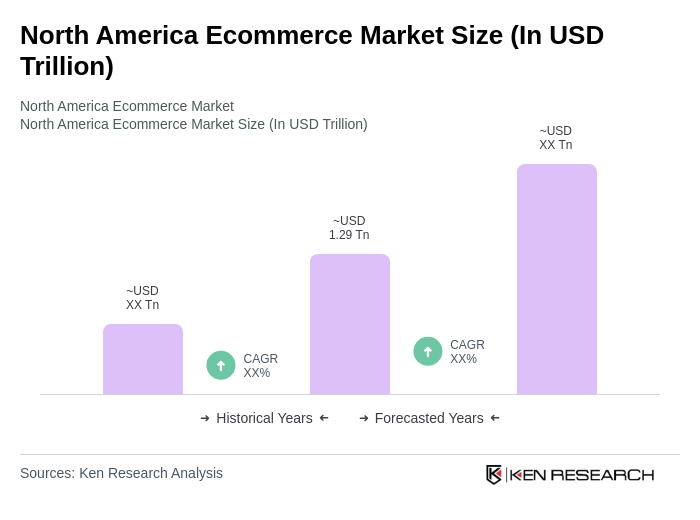
- The North America Ecommerce Market is valued at USD 1.29 trillion, based on a five-year historical analysis. This growth is primarily driven by the increasing penetration of the internet, the rise of mobile commerce, and changing consumer preferences towards online shopping. The convenience of shopping from home, coupled with advancements in payment technologies and logistics, has significantly contributed to the market's expansion.
- The United States and Canada dominate the North American Ecommerce Market due to their advanced technological infrastructure, high disposable incomes, and a strong consumer base that favors online shopping. Major urban centers like New York, Los Angeles, Toronto, and Vancouver serve as key hubs for ecommerce activities, benefiting from a combination of population density and robust logistics networks.
- In 2023, remote-seller tax collection stems from the 2018 Supreme Court ruling in South Dakota v. Wayfair, which enabled states to require out-of-state online sellers to collect sales tax based on economic nexus, regardless of physical presence. This regulation aims to level the playing field between online and brick-and-mortar retailers, ensuring that local businesses are not disadvantaged by the growing trend of online shopping.
North America Ecommerce Market Segmentation
By Type:The ecommerce market can be segmented into various types, including B2C, B2B, C2C, C2B, D2C, and others. Among these, B2C is the most dominant segment, driven by the increasing number of consumers shopping online for convenience and variety. B2B transactions are also significant, as businesses increasingly adopt online platforms for procurement and sales. C2C and D2C models are gaining traction, particularly with the rise of social commerce and direct-to-consumer brands.

By End-User:The ecommerce market is segmented by end-users, including retail consumers, small businesses, large enterprises, and government agencies. Retail consumers represent the largest segment, driven by the convenience of online shopping and the availability of a wide range of products. Small businesses are increasingly leveraging ecommerce platforms to reach broader markets, while large enterprises utilize these channels for both B2B and B2C transactions. Government agencies are also adopting ecommerce solutions for procurement and service delivery.

North America Ecommerce Market Competitive Landscape
The North America Ecommerce Market is characterized by a dynamic mix of regional and international players. Leading participants such as Amazon.com, Inc., Walmart Inc., Apple Inc. (Apple Online Store), eBay Inc., Shopify Inc., Target Corporation, Best Buy Co., Inc., Wayfair Inc., Etsy, Inc., Chewy, Inc., Costco Wholesale Corporation, The Home Depot, Inc., Lowe’s Companies, Inc., Instacart (Maplebear Inc.), Rakuten Group, Inc. (Rakuten.com, Rakuten Rewards) contribute to innovation, geographic expansion, and service delivery in this space.
North America Ecommerce Market Industry Analysis
Growth Drivers
- Increased Internet Penetration:As of in future, approximately 95% of the North American population has access to the internet, translating to over 330 million users. This widespread connectivity has significantly boosted online shopping, with the average consumer spending around $1,300 annually on e-commerce platforms. The rise in internet accessibility, particularly in rural areas, is expected to further enhance e-commerce growth, as more consumers engage in online transactions and explore diverse product offerings.
- Mobile Commerce Growth:In future, mobile commerce is projected to account for nearly $600 billion in sales, representing a substantial increase from previous years. With over 85% of consumers using smartphones for shopping, mobile-optimized websites and apps are crucial for retailers. The convenience of mobile payments and the rise of social media shopping are driving this trend, as consumers increasingly prefer to shop on-the-go, leading to higher conversion rates for e-commerce businesses.
- Enhanced Logistics and Delivery Services:The logistics sector in North America is expected to invest over $120 billion in technology and infrastructure improvements by in future. This investment aims to streamline supply chains and enhance delivery efficiency. Companies like Amazon are setting new standards with same-day delivery options, which are becoming increasingly common. Improved logistics not only reduce delivery times but also enhance customer satisfaction, driving repeat purchases and fostering brand loyalty in the e-commerce space.
Market Challenges
- Cybersecurity Threats:In future, cybercrime is projected to cost North American businesses over $7 trillion, highlighting the significant threat posed to e-commerce platforms. With increasing data breaches and hacking incidents, consumer trust is at risk. E-commerce companies must invest heavily in cybersecurity measures, including encryption and fraud detection systems, to protect sensitive customer information and maintain their competitive edge in the market.
- Intense Competition:The North American e-commerce market is characterized by fierce competition, with over 2.5 million online retailers vying for consumer attention. Major players like Amazon and Walmart dominate, making it challenging for smaller businesses to gain market share. This competitive landscape pressures companies to innovate continuously and offer unique value propositions, which can strain resources and impact profitability, particularly for new entrants in the market.
North America Ecommerce Market Future Outlook
The North American e-commerce market is poised for continued evolution, driven by technological advancements and changing consumer preferences. As artificial intelligence and machine learning become more integrated into e-commerce platforms, personalized shopping experiences will enhance customer engagement. Additionally, the rise of social commerce and omnichannel retailing will reshape how consumers interact with brands, creating a more seamless shopping journey. Companies that adapt to these trends will likely thrive in this dynamic environment, capitalizing on emerging opportunities.
Market Opportunities
- Expansion of Online Payment Solutions:The online payment sector is expected to grow significantly, with digital wallets projected to process over $1.5 trillion in transactions by in future. This growth presents an opportunity for e-commerce businesses to enhance customer convenience and security, attracting more users who prefer seamless payment experiences. Companies that adopt diverse payment options can increase conversion rates and customer satisfaction.
- Growth in Niche Markets:Niche markets are anticipated to expand, with specialized e-commerce platforms projected to generate over $250 billion in sales by in future. This growth allows businesses to cater to specific consumer needs and preferences, creating unique product offerings. Companies that identify and target these niche segments can differentiate themselves from larger competitors, fostering brand loyalty and driving sustainable growth.
Scope of the Report
| Segment | Sub-Segments |
|---|---|
| By Type | B2C B2B C2C C2B D2C Others |
| By End-User | Retail Consumers Small Businesses Large Enterprises Government Agencies |
| By Sales Channel | Online Marketplaces Brand Websites Social Commerce Mobile Apps |
| By Product Category | Electronics Fashion & Apparel Home & Furniture Health, Beauty & Wellness Grocery & Food Delivery Sporting Goods & Outdoor |
| By Payment Method | Credit/Debit Cards Digital Wallets (Apple Pay, PayPal, Google Pay) Buy Now, Pay Later (BNPL) Bank Transfers/ACH |
| By Fulfillment & Delivery Method | Standard Shipping Expedited/Express Shipping Buy Online, Pick Up In Store (BOPIS) Same-Day/On-Demand Delivery |
| By Device | Smartphone Desktop/Laptop Tablet |
| By Country | United States Canada |
Key Target Audience
Investors and Venture Capitalist Firms
Government and Regulatory Bodies (e.g., Federal Trade Commission, U.S. Department of Commerce)
Manufacturers and Producers
Distributors and Retailers
Logistics and Supply Chain Companies
Payment Processing Companies
Industry Associations (e.g., National Retail Federation)
Financial Institutions
Players Mentioned in the Report:
Amazon.com, Inc.
Walmart Inc.
Apple Inc. (Apple Online Store)
eBay Inc.
Shopify Inc.
Target Corporation
Best Buy Co., Inc.
Wayfair Inc.
Etsy, Inc.
Chewy, Inc.
Costco Wholesale Corporation
The Home Depot, Inc.
Lowes Companies, Inc.
Instacart (Maplebear Inc.)
Rakuten Group, Inc. (Rakuten.com, Rakuten Rewards)
Table of Contents
Market Assessment Phase
1. Executive Summary and Approach
2. North America Ecommerce Market Overview
2.1 Key Insights and Strategic Recommendations
2.2 North America Ecommerce Market Overview
2.3 Definition and Scope
2.4 Evolution of Market Ecosystem
2.5 Timeline of Key Regulatory Milestones
2.6 Value Chain & Stakeholder Mapping
2.7 Business Cycle Analysis
2.8 Policy & Incentive Landscape
3. North America Ecommerce Market Analysis
3.1 Growth Drivers
3.1.1 Increased Internet Penetration
3.1.2 Mobile Commerce Growth
3.1.3 Shift in Consumer Behavior
3.1.4 Enhanced Logistics and Delivery Services
3.2 Market Challenges
3.2.1 Cybersecurity Threats
3.2.2 Intense Competition
3.2.3 Regulatory Compliance Issues
3.2.4 Supply Chain Disruptions
3.3 Market Opportunities
3.3.1 Expansion of Online Payment Solutions
3.3.2 Growth in Niche Markets
3.3.3 Integration of AI and Machine Learning
3.3.4 Sustainability Initiatives
3.4 Market Trends
3.4.1 Personalization of Shopping Experiences
3.4.2 Rise of Social Commerce
3.4.3 Subscription-Based Models
3.4.4 Omnichannel Retailing
3.5 Government Regulation
3.5.1 Data Protection Regulations
3.5.2 Taxation Policies on E-commerce
3.5.3 Consumer Protection Laws
3.5.4 Trade Regulations
4. SWOT Analysis
5. Stakeholder Analysis
6. Porter's Five Forces Analysis
7. North America Ecommerce Market Market Size, 2019-2024
7.1 By Value
7.2 By Volume
7.3 By Average Selling Price
8. North America Ecommerce Market Segmentation
8.1 By Type
8.1.1 B2C
8.1.2 B2B
8.1.3 C2C
8.1.4 C2B
8.1.5 D2C
8.1.6 Others
8.2 By End-User
8.2.1 Retail Consumers
8.2.2 Small Businesses
8.2.3 Large Enterprises
8.2.4 Government Agencies
8.3 By Sales Channel
8.3.1 Online Marketplaces
8.3.2 Brand Websites
8.3.3 Social Commerce
8.3.4 Mobile Apps
8.4 By Product Category
8.4.1 Electronics
8.4.2 Fashion & Apparel
8.4.3 Home & Furniture
8.4.4 Health, Beauty & Wellness
8.4.5 Grocery & Food Delivery
8.4.6 Sporting Goods & Outdoor
8.5 By Payment Method
8.5.1 Credit/Debit Cards
8.5.2 Digital Wallets (Apple Pay, PayPal, Google Pay)
8.5.3 Buy Now, Pay Later (BNPL)
8.5.4 Bank Transfers/ACH
8.6 By Fulfillment & Delivery Method
8.6.1 Standard Shipping
8.6.2 Expedited/Express Shipping
8.6.3 Buy Online, Pick Up In Store (BOPIS)
8.6.4 Same-Day/On-Demand Delivery
8.7 By Device
8.7.1 Smartphone
8.7.2 Desktop/Laptop
8.7.3 Tablet
8.8 By Country
8.8.1 United States
8.8.2 Canada
9. North America Ecommerce Market Competitive Analysis
9.1 Market Share of Key Players
9.2 KPIs for Cross Comparison of Key Players
9.2.1 Gross Merchandise Value (GMV)
9.2.2 Active Buyers/Monthly Active Users (MAUs)
9.2.3 Order Frequency (Orders per Buyer per Year)
9.2.4 Average Order Value (AOV)
9.2.5 Conversion Rate (Site/App)
9.2.6 Customer Acquisition Cost (CAC)
9.2.7 Customer Lifetime Value (CLV)
9.2.8 Take Rate/Marketplace Commission (%)
9.2.9 Fulfillment Coverage (Same-day/BOPIS Zip Codes)
9.2.10 On-time Delivery Rate / Net Promoter Score (NPS)
9.2.11 Advertising/3P Services Revenue Mix
9.2.12 Return Rate (%) and Cancellation Rate (%)
9.3 SWOT Analysis of Top Players
9.4 Pricing Analysis
9.5 List of Major Companies
9.5.1 Amazon.com, Inc.
9.5.2 Walmart Inc.
9.5.3 Apple Inc. (Apple Online Store)
9.5.4 eBay Inc.
9.5.5 Shopify Inc.
9.5.6 Target Corporation
9.5.7 Best Buy Co., Inc.
9.5.8 Wayfair Inc.
9.5.9 Etsy, Inc.
9.5.10 Chewy, Inc.
9.5.11 Costco Wholesale Corporation
9.5.12 The Home Depot, Inc.
9.5.13 Lowe’s Companies, Inc.
9.5.14 Instacart (Maplebear Inc.)
9.5.15 Rakuten Group, Inc. (Rakuten.com, Rakuten Rewards)
10. North America Ecommerce Market End-User Analysis
10.1 Procurement Behavior of Key Ministries
10.1.1 Government Procurement Policies
10.1.2 Budget Allocation Trends
10.1.3 Supplier Selection Criteria
10.2 Corporate Spend on Infrastructure & Energy
10.2.1 Investment in E-commerce Infrastructure
10.2.2 Spending on Digital Marketing
10.2.3 Budget for Technology Upgrades
10.3 Pain Point Analysis by End-User Category
10.3.1 Delivery Delays
10.3.2 Product Availability Issues
10.3.3 Customer Service Challenges
10.4 User Readiness for Adoption
10.4.1 Technology Adoption Rates
10.4.2 User Training and Support Needs
10.4.3 Attitudes Towards Online Shopping
10.5 Post-Deployment ROI and Use Case Expansion
10.5.1 Measurement of ROI
10.5.2 Expansion into New Markets
10.5.3 Customer Feedback Integration
11. North America Ecommerce Market Future Size, 2025-2030
11.1 By Value
11.2 By Volume
11.3 By Average Selling Price
Go-To-Market Strategy Phase
1. Whitespace Analysis + Business Model Canvas
1.1 Market Gaps Identification
1.2 Business Model Framework
2. Marketing and Positioning Recommendations
2.1 Branding Strategies
2.2 Product USPs
3. Distribution Plan
3.1 Urban Retail Strategies
3.2 Rural NGO Tie-Ups
4. Channel & Pricing Gaps
4.1 Underserved Routes
4.2 Pricing Bands
5. Unmet Demand & Latent Needs
5.1 Category Gaps
5.2 Consumer Segments
6. Customer Relationship
6.1 Loyalty Programs
6.2 After-Sales Service
7. Value Proposition
7.1 Sustainability Initiatives
7.2 Integrated Supply Chains
8. Key Activities
8.1 Regulatory Compliance
8.2 Branding Efforts
8.3 Distribution Setup
9. Entry Strategy Evaluation
9.1 Domestic Market Entry Strategy
9.1.1 Product Mix
9.1.2 Pricing Band
9.1.3 Packaging Considerations
9.2 Export Entry Strategy
9.2.1 Target Countries
9.2.2 Compliance Roadmap
10. Entry Mode Assessment
10.1 Joint Ventures
10.2 Greenfield Investments
10.3 Mergers & Acquisitions
10.4 Distributor Model
11. Capital and Timeline Estimation
11.1 Capital Requirements
11.2 Timelines
12. Control vs Risk Trade-Off
12.1 Ownership vs Partnerships
13. Profitability Outlook
13.1 Breakeven Analysis
13.2 Long-Term Sustainability
14. Potential Partner List
14.1 Distributors
14.2 Joint Ventures
14.3 Acquisition Targets
15. Execution Roadmap
15.1 Phased Plan for Market Entry
15.1.1 Market Setup
15.1.2 Market Entry
15.1.3 Growth Acceleration
15.1.4 Scale & Stabilize
15.2 Key Activities and Milestones
15.2.1 Activity Timeline
15.2.2 Milestone Tracking
Research Methodology
Phase 1: Approach1
Desk Research
- Analysis of industry reports from market research firms focusing on eCommerce trends in North America
- Review of government publications and economic data from the U.S. Census Bureau and Statistics Canada
- Examination of consumer behavior studies and reports from eCommerce platforms and payment processors
Primary Research
- Interviews with executives from leading eCommerce companies to gather insights on market dynamics
- Surveys targeting online shoppers to understand purchasing habits and preferences
- Focus groups with industry experts to discuss emerging trends and challenges in the eCommerce landscape
Validation & Triangulation
- Cross-validation of findings through comparison with historical sales data and growth rates
- Triangulation of insights from primary interviews with secondary data sources for accuracy
- Sanity checks through expert panel reviews to ensure the reliability of the data collected
Phase 2: Market Size Estimation1
Top-down Assessment
- Estimation of total eCommerce sales based on national retail sales data and online penetration rates
- Segmentation of the market by product categories such as electronics, fashion, and groceries
- Incorporation of macroeconomic indicators such as GDP growth and consumer spending trends
Bottom-up Modeling
- Collection of sales data from a representative sample of eCommerce businesses across various sectors
- Analysis of average order values and transaction volumes to derive market size estimates
- Estimation of growth rates based on historical performance and emerging market trends
Forecasting & Scenario Analysis
- Development of forecasting models using time-series analysis and market growth drivers
- Scenario analysis based on potential impacts of economic fluctuations and technological advancements
- Creation of multiple growth scenarios (baseline, optimistic, and pessimistic) through 2030
Phase 3: CATI Sample Composition1
| Scope Item/Segment | Sample Size | Target Respondent Profiles |
|---|---|---|
| General E-commerce Market Insights | 120 | eCommerce Managers, Marketing Directors |
| Consumer Electronics Online Sales | 90 | Product Managers, Sales Executives |
| Fashion and Apparel E-commerce Trends | 80 | Brand Managers, Retail Buyers |
| Grocery Delivery Services | 70 | Operations Managers, Supply Chain Analysts |
| Online Payment Solutions | 85 | Finance Officers, IT Managers |
Frequently Asked Questions
What is the current value of the North America Ecommerce Market?
The North America Ecommerce Market is valued at approximately USD 1.29 trillion, reflecting significant growth driven by increased internet penetration, mobile commerce, and evolving consumer preferences towards online shopping.
Which countries dominate the North American Ecommerce Market?
What are the main segments of the North America Ecommerce Market?
How has the Supreme Court ruling in South Dakota v. Wayfair impacted ecommerce?
Why Buy From Us?

What makes us stand out is that our consultants follow Robust, Refine and Result (RRR) methodology. Robust for clear definitions, approaches and sanity checking, Refine for differentiating respondents' facts and opinions, and Result for presenting data with story.

We have set a benchmark in the industry by offering our clients with syndicated and customized market research reports featuring coverage of entire market as well as meticulous research and analyst insights.

While we don't replace traditional research, we flip the method upside down. Our dual approach of Top Bottom & Bottom Top ensures quality deliverable by not just verifying company fundamentals but also looking at the sector and macroeconomic factors.

With one step in the future, our research team constantly tries to show you the bigger picture. We help with some of the tough questions you may encounter along the way: How is the industry positioned? Best marketing channel? KPI's of competitors? By aligning every element, we help maximize success.

Our report gives you instant access to the answers and sources that other companies might choose to hide. We elaborate each steps of research methodology we have used and showcase you the sample size to earn your trust.

If you need any support, we are here! We pride ourselves on universe strength, data quality, and quick, friendly, and professional service.