North America Jeans Market

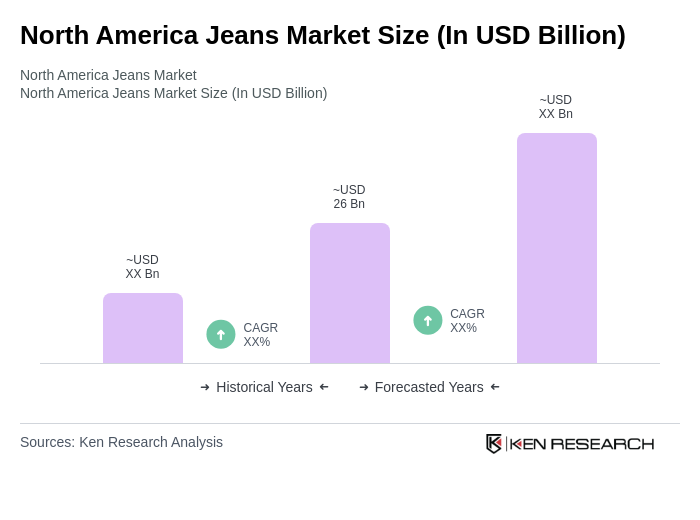
North America jeans market, valued at USD 26 billion, is growing due to demand for sustainable denim, e-commerce rise, and casual trends, dominated by US and Canada with key brands like Levi Strauss.

Region:North America

Author(s):Dev

Product Code:KRAB0661

Pages:97

Published On:August 2025
About the Report

Base Year 2024

North America Jeans Market Overview

  • The North America Jeans Market is valued at USD 26 billion, based on a five-year historical analysis. This growth is primarily driven by the increasing demand for casual wear, evolving fashion trends, and the rise of e-commerce platforms that facilitate easy access to a variety of denim products. The market has seen a shift towards sustainable and eco-friendly denim options, reflecting changing consumer preferences. Leading brands are investing in eco-friendly materials and sustainable manufacturing practices, with innovations such as plant-based and organic cotton jeans gaining traction among environmentally conscious consumers .
  • The United States and Canada dominate the North America Jeans Market due to their large consumer base, strong retail infrastructure, and the presence of major denim brands. Urban centers like New York, Los Angeles, and Toronto are key markets, driven by fashion-forward consumers and a vibrant retail landscape that supports both high-end and budget-friendly denim options. Premium jeans and exclusive collections are particularly popular, with collaborative launches and limited editions driving consumer interest .
  • In 2023, the U.S. government implemented the Textile Sustainability Regulations under the Environmental Protection Agency (EPA), requiring textile brands, including denim manufacturers, to disclose their environmental impact and adopt eco-friendly production methods. These regulations mandate transparency in sourcing, waste management, and carbon footprint reporting, encouraging a shift towards sustainable denim that meets consumer demand for environmentally responsible products .
North America Jeans Market Size

North America Jeans Market Segmentation

By Type:The jeans market can be segmented into various types, including skinny jeans, bootcut jeans, straight leg jeans, wide leg jeans, distressed jeans, high-waisted jeans, baggy/loose fit jeans, vintage/retro jeans, and others. Each type caters to different consumer preferences and fashion trends, with skinny jeans currently leading the market due to their popularity among various demographics. The market also shows rising interest in relaxed fits and vintage styles, reflecting the cyclical nature of fashion and the influence of retro aesthetics .
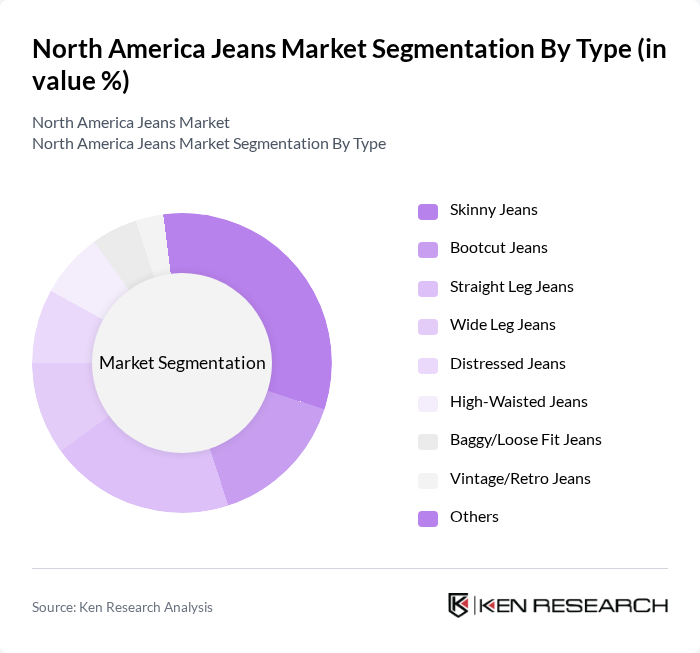
North America Jeans Market segmentation by Type.

By End-User:The jeans market is segmented by end-user into men, women, and children. Each segment has distinct preferences and purchasing behaviors, with women’s jeans leading in terms of variety and style options. The increasing focus on gender-neutral fashion and inclusive sizing is also influencing market dynamics, as brands expand their offerings to cater to diverse consumer needs .
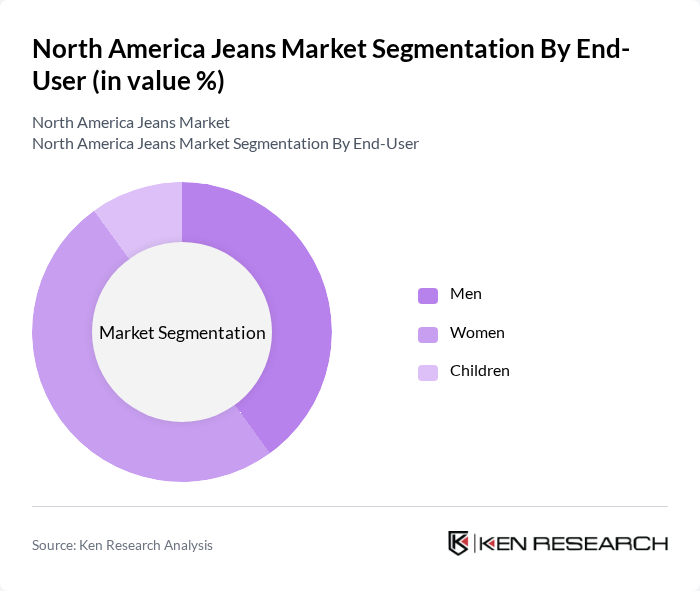
North America Jeans Market segmentation by End-User.

North America Jeans Market Competitive Landscape

The North America Jeans Market is characterized by a dynamic mix of regional and international players. Leading participants such as Levi Strauss & Co., Wrangler (Kontoor Brands, Inc.), Lee (Kontoor Brands, Inc.), American Eagle Outfitters, Inc., Gap Inc., True Religion Brand Jeans, Diesel S.p.A., Lucky Brand Jeans, 7 For All Mankind, Citizens of Humanity, AG Adriano Goldschmied, J Brand, Nudie Jeans Co., Madewell, Uniqlo Co., Ltd., PVH Corp. (Calvin Klein, Tommy Hilfiger), H&M Group, Abercrombie & Fitch Co., Express, Inc., Old Navy (Gap Inc.) contribute to innovation, geographic expansion, and service delivery in this space.

Levi Strauss & Co.

1853

San Francisco, California, USA

Wrangler (Kontoor Brands, Inc.)

1947

Greensboro, North Carolina, USA

Lee (Kontoor Brands, Inc.)

1889

Greensboro, North Carolina, USA

American Eagle Outfitters, Inc.

1977

Pittsburgh, Pennsylvania, USA

Gap Inc.

1969

San Francisco, California, USA

Company

Establishment Year

Headquarters

Market Share (%)

Revenue (USD Millions)

Revenue Growth Rate (YoY %)

Gross Margin (%)

Market Penetration Rate

Customer Retention Rate

North America Jeans Market Industry Analysis

Growth Drivers

  • Increasing Demand for Sustainable Fashion:The North American jeans market is witnessing a significant shift towards sustainable fashion, with 65% of consumers prioritizing eco-friendly products. In future, the sustainable denim segment is projected to reach $1.6 billion, driven by brands adopting organic cotton and recycled materials. This trend aligns with the growing awareness of environmental issues, as 75% of millennials express a willingness to pay more for sustainable products, indicating a robust market potential for eco-conscious denim brands.
  • Rise of E-commerce Platforms:E-commerce sales in the apparel sector are expected to exceed $220 billion in North America in future, with jeans representing a significant portion of this growth. The convenience of online shopping, coupled with the rise of mobile commerce, has led to a 30% increase in online jeans sales over the past year. Major retailers are investing heavily in their online platforms, enhancing user experience and expanding their reach, which is crucial for capturing the digitally-savvy consumer base.
  • Growing Popularity of Casual Wear:The casual wear segment, particularly jeans, is projected to grow by $4 billion in North America in future, fueled by the shift towards remote work and relaxed dress codes. This trend is supported by a 45% increase in casual clothing purchases since 2020, as consumers prioritize comfort without sacrificing style. Brands that offer versatile and stylish denim options are well-positioned to capitalize on this growing demand for casual attire in everyday life.

Market Challenges

  • Intense Competition from Fast Fashion Brands:The North American jeans market faces fierce competition from fast fashion retailers, which account for approximately 35% of total denim sales. These brands leverage low prices and rapid production cycles, making it challenging for traditional denim manufacturers to maintain market share. In future, the pressure to innovate and differentiate products will intensify, as consumers increasingly gravitate towards affordable yet trendy options offered by fast fashion giants.
  • Fluctuating Raw Material Prices:The volatility in cotton prices, which can fluctuate by up to 25% annually, poses a significant challenge for the jeans market. In future, the average price of cotton is projected to be around $1.25 per pound, impacting production costs and profit margins for denim manufacturers. This unpredictability necessitates strategic sourcing and inventory management to mitigate risks associated with raw material price fluctuations, which can affect overall market stability.

North America Jeans Market Future Outlook

The North American jeans market is poised for transformative growth, driven by evolving consumer preferences and technological advancements. As sustainability becomes a core value, brands are expected to innovate in eco-friendly materials and production methods. Additionally, the integration of augmented reality in online shopping will enhance customer experiences, making it easier to visualize products. The market will likely see increased collaboration with influencers, further driving engagement and brand loyalty among younger consumers who prioritize authenticity and style.

Market Opportunities

  • Expansion into Emerging Markets:North American denim brands have a significant opportunity to expand into emerging markets, where demand for jeans is rising. Countries like India and Brazil are experiencing a growing middle class, with denim sales projected to increase by 20% annually. This expansion can lead to new revenue streams and brand recognition in untapped regions, enhancing overall market presence.
  • Customization and Personalization Trends:The trend towards customization in fashion presents a lucrative opportunity for jeans manufacturers. In future, 35% of consumers are expected to seek personalized denim options, such as tailored fits and unique designs. Brands that offer customization services can enhance customer satisfaction and loyalty, driving sales and differentiating themselves in a competitive market landscape.

Scope of the Report

SegmentSub-Segments
By Type

Skinny Jeans

Bootcut Jeans

Straight Leg Jeans

Wide Leg Jeans

Distressed Jeans

High-Waisted Jeans

Baggy/Loose Fit Jeans

Vintage/Retro Jeans

Others

By End-User

Men

Women

Children

By Price Range

Mass/Budget

Premium

Luxury

By Distribution Channel

Online Retail

Department Stores

Specialty Stores

Discount Stores

Brand-Owned Stores

By Fabric Type

Cotton Denim

Stretch Denim

Organic/Sustainable Denim

Blended Fabrics

By Style

Casual

Formal

Athletic/Performance

By Occasion

Everyday Wear

Work Wear

Party Wear

Key Target Audience

Investors and Venture Capitalist Firms

Government and Regulatory Bodies (e.g., U.S. Department of Commerce, Consumer Product Safety Commission)

Manufacturers and Producers

Distributors and Retailers

Textile and Apparel Trade Associations

Fashion Industry Analysts

Logistics and Supply Chain Companies

Financial Institutions

Players Mentioned in the Report:

Levi Strauss & Co.

Wrangler (Kontoor Brands, Inc.)

Lee (Kontoor Brands, Inc.)

American Eagle Outfitters, Inc.

Gap Inc.

True Religion Brand Jeans

Diesel S.p.A.

Lucky Brand Jeans

7 For All Mankind

Citizens of Humanity

AG Adriano Goldschmied

J Brand

Nudie Jeans Co.

Madewell

Uniqlo Co., Ltd.

PVH Corp. (Calvin Klein, Tommy Hilfiger)

H&M Group

Abercrombie & Fitch Co.

Express, Inc.

Old Navy (Gap Inc.)

Table of Contents

Market Assessment Phase

1. Executive Summary and Approach


2. North America Jeans Market Overview

2.1 Key Insights and Strategic Recommendations

2.2 North America Jeans Market Overview

2.3 Definition and Scope

2.4 Evolution of Market Ecosystem

2.5 Timeline of Key Regulatory Milestones

2.6 Value Chain & Stakeholder Mapping

2.7 Business Cycle Analysis

2.8 Policy & Incentive Landscape


3. North America Jeans Market Analysis

3.1 Growth Drivers

3.1.1 Increasing Demand for Sustainable Fashion
3.1.2 Rise of E-commerce Platforms
3.1.3 Growing Popularity of Casual Wear
3.1.4 Innovations in Denim Fabric Technology

3.2 Market Challenges

3.2.1 Intense Competition from Fast Fashion Brands
3.2.2 Fluctuating Raw Material Prices
3.2.3 Changing Consumer Preferences
3.2.4 Environmental Regulations and Compliance Costs

3.3 Market Opportunities

3.3.1 Expansion into Emerging Markets
3.3.2 Collaborations with Influencers and Designers
3.3.3 Customization and Personalization Trends
3.3.4 Growth in Online Retail Channels

3.4 Market Trends

3.4.1 Shift Towards Eco-Friendly Production
3.4.2 Popularity of Vintage and Retro Styles
3.4.3 Integration of Technology in Retail Experiences
3.4.4 Rise of Gender-Neutral Fashion

3.5 Government Regulation

3.5.1 Import Tariffs on Denim Products
3.5.2 Labor Standards and Fair Trade Practices
3.5.3 Environmental Protection Regulations
3.5.4 Consumer Protection Laws

4. SWOT Analysis


5. Stakeholder Analysis


6. Porter's Five Forces Analysis


7. North America Jeans Market Market Size, 2019-2024

7.1 By Value

7.2 By Volume

7.3 By Average Selling Price


8. North America Jeans Market Segmentation

8.1 By Type

8.1.1 Skinny Jeans
8.1.2 Bootcut Jeans
8.1.3 Straight Leg Jeans
8.1.4 Wide Leg Jeans
8.1.5 Distressed Jeans
8.1.6 High-Waisted Jeans
8.1.7 Baggy/Loose Fit Jeans
8.1.8 Vintage/Retro Jeans
8.1.9 Others

8.2 By End-User

8.2.1 Men
8.2.2 Women
8.2.3 Children

8.3 By Price Range

8.3.1 Mass/Budget
8.3.2 Premium
8.3.3 Luxury

8.4 By Distribution Channel

8.4.1 Online Retail
8.4.2 Department Stores
8.4.3 Specialty Stores
8.4.4 Discount Stores
8.4.5 Brand-Owned Stores

8.5 By Fabric Type

8.5.1 Cotton Denim
8.5.2 Stretch Denim
8.5.3 Organic/Sustainable Denim
8.5.4 Blended Fabrics

8.6 By Style

8.6.1 Casual
8.6.2 Formal
8.6.3 Athletic/Performance

8.7 By Occasion

8.7.1 Everyday Wear
8.7.2 Work Wear
8.7.3 Party Wear

9. North America Jeans Market Competitive Analysis

9.1 Market Share of Key Players

9.2 KPIs for Cross Comparison of Key Players

9.2.1 Company Name
9.2.2 Market Share (%)
9.2.3 Revenue (USD Millions)
9.2.4 Revenue Growth Rate (YoY %)
9.2.5 Gross Margin (%)
9.2.6 Market Penetration Rate
9.2.7 Customer Retention Rate
9.2.8 Pricing Strategy (Mass, Premium, Luxury)
9.2.9 Brand Equity Score
9.2.10 Distribution Network Coverage
9.2.11 Product Innovation Index
9.2.12 Sustainability Initiatives (Eco-friendly Product Share)
9.2.13 Customer Satisfaction Score (NPS)

9.3 SWOT Analysis of Top Players

9.4 Pricing Analysis

9.5 Detailed Profile of Major Companies

9.5.1 Levi Strauss & Co.
9.5.2 Wrangler (Kontoor Brands, Inc.)
9.5.3 Lee (Kontoor Brands, Inc.)
9.5.4 American Eagle Outfitters, Inc.
9.5.5 Gap Inc.
9.5.6 True Religion Brand Jeans
9.5.7 Diesel S.p.A.
9.5.8 Lucky Brand Jeans
9.5.9 7 For All Mankind
9.5.10 Citizens of Humanity
9.5.11 AG Adriano Goldschmied
9.5.12 J Brand
9.5.13 Nudie Jeans Co.
9.5.14 Madewell
9.5.15 Uniqlo Co., Ltd.
9.5.16 PVH Corp. (Calvin Klein, Tommy Hilfiger)
9.5.17 H&M Group
9.5.18 Abercrombie & Fitch Co.
9.5.19 Express, Inc.
9.5.20 Old Navy (Gap Inc.)

10. North America Jeans Market End-User Analysis

10.1 Procurement Behavior of Key Ministries

10.1.1 Government Procurement Policies
10.1.2 Budget Allocations for Apparel
10.1.3 Supplier Selection Criteria

10.2 Corporate Spend on Infrastructure & Energy

10.2.1 Investment in Sustainable Practices
10.2.2 Budget for Employee Uniforms
10.2.3 Spending on Promotional Apparel

10.3 Pain Point Analysis by End-User Category

10.3.1 Sizing and Fit Issues
10.3.2 Quality and Durability Concerns
10.3.3 Availability of Styles

10.4 User Readiness for Adoption

10.4.1 Awareness of Sustainable Options
10.4.2 Willingness to Pay for Quality
10.4.3 Adoption of Online Shopping

10.5 Post-Deployment ROI and Use Case Expansion

10.5.1 Evaluation of Cost Savings
10.5.2 Impact on Employee Satisfaction
10.5.3 Opportunities for Brand Expansion

11. North America Jeans Market Future Size, 2025-2030

11.1 By Value

11.2 By Volume

11.3 By Average Selling Price


Go-To-Market Strategy Phase

1. Whitespace Analysis + Business Model Canvas

1.1 Market Gaps Identification

1.2 Value Proposition Development

1.3 Revenue Streams Analysis

1.4 Key Partnerships

1.5 Cost Structure Overview

1.6 Customer Segments

1.7 Channels of Distribution


2. Marketing and Positioning Recommendations

2.1 Branding Strategies

2.2 Product USPs

2.3 Target Audience Identification

2.4 Marketing Channels

2.5 Promotional Activities


3. Distribution Plan

3.1 Urban Retail Strategies

3.2 Rural NGO Tie-ups

3.3 E-commerce Integration

3.4 Logistics and Supply Chain Management


4. Channel & Pricing Gaps

4.1 Underserved Routes

4.2 Pricing Bands Analysis

4.3 Competitor Pricing Strategies


5. Unmet Demand & Latent Needs

5.1 Category Gaps

5.2 Consumer Segments Analysis

5.3 Emerging Trends


6. Customer Relationship

6.1 Loyalty Programs

6.2 After-sales Service

6.3 Customer Feedback Mechanisms


7. Value Proposition

7.1 Sustainability Initiatives

7.2 Integrated Supply Chains

7.3 Unique Selling Points


8. Key Activities

8.1 Regulatory Compliance

8.2 Branding Efforts

8.3 Distribution Setup


9. Entry Strategy Evaluation

9.1 Domestic Market Entry Strategy

9.1.1 Product Mix Considerations
9.1.2 Pricing Band Strategy
9.1.3 Packaging Innovations

9.2 Export Entry Strategy

9.2.1 Target Countries Analysis
9.2.2 Compliance Roadmap

10. Entry Mode Assessment

10.1 Joint Ventures

10.2 Greenfield Investments

10.3 Mergers & Acquisitions

10.4 Distributor Model


11. Capital and Timeline Estimation

11.1 Capital Requirements

11.2 Timelines for Market Entry


12. Control vs Risk Trade-Off

12.1 Ownership vs Partnerships


13. Profitability Outlook

13.1 Breakeven Analysis

13.2 Long-term Sustainability


14. Potential Partner List

14.1 Distributors

14.2 Joint Ventures

14.3 Acquisition Targets


15. Execution Roadmap

15.1 Phased Plan for Market Entry

15.1.1 Market Setup
15.1.2 Market Entry
15.1.3 Growth Acceleration
15.1.4 Scale & Stabilize

15.2 Key Activities and Milestones

15.2.1 Activity Planning
15.2.2 Milestone Tracking

Research Methodology

ApproachModellingSample

Phase 1: Approach1

Desk Research

  • Analysis of industry reports from fashion and apparel associations in North America
  • Review of market trends and consumer behavior studies published by market research firms
  • Examination of trade publications and online platforms focusing on denim and apparel markets

Primary Research

  • Interviews with brand managers and product developers from leading denim manufacturers
  • Surveys targeting retail buyers and merchandisers in major department stores
  • Focus groups with consumers to understand preferences and purchasing behavior in jeans

Validation & Triangulation

  • Cross-validation of findings through multiple data sources including sales data and consumer insights
  • Triangulation of qualitative insights from interviews with quantitative data from surveys
  • Sanity checks conducted through expert reviews from industry veterans and analysts

Phase 2: Market Size Estimation1

Top-down Assessment

  • Estimation of total market size based on national apparel spending and denim's market share
  • Segmentation of the market by demographics, including age, gender, and income levels
  • Incorporation of growth rates from historical data and projected trends in fashion consumption

Bottom-up Modeling

  • Collection of sales data from key retailers and online platforms selling jeans
  • Estimation of average selling prices and volume sold across different jean categories
  • Analysis of production costs and supply chain dynamics affecting pricing strategies

Forecasting & Scenario Analysis

  • Utilization of time-series analysis to project future market growth based on historical trends
  • Scenario modeling based on economic indicators, fashion trends, and consumer preferences
  • Development of best-case, worst-case, and most-likely scenarios through 2030

Phase 3: CATI Sample Composition1

Scope Item/SegmentSample SizeTarget Respondent Profiles
Denim Retailers100Store Managers, Buyers, Merchandisers
Consumer Preferences120Fashion-conscious Consumers, Casual Buyers
Manufacturers & Suppliers80Production Managers, Supply Chain Coordinators
Online Retail Platforms60E-commerce Managers, Digital Marketing Specialists
Fashion Industry Experts40Fashion Analysts, Trend Forecasters

Frequently Asked Questions

What is the current value of the North America Jeans Market?

The North America Jeans Market is valued at approximately USD 26 billion, reflecting a robust demand for casual wear and evolving fashion trends, particularly in the United States and Canada.

What factors are driving growth in the North America Jeans Market?

How is sustainability impacting the jeans market in North America?

Which types of jeans are most popular in North America?

Other Regional/Country Reports

USA Jeans Market Outlook to 2030

Indonesia Jeans Market

Malaysia Jeans Market

KSA Jeans Market

APAC Jeans Market

SEA Jeans Market

Why Buy From Us?

Refine Robust Result (RRR) Framework

What makes us stand out is that our consultants follow Robust, Refine and Result (RRR) methodology. Robust for clear definitions, approaches and sanity checking, Refine for differentiating respondents' facts and opinions, and Result for presenting data with story.

Our Reach Is Unmatched

We have set a benchmark in the industry by offering our clients with syndicated and customized market research reports featuring coverage of entire market as well as meticulous research and analyst insights.

Shifting the Research Paradigm

While we don't replace traditional research, we flip the method upside down. Our dual approach of Top Bottom & Bottom Top ensures quality deliverable by not just verifying company fundamentals but also looking at the sector and macroeconomic factors.

More Insights-Better Decisions

With one step in the future, our research team constantly tries to show you the bigger picture. We help with some of the tough questions you may encounter along the way: How is the industry positioned? Best marketing channel? KPI's of competitors? By aligning every element, we help maximize success.

Transparency and Trust

Our report gives you instant access to the answers and sources that other companies might choose to hide. We elaborate each steps of research methodology we have used and showcase you the sample size to earn your trust.

Round the Clock Support

If you need any support, we are here! We pride ourselves on universe strength, data quality, and quick, friendly, and professional service.

Why Clients Choose Us?

400000+
Reports in repository
150+
Consulting projects a year
100+
Analysts
8000+
Client Queries in 2022








