About the Report
Base Year 2024Listen to the audio summary
North America Long Haul Transport Market Overview
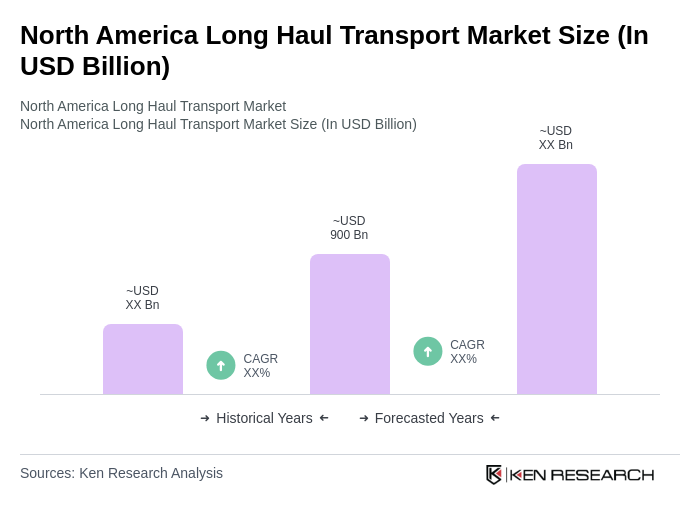
- The North America Long Haul Transport Market is valued at approximately USD 900 billion, based on a five-year historical analysis. This reflects the size of the region’s truck freight market alone approaching the high eight-hundred billions, alongside meaningful long-haul contributions from rail, intermodal, air cargo, and domestic maritime that collectively lift the broader long-haul transport market close to the nine-hundred-billion range . Growth is primarily driven by e-commerce expansion, rising consumer goods demand, and the push for efficient, technology-enabled supply chains; industry sources continue to cite trucking’s dominant role in North American freight by tonnage and revenue . The market has also seen notable investment in telematics, route optimization, and intermodal capacity, enhancing operational efficiency and service delivery .
- Key players in this market include the United States and Canada, which dominate due to extensive highway networks, advanced logistics hubs, and high freight volumes; major U.S. metros such as Los Angeles, Chicago, and Dallas function as critical nodes for domestic distribution and cross-border flows with Canada and Mexico . Trucking retains the largest mode share in North America’s freight mix, reinforcing the centrality of these corridors and hubs in long-haul routing .
- In 2021, the United States enacted the Infrastructure Investment and Jobs Act totaling approximately USD 1.2 trillion, with multi-year funding streams for highways, bridges, safety, and freight infrastructure that continue to be implemented, aiming to enhance safety, reduce congestion, and support more sustainable transport operations—factors that benefit long-haul efficiency and reliability .
North America Long Haul Transport Market Segmentation
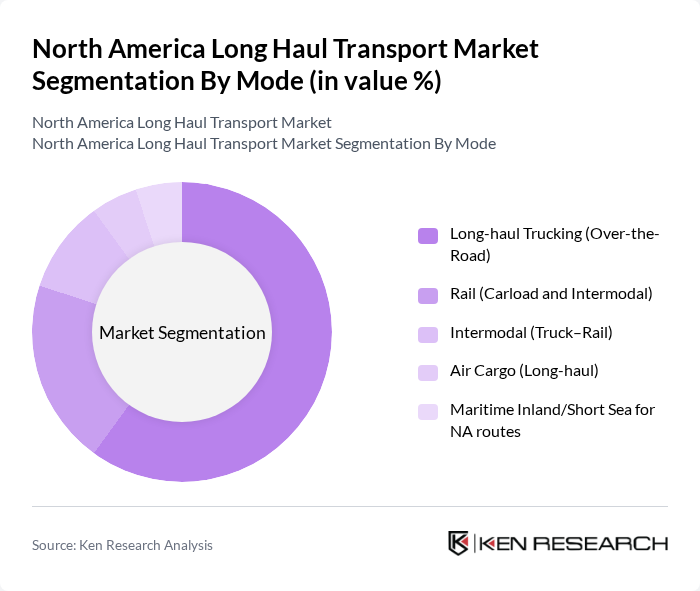
By Mode:The long haul transport market is segmented by mode into various categories, including Long-haul Trucking (Over-the-Road), Rail (Carload and Intermodal), Intermodal (Truck–Rail), Air Cargo (Long-haul), and Maritime Inland/Short Sea for NA routes. Among these, Long-haul Trucking is the most dominant mode due to its flexibility, extensive reach, and ability to transport a wide variety of goods directly to their destinations . Rail transport is also significant—especially for bulk commodities and unit trains—while intermodal services continue to gain traction as shippers blend truck and rail to improve cost and emissions performance .
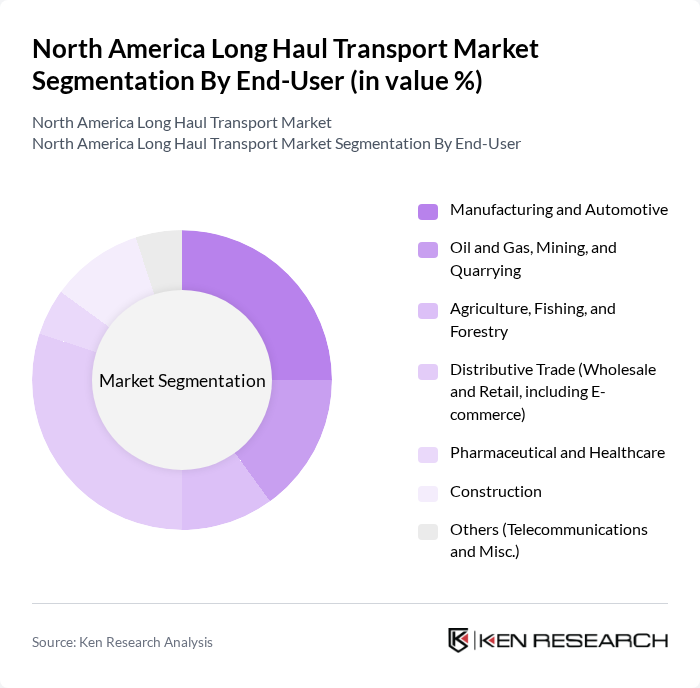
By End-User:The market is also segmented by end-user industries, including Manufacturing and Automotive, Oil and Gas, Mining and Quarrying, Agriculture, Fishing and Forestry, Distributive Trade (Wholesale and Retail, including E-commerce), Pharmaceutical and Healthcare, Construction, and Others (Telecommunications and Misc.). The Distributive Trade sector is the largest end-user, supported by sustained e-commerce growth and retailer logistics optimization across long-haul lanes . Manufacturing and Automotive are also key shippers, relying on time-definite long-haul moves for parts and finished vehicles; temperature-controlled flows in pharma and food continue to expand long-haul refrigerated demand .
North America Long Haul Transport Market Competitive Landscape
The North America Long Haul Transport Market is characterized by a dynamic mix of regional and international players. Leading participants such as J.B. Hunt Transport Services, Inc., Schneider National, Inc., Knight-Swift Transportation Holdings Inc., Werner Enterprises, Inc., XPO, Inc., Landstar System, Inc., Old Dominion Freight Line, Inc., C.H. Robinson Worldwide, Inc., TFI International Inc., Saia, Inc., ArcBest Corporation, Estes Express Lines, R+L Carriers, ABF Freight (ArcBest), FedEx Freight, UPS Supply Chain Solutions, Penske Logistics, Ryder System, Inc., Bison Transport Inc., C.R. England, Inc. contribute to innovation, geographic expansion, and service delivery in this space .
North America Long Haul Transport Market Industry Analysis
Growth Drivers
- Increasing E-commerce Demand:The surge in e-commerce has significantly impacted the long haul transport sector, with U.S. e-commerce sales projected to reach $1.1 trillion in future, up from $900 billion in 2022. This growth necessitates efficient logistics and transportation solutions to meet consumer expectations for rapid delivery. As online shopping continues to expand, the demand for long haul transport services will increase, driving revenue growth in the sector and creating a robust market environment.
- Infrastructure Investments:The U.S. government has allocated approximately $1.2 trillion for infrastructure improvements under the Infrastructure Investment and Jobs Act. This funding aims to enhance roads, bridges, and ports, which are critical for long haul transport efficiency. Improved infrastructure will reduce transit times and costs, enabling transport companies to optimize their operations and expand their service offerings, thus fostering market growth in the long haul transport sector.
- Technological Advancements in Fleet Management:The adoption of advanced fleet management technologies is transforming the long haul transport industry. In future, the global fleet management market is expected to reach $30 billion, driven by innovations such as GPS tracking, telematics, and route optimization software. These technologies enhance operational efficiency, reduce costs, and improve service reliability, positioning companies to better meet the increasing demands of the market and gain a competitive edge.
Market Challenges
- Driver Shortages:The long haul transport industry faces a significant driver shortage, with estimates indicating a shortfall of 160,000 drivers in future. This shortage is exacerbated by an aging workforce and high turnover rates, which hinder companies' ability to meet growing demand. As a result, transport firms may struggle to maintain service levels, leading to increased operational costs and potential delays in delivery, ultimately impacting customer satisfaction and market competitiveness.
- Regulatory Compliance Costs:Compliance with stringent regulations, such as the Federal Motor Carrier Safety Administration's (FMCSA) safety standards, imposes substantial costs on long haul transport companies. In future, compliance costs are projected to exceed $10 billion across the industry. These expenses include investments in safety training, vehicle upgrades, and administrative overhead, which can strain profit margins and limit the ability of companies to invest in growth initiatives or technological advancements.
North America Long Haul Transport Market Future Outlook
The North America long haul transport market is poised for significant evolution, driven by technological advancements and changing consumer preferences. As e-commerce continues to thrive, logistics companies will increasingly adopt automation and data analytics to enhance operational efficiency. Furthermore, sustainability initiatives will shape the industry, with a growing emphasis on reducing carbon footprints through electric and autonomous vehicles. These trends will create a dynamic landscape, fostering innovation and competitive strategies among market players in the coming years.
Market Opportunities
- Expansion of Last-Mile Delivery Services:The increasing demand for last-mile delivery solutions presents a lucrative opportunity for long haul transport companies. With e-commerce sales expected to rise, businesses can capitalize on this trend by integrating last-mile logistics into their operations, enhancing customer satisfaction and expanding their service offerings to meet consumer expectations for timely deliveries.
- Adoption of Electric and Autonomous Vehicles:The shift towards electric and autonomous vehicles is set to revolutionize the long haul transport sector. In future, investments in electric vehicle technology are projected to reach $20 billion, driven by environmental regulations and consumer demand for sustainable practices. This transition will not only reduce operational costs but also position companies as leaders in sustainability, appealing to environmentally conscious consumers.
Scope of the Report
| Segment | Sub-Segments |
|---|---|
| By Mode | Long-haul Trucking (Over-the-Road) Rail (Carload and Intermodal) Intermodal (Truck–Rail) Air Cargo (Long-haul) Maritime Inland/Short Sea for NA routes |
| By End-User | Manufacturing and Automotive Oil and Gas, Mining, and Quarrying Agriculture, Fishing, and Forestry Distributive Trade (Wholesale and Retail, including E-commerce) Pharmaceutical and Healthcare Construction Others (Telecommunications and Misc.) |
| By Service Type | Full Truckload (FTL) Less Than Truckload (LTL) Dedicated Contract Carriage (DCC) Intermodal Drayage and Linehaul Expedited/Time-definite Refrigerated/Temperature-Controlled |
| By Distribution/Contracting Model | Direct Shipper–Carrier Third-Party Logistics (3PL/Brokerage) Managed Transportation/4PL Freight Forwarding |
| By Fleet Ownership | Owned Fleet Leased Fleet Outsourced/Owner-Operator Network |
| By Cargo Type | Dry Van Bulk and Tank (Liquid/Gas) Reefer (Perishables) Hazardous Materials (HAZMAT) Oversized/Project Cargo |
| By Route | Domestic Cross-border (US–Canada) Cross-border (US–Mexico) |
Key Target Audience
Investors and Venture Capitalist Firms
Government and Regulatory Bodies (e.g., Federal Motor Carrier Safety Administration, Department of Transportation)
Logistics and Supply Chain Companies
Freight Forwarders
Transportation Equipment Manufacturers
Fuel Suppliers and Energy Providers
Insurance Companies
Trade Associations and Advocacy Groups
Players Mentioned in the Report:
J.B. Hunt Transport Services, Inc.
Schneider National, Inc.
Knight-Swift Transportation Holdings Inc.
Werner Enterprises, Inc.
XPO, Inc.
Landstar System, Inc.
Old Dominion Freight Line, Inc.
C.H. Robinson Worldwide, Inc.
TFI International Inc.
Saia, Inc.
ArcBest Corporation
Estes Express Lines
R+L Carriers
ABF Freight (ArcBest)
FedEx Freight
UPS Supply Chain Solutions
Penske Logistics
Ryder System, Inc.
Bison Transport Inc.
C.R. England, Inc.
Table of Contents
Market Assessment Phase
1. Executive Summary and Approach
2. North America Long Haul Transport Market Overview
2.1 Key Insights and Strategic Recommendations
2.2 North America Long Haul Transport Market Overview
2.3 Definition and Scope
2.4 Evolution of Market Ecosystem
2.5 Timeline of Key Regulatory Milestones
2.6 Value Chain & Stakeholder Mapping
2.7 Business Cycle Analysis
2.8 Policy & Incentive Landscape
3. North America Long Haul Transport Market Analysis
3.1 Growth Drivers
3.1.1 Increasing E-commerce Demand
3.1.2 Infrastructure Investments
3.1.3 Technological Advancements in Fleet Management
3.1.4 Rising Fuel Efficiency Standards
3.2 Market Challenges
3.2.1 Driver Shortages
3.2.2 Regulatory Compliance Costs
3.2.3 Competition from Alternative Transport Modes
3.2.4 Environmental Regulations
3.3 Market Opportunities
3.3.1 Expansion of Last-Mile Delivery Services
3.3.2 Adoption of Electric and Autonomous Vehicles
3.3.3 Growth in Cross-Border Trade
3.3.4 Development of Smart Logistics Solutions
3.4 Market Trends
3.4.1 Digital Transformation in Logistics
3.4.2 Sustainability Initiatives
3.4.3 Increased Use of Data Analytics
3.4.4 Collaborative Logistics Models
3.5 Government Regulation
3.5.1 Hours of Service Regulations
3.5.2 Emission Standards
3.5.3 Safety Regulations
3.5.4 Transportation Infrastructure Investment Programs
4. SWOT Analysis
5. Stakeholder Analysis
6. Porter's Five Forces Analysis
7. North America Long Haul Transport Market Market Size, 2019-2024
7.1 By Value
7.2 By Volume
7.3 By Average Selling Price
8. North America Long Haul Transport Market Segmentation
8.1 By Mode
8.1.1 Long-haul Trucking (Over-the-Road)
8.1.2 Rail (Carload and Intermodal)
8.1.3 Intermodal (Truck–Rail)
8.1.4 Air Cargo (Long-haul)
8.1.5 Maritime Inland/Short Sea for NA routes
8.2 By End-User
8.2.1 Manufacturing and Automotive
8.2.2 Oil and Gas, Mining, and Quarrying
8.2.3 Agriculture, Fishing, and Forestry
8.2.4 Distributive Trade (Wholesale and Retail, including E-commerce)
8.2.5 Pharmaceutical and Healthcare
8.2.6 Construction
8.2.7 Others (Telecommunications and Misc.)
8.3 By Service Type
8.3.1 Full Truckload (FTL)
8.3.2 Less Than Truckload (LTL)
8.3.3 Dedicated Contract Carriage (DCC)
8.3.4 Intermodal Drayage and Linehaul
8.3.5 Expedited/Time-definite
8.3.6 Refrigerated/Temperature-Controlled
8.4 By Distribution/Contracting Model
8.4.1 Direct Shipper–Carrier
8.4.2 Third-Party Logistics (3PL/Brokerage)
8.4.3 Managed Transportation/4PL
8.4.4 Freight Forwarding
8.5 By Fleet Ownership
8.5.1 Owned Fleet
8.5.2 Leased Fleet
8.5.3 Outsourced/Owner-Operator Network
8.6 By Cargo Type
8.6.1 Dry Van
8.6.2 Bulk and Tank (Liquid/Gas)
8.6.3 Reefer (Perishables)
8.6.4 Hazardous Materials (HAZMAT)
8.6.5 Oversized/Project Cargo
8.7 By Route
8.7.1 Domestic
8.7.2 Cross-border (US–Canada)
8.7.3 Cross-border (US–Mexico)
9. North America Long Haul Transport Market Competitive Analysis
9.1 Market Share of Key Players
9.2 Cross Comparison of Key Players
9.2.1 Company Name
9.2.2 Group Size (Enterprise revenue tier)
9.2.3 North America Long-haul Revenue (USD, latest FY)
9.2.4 Revenue CAGR (3-year)
9.2.5 Operating Ratio (Operating expenses/revenue)
9.2.6 OR Improvement (bps, YoY)
9.2.7 Fleet Size (Tractors/Power units)
9.2.8 Trailer/Container Count
9.2.9 Miles per Truck per Week (or Tractor Utilization)
9.2.10 Load Factor (FTL) / Weight per Shipment (LTL)
9.2.11 On-time Delivery Rate (%)
9.2.12 Safety Metrics (DOT reportables per million miles, CSA)
9.2.13 Driver Turnover Rate (%)
9.2.14 Empty Miles (% of total miles)
9.2.15 Fuel Efficiency (MPG or fuel cost per mile)
9.2.16 Intermodal Mix (% revenue)
9.2.17 Cross-border Mix (% revenue US–CA/US–MX)
9.2.18 Capex Intensity (% of revenue)
9.2.19 EBITDA Margin (%)
9.2.20 Net Promoter Score (NPS) / Customer Satisfaction
9.3 SWOT Analysis of Top Players
9.4 Pricing Analysis
9.5 Detailed Profile of Major Companies
9.5.1 J.B. Hunt Transport Services, Inc.
9.5.2 Schneider National, Inc.
9.5.3 Knight-Swift Transportation Holdings Inc.
9.5.4 Werner Enterprises, Inc.
9.5.5 XPO, Inc.
9.5.6 Landstar System, Inc.
9.5.7 Old Dominion Freight Line, Inc.
9.5.8 C.H. Robinson Worldwide, Inc.
9.5.9 TFI International Inc.
9.5.10 Saia, Inc.
9.5.11 ArcBest Corporation
9.5.12 Estes Express Lines
9.5.13 R+L Carriers
9.5.14 ABF Freight (ArcBest)
9.5.15 FedEx Freight
9.5.16 UPS Supply Chain Solutions
9.5.17 Penske Logistics
9.5.18 Ryder System, Inc.
9.5.19 Bison Transport Inc.
9.5.20 C.R. England, Inc.
10. North America Long Haul Transport Market End-User Analysis
10.1 Procurement Behavior of Key Ministries
10.1.1 Budget Allocation Trends
10.1.2 Contracting Processes
10.1.3 Supplier Selection Criteria
10.2 Corporate Spend on Infrastructure & Energy
10.2.1 Investment Priorities
10.2.2 Funding Sources
10.2.3 Project Timelines
10.3 Pain Point Analysis by End-User Category
10.3.1 Delivery Delays
10.3.2 Cost Overruns
10.3.3 Compliance Issues
10.4 User Readiness for Adoption
10.4.1 Technology Adoption Rates
10.4.2 Training Needs
10.4.3 Change Management Challenges
10.5 Post-Deployment ROI and Use Case Expansion
10.5.1 Performance Metrics
10.5.2 Scalability Potential
10.5.3 Long-term Benefits
11. North America Long Haul Transport Market Future Size, 2025-2030
11.1 By Value
11.2 By Volume
11.3 By Average Selling Price
Go-To-Market Strategy Phase
1. Whitespace Analysis + Business Model Canvas
1.1 Market Gaps Identification
1.2 Value Proposition Development
1.3 Revenue Streams Analysis
2. Marketing and Positioning Recommendations
2.1 Branding Strategies
2.2 Product USPs
3. Distribution Plan
3.1 Urban Retail Strategies
3.2 Rural NGO Tie-ups
4. Channel & Pricing Gaps
4.1 Underserved Routes
4.2 Pricing Bands Analysis
5. Unmet Demand & Latent Needs
5.1 Category Gaps
5.2 Consumer Segments
6. Customer Relationship
6.1 Loyalty Programs
6.2 After-sales Service
7. Value Proposition
7.1 Sustainability Initiatives
7.2 Integrated Supply Chains
8. Key Activities
8.1 Regulatory Compliance
8.2 Branding Efforts
8.3 Distribution Setup
9. Entry Strategy Evaluation
9.1 Domestic Market Entry Strategy
9.1.1 Product Mix Considerations
9.1.2 Pricing Band Strategy
9.1.3 Packaging Options
9.2 Export Entry Strategy
9.2.1 Target Countries
9.2.2 Compliance Roadmap
10. Entry Mode Assessment
10.1 Joint Ventures
10.2 Greenfield Investments
10.3 Mergers & Acquisitions
10.4 Distributor Model
11. Capital and Timeline Estimation
11.1 Capital Requirements
11.2 Timelines for Implementation
12. Control vs Risk Trade-Off
12.1 Ownership Considerations
12.2 Partnerships Evaluation
13. Profitability Outlook
13.1 Breakeven Analysis
13.2 Long-term Sustainability
14. Potential Partner List
14.1 Distributors
14.2 Joint Ventures
14.3 Acquisition Targets
15. Execution Roadmap
15.1 Phased Plan for Market Entry
15.1.1 Market Setup
15.1.2 Market Entry
15.1.3 Growth Acceleration
15.1.4 Scale & Stabilize
15.2 Key Activities and Milestones
15.2.1 Milestone Planning
15.2.2 Activity Tracking
Research Methodology
Phase 1: Approach1
Desk Research
- Analysis of industry reports from transportation associations and logistics publications
- Review of government transportation statistics and freight movement data
- Examination of market trends and forecasts from reputable economic research institutions
Primary Research
- Interviews with logistics executives from major long-haul transport companies
- Surveys targeting fleet managers and operations directors in the trucking industry
- Field interviews with drivers and logistics coordinators to gather firsthand insights
Validation & Triangulation
- Cross-validation of findings through multiple data sources, including trade publications and expert opinions
- Triangulation of quantitative data with qualitative insights from industry experts
- Sanity checks conducted through peer reviews and expert panel discussions
Phase 2: Market Size Estimation1
Top-down Assessment
- Estimation of total freight transport spending in North America as a baseline
- Segmentation of market size by freight type, including full truckload and less-than-truckload
- Incorporation of macroeconomic indicators such as GDP growth and consumer demand trends
Bottom-up Modeling
- Collection of operational data from leading long-haul transport firms to establish benchmarks
- Cost analysis based on fuel prices, labor costs, and maintenance expenses
- Volume and revenue projections based on historical performance and market trends
Forecasting & Scenario Analysis
- Development of forecasting models using historical data and predictive analytics
- Scenario analysis based on potential regulatory changes and technological advancements
- Creation of multiple growth scenarios, including best-case, worst-case, and most likely outcomes through 2030
Phase 3: CATI Sample Composition1
| Scope Item/Segment | Sample Size | Target Respondent Profiles |
|---|---|---|
| Long-Haul Trucking Operations | 140 | Fleet Managers, Operations Executives |
| Freight Brokerage Services | 90 | Brokerage Owners, Sales Managers |
| Logistics Technology Providers | 80 | Product Managers, IT Directors |
| Regulatory Compliance in Transport | 70 | Compliance Officers, Safety Managers |
| Environmental Impact Assessments | 60 | Sustainability Managers, Environmental Analysts |
Frequently Asked Questions
What is the current value of the North America Long Haul Transport Market?
The North America Long Haul Transport Market is valued at approximately USD 900 billion, reflecting significant contributions from trucking, rail, intermodal, air cargo, and domestic maritime sectors, driven by e-commerce growth and rising consumer demand.
What are the primary growth drivers for the North America Long Haul Transport Market?
Which modes of transport dominate the North America Long Haul Transport Market?
What challenges does the North America Long Haul Transport Market face?
Other Regional/Country Reports
Indonesia Long Haul Transport Market
Malaysia Long Haul Transport Market
KSA Long Haul Transport Market
APAC Long Haul Transport Market
SEA Long Haul Transport Market
Vietnam Long Haul Transport Market
Why Buy From Us?

What makes us stand out is that our consultants follow Robust, Refine and Result (RRR) methodology. Robust for clear definitions, approaches and sanity checking, Refine for differentiating respondents' facts and opinions, and Result for presenting data with story.

We have set a benchmark in the industry by offering our clients with syndicated and customized market research reports featuring coverage of entire market as well as meticulous research and analyst insights.

While we don't replace traditional research, we flip the method upside down. Our dual approach of Top Bottom & Bottom Top ensures quality deliverable by not just verifying company fundamentals but also looking at the sector and macroeconomic factors.

With one step in the future, our research team constantly tries to show you the bigger picture. We help with some of the tough questions you may encounter along the way: How is the industry positioned? Best marketing channel? KPI's of competitors? By aligning every element, we help maximize success.

Our report gives you instant access to the answers and sources that other companies might choose to hide. We elaborate each steps of research methodology we have used and showcase you the sample size to earn your trust.

If you need any support, we are here! We pride ourselves on universe strength, data quality, and quick, friendly, and professional service.