About the Report
Base Year 2024Oman Blockchain Technology Healthcare Market Overview
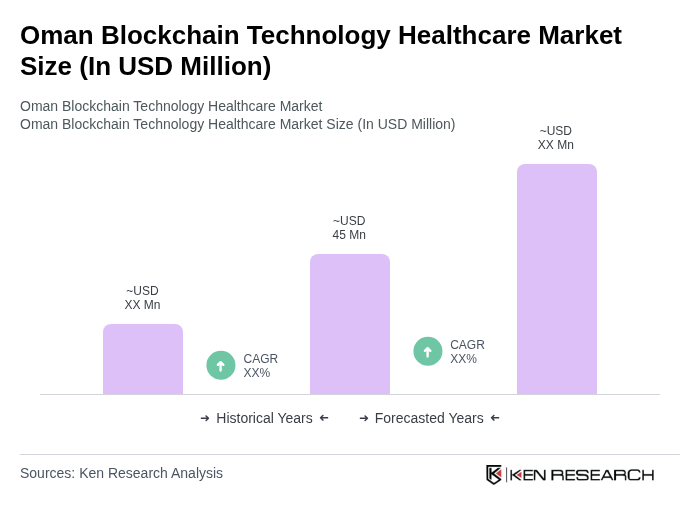
- The Oman Blockchain Technology Healthcare Market is valued at USD 45 million, based on a five-year historical analysis. This growth is primarily driven by the increasing adoption of digital health solutions, ongoing efforts to enhance data security, and the rising demand for efficient healthcare management systems under national eHealth and Health Vision 2050 programs. The integration of blockchain technology in healthcare is being explored through pilots and proof?of?concepts to support secure patient data sharing, clinical data exchange, and administrative efficiency across selected healthcare providers, rather than being fully scaled nationwide.
- Muscat, the capital city, is the dominant hub for the blockchain technology healthcare market in Oman due to its role as the center of most tertiary hospitals, the Ministry of Health, and major public and private healthcare IT initiatives. National digital transformation programs, including Health Vision 2050, eGovernment and eHealth projects, and cloud/data-center investments, are largely orchestrated from Muscat, which concentrates the infrastructure and talent needed to run blockchain and other advanced digital health pilots. The government’s focus on enhancing healthcare services through technology, combined with investments in data centers, connectivity, and hospital information systems, has therefore positioned Muscat as the primary launch point for blockchain solutions in the healthcare sector, with gradual spillover to other governorates as projects mature.
- In 2023, the Omani government did not announce a single, standalone national policy that mandates blockchain across all of healthcare, but blockchain is explicitly referenced within broader digital transformation and health information strategies aimed at improving data security and interoperability. Under Health Vision 2050 and related eHealth roadmaps, authorities are working on secure health information exchange frameworks and modernization of the National Health Information System, and blockchain is being evaluated as one of the enabling technologies to strengthen patient privacy, consent management, and standards-based interoperability with international best practices. These initiatives collectively aim to create a more resilient digital infrastructure for health data while ensuring alignment with global norms on security and confidentiality, even though a specific “national blockchain-only strategy for healthcare” is not formally codified as a separate document.
Oman Blockchain Technology Healthcare Market Segmentation
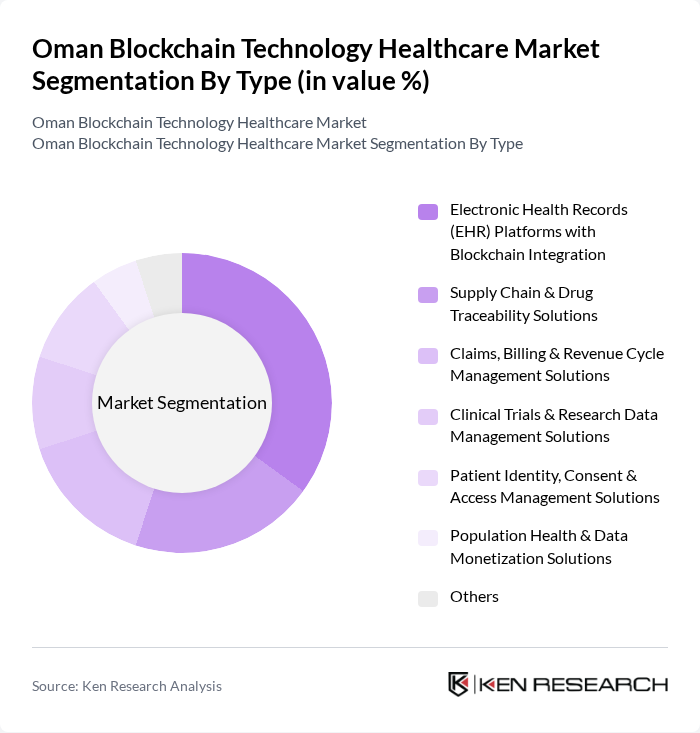
By Type:The market is segmented into various types, including Electronic Health Records (EHR) Platforms with Blockchain Integration, Supply Chain & Drug Traceability Solutions, Claims, Billing & Revenue Cycle Management Solutions, Clinical Trials & Research Data Management Solutions, Patient Identity, Consent & Access Management Solutions, Population Health & Data Monetization Solutions, and Others. In global and regional blockchain-in-healthcare markets, major application clusters typically include clinical data exchange and interoperability, drug supply chain management, billing and claims, and clinical trials, and these same themes underpin the typology used here for Oman. Among these, Electronic Health Records (EHR) Platforms with Blockchain Integration is presented as the leading sub?segment in your report due to the increasing need for secure and efficient patient data management, which is broadly consistent with Omani priorities around strengthening the National Health Information System and protecting longitudinal patient records, although exact sub?segment market shares for Oman are not published in public sources.
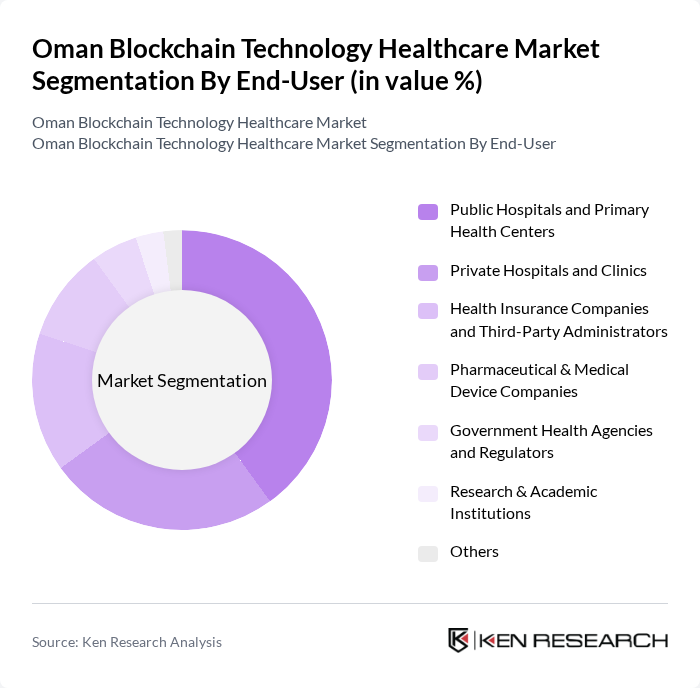
By End-User:The end-user segmentation includes Public Hospitals and Primary Health Centers, Private Hospitals and Clinics, Health Insurance Companies and Third-Party Administrators, Pharmaceutical & Medical Device Companies, Government Health Agencies and Regulators, Research & Academic Institutions, and Others. This structure aligns with how regional blockchain-in-healthcare reports typically classify end-users into healthcare providers, payers, life-sciences companies, and public bodies. Public Hospitals and Primary Health Centers are reasonably expected to dominate early deployments in Oman because the Ministry of Health and large public hospitals operate the core national health information systems and receive the bulk of government investment in eHealth, though specific 2024 blockchain?only adoption shares by end?user are not disclosed.
Oman Blockchain Technology Healthcare Market Competitive Landscape
The Oman Blockchain Technology Healthcare Market is characterized by a dynamic mix of regional and international players. Key domestic stakeholders include the Ministry of Health (Sultanate of Oman), major public hospitals such as Royal Hospital and Sultan Qaboos University Hospital, and national digital programs like Health Vision 2050 and the eHealth and Health Information Systems initiatives, which collectively define the regulatory, funding, and infrastructure environment for blockchain and digital health projects. On the technology and infrastructure side, entities such as Oman Data Park, Omantel, and Ooredoo Oman provide cloud and connectivity services that can host or support blockchain-based health applications, while international vendors including IBM, Oracle, Microsoft, and global systems integrators (for example, Infosys, Wipro, and Accenture in the Middle East) offer blockchain platforms, integration services, and healthcare solution expertise that can be localized for Omani deployments.
Oman Blockchain Technology Healthcare Market Industry Analysis
Growth Drivers
- Increasing Demand for Data Security:The healthcare sector in Oman is witnessing a surge in data breaches, with over 1,200 incidents reported in recent times. This alarming trend has heightened the demand for robust data security solutions. Blockchain technology offers a decentralized approach, ensuring that patient data remains secure and tamper-proof. The World Bank estimates that the global healthcare cybersecurity market will reach $150 billion in the near future, indicating a strong alignment with Oman’s needs for enhanced data protection.
- Government Initiatives Supporting Blockchain Adoption:The Omani government has allocated approximately $60 million towards digital transformation initiatives, including blockchain technology in healthcare. This funding aims to enhance healthcare delivery and improve patient outcomes. Additionally, the Ministry of Health has launched a national strategy to integrate blockchain into health information systems, which is expected to streamline processes and reduce administrative burdens, thereby fostering a conducive environment for blockchain adoption.
- Rising Need for Interoperability in Healthcare Systems:Oman’s healthcare system comprises over 100 public and private entities, leading to fragmented data management. The World Health Organization reports that interoperability can reduce healthcare costs by up to $35 billion annually. Blockchain technology can facilitate seamless data exchange among these entities, improving care coordination and patient outcomes. As Oman aims to enhance its healthcare infrastructure, the push for interoperability will drive blockchain adoption significantly.
Market Challenges
- Lack of Awareness and Understanding of Blockchain:Despite its potential, many healthcare stakeholders in Oman lack a clear understanding of blockchain technology. A recent survey indicated that 70% of healthcare professionals are unfamiliar with blockchain applications. This knowledge gap hinders the adoption of innovative solutions. Educational initiatives and workshops are essential to bridge this gap, ensuring that stakeholders recognize the benefits and functionalities of blockchain in healthcare.
- High Initial Implementation Costs:The initial costs associated with implementing blockchain technology can be prohibitive for many healthcare providers in Oman. Estimates suggest that setting up a blockchain infrastructure could range from $250,000 to $600,000, depending on the scale and complexity. This financial barrier may deter smaller healthcare facilities from adopting blockchain solutions, limiting the overall growth of the market. Financial incentives or subsidies may be necessary to encourage broader adoption.
Oman Blockchain Technology Healthcare Market Future Outlook
The future of blockchain technology in Oman’s healthcare sector appears promising, driven by increasing government support and a growing emphasis on data security. As healthcare providers begin to recognize the benefits of decentralized systems, we can expect a gradual shift towards blockchain integration. Additionally, the rise of telemedicine and digital health solutions will further propel the adoption of blockchain, enhancing patient engagement and data interoperability. Continuous investment in education and infrastructure will be crucial for overcoming existing challenges and unlocking the full potential of blockchain technology.
Market Opportunities
- Expansion of Telemedicine Services:The telemedicine market in Oman is projected to grow significantly, with an estimated value of $40 million in the near future. Integrating blockchain can enhance the security and privacy of telehealth consultations, making it a viable option for patients. This presents a unique opportunity for healthcare providers to leverage blockchain technology to build trust and improve service delivery.
- Development of Blockchain-based Health Records:The demand for secure and interoperable health records is increasing, with over 80% of patients expressing concerns about data privacy. Developing blockchain-based health records can address these concerns while ensuring data integrity. This opportunity aligns with global trends, as the electronic health record market is expected to reach $50 billion in the near future, indicating a ripe environment for blockchain solutions in Oman.
Scope of the Report
| Segment | Sub-Segments |
|---|---|
| By Type | Electronic Health Records (EHR) Platforms with Blockchain Integration Supply Chain & Drug Traceability Solutions Claims, Billing & Revenue Cycle Management Solutions Clinical Trials & Research Data Management Solutions Patient Identity, Consent & Access Management Solutions Population Health & Data Monetization Solutions Others |
| By End-User | Public Hospitals and Primary Health Centers Private Hospitals and Clinics Health Insurance Companies and Third-Party Administrators Pharmaceutical & Medical Device Companies Government Health Agencies and Regulators Research & Academic Institutions Others |
| By Application | Clinical Data Exchange & Interoperability Data Security, Privacy & Audit Trails E-Prescriptions & Medication Management Claims Adjudication & Fraud Detection Drug & Medical Device Supply Chain Management Patient Engagement, Portals & Consent Management Others |
| By Deployment Model | Public Blockchain Private / Permissioned Blockchain Consortium / Hybrid Blockchain Blockchain-as-a-Service (BaaS) Others |
| By Technology | Smart Contracts Distributed Ledger Technology (DLT) Platforms Cryptographic Security & Identity Management Tokenization & Incentive Mechanisms Others |
| By Investment Source | Government Funding & National Programs Private Investments from Local Enterprises Regional and International Venture Capital Strategic Partnerships & Corporate Venture Arms Others |
| By Policy Support | E-Health and Digital Transformation Initiatives Tax Incentives & Regulatory Sandboxes National Data Protection & Cybersecurity Frameworks Public-Private Partnership (PPP) and Innovation Programs Others |
Key Target Audience
Investors and Venture Capitalist Firms
Government and Regulatory Bodies (e.g., Ministry of Health, Telecommunications Regulatory Authority)
Healthcare Providers and Institutions
Blockchain Technology Developers
Pharmaceutical Companies
Health Insurance Companies
Medical Device Manufacturers
Healthcare IT Solution Providers
Players Mentioned in the Report:
Ministry of Health, Sultanate of Oman
Oman Vision 2050 / eHealth & Health Information System Programs
Oman Data Park
Omantel
Oman Telecommunications Company (Ooredoo Oman)
Information Technology Authority / Ministry of Transport, Communications and Information Technology (MTCIT)
Royal Hospital, Muscat
Sultan Qaboos University Hospital
National Health Information Center / Al Shifa System Stakeholders
Blockchain Solutions & Services (BSS)
IBM Middle East FZ-LLC
Oracle Corporation (Oracle Health & Oracle Cloud Infrastructure)
Microsoft Gulf FZ-LLC (Azure Blockchain & Cloud for Healthcare)
Ethereum Enterprise Alliance Members active in GCC Healthcare
Regional HealthTech & Blockchain Integrators (e.g., Infosys, Wipro, Accenture Middle East)
Table of Contents
Market Assessment Phase
1. Executive Summary and Approach
2. Oman Blockchain Technology Healthcare Market Overview
2.1 Key Insights and Strategic Recommendations
2.2 Oman Blockchain Technology Healthcare Market Overview
2.3 Definition and Scope
2.4 Evolution of Market Ecosystem
2.5 Timeline of Key Regulatory Milestones
2.6 Value Chain & Stakeholder Mapping
2.7 Business Cycle Analysis
2.8 Policy & Incentive Landscape
3. Oman Blockchain Technology Healthcare Market Analysis
3.1 Growth Drivers
3.1.1 Increasing Demand for Data Security
3.1.2 Government Initiatives Supporting Blockchain Adoption
3.1.3 Rising Need for Interoperability in Healthcare Systems
3.1.4 Enhanced Patient Engagement and Empowerment
3.2 Market Challenges
3.2.1 Lack of Awareness and Understanding of Blockchain
3.2.2 Regulatory Uncertainties
3.2.3 High Initial Implementation Costs
3.2.4 Integration with Existing Healthcare Systems
3.3 Market Opportunities
3.3.1 Expansion of Telemedicine Services
3.3.2 Development of Blockchain-based Health Records
3.3.3 Collaborations with Tech Startups
3.3.4 Increasing Investment in Health Tech Innovations
3.4 Market Trends
3.4.1 Adoption of Decentralized Clinical Trials
3.4.2 Growth of Health Data Marketplaces
3.4.3 Rise of Patient-Centric Care Models
3.4.4 Integration of AI with Blockchain Solutions
3.5 Government Regulation
3.5.1 Data Protection Laws
3.5.2 Telehealth Regulations
3.5.3 Blockchain Technology Guidelines
3.5.4 Health Information Exchange Policies
4. SWOT Analysis
5. Stakeholder Analysis
6. Porter's Five Forces Analysis
7. Oman Blockchain Technology Healthcare Market Market Size, 2019-2024
7.1 By Value
7.2 By Volume
7.3 By Average Selling Price
8. Oman Blockchain Technology Healthcare Market Segmentation
8.1 By Type
8.1.1 Electronic Health Records (EHR) Platforms with Blockchain Integration
8.1.2 Supply Chain & Drug Traceability Solutions
8.1.3 Claims, Billing & Revenue Cycle Management Solutions
8.1.4 Clinical Trials & Research Data Management Solutions
8.1.5 Patient Identity, Consent & Access Management Solutions
8.1.6 Population Health & Data Monetization Solutions
8.1.7 Others
8.2 By End-User
8.2.1 Public Hospitals and Primary Health Centers
8.2.2 Private Hospitals and Clinics
8.2.3 Health Insurance Companies and Third-Party Administrators
8.2.4 Pharmaceutical & Medical Device Companies
8.2.5 Government Health Agencies and Regulators
8.2.6 Research & Academic Institutions
8.2.7 Others
8.3 By Application
8.3.1 Clinical Data Exchange & Interoperability
8.3.2 Data Security, Privacy & Audit Trails
8.3.3 E-Prescriptions & Medication Management
8.3.4 Claims Adjudication & Fraud Detection
8.3.5 Drug & Medical Device Supply Chain Management
8.3.6 Patient Engagement, Portals & Consent Management
8.3.7 Others
8.4 By Deployment Model
8.4.1 Public Blockchain
8.4.2 Private / Permissioned Blockchain
8.4.3 Consortium / Hybrid Blockchain
8.4.4 Blockchain-as-a-Service (BaaS)
8.4.5 Others
8.5 By Technology
8.5.1 Smart Contracts
8.5.2 Distributed Ledger Technology (DLT) Platforms
8.5.3 Cryptographic Security & Identity Management
8.5.4 Tokenization & Incentive Mechanisms
8.5.5 Others
8.6 By Investment Source
8.6.1 Government Funding & National Programs
8.6.2 Private Investments from Local Enterprises
8.6.3 Regional and International Venture Capital
8.6.4 Strategic Partnerships & Corporate Venture Arms
8.6.5 Others
8.7 By Policy Support
8.7.1 E-Health and Digital Transformation Initiatives
8.7.2 Tax Incentives & Regulatory Sandboxes
8.7.3 National Data Protection & Cybersecurity Frameworks
8.7.4 Public-Private Partnership (PPP) and Innovation Programs
8.7.5 Others
9. Oman Blockchain Technology Healthcare Market Competitive Analysis
9.1 Market Share of Key Players
9.2 Cross Comparison of Key Players
9.2.1 Company Name
9.2.2 Group Size (Large, Medium, or Small as per industry convention)
9.2.3 Healthcare Blockchain Revenue (US$ Million)
9.2.4 Revenue Growth Rate in Oman (%)
9.2.5 Number of Active Healthcare Blockchain Deployments in Oman
9.2.6 Average Contract Value per Healthcare Client (US$)
9.2.7 Share of Healthcare Revenue from Oman (%)
9.2.8 Time-to-Deploy (Average Project Implementation Time in Months)
9.2.9 Compliance Readiness (Alignment with Omani Data Protection & Health Regulations)
9.2.10 Ecosystem Partnerships (Hospitals, Insurers, Ministries, Tech Partners)
9.2.11 R&D Intensity (R&D Spend as % of Total Revenue)
9.2.12 Innovation Pipeline (Number of Pilots / New Healthcare Use Cases in Last 3 Years)
9.3 SWOT Analysis of Top Players
9.4 Pricing Analysis
9.5 Detailed Profile of Major Companies
9.5.1 Ministry of Health, Sultanate of Oman
9.5.2 Oman Vision 2050 / eHealth & Health Information System Programs
9.5.3 Oman Data Park
9.5.4 Omantel
9.5.5 Oman Telecommunications Company (Ooredoo Oman)
9.5.6 Information Technology Authority / Ministry of Transport, Communications and Information Technology (MTCIT)
9.5.7 Royal Hospital, Muscat
9.5.8 Sultan Qaboos University Hospital
9.5.9 National Health Information Center / Al Shifa System Stakeholders
9.5.10 Blockchain Solutions & Services (BSS)
9.5.11 IBM Middle East FZ-LLC
9.5.12 Oracle Corporation (Oracle Health & Oracle Cloud Infrastructure)
9.5.13 Microsoft Gulf FZ-LLC (Azure Blockchain & Cloud for Healthcare)
9.5.14 Ethereum Enterprise Alliance Members active in GCC Healthcare
9.5.15 Regional HealthTech & Blockchain Integrators (e.g., Infosys, Wipro, Accenture Middle East)
10. Oman Blockchain Technology Healthcare Market End-User Analysis
10.1 Procurement Behavior of Key Ministries
10.1.1 Ministry of Health
10.1.2 Ministry of Finance
10.1.3 Ministry of Technology and Communications
10.1.4 Others
10.2 Corporate Spend on Infrastructure & Energy
10.2.1 Healthcare Infrastructure Investments
10.2.2 Technology Upgrades
10.2.3 Training and Development
10.2.4 Others
10.3 Pain Point Analysis by End-User Category
10.3.1 Hospitals
10.3.2 Clinics
10.3.3 Insurance Companies
10.3.4 Patients
10.3.5 Others
10.4 User Readiness for Adoption
10.4.1 Awareness Levels
10.4.2 Training Needs
10.4.3 Infrastructure Readiness
10.4.4 Others
10.5 Post-Deployment ROI and Use Case Expansion
10.5.1 ROI Measurement Techniques
10.5.2 Use Case Identification
10.5.3 Scalability Considerations
10.5.4 Others
11. Oman Blockchain Technology Healthcare Market Future Size, 2025-2030
11.1 By Value
11.2 By Volume
11.3 By Average Selling Price
Go-To-Market Strategy Phase
1. Whitespace Analysis + Business Model Canvas
1.1 Market Gaps Identification
1.2 Business Model Development
2. Marketing and Positioning Recommendations
2.1 Branding Strategies
2.2 Product USPs
3. Distribution Plan
3.1 Urban Retail Strategies
3.2 Rural NGO Tie-ups
4. Channel & Pricing Gaps
4.1 Underserved Routes
4.2 Pricing Bands
5. Unmet Demand & Latent Needs
5.1 Category Gaps
5.2 Consumer Segments
6. Customer Relationship
6.1 Loyalty Programs
6.2 After-sales Service
7. Value Proposition
7.1 Sustainability
7.2 Integrated Supply Chains
8. Key Activities
8.1 Regulatory Compliance
8.2 Branding
8.3 Distribution Setup
9. Entry Strategy Evaluation
9.1 Domestic Market Entry Strategy
9.1.1 Product Mix
9.1.2 Pricing Band
9.1.3 Packaging
9.2 Export Entry Strategy
9.2.1 Target Countries
9.2.2 Compliance Roadmap
10. Entry Mode Assessment
10.1 Joint Ventures
10.2 Greenfield Investments
10.3 Mergers & Acquisitions
10.4 Distributor Model
11. Capital and Timeline Estimation
11.1 Capital Requirements
11.2 Timelines
12. Control vs Risk Trade-Off
12.1 Ownership vs Partnerships
13. Profitability Outlook
13.1 Breakeven Analysis
13.2 Long-term Sustainability
14. Potential Partner List
14.1 Distributors
14.2 Joint Ventures
14.3 Acquisition Targets
15. Execution Roadmap
15.1 Phased Plan for Market Entry
15.1.1 Market Setup
15.1.2 Market Entry
15.1.3 Growth Acceleration
15.1.4 Scale & Stabilize
15.2 Key Activities and Milestones
Research Methodology
Phase 1: Approach1
Desk Research
- Analysis of government healthcare reports and blockchain technology publications
- Review of academic journals focusing on blockchain applications in healthcare
- Examination of market research reports and white papers from industry experts
Primary Research
- Interviews with healthcare administrators and IT managers in hospitals
- Surveys targeting blockchain technology providers and healthcare consultants
- Focus groups with healthcare professionals discussing blockchain integration
Validation & Triangulation
- Cross-validation of findings through multiple expert interviews
- Triangulation of data from government, industry reports, and primary research
- Sanity checks through feedback from a panel of healthcare blockchain experts
Phase 2: Market Size Estimation1
Top-down Assessment
- Estimation of total healthcare expenditure in Oman as a baseline
- Analysis of the proportion of spending allocated to technology and innovation
- Incorporation of government initiatives promoting digital health solutions
Bottom-up Modeling
- Data collection from healthcare providers on current blockchain projects
- Cost analysis of blockchain implementation in various healthcare settings
- Volume estimates based on patient data management and transaction frequency
Forecasting & Scenario Analysis
- Multi-factor regression analysis considering healthcare digitization trends
- Scenario modeling based on regulatory changes and technology adoption rates
- Development of baseline, optimistic, and pessimistic market forecasts through 2030
Phase 3: CATI Sample Composition1
| Scope Item/Segment | Sample Size | Target Respondent Profiles |
|---|---|---|
| Hospital Blockchain Integration | 120 | IT Managers, Healthcare Administrators |
| Pharmaceutical Supply Chain Management | 90 | Supply Chain Directors, Compliance Officers |
| Patient Data Security Solutions | 80 | Data Protection Officers, IT Security Managers |
| Telemedicine and Blockchain Applications | 70 | Telehealth Coordinators, Healthcare IT Specialists |
| Blockchain for Health Records Management | 100 | Clinical Data Managers, Health Information Officers |
Frequently Asked Questions
What is the current value of the Oman Blockchain Technology Healthcare Market?
The Oman Blockchain Technology Healthcare Market is valued at approximately USD 45 million, reflecting a five-year historical analysis. This growth is driven by the increasing adoption of digital health solutions and the demand for efficient healthcare management systems.
What are the main drivers of growth in the Oman Blockchain Technology Healthcare Market?
Which city in Oman is the primary hub for blockchain technology in healthcare?
What challenges does the Oman Blockchain Technology Healthcare Market face?
Other Regional/Country Reports
Indonesia Blockchain Technology Healthcare Market
Malaysia Blockchain Technology Healthcare Market
KSA Blockchain Technology Healthcare Market
APAC Blockchain Technology Healthcare Market
SEA Blockchain Technology Healthcare Market
Vietnam Blockchain Technology Healthcare Market
Other Adjacent Reports
Brazil Health Data Security Market
Global Telemedicine Market Report Size, Share, Growth Drivers, Trends, Opportunities & Forecast 2025–2030KSA Supply Chain Management Healthcare Market
Vietnam Clinical Trials Data Management Market
Japan Health Insurance Technology Market
KSA Pharmaceutical Traceability Market
Kuwait Patient Identity Management Market
KSA Population Health Analytics Market
Kuwait Healthcare IT Infrastructure Market
Why Buy From Us?

What makes us stand out is that our consultants follow Robust, Refine and Result (RRR) methodology. Robust for clear definitions, approaches and sanity checking, Refine for differentiating respondents' facts and opinions, and Result for presenting data with story.

We have set a benchmark in the industry by offering our clients with syndicated and customized market research reports featuring coverage of entire market as well as meticulous research and analyst insights.

While we don't replace traditional research, we flip the method upside down. Our dual approach of Top Bottom & Bottom Top ensures quality deliverable by not just verifying company fundamentals but also looking at the sector and macroeconomic factors.

With one step in the future, our research team constantly tries to show you the bigger picture. We help with some of the tough questions you may encounter along the way: How is the industry positioned? Best marketing channel? KPI's of competitors? By aligning every element, we help maximize success.

Our report gives you instant access to the answers and sources that other companies might choose to hide. We elaborate each steps of research methodology we have used and showcase you the sample size to earn your trust.

If you need any support, we are here! We pride ourselves on universe strength, data quality, and quick, friendly, and professional service.