Region:Middle East
Author(s):Rebecca
Product Code:KRAC9875
Pages:88
Published On:November 2025
 Systems Market.png "Oman Military Electro Optical Infrared (EOIR) Systems Market Size")
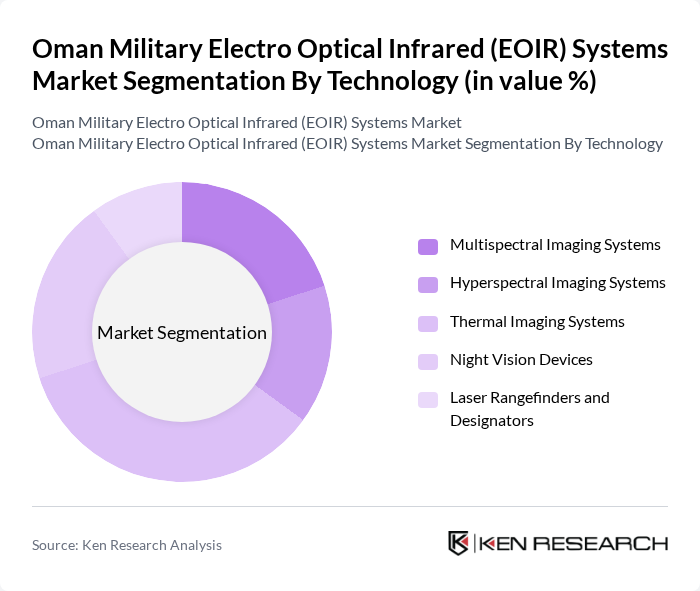
By Technology:The technology segment of the market includes various advanced systems that enhance military capabilities. The subsegments are Multispectral Imaging Systems, Hyperspectral Imaging Systems, Thermal Imaging Systems, Night Vision Devices, and Laser Rangefinders and Designators. Among these,Thermal Imaging Systemsare currently dominating the market due to their critical role in night operations and adverse weather conditions. The increasing need for effective surveillance and reconnaissance in military operations has led to a surge in demand for these systems, making them essential for modern warfare. The trend toward miniaturization and integration of AI in thermal imaging is further accelerating adoption in Oman and the broader region .
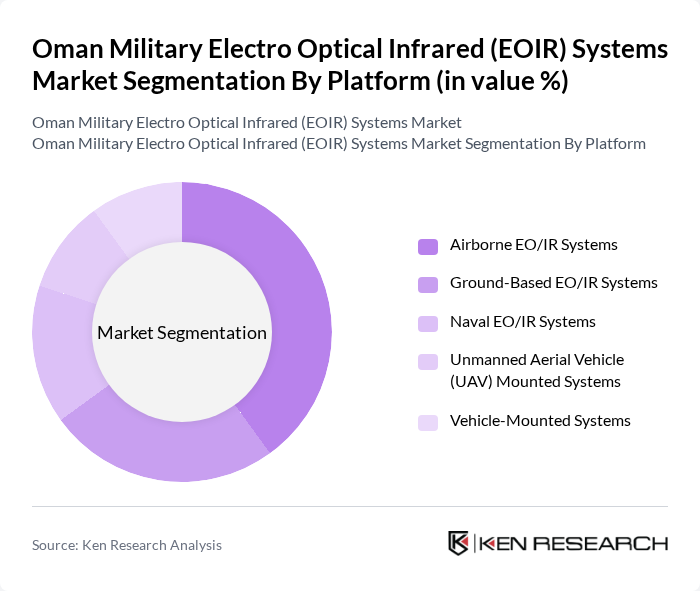
By Platform:The platform segment encompasses various deployment methods for EOIR systems, including Airborne EO/IR Systems, Ground-Based EO/IR Systems, Naval EO/IR Systems, Unmanned Aerial Vehicle (UAV) Mounted Systems, and Vehicle-Mounted Systems.Airborne EO/IR Systemsare leading this segment due to their versatility and effectiveness in providing real-time intelligence and surveillance from the sky. The increasing use of drones and aircraft for reconnaissance missions has significantly boosted the demand for airborne systems, making them a critical component of modern military operations. The adoption of EOIR payloads on UAVs and manned aircraft is accelerating as Oman invests in ISR modernization .
The Oman Military Electro Optical Infrared (EOIR) Systems Market is characterized by a dynamic mix of regional and international players. Leading participants such as Thales Group, Raytheon Technologies Corporation, Northrop Grumman Corporation, Leonardo S.p.A., BAE Systems PLC, Elbit Systems Ltd., L3Harris Technologies Inc., Saab AB, Rheinmetall AG, General Dynamics Corporation, FLIR Systems Inc. (Teledyne Technologies), QinetiQ Group PLC, Ultra Electronics Holdings PLC, Hensoldt AG, Aselsan A.?. contribute to innovation, geographic expansion, and service delivery in this space .
The future of the Oman Military EOIR systems market appears promising, driven by ongoing technological advancements and increased defense spending. As Oman seeks to modernize its military capabilities, the integration of AI and machine learning into EOIR systems will enhance operational efficiency. Additionally, international collaborations and joint ventures are expected to facilitate knowledge transfer and improve local manufacturing capabilities, ultimately strengthening the defense sector and ensuring national security.
| Segment | Sub-Segments |
|---|---|
| By Technology | Multispectral Imaging Systems Hyperspectral Imaging Systems Thermal Imaging Systems Night Vision Devices Laser Rangefinders and Designators |
| By Platform | Airborne EO/IR Systems Ground-Based EO/IR Systems Naval EO/IR Systems Unmanned Aerial Vehicle (UAV) Mounted Systems Vehicle-Mounted Systems |
| By Application | Surveillance and Reconnaissance Target Acquisition and Designation Weapon Sighting and Fire Control Navigation and Guidance Search and Rescue Operations |
| By Component | Optics and Sensors Control Systems Human Machine Interfaces Processors and Computing Units Other Components |
| By End-User | Royal Oman Air Force Royal Oman Navy Royal Oman Army Royal Oman Police Paramilitary and Border Security Forces |
| By Region | Muscat Dhofar Al Batinah Al Dakhiliyah Musandam |
| Scope Item/Segment | Sample Size | Target Respondent Profiles |
|---|---|---|
| Military Procurement Officials | 60 | Defense Procurement Managers, Budget Analysts |
| EOIR Technology Providers | 50 | Product Managers, Sales Directors |
| Military End-Users | 40 | Field Operators, Tactical Commanders |
| Defense Analysts | 40 | Market Researchers, Policy Advisors |
| Industry Experts | 40 | Technology Consultants, Defense Strategists |
The Oman Military Electro Optical Infrared (EOIR) Systems Market is valued at approximately USD 1.1 billion, reflecting a significant investment in advanced military capabilities and surveillance technologies over the past five years.

What makes us stand out is that our consultants follow Robust, Refine and Result (RRR) methodology. Robust for clear definitions, approaches and sanity checking, Refine for differentiating respondents' facts and opinions, and Result for presenting data with story.

We have set a benchmark in the industry by offering our clients with syndicated and customized market research reports featuring coverage of entire market as well as meticulous research and analyst insights.

While we don't replace traditional research, we flip the method upside down. Our dual approach of Top Bottom & Bottom Top ensures quality deliverable by not just verifying company fundamentals but also looking at the sector and macroeconomic factors.

With one step in the future, our research team constantly tries to show you the bigger picture. We help with some of the tough questions you may encounter along the way: How is the industry positioned? Best marketing channel? KPI's of competitors? By aligning every element, we help maximize success.

Our report gives you instant access to the answers and sources that other companies might choose to hide. We elaborate each steps of research methodology we have used and showcase you the sample size to earn your trust.

If you need any support, we are here! We pride ourselves on universe strength, data quality, and quick, friendly, and professional service.













