Region:Middle East
Author(s):Rebecca
Product Code:KRAD4323
Pages:96
Published On:December 2025
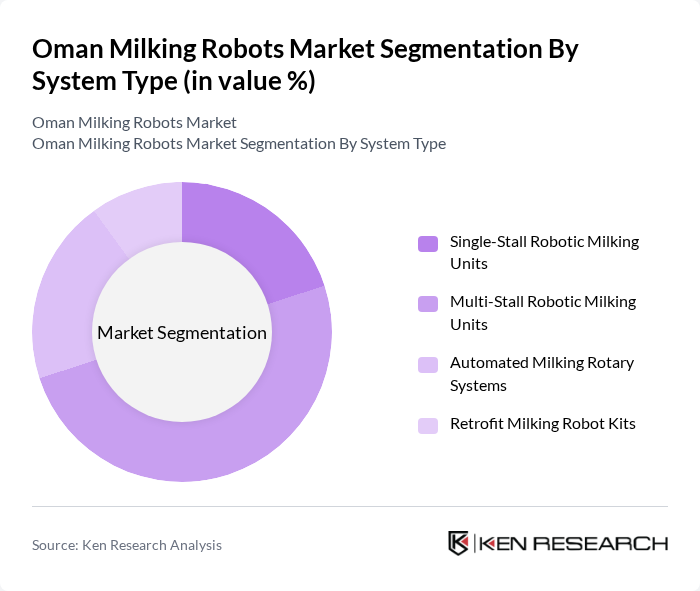
By System Type:The system type segmentation includes Single-Stall Robotic Milking Units, Multi-Stall Robotic Milking Units, Automated Milking Rotary Systems, and Retrofit Milking Robot Kits. Global and regional evidence shows that multi?stall and rotary automated milking solutions are preferred by medium and large commercial farms because they allow more cows to be milked per hour and improve labor productivity, which supports the assumption that Multi-Stall Robotic Milking Units are leading the market in Oman for larger herds. The trend towards consolidation into larger, professionally managed dairy farms across many markets has driven demand for these higher?throughput systems, while retrofit kits are often used to incrementally automate existing parlors and single?stall units are more common for smaller or pilot operations.
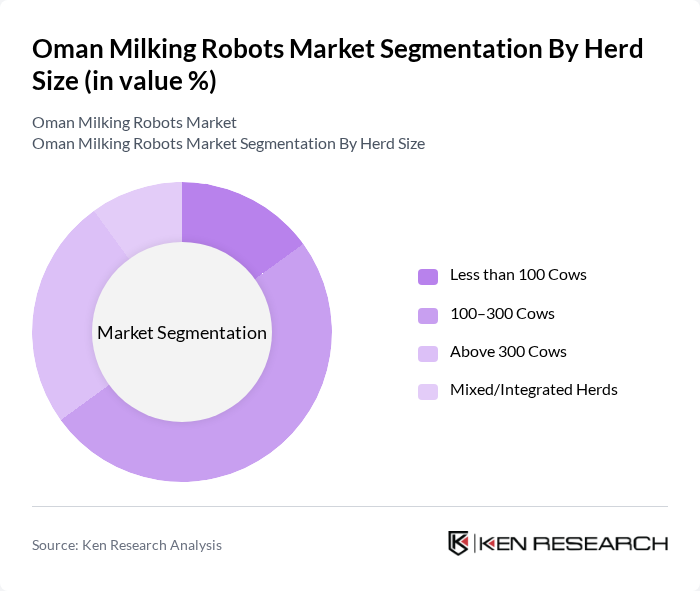
By Herd Size:The herd size segmentation includes Less than 100 Cows, 100–300 Cows, Above 300 Cows, and Mixed/Integrated Herds. In line with global patterns, where medium?sized dairy farms represent a major share of robotic?milking adoption because they balance investment capacity with the need to reduce labor dependence, the segment of 100–300 Cows can be viewed as a likely core adopter group in Oman as well. This size allows for a balance between operational efficiency, capital intensity, and management complexity, making it attractive for farms that are modernizing operations and looking to automate milking while controlling unit costs per liter of milk.
The Oman Milking Robots Market is characterized by a dynamic mix of regional and international players. At the global level, leading manufacturers such as DeLaval International AB, Lely Industries N.V., GEA Group AG, BouMatic LLC, Fullwood Packo Ltd, SAC Milking A/S, Afimilk Ltd, Dairymaster, Nedap N.V. (Livestock Management), Waikato Milking Systems NZ Ltd, and Tetra Pak Group are all active in automated milking and precision?dairy technologies and supply the Middle East region through distributors and integrators. In the Gulf, regional dairy producers and value?chain companies such as Pearson International LLC (Gulf Dairy Equipment), Al Rawabi Dairy Company, Mazoon Dairy Company SAOC, and Dhofar Cattle Feed Co. SAOG typically act as adopters, partners, or channel nodes for these technologies, contributing to localized service, integration, and training capabilities.
The future of the Oman milking robots market appears promising, driven by ongoing technological advancements and increasing government support for modern agricultural practices. As farmers become more aware of the benefits of automation, adoption rates are expected to rise. Additionally, the integration of IoT technologies will enhance operational efficiency, allowing for real-time monitoring and data-driven decision-making. This evolution will likely position Oman as a regional leader in dairy production, fostering sustainable growth in the sector.
| Segment | Sub-Segments |
|---|---|
| By System Type | Single-Stall Robotic Milking Units Multi-Stall Robotic Milking Units Automated Milking Rotary Systems Retrofit Milking Robot Kits |
| By Herd Size | Less than 100 Cows –300 Cows Above 300 Cows Mixed/Integrated Herds |
| By Farm Ownership | Privately Owned Commercial Dairy Farms Government and Semi-Government Farms Cooperative Dairy Farms Research and Demonstration Farms |
| By Offering | Hardware (Robots, Sensors, Milking Parlors) Software (Herd & Data Management) Services (Installation, Training, Maintenance) Aftermarket Parts & Upgrades |
| By Application | Milk Harvesting & Teat Preparation Herd Health & Behavior Monitoring Feeding & Barn Automation Integration Analytics & Performance Optimization |
| By Sales Channel | Direct Sales (OEM to Farm) Local Distributors & Dealers System Integrators & Engineering Firms Regional Importers/Value-Added Resellers |
| By Region | Muscat & Al Batinah Dhofar Al Dakhiliyah & Al Sharqiyah Other Governorates |
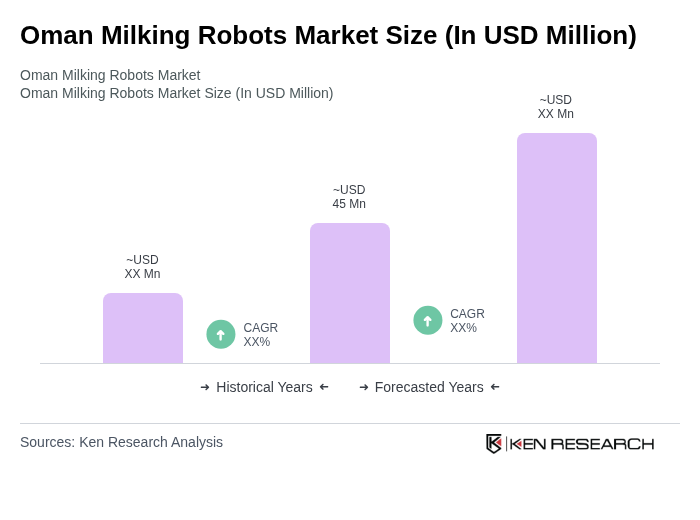
The Oman Milking Robots Market is valued at approximately USD 45 million, reflecting a growing trend in automated dairy farming practices driven by efficiency, labor reduction, and improved milk production.

What makes us stand out is that our consultants follow Robust, Refine and Result (RRR) methodology. Robust for clear definitions, approaches and sanity checking, Refine for differentiating respondents' facts and opinions, and Result for presenting data with story.

We have set a benchmark in the industry by offering our clients with syndicated and customized market research reports featuring coverage of entire market as well as meticulous research and analyst insights.

While we don't replace traditional research, we flip the method upside down. Our dual approach of Top Bottom & Bottom Top ensures quality deliverable by not just verifying company fundamentals but also looking at the sector and macroeconomic factors.

With one step in the future, our research team constantly tries to show you the bigger picture. We help with some of the tough questions you may encounter along the way: How is the industry positioned? Best marketing channel? KPI's of competitors? By aligning every element, we help maximize success.

Our report gives you instant access to the answers and sources that other companies might choose to hide. We elaborate each steps of research methodology we have used and showcase you the sample size to earn your trust.

If you need any support, we are here! We pride ourselves on universe strength, data quality, and quick, friendly, and professional service.













