Oman Pharmaceutical Collaborative Robots Market Report Size, Share, Growth Drivers, Trends, Opportunities & Forecast 2025–2030

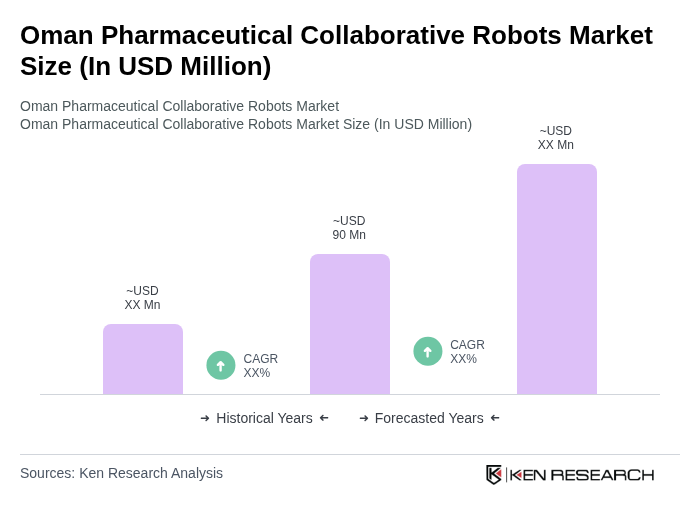
Oman Pharmaceutical Collaborative Robots Market at USD 90 Mn, fueled by automation in manufacturing, precision, and regulatory compliance for enhanced efficiency.

Region:Middle East

Author(s):Rebecca

Product Code:KRAD5028

Pages:83

Published On:December 2025
About the Report

Base Year 2024

Oman Pharmaceutical Collaborative Robots Market Overview

  • The Oman Pharmaceutical Collaborative Robots Market is valued at USD 90 million, based on a five-year historical analysis, as part of the broader growth in Oman’s robotics and automation ecosystem. This growth is primarily driven by the increasing demand for automation in pharmaceutical manufacturing processes, which enhances efficiency, reduces human error, and supports higher throughput. The rising focus on quality control, data integrity, and compliance with stringent regulatory standards further propels the adoption of collaborative robots in areas such as sterile filling, packaging, inspection, and laboratory automation.
  • Muscat, the capital city, is a dominant player in the market due to its concentration of pharmaceutical companies, distribution hubs, and research institutions, supported by industrial estates such as Rusayl and Knowledge Oasis Muscat. Additionally, the Dhofar region, particularly Salalah, is emerging as a key area for pharmaceutical and healthcare-related production within wider manufacturing initiatives, supported by government programs aimed at boosting local manufacturing capabilities and leveraging the Salalah Free Zone and port infrastructure. These regions benefit from strategic investments, incentives for industrial automation, and a growing skilled workforce in engineering, IT, and life sciences under Oman Vision 2040 industrial diversification priorities.
  • In 2023, the Omani government strengthened its regulatory framework for pharmaceutical manufacturing automation by aligning Good Manufacturing Practice (GMP) and quality requirements with international standards under the Pharmaceutical Products Law issued by the Ministry of Health and enforced through the Ministry of Health’s Guidance for Pharmaceutical Manufacturing Facilities and Good Manufacturing Practice Guidelines, 2017, which require validated, documented, and controlled automated processes for critical operations. These instruments promote the adoption of advanced automation technologies, including collaborative robots, to ensure traceability, consistent product quality, and compliance with international benchmarks, thereby fostering innovation and competitiveness within the local pharmaceutical industry.
Oman Pharmaceutical Collaborative Robots Market Size

Oman Pharmaceutical Collaborative Robots Market Segmentation

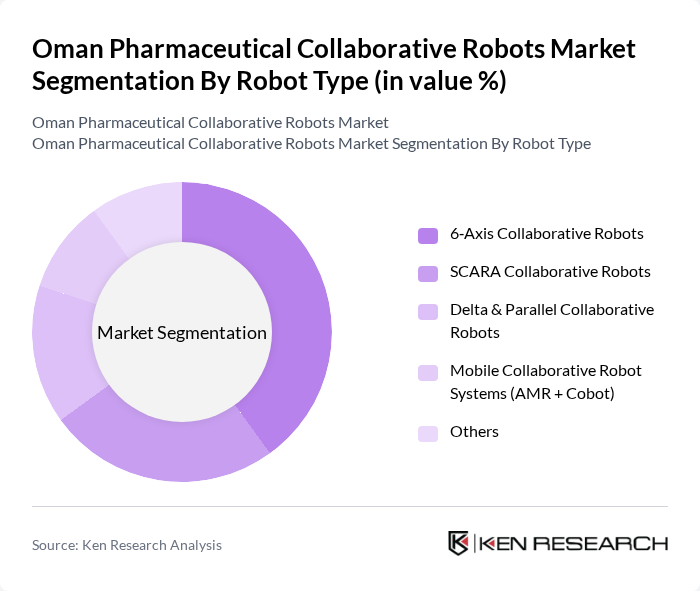
By Robot Type:The market is segmented into various robot types, including 6-Axis Collaborative Robots, SCARA Collaborative Robots, Delta & Parallel Collaborative Robots, Mobile Collaborative Robot Systems (AMR + Cobot), and Others. This structure is in line with global pharmaceutical robotics classifications, where articulated 6?axis, SCARA, and Delta architectures dominate core production and packaging tasks. Among these, 6-Axis Collaborative Robots are leading the market due to their versatility, higher degrees of freedom, and ability to perform complex tasks such as aseptic handling, machine tending, and quality inspection in confined spaces, making them particularly suitable for cleanroom and pharmaceutical applications.
Oman Pharmaceutical Collaborative Robots Market segmentation by Robot Type.

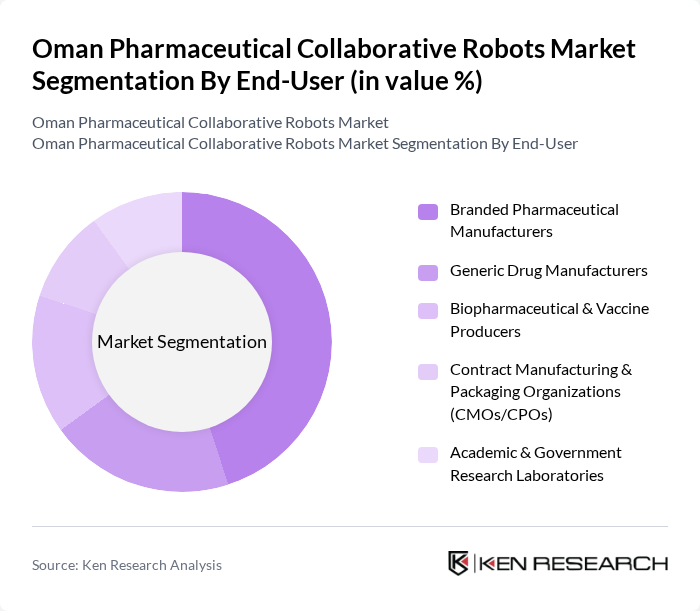
By End-User:The end-user segmentation includes Branded Pharmaceutical Manufacturers, Generic Drug Manufacturers, Biopharmaceutical & Vaccine Producers, Contract Manufacturing & Packaging Organizations (CMOs/CPOs), and Academic & Government Research Laboratories. This segmentation aligns with global adoption patterns, where originator brands, generics, and biopharma facilities are the primary users of cobots for fill?finish, packaging, inspection, and lab workflows. Branded Pharmaceutical Manufacturers dominate this segment due to their relatively larger capital expenditure on automation, stronger focus on global regulatory compliance, and the need to support high-value, small-batch and specialty drug production with consistent quality and traceability.
Oman Pharmaceutical Collaborative Robots Market segmentation by End-User.

Oman Pharmaceutical Collaborative Robots Market Competitive Landscape

The Oman Pharmaceutical Collaborative Robots Market is characterized by a dynamic mix of regional and international players. Leading participants such as ABB Ltd., KUKA AG, Universal Robots A/S, FANUC Corporation, Yaskawa Electric Corporation, Omron Corporation, Techman Robot Inc., AUBO (Beijing) Robotics Technology Co., Ltd., Stäubli Robotics, Kawasaki Heavy Industries, Ltd. – Robotics Division, Mitsubishi Electric Corporation, DENSO Corporation, Epson Robots (Seiko Epson Corporation), Doosan Robotics Inc., local System Integrators & Automation Partners in Oman contribute to innovation, geographic expansion, and service delivery in this space, mirroring their established role as key suppliers in the global pharmaceutical robots and collaborative robots markets.

ABB Ltd.

1988

Zurich, Switzerland

KUKA AG

1898

Augsburg, Germany

Universal Robots A/S

2005

Odense, Denmark

FANUC Corporation

1956

Yamanashi, Japan

Yaskawa Electric Corporation

1915

Kitakyushu, Japan

Company

Establishment Year

Headquarters

Annual Pharmaceutical Cobot Revenue in Oman (USD Million)

3?Year Revenue CAGR from Pharmaceutical Applications in Oman

Share of Pharma in Vendor’s Total Oman Robotics Revenue (%)

Number of Pharma Use Cases Deployed in Oman

Average Payback Period for Pharma Cobot Projects (Months)

Average System Price per Pharma Cobot Cell in Oman (USD)

Oman Pharmaceutical Collaborative Robots Market Industry Analysis

Growth Drivers

  • Increasing Demand for Automation in Pharmaceutical Manufacturing:The pharmaceutical sector in Oman is experiencing a significant shift towards automation, driven by the need for increased production efficiency. In future, the sector is projected to grow by 6.5%, with automation technologies expected to account for 30% of manufacturing processes. This shift is fueled by the rising complexity of drug formulations, necessitating advanced robotic solutions to enhance productivity and reduce human error, ultimately leading to improved patient outcomes.
  • Rising Labor Costs and Shortages:Oman faces a growing challenge with labor costs, which have increased by 4.2% annually since the previous year. This trend is compounded by a shortage of skilled labor in the pharmaceutical industry, with a reported gap of approximately 1,500 qualified professionals in future. As companies seek to mitigate these challenges, the adoption of collaborative robots becomes a viable solution, allowing for streamlined operations and reduced dependency on human labor, thereby optimizing overall production costs.
  • Enhanced Precision and Efficiency in Drug Production:The demand for high-quality pharmaceuticals is driving the need for precision in drug production. In future, the global pharmaceutical market is expected to reach $1.5 trillion, with Oman aiming to capture a larger share through improved manufacturing processes. Collaborative robots can significantly enhance precision, reducing production errors by up to 50%, which is crucial for compliance with stringent regulatory standards and ensuring patient safety in drug delivery.

Market Challenges

  • High Initial Investment Costs:The implementation of collaborative robots in pharmaceutical manufacturing requires substantial upfront investment, often exceeding $200,000 per unit. This financial barrier can deter smaller companies from adopting these technologies, especially in a market where profit margins are tight. In future, it is estimated that only 15% of Omani pharmaceutical firms will have the capital to invest in automation, limiting the overall growth potential of the collaborative robots market.
  • Limited Awareness and Understanding of Collaborative Robots:A significant challenge in Oman is the lack of awareness regarding the benefits and functionalities of collaborative robots. Surveys indicate that over 60% of pharmaceutical companies have limited knowledge about automation technologies. This gap in understanding can hinder adoption rates, as companies may be reluctant to invest in unfamiliar technologies, thereby slowing the overall growth of the collaborative robots market in the region.

Oman Pharmaceutical Collaborative Robots Market Future Outlook

The future of the Oman pharmaceutical collaborative robots market appears promising, driven by technological advancements and increasing demand for automation. As companies invest in research and development, the integration of AI and machine learning into robotic systems is expected to enhance operational efficiency. Furthermore, the growing emphasis on sustainability in pharmaceutical production will likely lead to innovative solutions that align with environmental goals, fostering a more resilient and competitive market landscape in the coming years.

Market Opportunities

  • Expansion of Biopharmaceuticals and Personalized Medicine:The biopharmaceutical sector in Oman is projected to grow by 8% annually, creating a significant opportunity for collaborative robots. These technologies can streamline the production of personalized medicines, which require precise and flexible manufacturing processes, thus enhancing the overall efficiency and responsiveness of pharmaceutical companies to market demands.
  • Technological Advancements in Robotics:Continuous advancements in robotics technology, including improved sensors and AI capabilities, present a unique opportunity for the pharmaceutical sector. In future, it is anticipated that the integration of these technologies will reduce operational costs by 20%, making automation more accessible and attractive to Omani pharmaceutical firms, thereby driving market growth.

Scope of the Report

SegmentSub-Segments
By Robot Type

?Axis Collaborative Robots

SCARA Collaborative Robots

Delta & Parallel Collaborative Robots

Mobile Collaborative Robot Systems (AMR + Cobot)

Others

By End-User

Branded Pharmaceutical Manufacturers

Generic Drug Manufacturers

Biopharmaceutical & Vaccine Producers

Contract Manufacturing & Packaging Organizations (CMOs/CPOs)

Academic & Government Research Laboratories

By Application

Primary & Secondary Packaging

Sterile Compounding and Aseptic Filling

Quality Control, Inspection & Testing

Material Handling, Line Loading & Palletizing

Laboratory Automation (Sample Prep, Assay Handling)

By Payload Capacity

Up to 5 kg

kg to 10 kg

kg to 20 kg

Above 20 kg

Others

By Region

Muscat Governorate

Dhofar (Salalah)

Al Batinah (incl. Sohar)

Ad Dakhiliyah (incl. Nizwa)

Other Governorates

By Enabling Technology

Integrated Vision Systems

Force & Torque Sensing

Safety & Compliance Systems (ISO 10218 / ISO 13849)

Advanced Control & Programming Platforms

Data Connectivity, IIoT & Remote Monitoring

By Customer Size

Large Multinational Pharma & Biopharma Sites

Regional & Mid?Sized Manufacturers

Small Local Manufacturers

New Entrants & Technology Startups

Public Sector & Institutional Buyers

Key Target Audience

Investors and Venture Capitalist Firms

Government and Regulatory Bodies (e.g., Ministry of Health, Oman Pharmaceutical Association)

Pharmaceutical Manufacturers and Producers

Healthcare Providers and Hospitals

Robotics and Automation Technology Providers

Supply Chain and Logistics Companies

Industry Associations and Trade Organizations

Financial Institutions and Banks

Players Mentioned in the Report:

ABB Ltd.

KUKA AG

Universal Robots A/S

FANUC Corporation

Yaskawa Electric Corporation

Omron Corporation

Techman Robot Inc.

AUBO (Beijing) Robotics Technology Co., Ltd.

Staubli Robotics

Kawasaki Heavy Industries, Ltd. Robotics Division

Mitsubishi Electric Corporation

DENSO Corporation

Epson Robots (Seiko Epson Corporation)

Doosan Robotics Inc.

local System Integrators & Automation Partners in Oman

Table of Contents

Market Assessment Phase

1. Executive Summary and Approach


2. Oman Pharmaceutical Collaborative Robots Market Overview

2.1 Key Insights and Strategic Recommendations

2.2 Oman Pharmaceutical Collaborative Robots Market Overview

2.3 Definition and Scope

2.4 Evolution of Market Ecosystem

2.5 Timeline of Key Regulatory Milestones

2.6 Value Chain & Stakeholder Mapping

2.7 Business Cycle Analysis

2.8 Policy & Incentive Landscape


3. Oman Pharmaceutical Collaborative Robots Market Analysis

3.1 Growth Drivers

3.1.1 Increasing Demand for Automation in Pharmaceutical Manufacturing
3.1.2 Rising Labor Costs and Shortages
3.1.3 Enhanced Precision and Efficiency in Drug Production
3.1.4 Growing Focus on Safety and Compliance Standards

3.2 Market Challenges

3.2.1 High Initial Investment Costs
3.2.2 Limited Awareness and Understanding of Collaborative Robots
3.2.3 Integration with Existing Systems
3.2.4 Regulatory Hurdles and Compliance Issues

3.3 Market Opportunities

3.3.1 Expansion of Biopharmaceuticals and Personalized Medicine
3.3.2 Technological Advancements in Robotics
3.3.3 Increasing Investment in R&D by Pharmaceutical Companies
3.3.4 Collaborations and Partnerships in the Robotics Sector

3.4 Market Trends

3.4.1 Adoption of AI and Machine Learning in Robotics
3.4.2 Shift Towards Modular and Flexible Manufacturing Systems
3.4.3 Growing Emphasis on Sustainability in Pharmaceutical Production
3.4.4 Rise of Remote Monitoring and Control Technologies

3.5 Government Regulation

3.5.1 Compliance with International Safety Standards
3.5.2 Incentives for Automation in Manufacturing
3.5.3 Regulations on Robotics in Healthcare Settings
3.5.4 Guidelines for Data Security and Privacy in Robotics

4. SWOT Analysis


5. Stakeholder Analysis


6. Porter's Five Forces Analysis


7. Oman Pharmaceutical Collaborative Robots Market Market Size, 2019-2024

7.1 By Value

7.2 By Volume

7.3 By Average Selling Price


8. Oman Pharmaceutical Collaborative Robots Market Segmentation

8.1 By Robot Type

8.1.1 6?Axis Collaborative Robots
8.1.2 SCARA Collaborative Robots
8.1.3 Delta & Parallel Collaborative Robots
8.1.4 Mobile Collaborative Robot Systems (AMR + Cobot)
8.1.5 Others

8.2 By End-User

8.2.1 Branded Pharmaceutical Manufacturers
8.2.2 Generic Drug Manufacturers
8.2.3 Biopharmaceutical & Vaccine Producers
8.2.4 Contract Manufacturing & Packaging Organizations (CMOs/CPOs)
8.2.5 Academic & Government Research Laboratories

8.3 By Application

8.3.1 Primary & Secondary Packaging
8.3.2 Sterile Compounding and Aseptic Filling
8.3.3 Quality Control, Inspection & Testing
8.3.4 Material Handling, Line Loading & Palletizing
8.3.5 Laboratory Automation (Sample Prep, Assay Handling)

8.4 By Payload Capacity

8.4.1 Up to 5 kg
8.4.2 5 kg to 10 kg
8.4.3 10 kg to 20 kg
8.4.4 Above 20 kg
8.4.5 Others

8.5 By Region

8.5.1 Muscat Governorate
8.5.2 Dhofar (Salalah)
8.5.3 Al Batinah (incl. Sohar)
8.5.4 Ad Dakhiliyah (incl. Nizwa)
8.5.5 Other Governorates

8.6 By Enabling Technology

8.6.1 Integrated Vision Systems
8.6.2 Force & Torque Sensing
8.6.3 Safety & Compliance Systems (ISO 10218 / ISO 13849)
8.6.4 Advanced Control & Programming Platforms
8.6.5 Data Connectivity, IIoT & Remote Monitoring

8.7 By Customer Size

8.7.1 Large Multinational Pharma & Biopharma Sites
8.7.2 Regional & Mid?Sized Manufacturers
8.7.3 Small Local Manufacturers
8.7.4 New Entrants & Technology Startups
8.7.5 Public Sector & Institutional Buyers

9. Oman Pharmaceutical Collaborative Robots Market Competitive Analysis

9.1 Market Share of Key Players

9.2 Cross Comparison of Key Players

9.2.1 Installed Base of Pharmaceutical Cobots in Oman (Units)
9.2.2 Annual Pharmaceutical Cobot Revenue in Oman (USD Million)
9.2.3 3?Year Revenue CAGR from Pharmaceutical Applications in Oman
9.2.4 Share of Pharma in Vendor’s Total Oman Robotics Revenue (%)
9.2.5 Number of Pharma Use Cases Deployed in Oman
9.2.6 Average Payback Period for Pharma Cobot Projects (Months)
9.2.7 Average System Price per Pharma Cobot Cell in Oman (USD)
9.2.8 Compliance Readiness (GMP/ISO/21 CFR Part 11 Scorecard)
9.2.9 Service & Support Footprint in Oman (FTEs / Response SLAs)
9.2.10 Partnership Network with Local Integrators & Pharma End?Users

9.3 SWOT Analysis of Top Players

9.4 Pricing Analysis

9.5 Detailed Profile of Major Companies

9.5.1 ABB Ltd.
9.5.2 KUKA AG
9.5.3 Universal Robots A/S
9.5.4 FANUC Corporation
9.5.5 Yaskawa Electric Corporation
9.5.6 Omron Corporation
9.5.7 Techman Robot Inc.
9.5.8 AUBO (Beijing) Robotics Technology Co., Ltd.
9.5.9 Stäubli Robotics
9.5.10 Kawasaki Heavy Industries, Ltd. – Robotics Division
9.5.11 Mitsubishi Electric Corporation
9.5.12 DENSO Corporation
9.5.13 Epson Robots (Seiko Epson Corporation)
9.5.14 Doosan Robotics Inc.
9.5.15 local System Integrators & Automation Partners in Oman

10. Oman Pharmaceutical Collaborative Robots Market End-User Analysis

10.1 Procurement Behavior of Key Ministries

10.1.1 Budget Allocation for Robotics
10.1.2 Decision-Making Process
10.1.3 Supplier Selection Criteria
10.1.4 Contract Management Practices

10.2 Corporate Spend on Infrastructure & Energy

10.2.1 Investment Trends in Automation
10.2.2 Budgeting for Collaborative Robots
10.2.3 Cost-Benefit Analysis Practices
10.2.4 Long-term Financial Commitments

10.3 Pain Point Analysis by End-User Category

10.3.1 Operational Inefficiencies
10.3.2 Compliance Challenges
10.3.3 Labor Shortages
10.3.4 Technology Integration Issues

10.4 User Readiness for Adoption

10.4.1 Training and Skill Development Needs
10.4.2 Change Management Strategies
10.4.3 Perceived Value of Collaborative Robots
10.4.4 Support from Leadership

10.5 Post-Deployment ROI and Use Case Expansion

10.5.1 Measurement of ROI
10.5.2 Expansion into New Applications
10.5.3 User Feedback and Iteration
10.5.4 Long-term Sustainability Considerations

11. Oman Pharmaceutical Collaborative Robots Market Future Size, 2025-2030

11.1 By Value

11.2 By Volume

11.3 By Average Selling Price


Go-To-Market Strategy Phase

1. Whitespace Analysis + Business Model Canvas

1.1 Market Gaps Identification

1.2 Value Proposition Development

1.3 Revenue Streams Analysis

1.4 Key Partnerships Exploration

1.5 Cost Structure Assessment


2. Marketing and Positioning Recommendations

2.1 Branding Strategies

2.2 Product USPs


3. Distribution Plan

3.1 Urban Retail vs Rural NGO Tie-ups


4. Channel & Pricing Gaps

4.1 Underserved Routes

4.2 Pricing Bands


5. Unmet Demand & Latent Needs

5.1 Category Gaps

5.2 Consumer Segments


6. Customer Relationship

6.1 Loyalty Programs

6.2 After-sales Service


7. Value Proposition

7.1 Sustainability

7.2 Integrated Supply Chains


8. Key Activities

8.1 Regulatory Compliance

8.2 Branding

8.3 Distribution Setup


9. Entry Strategy Evaluation

9.1 Domestic Market Entry Strategy

9.1.1 Product Mix
9.1.2 Pricing Band
9.1.3 Packaging

9.2 Export Entry Strategy

9.2.1 Target Countries
9.2.2 Compliance Roadmap

10. Entry Mode Assessment

10.1 JV

10.2 Greenfield

10.3 M&A

10.4 Distributor Model


11. Capital and Timeline Estimation

11.1 Capital Requirements

11.2 Timelines


12. Control vs Risk Trade-Off

12.1 Ownership vs Partnerships


13. Profitability Outlook

13.1 Breakeven Analysis

13.2 Long-term Sustainability


14. Potential Partner List

14.1 Distributors

14.2 JVs

14.3 Acquisition Targets


15. Execution Roadmap

15.1 Phased Plan for Market Entry

15.1.1 Market Setup
15.1.2 Market Entry
15.1.3 Growth Acceleration
15.1.4 Scale & Stabilize

15.2 Key Activities and Milestones

15.2.1 Milestone Planning
15.2.2 Activity Tracking

Research Methodology

ApproachModellingSample

Phase 1: Approach1

Desk Research

  • Analysis of industry reports from pharmaceutical associations in Oman
  • Review of government publications on healthcare and pharmaceutical regulations
  • Examination of market trends and forecasts from global pharmaceutical research firms

Primary Research

  • Interviews with key stakeholders in the pharmaceutical sector, including manufacturers and distributors
  • Surveys conducted with healthcare professionals regarding the adoption of collaborative robots
  • Field visits to pharmaceutical facilities utilizing robotic technology for insights on operational efficiency

Validation & Triangulation

  • Cross-validation of data from multiple sources, including trade publications and expert interviews
  • Triangulation of findings from primary and secondary research to ensure consistency
  • Sanity checks through expert panel reviews comprising industry veterans and technology specialists

Phase 2: Market Size Estimation1

Top-down Assessment

  • Estimation of the overall pharmaceutical market size in Oman as a baseline for collaborative robots
  • Segmentation of the market by application areas such as packaging, dispensing, and inventory management
  • Incorporation of growth rates from healthcare expenditure and technological adoption trends

Bottom-up Modeling

  • Collection of data on the number of pharmaceutical firms currently using collaborative robots
  • Estimation of average spending on robotic solutions per firm based on operational needs
  • Calculation of total market size by aggregating firm-level data across the sector

Forecasting & Scenario Analysis

  • Development of predictive models based on historical adoption rates and technological advancements
  • Scenario analysis considering factors such as regulatory changes and market entry of new technologies
  • Projections of market growth under different economic conditions through 2030

Phase 3: CATI Sample Composition1

Scope Item/SegmentSample SizeTarget Respondent Profiles
Pharmaceutical Manufacturing120Production Managers, Operations Directors
Pharmaceutical Distribution90Logistics Coordinators, Supply Chain Managers
Healthcare Providers80Pharmacists, Hospital Administrators
Robotics Technology Providers60Sales Engineers, Product Managers
Regulatory Bodies40Policy Makers, Compliance Officers

Frequently Asked Questions

What is the current value of the Oman Pharmaceutical Collaborative Robots Market?

The Oman Pharmaceutical Collaborative Robots Market is valued at approximately USD 90 million, reflecting a significant growth trend driven by the increasing demand for automation in pharmaceutical manufacturing processes.

What factors are driving the growth of collaborative robots in Oman's pharmaceutical sector?

Which regions in Oman are leading in the pharmaceutical collaborative robots market?

What types of collaborative robots are most commonly used in Oman's pharmaceutical industry?

Other Regional/Country Reports

Indonesia Pharmaceutical Collaborative Robots Market

Malaysia Pharmaceutical Collaborative Robots Market

KSA Pharmaceutical Collaborative Robots Market

APAC Pharmaceutical Collaborative Robots Market

SEA Pharmaceutical Collaborative Robots Market

Vietnam Pharmaceutical Collaborative Robots Market

Other Adjacent Reports

Mexico Pharmaceutical Automation Market

Mexico Industrial Robotics Market

South Africa Biopharmaceutical Manufacturing Market

KSA Laboratory Automation Market

South Africa Medical Device Manufacturing Market

Egypt Packaging Automation Market

Bahrain Cleanroom Technology Market

Mexico Supply Chain Automation Market

Japan Healthcare Robotics Market

Qatar Precision Engineering Market

Why Buy From Us?

Refine Robust Result (RRR) Framework

What makes us stand out is that our consultants follow Robust, Refine and Result (RRR) methodology. Robust for clear definitions, approaches and sanity checking, Refine for differentiating respondents' facts and opinions, and Result for presenting data with story.

Our Reach Is Unmatched

We have set a benchmark in the industry by offering our clients with syndicated and customized market research reports featuring coverage of entire market as well as meticulous research and analyst insights.

Shifting the Research Paradigm

While we don't replace traditional research, we flip the method upside down. Our dual approach of Top Bottom & Bottom Top ensures quality deliverable by not just verifying company fundamentals but also looking at the sector and macroeconomic factors.

More Insights-Better Decisions

With one step in the future, our research team constantly tries to show you the bigger picture. We help with some of the tough questions you may encounter along the way: How is the industry positioned? Best marketing channel? KPI's of competitors? By aligning every element, we help maximize success.

Transparency and Trust

Our report gives you instant access to the answers and sources that other companies might choose to hide. We elaborate each steps of research methodology we have used and showcase you the sample size to earn your trust.

Round the Clock Support

If you need any support, we are here! We pride ourselves on universe strength, data quality, and quick, friendly, and professional service.

Why Clients Choose Us?

400000+
Reports in repository
150+
Consulting projects a year
100+
Analysts
8000+
Client Queries in 2022








