Oman Premium Coffee Pods Retail Market

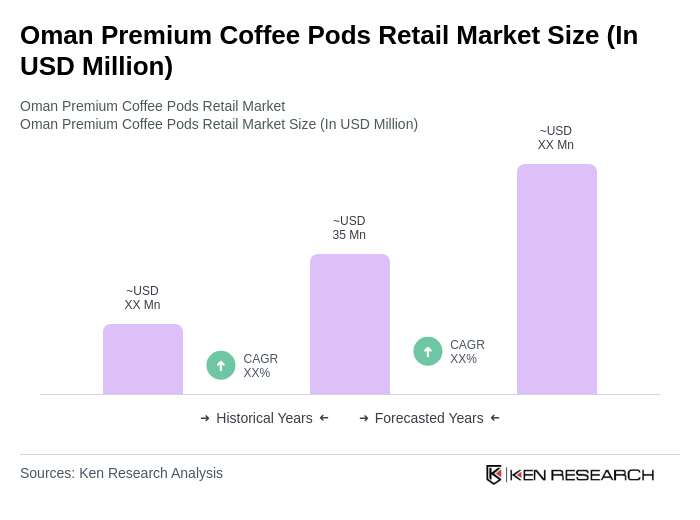
Oman Premium Coffee Pods Retail Market, valued at USD 35 million, grows with rising demand for convenient, premium coffee solutions and eco-friendly packaging.

Region:Middle East

Author(s):Shubham

Product Code:KRAC1514

Pages:88

Published On:October 2025
About the Report

Base Year 2024

Oman Premium Coffee Pods Retail Market Overview

  • The Oman Premium Coffee Pods Retail Market is valued at USD 35 million, based on a five-year historical analysis. This market growth is driven by rising consumer demand for convenient coffee solutions, the expansion of e-commerce and subscription models, and the increasing popularity of premium coffee experiences at home. The adoption of premium coffee pods has accelerated due to their ease of use, portion control, and the wide variety of flavors and brewing technologies available, appealing to a broad consumer base.
  • Muscat, the capital city, remains the dominant player in the Oman Premium Coffee Pods Retail Market, supported by its urban population and high disposable income levels. Salalah and Sohar are also notable contributors, with the growing café culture and increasing number of coffee shops fueling market expansion. Urbanization, evolving consumer lifestyles, and the proliferation of specialty coffee outlets in these regions have led to heightened demand for premium coffee products.
  • In 2023, the Omani government implemented the “Regulation on Packaging and Waste Management for Food and Beverage Products, 2023” issued by the Ministry of Commerce, Industry and Investment Promotion. This regulation mandates the use of eco-friendly packaging for coffee pods, including operational guidelines for biodegradable and recyclable materials, and requires manufacturers to comply with labeling and reporting standards. The initiative aligns with global sustainability trends and consumer preferences for environmentally responsible products.
Oman Premium Coffee Pods Retail Market Size

Oman Premium Coffee Pods Retail Market Segmentation

By Product Type:The product type segmentation encompasses a diverse range of coffee pods tailored to evolving consumer preferences. Coffee capsules are favored for their convenience and compatibility with automated machines. Single-origin and flavored pods attract consumers seeking distinctive taste experiences and variety. Organic and decaffeinated pods are increasingly popular among health-conscious consumers, reflecting a shift toward wellness and natural ingredients. The market’s diversity enables consumers to select products based on flavor, origin, dietary needs, and brewing method.
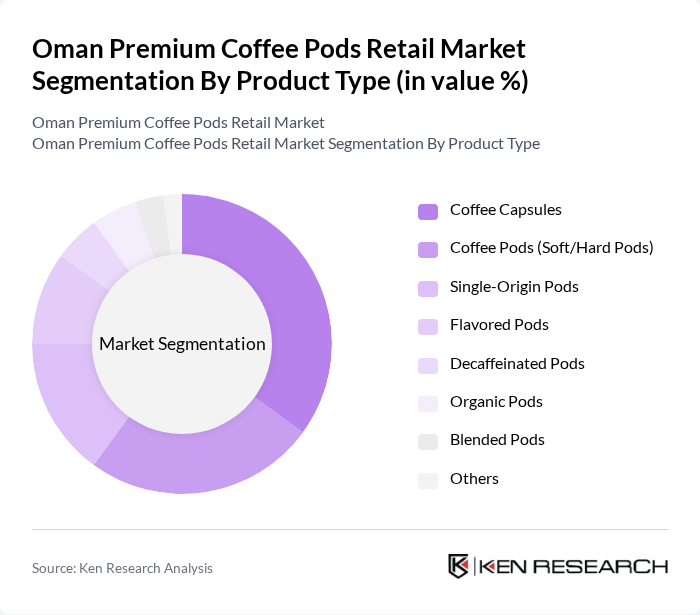
Oman Premium Coffee Pods Retail Market segmentation by Product Type.

By End-User:The end-user segmentation reflects the broad adoption of premium coffee pods across consumer groups. Households constitute the largest segment, driven by the convenience of brewing café-quality coffee at home. Offices and workplaces increasingly utilize coffee pods for efficient beverage service. Cafés and restaurants incorporate premium pods to diversify offerings, while the hospitality sector leverages these products to elevate guest experiences and meet rising expectations for quality and convenience.
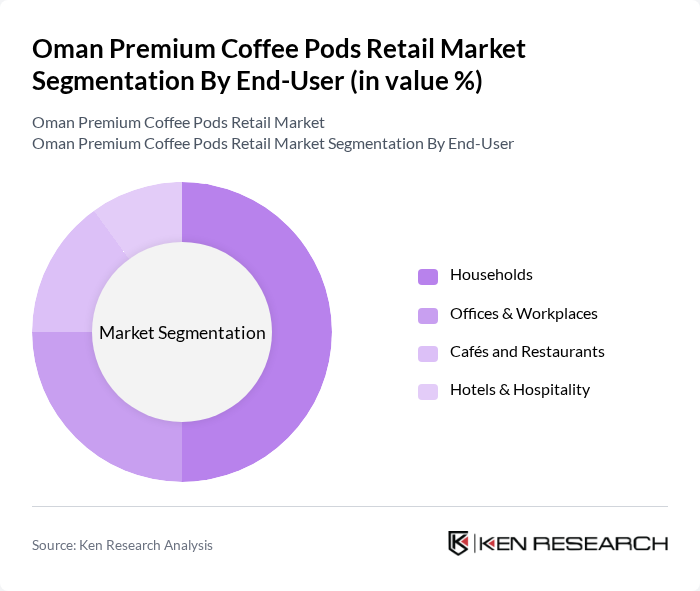
Oman Premium Coffee Pods Retail Market segmentation by End-User.

Oman Premium Coffee Pods Retail Market Competitive Landscape

The Oman Premium Coffee Pods Retail Market features a dynamic mix of regional and international players. Leading participants such as Nespresso (Nestlé S.A.), Lavazza Group, illycaffè S.p.A., Keurig Dr Pepper Inc., Starbucks Corporation, JDE Peet's (Douwe Egberts, L'OR, Jacobs), Tchibo GmbH, Costa Coffee (The Coca-Cola Company), Caffè Vergnano S.p.A., Segafredo Zanetti (Massimo Zanetti Beverage Group), Al Ameed Coffee, Boncafé Middle East, Coffee Planet, Al Manara Roastery, and Muscat Coffee Company drive innovation, geographic expansion, and service delivery in the market.

Nespresso

1986

Lausanne, Switzerland

Lavazza Group

1895

Turin, Italy

illycaffè

1933

Trieste, Italy

Keurig Dr Pepper

2018

Frisco, Texas, USA

Starbucks Corporation

1971

Seattle, Washington, USA

Company

Establishment Year

Headquarters

Revenue (USD Million)

Revenue Growth Rate (%)

Number of SKUs/Variants Offered

Distribution Channel Coverage

Average Selling Price per Pod

Customer Retention Rate (%)

Oman Premium Coffee Pods Retail Market Industry Analysis

Growth Drivers

  • Increasing Consumer Preference for Convenience:The demand for convenience in coffee consumption is surging, with over 60% of consumers in Oman preferring quick and easy coffee solutions. The World Bank reported that the convenience food market in Oman is projected to reach $1.5 billion in future, indicating a strong trend towards ready-to-use products. This shift is driving the growth of premium coffee pods, as they offer a hassle-free brewing experience without compromising on quality.
  • Rise in Disposable Income:Oman’s GDP per capita is expected to rise to approximately $25,000 in future, reflecting a growing middle class with increased purchasing power. As disposable incomes rise, consumers are more willing to spend on premium products, including high-quality coffee pods. This trend is supported by the International Monetary Fund, which forecasts a 4% growth in Oman’s economy, further enhancing consumer spending capabilities in the premium coffee segment.
  • Growth of Specialty Coffee Culture:The specialty coffee market in Oman is expanding, with a reported increase of 20% in specialty coffee consumption over the past year. This growth is driven by a younger demographic that values unique flavors and artisanal products. According to industry reports, the number of specialty coffee shops in Oman has tripled since 2020, creating a robust market for premium coffee pods that cater to this evolving consumer preference for quality and variety.

Market Challenges

  • High Competition from Traditional Coffee:The traditional coffee market in Oman remains strong, with over 70% of coffee drinkers still preferring brewed coffee. This entrenched preference poses a significant challenge for premium coffee pod retailers. The Oman Coffee Association reports that traditional coffee sales are projected to reach $400 million in future, highlighting the fierce competition that premium coffee pods must overcome to gain market share.
  • Price Sensitivity Among Consumers:Despite rising incomes, many consumers in Oman remain price-sensitive, particularly in the coffee segment. A recent survey indicated that 60% of consumers consider price as the primary factor when purchasing coffee products. This sensitivity can hinder the growth of premium coffee pods, which typically carry a higher price point compared to traditional options, making it essential for brands to balance quality with affordability to attract price-conscious buyers.

Oman Premium Coffee Pods Retail Market Future Outlook

The future of the Oman premium coffee pods market appears promising, driven by evolving consumer preferences and a growing appreciation for quality coffee. As disposable incomes rise and the specialty coffee culture flourishes, the demand for premium products is expected to increase. Retailers are likely to focus on innovative marketing strategies and product diversification to capture the attention of younger consumers, while sustainability trends will shape product offerings and packaging solutions in the coming years.

Market Opportunities

  • Introduction of New Flavors and Blends:There is a significant opportunity to introduce unique flavors and blends tailored to local tastes. With the Omani coffee market valuing authenticity, brands can leverage this by offering region-specific blends, potentially increasing sales by 30% as consumers seek novel experiences in their coffee consumption.
  • Expansion into Online Retail:The e-commerce sector in Oman is projected to grow to $1.5 billion in future, presenting a lucrative opportunity for premium coffee pod brands. By establishing a strong online presence, companies can reach a broader audience, particularly tech-savvy younger consumers who prefer shopping online, thus enhancing market penetration and sales growth.

Scope of the Report

SegmentSub-Segments
By Product Type

Coffee Capsules

Coffee Pods (Soft/Hard Pods)

Single-Origin Pods

Flavored Pods

Decaffeinated Pods

Organic Pods

Blended Pods

Others

By End-User

Households

Offices & Workplaces

Cafés and Restaurants

Hotels & Hospitality

By Distribution Channel

Supermarkets & Hypermarkets

Convenience Stores

Specialty Coffee Stores

E-commerce

Foodservice Channels

Others

By Price Range

Premium

Mid-Range

Budget

By Packaging Type

Single-Serve Packs

Multi-Pack Boxes

Bulk Packaging

By Brand Loyalty

Brand Loyal Customers

Price-Sensitive Customers

New Customers

By Distribution Mode

Direct Distribution

Indirect Distribution

Franchise Distribution

Key Target Audience

Investors and Venture Capitalist Firms

Government and Regulatory Bodies (e.g., Ministry of Commerce, Industry and Investment Promotion)

Manufacturers and Producers

Distributors and Retailers

Importers and Exporters

Hospitality Industry Stakeholders (e.g., Hotels and Cafés)

Food and Beverage Trade Associations

Financial Institutions

Players Mentioned in the Report:

Nespresso (Nestle S.A.)

Lavazza Group

illycaffe S.p.A.

Keurig Dr Pepper Inc.

Starbucks Corporation

JDE Peet's (Douwe Egberts, L'OR, Jacobs)

Tchibo GmbH

Costa Coffee (The Coca-Cola Company)

Caffe Vergnano S.p.A.

Segafredo Zanetti (Massimo Zanetti Beverage Group)

Al Ameed Coffee

Boncafe Middle East

Coffee Planet

Al Manara Roastery

Muscat Coffee Company

Table of Contents

Market Assessment Phase

1. Executive Summary and Approach


2. Oman Premium Coffee Pods Retail Market Overview

2.1 Key Insights and Strategic Recommendations

2.2 Oman Premium Coffee Pods Retail Market Overview

2.3 Definition and Scope

2.4 Evolution of Market Ecosystem

2.5 Timeline of Key Regulatory Milestones

2.6 Value Chain & Stakeholder Mapping

2.7 Business Cycle Analysis

2.8 Policy & Incentive Landscape


3. Oman Premium Coffee Pods Retail Market Analysis

3.1 Growth Drivers

3.1.1 Increasing consumer preference for convenience
3.1.2 Rise in disposable income
3.1.3 Growth of specialty coffee culture
3.1.4 Expansion of retail channels

3.2 Market Challenges

3.2.1 High competition from traditional coffee
3.2.2 Price sensitivity among consumers
3.2.3 Limited awareness of premium products
3.2.4 Supply chain disruptions

3.3 Market Opportunities

3.3.1 Introduction of new flavors and blends
3.3.2 Expansion into online retail
3.3.3 Collaborations with local cafes
3.3.4 Growth in corporate gifting

3.4 Market Trends

3.4.1 Increasing demand for sustainable products
3.4.2 Rise of subscription services
3.4.3 Innovations in packaging
3.4.4 Health-conscious consumer behavior

3.5 Government Regulation

3.5.1 Food safety standards
3.5.2 Import regulations on coffee products
3.5.3 Environmental regulations on packaging
3.5.4 Trade agreements affecting coffee imports

4. SWOT Analysis


5. Stakeholder Analysis


6. Porter's Five Forces Analysis


7. Oman Premium Coffee Pods Retail Market Market Size, 2019-2024

7.1 By Value

7.2 By Volume

7.3 By Average Selling Price


8. Oman Premium Coffee Pods Retail Market Segmentation

8.1 By Product Type

8.1.1 Coffee Capsules
8.1.2 Coffee Pods (Soft/Hard Pods)
8.1.3 Single-Origin Pods
8.1.4 Flavored Pods
8.1.5 Decaffeinated Pods
8.1.6 Organic Pods
8.1.7 Blended Pods
8.1.8 Others

8.2 By End-User

8.2.1 Households
8.2.2 Offices & Workplaces
8.2.3 Cafés and Restaurants
8.2.4 Hotels & Hospitality

8.3 By Distribution Channel

8.3.1 Supermarkets & Hypermarkets
8.3.2 Convenience Stores
8.3.3 Specialty Coffee Stores
8.3.4 E-commerce
8.3.5 Foodservice Channels
8.3.6 Others

8.4 By Price Range

8.4.1 Premium
8.4.2 Mid-Range
8.4.3 Budget

8.5 By Packaging Type

8.5.1 Single-Serve Packs
8.5.2 Multi-Pack Boxes
8.5.3 Bulk Packaging

8.6 By Brand Loyalty

8.6.1 Brand Loyal Customers
8.6.2 Price-Sensitive Customers
8.6.3 New Customers

8.7 By Distribution Mode

8.7.1 Direct Distribution
8.7.2 Indirect Distribution
8.7.3 Franchise Distribution

9. Oman Premium Coffee Pods Retail Market Competitive Analysis

9.1 Market Share of Key Players

9.2 KPIs for Cross Comparison of Key Players

9.2.1 Market Share (%)
9.2.2 Revenue (USD Million)
9.2.3 Revenue Growth Rate (%)
9.2.4 Number of SKUs/Variants Offered
9.2.5 Distribution Channel Coverage
9.2.6 Average Selling Price per Pod
9.2.7 Customer Retention Rate (%)
9.2.8 Brand Awareness (Survey-Based Index)
9.2.9 Sustainability/Green Product Share (%)
9.2.10 Online Sales Penetration (%)

9.3 SWOT Analysis of Top Players

9.4 Pricing Analysis

9.5 Detailed Profile of Major Companies

9.5.1 Nespresso (Nestlé S.A.)
9.5.2 Lavazza Group
9.5.3 illycaffè S.p.A.
9.5.4 Keurig Dr Pepper Inc.
9.5.5 Starbucks Corporation
9.5.6 JDE Peet's (Douwe Egberts, L'OR, Jacobs)
9.5.7 Tchibo GmbH
9.5.8 Costa Coffee (The Coca-Cola Company)
9.5.9 Caffè Vergnano S.p.A.
9.5.10 Segafredo Zanetti (Massimo Zanetti Beverage Group)
9.5.11 Al Ameed Coffee
9.5.12 Boncafé Middle East
9.5.13 Coffee Planet
9.5.14 Al Manara Roastery
9.5.15 Muscat Coffee Company

10. Oman Premium Coffee Pods Retail Market End-User Analysis

10.1 Procurement Behavior of Key Ministries

10.1.1 Coffee procurement policies
10.1.2 Budget allocation for coffee products
10.1.3 Supplier selection criteria

10.2 Corporate Spend on Infrastructure & Energy

10.2.1 Investment in coffee equipment
10.2.2 Budget for employee coffee services
10.2.3 Spending on coffee-related events

10.3 Pain Point Analysis by End-User Category

10.3.1 Quality consistency issues
10.3.2 Supply chain reliability
10.3.3 Pricing fluctuations

10.4 User Readiness for Adoption

10.4.1 Awareness of premium coffee benefits
10.4.2 Willingness to pay for quality
10.4.3 Availability of coffee machines

10.5 Post-Deployment ROI and Use Case Expansion

10.5.1 Measurement of customer satisfaction
10.5.2 Analysis of repeat purchases
10.5.3 Expansion into new customer segments

11. Oman Premium Coffee Pods Retail Market Future Size, 2025-2030

11.1 By Value

11.2 By Volume

11.3 By Average Selling Price


Go-To-Market Strategy Phase

1. Whitespace Analysis + Business Model Canvas

1.1 Market gaps identification

1.2 Value proposition development

1.3 Revenue model exploration

1.4 Customer segment analysis

1.5 Key partnerships identification

1.6 Cost structure evaluation

1.7 Channels of distribution


2. Marketing and Positioning Recommendations

2.1 Branding strategies

2.2 Product USPs

2.3 Target audience segmentation

2.4 Communication strategies

2.5 Digital marketing initiatives


3. Distribution Plan

3.1 Urban retail strategies

3.2 Rural NGO tie-ups

3.3 E-commerce integration

3.4 Partnerships with local retailers


4. Channel & Pricing Gaps

4.1 Underserved routes

4.2 Pricing bands analysis

4.3 Competitor pricing comparison

4.4 Consumer price sensitivity


5. Unmet Demand & Latent Needs

5.1 Category gaps identification

5.2 Consumer segments analysis

5.3 Product innovation opportunities


6. Customer Relationship

6.1 Loyalty programs

6.2 After-sales service

6.3 Customer feedback mechanisms


7. Value Proposition

7.1 Sustainability initiatives

7.2 Integrated supply chains

7.3 Quality assurance measures


8. Key Activities

8.1 Regulatory compliance

8.2 Branding efforts

8.3 Distribution setup


9. Entry Strategy Evaluation

9.1 Domestic Market Entry Strategy

9.1.1 Product mix considerations
9.1.2 Pricing band strategy
9.1.3 Packaging innovations

9.2 Export Entry Strategy

9.2.1 Target countries analysis
9.2.2 Compliance roadmap development

10. Entry Mode Assessment

10.1 JV opportunities

10.2 Greenfield investments

10.3 M&A considerations

10.4 Distributor model evaluation


11. Capital and Timeline Estimation

11.1 Capital requirements

11.2 Timelines for market entry


12. Control vs Risk Trade-Off

12.1 Ownership considerations

12.2 Partnerships evaluation


13. Profitability Outlook

13.1 Breakeven analysis

13.2 Long-term sustainability strategies


14. Potential Partner List

14.1 Distributors identification

14.2 JVs exploration

14.3 Acquisition targets


15. Execution Roadmap

15.1 Phased Plan for Market Entry

15.1.1 Market Setup
15.1.2 Market Entry
15.1.3 Growth Acceleration
15.1.4 Scale & Stabilize

15.2 Key Activities and Milestones

15.2.1 Activity timelines
15.2.2 Milestone tracking

Research Methodology

ApproachModellingSample

Phase 1: Approach1

Desk Research

  • Analysis of market reports from local and international coffee associations
  • Review of government publications on coffee import/export statistics in Oman
  • Examination of consumer behavior studies related to coffee consumption trends in the region

Primary Research

  • Interviews with key stakeholders in the coffee supply chain, including importers and distributors
  • Surveys targeting retail managers in specialty coffee shops and supermarkets
  • Focus group discussions with coffee consumers to understand preferences for premium coffee pods

Validation & Triangulation

  • Cross-validation of findings through multiple data sources, including sales data and consumer feedback
  • Triangulation of insights from industry experts and market analysts
  • Sanity checks through comparison with historical market performance and growth rates

Phase 2: Market Size Estimation1

Top-down Assessment

  • Estimation of total coffee consumption in Oman and segmentation by coffee type
  • Analysis of the growth of the coffee pod segment within the overall coffee market
  • Incorporation of demographic trends and urbanization effects on coffee consumption

Bottom-up Modeling

  • Collection of sales data from leading retailers and coffee pod manufacturers
  • Estimation of average price points for premium coffee pods across different retail channels
  • Volume estimates based on consumer purchasing patterns and frequency of pod usage

Forecasting & Scenario Analysis

  • Development of growth scenarios based on economic indicators and consumer trends
  • Analysis of potential impacts from emerging coffee trends, such as sustainability and specialty blends
  • Creation of baseline, optimistic, and pessimistic forecasts through 2030

Phase 3: CATI Sample Composition1

Scope Item/SegmentSample SizeTarget Respondent Profiles
Retail Coffee Shops100Owners, Managers, Baristas
Supermarket Chains80Category Managers, Purchasing Agents
Online Coffee Retailers60E-commerce Managers, Marketing Directors
Consumer Focus Groups40Coffee Enthusiasts, Regular Consumers
Importers and Distributors50Supply Chain Managers, Sales Executives

Frequently Asked Questions

What is the current value of the Oman Premium Coffee Pods Retail Market?

The Oman Premium Coffee Pods Retail Market is valued at approximately USD 35 million, reflecting a growing consumer demand for convenient coffee solutions and premium coffee experiences at home.

What factors are driving the growth of the Oman Premium Coffee Pods Market?

Which cities are the main contributors to the Oman Premium Coffee Pods Market?

What regulations affect the packaging of coffee pods in Oman?

Other Regional/Country Reports

Indonesia Premium Coffee Pods Retail Market

Malaysia Premium Coffee Pods Retail Market

KSA Premium Coffee Pods Retail Market

APAC Premium Coffee Pods Retail Market

SEA Premium Coffee Pods Retail Market

Vietnam Premium Coffee Pods Retail Market

Other Adjacent Reports

Germany Single-Serve Coffee Machines Market

Thailand Specialty Coffee Beans Market

UAE Instant Coffee Products Market

Belgium Tea Pods Retail Market

Mexico Espresso Capsule Market

Qatar Organic Coffee Blends Market

Bahrain Flavored Coffee Syrups Market

South Africa Coffee Subscription Services Market

South Africa Home Brewing Equipment Market

Philippines Sustainable Beverage Packaging Market

Why Buy From Us?

Refine Robust Result (RRR) Framework

What makes us stand out is that our consultants follow Robust, Refine and Result (RRR) methodology. Robust for clear definitions, approaches and sanity checking, Refine for differentiating respondents' facts and opinions, and Result for presenting data with story.

Our Reach Is Unmatched

We have set a benchmark in the industry by offering our clients with syndicated and customized market research reports featuring coverage of entire market as well as meticulous research and analyst insights.

Shifting the Research Paradigm

While we don't replace traditional research, we flip the method upside down. Our dual approach of Top Bottom & Bottom Top ensures quality deliverable by not just verifying company fundamentals but also looking at the sector and macroeconomic factors.

More Insights-Better Decisions

With one step in the future, our research team constantly tries to show you the bigger picture. We help with some of the tough questions you may encounter along the way: How is the industry positioned? Best marketing channel? KPI's of competitors? By aligning every element, we help maximize success.

Transparency and Trust

Our report gives you instant access to the answers and sources that other companies might choose to hide. We elaborate each steps of research methodology we have used and showcase you the sample size to earn your trust.

Round the Clock Support

If you need any support, we are here! We pride ourselves on universe strength, data quality, and quick, friendly, and professional service.

Why Clients Choose Us?

400000+
Reports in repository
150+
Consulting projects a year
100+
Analysts
8000+
Client Queries in 2022








