About the Report
Base Year 2024Oman Reconstituted Milk Market Overview
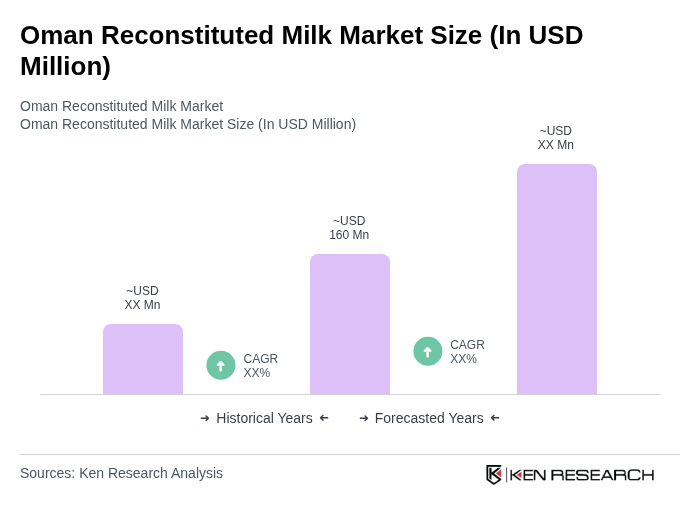
- The Oman Reconstituted Milk Market is valued at USD 160 million, based on a five-year historical analysis of the country’s packaged milk and broader dairy products market, where milk alone generates around USD 150–160 million in annual revenue and total dairy exceeds USD 900 million. This growth is primarily driven by increasing consumer demand for convenient and nutritious dairy options, particularly long?life and powdered formats that can be reconstituted, alongside rising health consciousness and a young, urbanizing population. The market has seen a steady rise in the consumption of reconstituted milk due to its affordability, longer shelf life, suitability for ambient storage, and versatility in various culinary applications in both households and foodservice.
- Muscat, the capital city, is a dominant player in the market due to its high population density, concentration of modern retail, and higher disposable incomes, which drive demand for packaged dairy products, including reconstituted milk. Additionally, the Dhofar Governorate, known for its favorable climate and agricultural activities, contributes significantly to domestic milk and dairy production through large integrated projects and traditional farming, supporting the supply base for liquid milk, powder, and recombined dairy products in the country.
- In 2023, the Omani government implemented regulations to enhance food safety standards in the dairy sector. This includes mandatory quality checks and certifications for all dairy products, including reconstituted milk, to ensure consumer safety and promote local production, in line with instruments such as the Food Safety Law issued by Royal Decree No. 84/2008 and the Oman Food Safety and Quality Center’s implementation of GCC Standardization Organization (GSO) standards for milk and dairy products (e.g., GSO 992/2015 for UHT milk and GSO 221/2010 for milk powders). Such regulations, which cover product composition, microbiological criteria, labeling, and facility hygiene, aim to boost consumer confidence and support the growth of the domestic dairy industry by ensuring that both locally produced and imported reconstituted milk consistently meet defined safety and quality benchmarks.
Oman Reconstituted Milk Market Segmentation
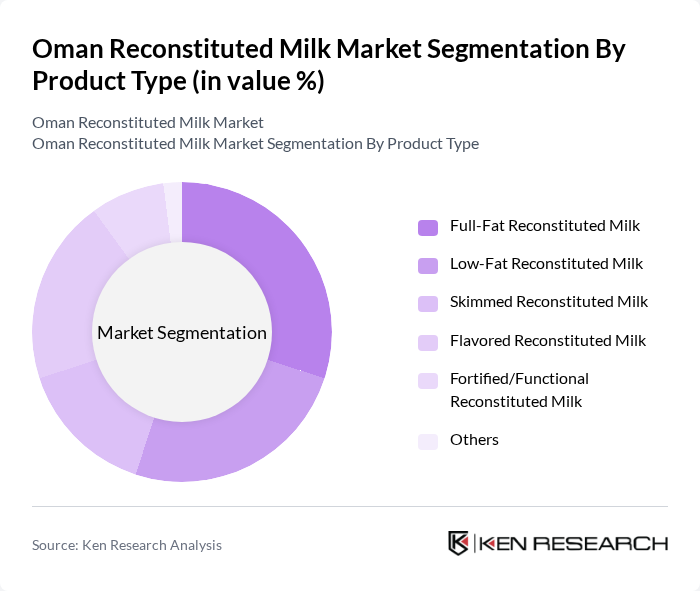
By Product Type:The product type segmentation includes various forms of reconstituted milk, catering to diverse consumer preferences. The subsegments are Full-Fat Reconstituted Milk, Low-Fat Reconstituted Milk, Skimmed Reconstituted Milk, Flavored Reconstituted Milk, Fortified/Functional Reconstituted Milk, and Others. Full-Fat Reconstituted Milk is popular among consumers seeking rich taste and energy-dense nutrition, particularly for families with children, while Low-Fat and Skimmed options cater to health-conscious individuals looking to manage fat and calorie intake in line with global trends toward reduced-fat dairy. Flavored varieties attract younger demographics and on-the-go consumers, as flavored recombined and UHT milks are widely used as ready-to-drink beverages in the Middle East, and fortified options appeal to those looking for added health benefits such as added vitamins, minerals, and functional ingredients.
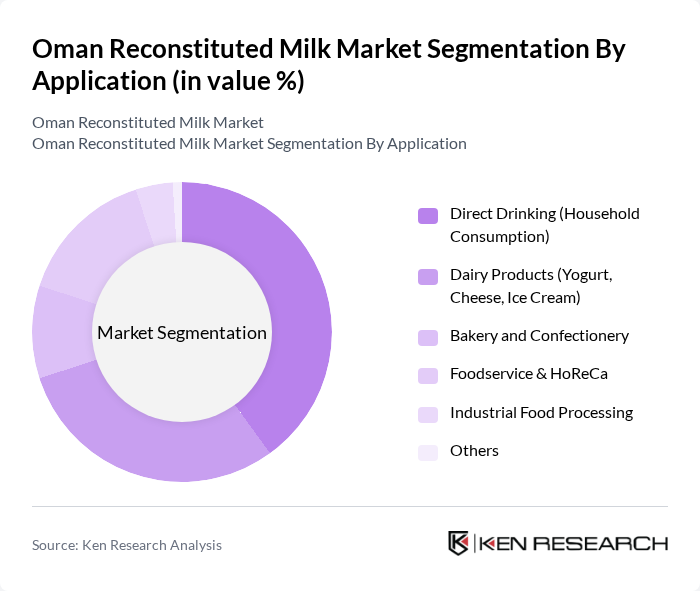
By Application:The application segmentation encompasses various uses of reconstituted milk, including Direct Drinking (Household Consumption), Dairy Products (Yogurt, Cheese, Ice Cream), Bakery and Confectionery, Foodservice & HoReCa, Industrial Food Processing, and Others. Direct Drinking is the leading application, driven by the growing trend of healthy living, demand for long-life ambient milk, and convenience for households that rely on UHT and powdered milk reconstitution as a primary drinking milk source. The dairy products segment also shows significant demand, as reconstituted milk is a key ingredient in yogurt, cheese, ice cream, and other recombined dairy lines commonly used in the Middle East and Africa, while bakery, confectionery, and broader food processing increasingly use milk powder and reconstituted milk for formulation consistency, cost efficiency, and shelf-life extension.
Oman Reconstituted Milk Market Competitive Landscape
The Oman Reconstituted Milk Market is characterized by a dynamic mix of regional and international players. Leading participants such as A’Saffa Foods SAOG (Dhofar Global Brands Subsidiary – Dairy & Beverages), Mazoon Dairy Company SAOC, Al Maraai Dairy & Beverages (Oman), Almarai Company (Saudi Arabia – Regional Supplier), National Dairy Products Manufacturing Company LLC (Oman), Dhofar Cattle Feed Co. SAOG (Dhofar Dairy & Juice Products), A’Safwah Dairy (Part of Atyab Food Industries), Nadec – National Agricultural Development Company, Al Safi Danone, Al Ain Farms, Lactalis Group, Arla Foods amba, Fonterra Co?operative Group Limited, FrieslandCampina N.V., Nestlé S.A. contribute to innovation, geographic expansion, and service delivery in this space.
Oman Reconstituted Milk Market Industry Analysis
Growth Drivers
- Increasing Health Consciousness:The growing awareness of health and nutrition among Omani consumers is driving the demand for reconstituted milk. In future, the health and wellness market in Oman is projected to reach approximately $1.4 billion, reflecting a 16.67% increase from the previous year. This trend is fueled by rising obesity rates, with 27% of the adult population classified as obese, prompting consumers to seek healthier dairy options that offer lower fat and higher nutritional value.
- Rising Demand for Dairy Alternatives:The shift towards dairy alternatives is gaining momentum in Oman, with the market for plant-based milk alternatives expected to grow by 20% annually. In future, the demand for lactose-free and fortified reconstituted milk is anticipated to increase, driven by a significant portion of the population (around 25%) experiencing lactose intolerance. This trend is further supported by the increasing availability of diverse dairy alternatives in retail outlets across the region.
- Expansion of Retail Channels:The expansion of retail channels, including supermarkets and online platforms, is enhancing the accessibility of reconstituted milk in Oman. As of future, the number of supermarkets in Oman is projected to reach 350, up from 250 in the previous year. This growth facilitates better distribution and visibility of reconstituted milk products, catering to the evolving shopping preferences of consumers who increasingly favor convenience and variety in their purchasing options.
Market Challenges
- Fluctuating Raw Material Prices:The reconstituted milk market in Oman faces challenges due to fluctuating raw material prices, particularly for milk powder. In future, the average price of milk powder is expected to rise by 10% due to global supply chain disruptions and increased demand. This volatility can significantly impact production costs, leading to potential price increases for consumers and reduced profit margins for manufacturers.
- Competition from Local and Imported Products:The market is characterized by intense competition from both local producers and imported dairy products. In future, imports of dairy products are projected to account for 45% of the total market share, with significant brands entering the Omani market. This competition pressures local manufacturers to innovate and maintain competitive pricing, which can strain resources and affect market positioning.
Oman Reconstituted Milk Market Future Outlook
The Oman reconstituted milk market is poised for significant transformation, driven by evolving consumer preferences and technological advancements. As health consciousness continues to rise, manufacturers are likely to focus on product innovation, including fortified and organic options. Additionally, the growth of e-commerce is expected to reshape distribution channels, making reconstituted milk more accessible. With the government's support for local dairy farmers, the market may also see increased production capacity, enhancing competitiveness against imports and fostering sustainable growth in the sector.
Market Opportunities
- Product Innovation and Diversification:There is a significant opportunity for product innovation in the reconstituted milk sector. By introducing flavors and fortified options, companies can cater to diverse consumer preferences. The introduction of at least seven new product lines in future could capture a larger market share, appealing to health-conscious consumers seeking variety in their dairy choices.
- Export Potential to Neighboring Markets:Oman’s strategic location offers substantial export potential for reconstituted milk to neighboring Gulf Cooperation Council (GCC) countries. In future, the GCC dairy market is expected to grow to $6 billion, presenting an opportunity for Omani producers to tap into this lucrative market. Establishing trade agreements could facilitate access and enhance regional competitiveness.
Scope of the Report
| Segment | Sub-Segments |
|---|---|
| By Product Type | Full-Fat Reconstituted Milk Low-Fat Reconstituted Milk Skimmed Reconstituted Milk Flavored Reconstituted Milk Fortified/Functional Reconstituted Milk Others |
| By Application | Direct Drinking (Household Consumption) Dairy Products (Yogurt, Cheese, Ice Cream) Bakery and Confectionery Foodservice & HoReCa Industrial Food Processing Others |
| By Packaging Format | Aseptic Cartons (Tetra Pak and Equivalent) Plastic Bottles (HDPE/PET) Flexible Pouches/Sachets Metal Cans Bulk Packs (Bags-in-Box, Industrial Sacks) Others |
| By Distribution Channel | Supermarkets/Hypermarkets Convenience Stores & Small Groceries Traditional Trade (Baqqalah/Neighborhood Stores) Online Retail & E?Commerce HoReCa & Institutional Procurement Others |
| By Region | Muscat Governorate Dhofar Governorate Al Batinah (North & South) Ad Dakhiliyah & Al Dhahirah Other Governorates (Al Sharqiyah, Al Wusta, Musandam) |
| By Consumer Segment | Household Consumers Expatriate Population Institutional Buyers (Schools, Hospitals, Camps) Foodservice Operators Others |
| By Nutritional & Functional Positioning | Standard Reconstituted Milk High-Protein/Performance Low-Fat/Low-Calorie Fortified with Vitamins & Minerals Lactose-Reduced/Lactose-Free Others |
Key Target Audience
Investors and Venture Capitalist Firms
Government and Regulatory Bodies (e.g., Ministry of Agriculture and Fisheries, Oman Food Safety Authority)
Manufacturers and Producers
Distributors and Retailers
Food and Beverage Importers
Packaging Suppliers
Industry Associations (e.g., Oman Dairy Association)
Financial Institutions
Players Mentioned in the Report:
ASaffa Foods SAOG (Dhofar Global Brands Subsidiary Dairy & Beverages)
Mazoon Dairy Company SAOC
Al Maraai Dairy & Beverages (Oman)
Almarai Company (Saudi Arabia Regional Supplier)
National Dairy Products Manufacturing Company LLC (Oman)
Dhofar Cattle Feed Co. SAOG (Dhofar Dairy & Juice Products)
ASafwah Dairy (Part of Atyab Food Industries)
Nadec National Agricultural Development Company
Al Safi Danone
Al Ain Farms
Lactalis Group
Arla Foods amba
Fonterra Cooperative Group Limited
FrieslandCampina N.V.
Nestle S.A.
Table of Contents
Market Assessment Phase
1. Executive Summary and Approach
2. Oman Reconstituted Milk Market Overview
2.1 Key Insights and Strategic Recommendations
2.2 Oman Reconstituted Milk Market Overview
2.3 Definition and Scope
2.4 Evolution of Market Ecosystem
2.5 Timeline of Key Regulatory Milestones
2.6 Value Chain & Stakeholder Mapping
2.7 Business Cycle Analysis
2.8 Policy & Incentive Landscape
3. Oman Reconstituted Milk Market Analysis
3.1 Growth Drivers
3.1.1 Increasing Health Consciousness
3.1.2 Rising Demand for Dairy Alternatives
3.1.3 Expansion of Retail Channels
3.2 Market Challenges
3.2.1 Fluctuating Raw Material Prices
3.2.2 Competition from Local and Imported Products
3.2.3 Regulatory Compliance Costs
3.2.4 Limited Consumer Awareness
3.3 Market Opportunities
3.3.1 Product Innovation and Diversification
3.3.2 Export Potential to Neighboring Markets
3.3.3 E-commerce Growth
3.3.4 Partnerships with Health and Wellness Brands
3.4 Market Trends
3.4.1 Shift Towards Organic and Natural Products
3.4.2 Increased Use of Sustainable Packaging
3.4.3 Growth of Online Grocery Shopping
3.4.4 Rising Popularity of Plant-Based Milk Alternatives
3.5 Government Regulation
3.5.1 Food Safety Standards
3.5.2 Labeling Requirements
3.5.3 Import Tariffs on Dairy Products
3.5.4 Subsidies for Local Dairy Farmers
4. SWOT Analysis
5. Stakeholder Analysis
6. Porter's Five Forces Analysis
7. Oman Reconstituted Milk Market Market Size, 2019-2024
7.1 By Value
7.2 By Volume
7.3 By Average Selling Price
8. Oman Reconstituted Milk Market Segmentation
8.1 By Product Type
8.1.1 Full-Fat Reconstituted Milk
8.1.2 Low-Fat Reconstituted Milk
8.1.3 Skimmed Reconstituted Milk
8.1.4 Flavored Reconstituted Milk
8.1.5 Fortified/Functional Reconstituted Milk
8.1.6 Others
8.2 By Application
8.2.1 Direct Drinking (Household Consumption)
8.2.2 Dairy Products (Yogurt, Cheese, Ice Cream)
8.2.3 Bakery and Confectionery
8.2.4 Foodservice & HoReCa
8.2.5 Industrial Food Processing
8.2.6 Others
8.3 By Packaging Format
8.3.1 Aseptic Cartons (Tetra Pak and Equivalent)
8.3.2 Plastic Bottles (HDPE/PET)
8.3.3 Flexible Pouches/Sachets
8.3.4 Metal Cans
8.3.5 Bulk Packs (Bags-in-Box, Industrial Sacks)
8.3.6 Others
8.4 By Distribution Channel
8.4.1 Supermarkets/Hypermarkets
8.4.2 Convenience Stores & Small Groceries
8.4.3 Traditional Trade (Baqqalah/Neighborhood Stores)
8.4.4 Online Retail & E?Commerce
8.4.5 HoReCa & Institutional Procurement
8.4.6 Others
8.5 By Region
8.5.1 Muscat Governorate
8.5.2 Dhofar Governorate
8.5.3 Al Batinah (North & South)
8.5.4 Ad Dakhiliyah & Al Dhahirah
8.5.5 Other Governorates (Al Sharqiyah, Al Wusta, Musandam)
8.6 By Consumer Segment
8.6.1 Household Consumers
8.6.2 Expatriate Population
8.6.3 Institutional Buyers (Schools, Hospitals, Camps)
8.6.4 Foodservice Operators
8.6.5 Others
8.7 By Nutritional & Functional Positioning
8.7.1 Standard Reconstituted Milk
8.7.2 High-Protein/Performance
8.7.3 Low-Fat/Low-Calorie
8.7.4 Fortified with Vitamins & Minerals
8.7.5 Lactose-Reduced/Lactose-Free
8.7.6 Others
9. Oman Reconstituted Milk Market Competitive Analysis
9.1 Market Share of Key Players
9.2 Cross Comparison of Key Players
9.2.1 Company Name
9.2.2 Oman Reconstituted Milk Revenue (USD Million)
9.2.3 Reconstituted Milk Volume Sold (Million Liters)
9.2.4 3?Year CAGR in Reconstituted Milk Sales
9.2.5 Share of Reconstituted Milk in Total Dairy Portfolio (%)
9.2.6 Average Realized Price per Liter (USD/Liter)
9.2.7 Gross Margin on Reconstituted Milk (%)
9.2.8 Distribution Reach in Oman (Number of Outlets/Points of Sale)
9.2.9 Presence Across Channels (Modern Trade, Traditional Trade, HoReCa, Online)
9.2.10 Number of Reconstituted Milk SKUs in Oman
9.2.11 Plant Utilization Rate for Reconstituted Milk Production (%)
9.2.12 Marketing & Promotion Spend on Reconstituted Milk (% of Category Sales)
9.3 SWOT Analysis of Top Players
9.4 Pricing Analysis
9.5 Detailed Profile of Major Companies
9.5.1 A’Saffa Foods SAOG (Dhofar Global Brands Subsidiary – Dairy & Beverages)
9.5.2 Mazoon Dairy Company SAOC
9.5.3 Al Maraai Dairy & Beverages (Oman)
9.5.4 Almarai Company (Saudi Arabia – Regional Supplier)
9.5.5 National Dairy Products Manufacturing Company LLC (Oman)
9.5.6 Dhofar Cattle Feed Co. SAOG (Dhofar Dairy & Juice Products)
9.5.7 A’Safwah Dairy (Part of Atyab Food Industries)
9.5.8 Nadec – National Agricultural Development Company
9.5.9 Al Safi Danone
9.5.10 Al Ain Farms
9.5.11 Lactalis Group
9.5.12 Arla Foods amba
9.5.13 Fonterra Co?operative Group Limited
9.5.14 FrieslandCampina N.V.
9.5.15 Nestlé S.A.
10. Oman Reconstituted Milk Market End-User Analysis
10.1 Procurement Behavior of Key Ministries
10.1.1 Ministry of Agriculture and Fisheries
10.1.2 Ministry of Health
10.1.3 Ministry of Education
10.1.4 Others
10.2 Corporate Spend on Infrastructure & Energy
10.2.1 Investment in Dairy Processing Facilities
10.2.2 Budget Allocation for Quality Control
10.2.3 Expenditure on Marketing and Promotion
10.2.4 Others
10.3 Pain Point Analysis by End-User Category
10.3.1 Supply Chain Disruptions
10.3.2 Quality Assurance Issues
10.3.3 Price Volatility
10.3.4 Others
10.4 User Readiness for Adoption
10.4.1 Awareness of Reconstituted Milk Benefits
10.4.2 Availability of Products in Market
10.4.3 Consumer Preferences
10.4.4 Others
10.5 Post-Deployment ROI and Use Case Expansion
10.5.1 Measurement of Sales Growth
10.5.2 Customer Feedback and Satisfaction
10.5.3 Market Share Increase
10.5.4 Others
11. Oman Reconstituted Milk Market Future Size, 2025-2030
11.1 By Value
11.2 By Volume
11.3 By Average Selling Price
Go-To-Market Strategy Phase
1. Whitespace Analysis + Business Model Canvas
1.1 Market Gaps Identification
1.2 Business Model Framework
2. Marketing and Positioning Recommendations
2.1 Branding Strategies
2.2 Product USPs
3. Distribution Plan
3.1 Urban Retail vs Rural NGO Tie-ups
4. Channel & Pricing Gaps
4.1 Underserved Routes
4.2 Pricing Bands
5. Unmet Demand & Latent Needs
5.1 Category Gaps
5.2 Consumer Segments
6. Customer Relationship
6.1 Loyalty Programs
6.2 After-sales Service
7. Value Proposition
7.1 Sustainability
7.2 Integrated Supply Chains
8. Key Activities
8.1 Regulatory Compliance
8.2 Branding
8.3 Distribution Setup
9. Entry Strategy Evaluation
9.1 Domestic Market Entry Strategy
9.1.1 Product Mix
9.1.2 Pricing Band
9.1.3 Packaging
9.2 Export Entry Strategy
9.2.1 Target Countries
9.2.2 Compliance Roadmap
10. Entry Mode Assessment
10.1 JV
10.2 Greenfield
10.3 M&A
10.4 Distributor Model
11. Capital and Timeline Estimation
11.1 Capital Requirements
11.2 Timelines
12. Control vs Risk Trade-Off
12.1 Ownership vs Partnerships
13. Profitability Outlook
13.1 Breakeven Analysis
13.2 Long-term Sustainability
14. Potential Partner List
14.1 Distributors
14.2 JVs
14.3 Acquisition Targets
15. Execution Roadmap
15.1 Phased Plan for Market Entry
15.1.1 Market Setup
15.1.2 Market Entry
15.1.3 Growth Acceleration
15.1.4 Scale & Stabilize
15.2 Key Activities and Milestones
15.2.1 Milestone Planning
15.2.2 Activity Tracking
Research Methodology
Phase 1: Approach1
Desk Research
- Analysis of industry reports from local and international dairy associations
- Review of government publications and trade statistics related to dairy production and consumption in Oman
- Examination of market trends and consumer behavior studies published in academic journals
Primary Research
- Interviews with dairy producers and processors operating in Oman
- Surveys conducted with retailers and distributors of reconstituted milk products
- Focus group discussions with consumers to understand preferences and purchasing behavior
Validation & Triangulation
- Cross-validation of findings through comparison with regional market data
- Triangulation of insights from primary interviews with secondary data sources
- Sanity checks performed by consulting industry experts and stakeholders
Phase 2: Market Size Estimation1
Top-down Assessment
- Estimation of total dairy market size in Oman and identification of reconstituted milk share
- Analysis of import/export data to gauge market dynamics and demand-supply balance
- Incorporation of demographic trends and urbanization rates affecting milk consumption
Bottom-up Modeling
- Collection of sales data from major retailers and distributors of reconstituted milk
- Estimation of average consumption per capita based on survey results
- Calculation of market size based on production volumes and import statistics
Forecasting & Scenario Analysis
- Development of growth projections based on historical consumption trends and economic indicators
- Scenario analysis considering factors such as price fluctuations and health trends influencing dairy consumption
- Creation of multiple forecasts (baseline, optimistic, and pessimistic) through 2030
Phase 3: CATI Sample Composition1
| Scope Item/Segment | Sample Size | Target Respondent Profiles |
|---|---|---|
| Retail Distribution of Reconstituted Milk | 100 | Store Managers, Category Buyers |
| Dairy Production Insights | 80 | Production Managers, Quality Control Supervisors |
| Consumer Preferences in Urban Areas | 120 | Household Decision Makers, Health-Conscious Consumers |
| Market Trends from Distributors | 70 | Sales Representatives, Logistics Coordinators |
| Health and Nutrition Perspectives | 60 | Nutritionists, Health Advisors |
Frequently Asked Questions
What is the current value of the Oman Reconstituted Milk Market?
The Oman Reconstituted Milk Market is valued at approximately USD 160 million, based on a historical analysis of the packaged milk and broader dairy products market, which generates around USD 150160 million annually from milk alone.
What factors are driving the growth of the Oman Reconstituted Milk Market?
Which regions in Oman are significant for the Reconstituted Milk Market?
What are the recent regulations affecting the Oman Reconstituted Milk Market?
Other Regional/Country Reports
Indonesia Reconstituted Milk Market
Malaysia Reconstituted Milk Market
KSA Reconstituted Milk Market
APAC Reconstituted Milk Market
SEA Reconstituted Milk Market
Vietnam Reconstituted Milk Market
Other Adjacent Reports
Brazil Powdered Milk Market
South Africa UHT Milk Market
Qatar Flavored Milk Market
Singapore Dairy Alternatives Market
Malaysia Yogurt Market
Vietnam Cheese Market
Qatar Ice Cream Market
Malaysia Bakery Ingredients Market
KSA Food Processing Ingredients Market
Indonesia Beverage Ingredients Market
Why Buy From Us?

What makes us stand out is that our consultants follow Robust, Refine and Result (RRR) methodology. Robust for clear definitions, approaches and sanity checking, Refine for differentiating respondents' facts and opinions, and Result for presenting data with story.

We have set a benchmark in the industry by offering our clients with syndicated and customized market research reports featuring coverage of entire market as well as meticulous research and analyst insights.

While we don't replace traditional research, we flip the method upside down. Our dual approach of Top Bottom & Bottom Top ensures quality deliverable by not just verifying company fundamentals but also looking at the sector and macroeconomic factors.

With one step in the future, our research team constantly tries to show you the bigger picture. We help with some of the tough questions you may encounter along the way: How is the industry positioned? Best marketing channel? KPI's of competitors? By aligning every element, we help maximize success.

Our report gives you instant access to the answers and sources that other companies might choose to hide. We elaborate each steps of research methodology we have used and showcase you the sample size to earn your trust.

If you need any support, we are here! We pride ourselves on universe strength, data quality, and quick, friendly, and professional service.