About the Report
Base Year 2024Oman Vitrification Market Overview
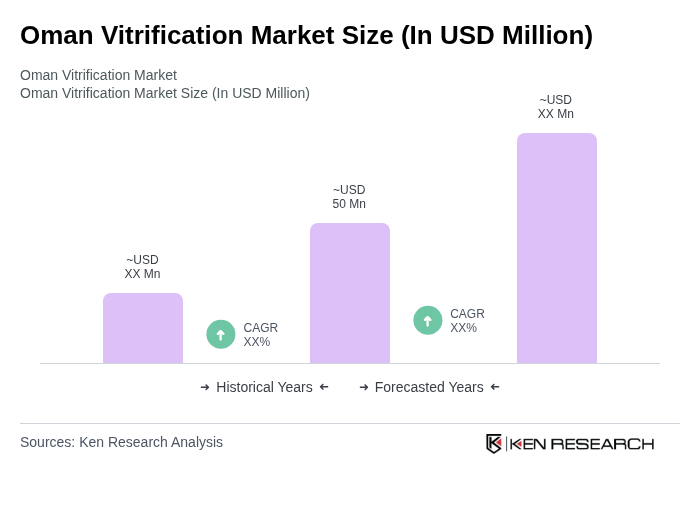
- The Oman Vitrification Market is valued at USD 50 million, based on a five-year historical analysis and alignment with the strong growth of the global vitrification market, which is driven by rising infertility rates, expanding IVF volumes, and increasing adoption of vitrification over slow-freezing techniques. This growth is primarily driven by increasing awareness of fertility preservation techniques, advancements in assisted reproductive technologies, and a rise in the number of IVF clinics and fertility centers across the Gulf region, including Oman. The demand for vitrification methods, which offer higher post?thaw survival and pregnancy rates compared to conventional slow freezing, has significantly contributed to the market's expansion.
- Muscat, the capital city, is a dominant player in the Oman Vitrification Market due to its concentration of advanced tertiary-care hospitals, private IVF centers, and specialty women’s health facilities that provide assisted reproductive technologies. Additionally, other cities like Salalah and Sohar are emerging as important centers for reproductive health services, driven by increasing investments in healthcare infrastructure, broader access to specialized gynecology and fertility care, and a growing population seeking fertility treatments in both public and private sectors.
- In 2023, the Omani government implemented regulations to enhance the quality and safety of assisted reproductive technologies. This includes mandatory accreditation for IVF clinics and adherence to international standards for vitrification procedures, ensuring that patients receive high-quality care and increasing public trust in fertility treatments, in line with the requirements of the Private Health Establishments Law and its executive regulations issued by the Ministry of Health, as well as the Ministerial Decision No. 57/2010 issuing the Regulations Organizing the Practice of the Profession of Human Assisted Reproductive Techniques.
Oman Vitrification Market Segmentation
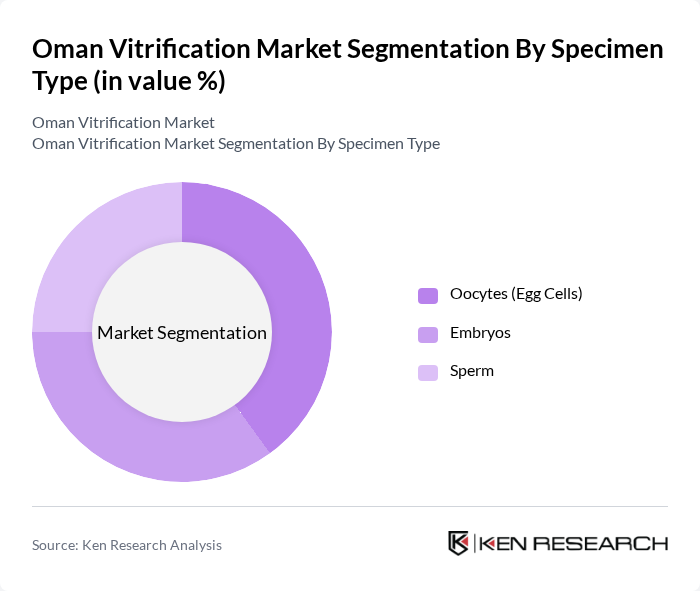
By Specimen Type:The specimen type segmentation includes Oocytes (Egg Cells), Embryos, and Sperm. Each of these subsegments plays a crucial role in the vitrification process, with varying applications in fertility treatments. Oocytes are often prioritized due to their significance in female fertility preservation and their leading share in the global vitrification market by specimen, supported by strong evidence of high survival, fertilization, and live-birth rates after vitrification. Embryos are critical for successful implantation in assisted reproductive technologies and are widely vitrified in routine IVF cycles to optimize cumulative pregnancy rates. Sperm vitrification is also essential for male fertility preservation, particularly in cancer patients and men undergoing gonadotoxic treatments, as well as for use in donor sperm programs.
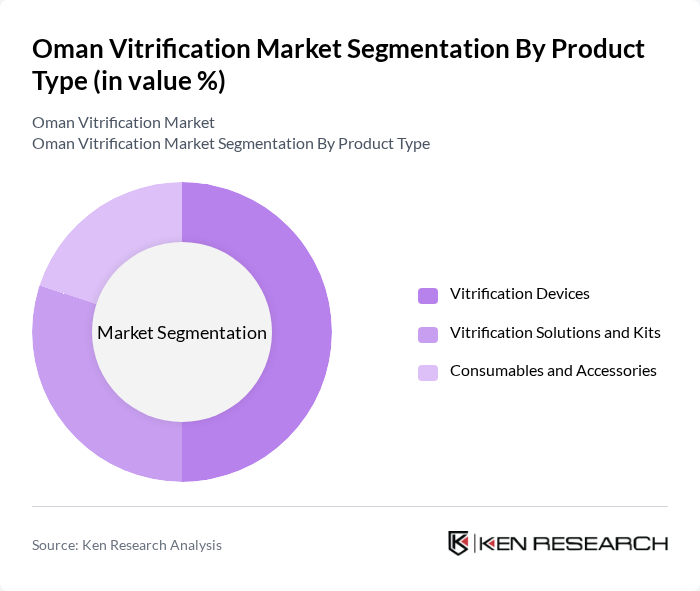
By Product Type:The product type segmentation encompasses Vitrification Devices, Vitrification Solutions and Kits, and Consumables and Accessories. Vitrification devices are essential for the cryopreservation process and typically account for the larger revenue share globally, reflecting demand for advanced equipment, automated systems, and precise temperature-control platforms in IVF laboratories. Vitrification solutions and kits provide the necessary cryoprotectant formulations and stepwise media systems for effective vitrification, with manufacturers continuously optimizing compositions to reduce toxicity and improve cell viability. Consumables and accessories, such as cryo-straws, cryo-tips, storage canes, and liquid nitrogen storage solutions, support the overall process, ensuring that clinics have the tools needed for consistent, standardized, and high-throughput procedures.
Oman Vitrification Market Competitive Landscape
The Oman Vitrification Market is characterized by a dynamic mix of regional and international players. Leading participants such as Cooper Surgical, Inc. (Fertility and Reproductive Health Division), Vitrolife AB, Kitazato Corporation, Hamilton Thorne, Inc., Genea Biomedx, Irvine Scientific, Origio (CooperSurgical subsidiary), Medicult (Origio), Esco Micro Pte. Ltd., Thermo Fisher Scientific (Reproductive Health Division), Fujifilm Irvine Scientific, Nidacon International, Embryotech Laboratories, Aga Khan University Hospital (Regional Provider), Middle East Fertility Society Member Institutions contribute to innovation, geographic expansion, and service delivery in this space, leveraging portfolios that span vitrification media, devices, and integrated ART solutions.
Oman Vitrification Market Industry Analysis
Growth Drivers
- Rising Demand for Fertility Preservation:The demand for fertility preservation in Oman is significantly increasing, driven by societal trends such as delayed parenthood. In future, approximately 15% of women aged 30-39 are expected to seek assisted reproductive technologies, reflecting a growing awareness of options like egg freezing. This demographic shift is supported by a 5% annual increase in fertility clinic visits, indicating a robust market for vitrification services as more individuals prioritize reproductive health.
- Government Healthcare Initiatives:The Omani government has launched several initiatives to enhance reproductive health services, allocating around OMR 2 million (approximately USD 5.2 million) in future for public awareness campaigns. These initiatives aim to improve access to assisted reproductive technologies, including vitrification. The Ministry of Health's focus on reproductive health is expected to increase the number of IVF procedures by 10% annually, further driving market growth.
- Technological Advancements:Innovations in cryopreservation and vitrification processes are transforming the fertility landscape in Oman. In future, the introduction of automated micro-fluidic systems is projected to enhance success rates by 20%, making procedures more efficient and accessible. Additionally, the integration of real-time monitoring technologies is expected to reduce operational errors, thereby increasing the reliability of fertility treatments and attracting more patients to clinics offering these advanced services.
Market Challenges
- High Capital Investment Requirements:Establishing IVF clinics in Oman necessitates substantial capital investment, often exceeding OMR 500,000 (approximately USD 1.3 million) for infrastructure and equipment. This financial barrier limits the entry of new players into the market, resulting in a concentration of services among a few established clinics. Consequently, the high costs associated with setting up and maintaining these facilities can hinder the overall growth of the vitrification market.
- Limited Awareness of Vitrification Benefits:Despite advancements in reproductive technologies, awareness of vitrification remains low among potential users in Oman. Surveys indicate that only 30% of the population understands the benefits of egg and embryo freezing. This lack of knowledge poses a significant challenge, as it directly impacts the demand for vitrification services. Educational initiatives are crucial to bridging this gap and fostering a more informed consumer base.
Oman Vitrification Market Future Outlook
The future of the Oman vitrification market appears promising, driven by increasing healthcare expenditure and a growing emphasis on reproductive health. As the government continues to invest in healthcare infrastructure, the number of private IVF clinics is expected to rise, enhancing accessibility. Furthermore, partnerships with international technology providers will likely introduce innovative solutions, improving service quality. Overall, these trends indicate a robust growth trajectory for the vitrification market in Oman, aligning with global advancements in reproductive technologies.
Market Opportunities
- Expansion of Private IVF Clinics:The establishment of new private IVF clinics presents a significant opportunity in Oman. With an estimated 20% increase in private healthcare facilities expected in future, this expansion will enhance access to vitrification services, catering to the rising demand for fertility treatments among the population.
- Public-Private Partnerships:Developing public-private partnerships in healthcare infrastructure can significantly boost the vitrification market. By leveraging private sector expertise and resources, Oman can enhance its reproductive health services, leading to improved patient outcomes and increased adoption of advanced technologies like vitrification.
Scope of the Report
| Segment | Sub-Segments |
|---|---|
| By Specimen Type | Oocytes (Egg Cells) Embryos Sperm |
| By Product Type | Vitrification Devices Vitrification Solutions and Kits Consumables and Accessories |
| By End-User | IVF Clinics and Fertility Centers Biobanks and Specimen Storage Facilities Research and Academic Institutions |
| By Application | Fertility Preservation for Cancer Patients Delayed Parenthood and Family Planning Assisted Reproductive Technology (ART) Programs Research and Development |
| By Technology Platform | Manual Vitrification Systems Automated Micro-Fluidic Vitrification Systems Semi-Automated Systems |
| By Service Model | Equipment Sales Consumables and Reagent Supply Service and Maintenance Contracts |
| By Market Maturity | Emerging Adoption Phase Growth Phase Mature Market Segments |
Key Target Audience
Investors and Venture Capitalist Firms
Government and Regulatory Bodies (e.g., Ministry of Health, Oman Environmental Authority)
Manufacturers and Producers of Vitrification Equipment
Distributors and Retailers of Vitrification Products
Pharmaceutical Companies involved in Vitrification
Biotechnology Firms specializing in Cryopreservation
Industry Associations related to Vitrification and Cryogenics
Financial Institutions providing funding for Vitrification Projects
Players Mentioned in the Report:
Cooper Surgical, Inc. (Fertility and Reproductive Health Division)
Vitrolife AB
Kitazato Corporation
Hamilton Thorne, Inc.
Genea Biomedx
Irvine Scientific
Origio (CooperSurgical subsidiary)
Medicult (Origio)
Esco Micro Pte. Ltd.
Thermo Fisher Scientific (Reproductive Health Division)
Fujifilm Irvine Scientific
Nidacon International
Embryotech Laboratories
Aga Khan University Hospital (Regional Provider)
Middle East Fertility Society Member Institutions
Table of Contents
Market Assessment Phase
1. Executive Summary and Approach
2. Oman Vitrification Market Overview
2.1 Key Insights and Strategic Recommendations
2.2 Oman Vitrification Market Overview
2.3 Definition and Scope
2.4 Evolution of Market Ecosystem
2.5 Timeline of Key Regulatory Milestones
2.6 Value Chain & Stakeholder Mapping
2.7 Business Cycle Analysis
2.8 Policy & Incentive Landscape
3. Oman Vitrification Market Analysis
3.1 Growth Drivers
3.1.1 Rising demand for fertility preservation and assisted reproductive technologies
3.1.2 Government healthcare initiatives promoting reproductive health services
3.1.3 Technological advancements in cryopreservation and vitrification processes
3.1.4 Increasing awareness of egg and embryo freezing among delayed parenthood demographics
3.2 Market Challenges
3.2.1 High capital investment requirements for IVF clinic infrastructure
3.2.2 Limited awareness of vitrification benefits among potential users
3.2.3 Regulatory and religious compliance considerations in Oman
3.2.4 Competition from regional fertility centers in GCC countries
3.3 Market Opportunities
3.3.1 Expansion of private IVF clinics and fertility centers
3.3.2 Partnerships with international reproductive health technology providers
3.3.3 Development of public-private partnerships in healthcare infrastructure
3.3.4 Increasing healthcare expenditure and insurance coverage for fertility treatments
3.4 Market Trends
3.4.1 Shift towards automated micro-fluidic vitrification systems reducing skill barriers
3.4.2 Adoption of closed-sample handling and real-time monitoring technologies
3.4.3 Growing integration of vitrification in comprehensive fertility preservation programs
3.4.4 Enhanced regulatory frameworks supporting assisted reproductive technologies
3.5 Government Regulation
3.5.1 Ministry of Health policies on assisted reproductive technology licensing
3.5.2 Healthcare facility accreditation and quality standards
3.5.3 Incentives for private healthcare sector development
3.5.4 Compliance requirements for biobanking and specimen storage facilities
4. SWOT Analysis
5. Stakeholder Analysis
6. Porter's Five Forces Analysis
7. Oman Vitrification Market Size, 2019-2024
7.1 By Value
7.2 By Volume
7.3 By Average Selling Price
8. Oman Vitrification Market Segmentation
8.1 By Specimen Type
8.1.1 Oocytes (Egg Cells)
8.1.2 Embryos
8.1.3 Sperm
8.2 By Product Type
8.2.1 Vitrification Devices
8.2.2 Vitrification Solutions and Kits
8.2.3 Consumables and Accessories
8.3 By End-User
8.3.1 IVF Clinics and Fertility Centers
8.3.2 Biobanks and Specimen Storage Facilities
8.3.3 Research and Academic Institutions
8.4 By Application
8.4.1 Fertility Preservation for Cancer Patients
8.4.2 Delayed Parenthood and Family Planning
8.4.3 Assisted Reproductive Technology (ART) Programs
8.4.4 Research and Development
8.5 By Technology Platform
8.5.1 Manual Vitrification Systems
8.5.2 Automated Micro-Fluidic Vitrification Systems
8.5.3 Semi-Automated Systems
8.6 By Service Model
8.6.1 Equipment Sales
8.6.2 Consumables and Reagent Supply
8.6.3 Service and Maintenance Contracts
8.7 By Market Maturity
8.7.1 Emerging Adoption Phase
8.7.2 Growth Phase
8.7.3 Mature Market Segments
9. Oman Vitrification Market Competitive Analysis
9.1 Market Share of Key Players
9.2 Cross Comparison of Key Players
9.2.1 Company Name
9.2.2 Company Size Classification (Large, Medium, or Small)
9.2.3 Revenue Growth Rate (Year-over-Year %)
9.2.4 Market Penetration Rate in Oman and GCC Region (%)
9.2.5 Customer Retention Rate (%)
9.2.6 Pricing Strategy (Premium, Mid-Range, or Value-Based)
9.2.7 Operational Efficiency Metrics (Equipment Uptime, Service Response Time)
9.2.8 Innovation Rate (New Product Launches per Year)
9.2.9 Brand Recognition and Market Reputation
9.2.10 Customer Satisfaction Index (NPS Score)
9.3 SWOT Analysis of Top Players
9.4 Pricing Analysis
9.5 Detailed Profile of Major Companies
9.5.1 Cooper Surgical, Inc. (Fertility and Reproductive Health Division)
9.5.2 Vitrolife AB
9.5.3 Kitazato Corporation
9.5.4 Hamilton Thorne, Inc.
9.5.5 Genea Biomedx
9.5.6 Irvine Scientific
9.5.7 Origio (CooperSurgical subsidiary)
9.5.8 Medicult (Origio)
9.5.9 Esco Micro Pte. Ltd.
9.5.10 Thermo Fisher Scientific (Reproductive Health Division)
9.5.11 Fujifilm Irvine Scientific
9.5.12 Nidacon International
9.5.13 Embryotech Laboratories
9.5.14 Aga Khan University Hospital (Regional Provider)
9.5.15 Middle East Fertility Society Member Institutions
10. Oman Vitrification Market End-User Analysis
10.1 Procurement Behavior of Key Ministries and Institutions
10.1.1 Ministry of Health - Reproductive Health Department
10.1.2 Ministry of Regional Municipalities and Water Resources
10.1.3 Private Healthcare Sector and Hospital Networks
10.1.4 Academic and Research Institutions
10.2 Corporate Spend on Healthcare Infrastructure & Fertility Services
10.2.1 Investment in IVF Clinic Infrastructure and Equipment
10.2.2 Budget Allocation for Reproductive Health Programs
10.2.3 Corporate Social Responsibility Initiatives in Healthcare
10.2.4 Insurance Coverage for Fertility Treatments
10.3 Pain Point Analysis by End-User Category
10.3.1 Private IVF Clinics
10.3.2 Public Healthcare Facilities
10.3.3 Biobanking and Research Centers
10.3.4 International Fertility Tourism Operators
10.4 User Readiness for Adoption
10.4.1 Awareness of Vitrification Benefits and Success Rates
10.4.2 Training and Capacity Building Needs for Clinical Staff
10.4.3 Financial Readiness and Budget Availability
10.4.4 Regulatory and Compliance Readiness
10.5 Post-Deployment ROI and Use Case Expansion
10.5.1 Measurement of Treatment Success Rates and Cost Savings
10.5.2 Evaluation of Patient Satisfaction and Outcomes
10.5.3 Opportunities for Scaling Fertility Services
10.5.4 Regional Market Expansion Potential
11. Oman Vitrification Market Future Size, 2025-2030
11.1 By Value
11.2 By Volume
11.3 By Average Selling Price
Go-To-Market Strategy Phase
1. Whitespace Analysis + Business Model Canvas
1.1 Market Gaps Identification
1.2 Business Model Development
2. Marketing and Positioning Recommendations
2.1 Branding Strategies
2.2 Product USPs
3. Distribution Plan
3.1 Direct Sales to IVF Clinics
3.2 Regional Distributor Partnerships
4. Channel & Pricing Gaps
4.1 Underserved Market Segments
4.2 Pricing Bands
5. Unmet Demand & Latent Needs
5.1 Category Gaps
5.2 Customer Segments
6. Customer Relationship
6.1 Loyalty Programs
6.2 After-sales Service and Technical Support
7. Value Proposition
7.1 Clinical Efficacy and Success Rates
7.2 Integrated Supply Chains and Logistics
8. Key Activities
8.1 Regulatory Compliance and Licensing
8.2 Branding and Market Education Efforts
8.3 Distribution and Logistics Setup
9. Entry Strategy Evaluation
9.1 Domestic Market Entry Strategy
9.1.1 Product Mix (Devices, Solutions, Consumables)
9.1.2 Pricing Band (Premium vs. Value-Based)
9.1.3 Packaging and Regulatory Compliance
9.2 Regional Export Entry Strategy
9.2.1 Target GCC and Middle East Countries
9.2.2 Compliance Roadmap for Regional Markets
10. Entry Mode Assessment
10.1 Joint Ventures with Local Healthcare Providers
10.2 Greenfield Investments in IVF Infrastructure
10.3 Mergers & Acquisitions of Existing Fertility Centers
10.4 Distributor Model with Regional Partners
11. Capital and Timeline Estimation
11.1 Capital Requirements
11.2 Timelines
12. Control vs Risk Trade-Off
12.1 Ownership vs Partnerships
13. Profitability Outlook
13.1 Breakeven Analysis
13.2 Long-term Sustainability
14. Potential Partner List
14.1 Distributors and Regional Agents
14.2 Joint Venture Partners
14.3 Acquisition Targets
15. Execution Roadmap
15.1 Phased Plan for Market Entry
15.1.1 Market Research and Regulatory Setup
15.1.2 Market
Research Methodology
Phase 1: Approach1
Desk Research
- Industry reports from Oman’s Ministry of Commerce and Industry
- Market analysis publications from regional trade associations
- Academic journals focusing on vitrification technologies and applications
Primary Research
- Interviews with key stakeholders in the vitrification supply chain
- Surveys targeting end-users in the construction and waste management sectors
- Field visits to vitrification facilities and related operational sites
Validation & Triangulation
- Cross-validation of data from multiple industry sources and reports
- Triangulation of findings from primary interviews and secondary data
- Expert panel reviews to ensure data accuracy and relevance
Phase 2: Market Size Estimation1
Top-down Assessment
- Analysis of national waste management policies impacting vitrification
- Estimation of market size based on government spending on waste treatment
- Segmentation by application areas such as construction and environmental remediation
Bottom-up Modeling
- Volume estimates based on operational capacities of existing vitrification plants
- Cost analysis derived from service pricing and operational expenditures
- Calculation of market size based on projected growth rates in waste generation
Forecasting & Scenario Analysis
- Multi-variable regression analysis incorporating economic growth and urbanization rates
- Scenario modeling based on potential regulatory changes and technological advancements
- Development of baseline, optimistic, and pessimistic market forecasts through 2030
Phase 3: CATI Sample Composition1
| Scope Item/Segment | Sample Size | Target Respondent Profiles |
|---|---|---|
| Construction Sector Vitrification Applications | 100 | Project Managers, Site Engineers |
| Waste Management Companies | 80 | Operations Managers, Environmental Compliance Officers |
| Government Regulatory Bodies | 50 | Policy Makers, Environmental Analysts |
| Research Institutions Focused on Vitrification | 40 | Research Scientists, Academic Professors |
| End-users in Industrial Applications | 70 | Procurement Managers, Facility Managers |
Frequently Asked Questions
What is the current value of the Oman Vitrification Market?
The Oman Vitrification Market is valued at approximately USD 50 million, reflecting a strong growth trajectory influenced by rising infertility rates and the increasing adoption of vitrification techniques over traditional slow-freezing methods.
What factors are driving the growth of the Oman Vitrification Market?
Which cities in Oman are leading in the Vitrification Market?
What regulations has the Omani government implemented for IVF clinics?
Other Regional/Country Reports
Indonesia Vitrification Market
Malaysia Vitrification Market
APAC Vitrification Market
SEA Vitrification Market
Vietnam Vitrification Market
Other Adjacent Reports
South Korea IVF Services Market
Middle East Fertility Preservation Market Size, Share, Growth Drivers, Trends, Opportunities & Forecast 2025–2030South Korea Cryopreservation Technology Market
Global Assisted Reproductive Technology Market Report Size Share Growth Drivers Trends Opportunities & Forecast 2025–2030South Africa Embryo Freezing Market
Malaysia Oocyte Vitrification Market
Germany Sperm Cryopreservation Market
Indonesia Reproductive Health Devices Market
Japan Genetic Screening Market
Brazil Fertility Clinics Market
Why Buy From Us?

What makes us stand out is that our consultants follow Robust, Refine and Result (RRR) methodology. Robust for clear definitions, approaches and sanity checking, Refine for differentiating respondents' facts and opinions, and Result for presenting data with story.

We have set a benchmark in the industry by offering our clients with syndicated and customized market research reports featuring coverage of entire market as well as meticulous research and analyst insights.

While we don't replace traditional research, we flip the method upside down. Our dual approach of Top Bottom & Bottom Top ensures quality deliverable by not just verifying company fundamentals but also looking at the sector and macroeconomic factors.

With one step in the future, our research team constantly tries to show you the bigger picture. We help with some of the tough questions you may encounter along the way: How is the industry positioned? Best marketing channel? KPI's of competitors? By aligning every element, we help maximize success.

Our report gives you instant access to the answers and sources that other companies might choose to hide. We elaborate each steps of research methodology we have used and showcase you the sample size to earn your trust.

If you need any support, we are here! We pride ourselves on universe strength, data quality, and quick, friendly, and professional service.