Oman Womens Health Market Report Size, Share, Growth Drivers, Trends, Opportunities & Forecast 2025–2030

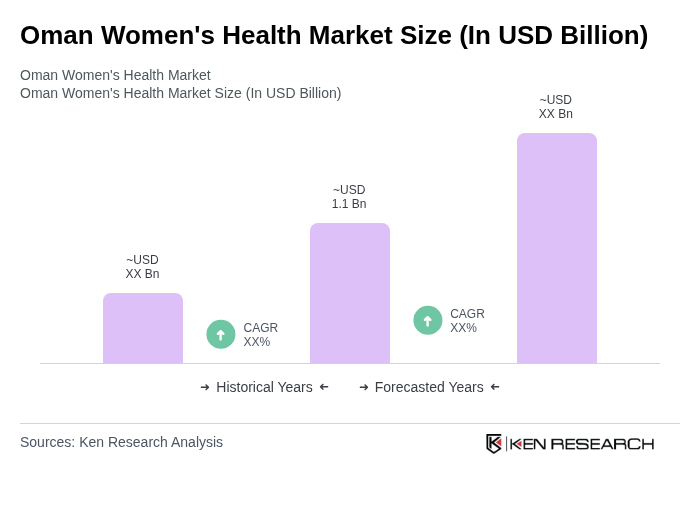
Oman Women's Health Market, valued at USD 1.1 billion, is growing due to increased awareness, government support, and tech advancements in reproductive and maternal health services.

Region:Middle East

Author(s):Shubham

Product Code:KRAD6586

Pages:85

Published On:December 2025
About the Report

Base Year 2024

Oman Women's Health Market Overview

  • The Oman Women's Health Market is valued at USD 1.1 billion, based on a five-year historical analysis, supported by rising healthcare expenditure in Oman, increasing awareness of women's health issues, and continued government investment in hospitals, primary care, and specialized services for women. Growing focus on chronic disease management, maternal health, and preventive care has further strengthened demand for comprehensive women's health services in the country.
  • Muscat, the capital city, is the dominant region in the Oman Women's Health Market due to its concentration of tertiary-care public hospitals (such as Royal Hospital and Khoula Hospital), university and teaching hospitals, and leading private multispecialty hospitals equipped with advanced diagnostic and treatment technologies. Other significant areas include Dhofar and Al Batinah, where the Ministry of Health and private providers have been expanding hospitals and primary health centers to meet the needs of the growing population and rising health awareness among women.
  • In 2023, the Omani government continued implementation of mandatory health insurance for expatriates and private?sector employees under the Unified Health Insurance Policy (Dhamani) issued by the Capital Market Authority, which includes coverage for essential women's health services such as maternity care and selected preventive services. This policy framework, together with Ministry of Health clinical guidelines on antenatal, postnatal, and reproductive health care, is designed to enhance access to core women's health services and strengthen financial protection for beneficiaries across the system.
Oman Women's Health Market Size

Oman Women's Health Market Segmentation

By Type:The market is segmented into various types of women's health services, including reproductive health, pregnancy and maternal care, gynecological care, menopause and hormonal disorders, cancer screening and management, sexual and reproductive health infections, mental and psychosocial health, wellness, nutrition, and lifestyle management, and others. Each of these segments aligns with national priorities such as safe motherhood, prevention and early detection of breast and cervical cancer, management of noncommunicable diseases, and improved mental health outcomes for women, contributing to the overall growth of the market.
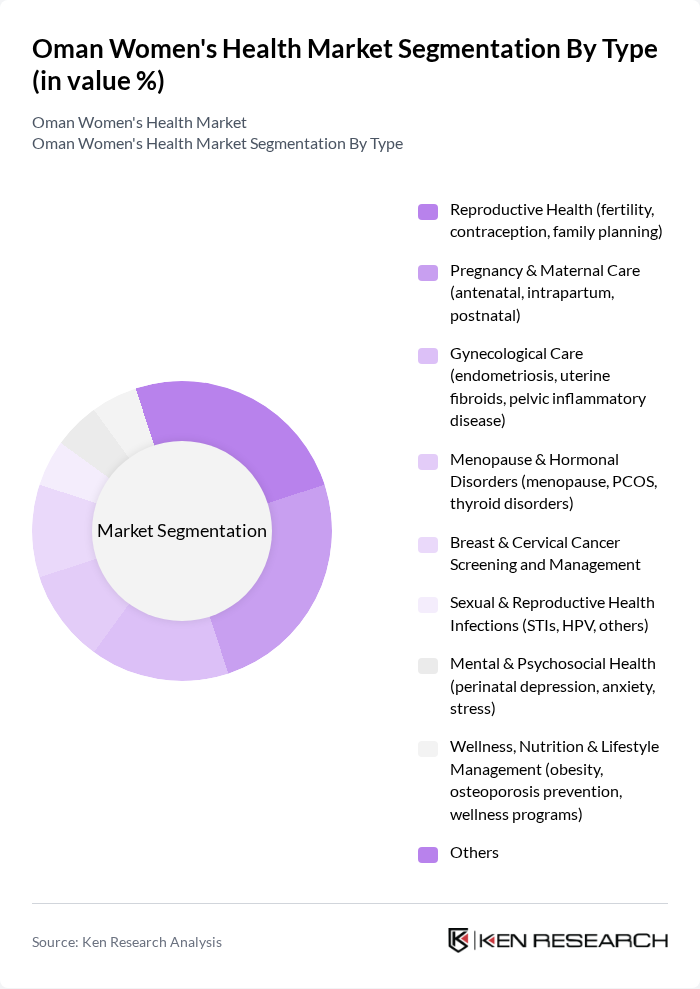
Oman Women's Health Market segmentation by Type.

By End-User:The end-user segmentation includes various healthcare providers such as public hospitals, private multispecialty hospitals, specialized obstetrics and gynecology clinics, primary health centers, diagnostic centers, telehealth platforms, NGOs, and community health organizations. Each of these end-users plays a crucial role in delivering women's health services across Oman, with public and teaching hospitals and primary health centers forming the backbone of maternal and reproductive health care, while private hospitals, diagnostic laboratories, and telehealth platforms are increasingly important in advanced diagnostics, fertility care, and follow-up consultations.
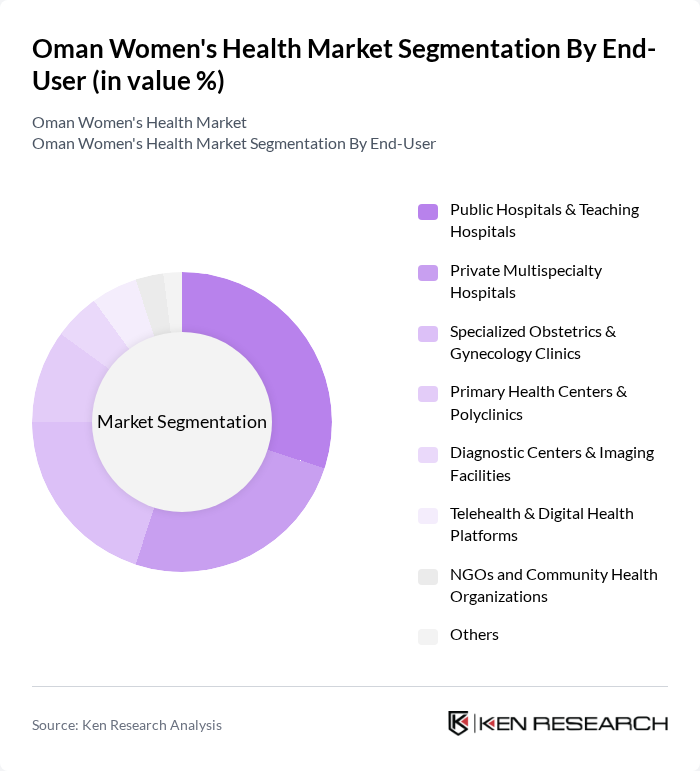
Oman Women's Health Market segmentation by End-User.

Oman Women's Health Market Competitive Landscape

The Oman Women's Health Market is characterized by a dynamic mix of regional and international players. Leading participants such as Royal Hospital (Ministry of Health, Muscat), Sultan Qaboos University Hospital (SQUH), Khoula Hospital, Al Nahda Hospital, Muscat Private Hospital, Badr Al Samaa Group of Hospitals & Medical Centres, Aster DM Healthcare – Oman (Aster Al Raffah Hospitals & Clinics), KIMS Oman Hospital (Aster KIMS), Starcare Hospital, Muscat, Al Hayat International Hospital, Burjeel Hospital, Muscat (Burjeel Holdings), NMC Specialty Hospital, Al Ghubra, Apollo Hospital Muscat (Apollo Medical Centre), Oman International Hospital, Hatat Polyclinic & Other Leading OB/GYN Clinics contribute to innovation, geographic expansion, and service delivery in this space.

Royal Hospital

1987

Muscat

Sultan Qaboos University Hospital

1990

Muscat

Khoula Hospital

1974

Muscat

Al Nahda Hospital

2005

Muscat

Muscat Private Hospital

2001

Muscat

Company

Establishment Year

Headquarters

Ownership Type (Public, Private, International Group)

Group Size (Bed Capacity / Number of Facilities in Oman)

Revenue from Women's Health Services (OMR, latest year)

Revenue Growth Rate in Women's Health Portfolio (CAGR %)

Share of Women's Health in Total Clinical Revenue (%)

Patient Volume – OB/GYN & Related Visits per Year

Oman Women's Health Market Industry Analysis

Growth Drivers

  • Increasing Awareness of Women's Health Issues:The awareness of women's health issues in Oman has significantly increased, with over 60% of women now actively seeking information on health topics. This shift is supported by government campaigns and community programs, which have led to a 30% rise in women attending health workshops and seminars. The Ministry of Health reported that approximately 160,000 women participated in health awareness initiatives, highlighting a growing commitment to addressing women's health concerns.
  • Government Initiatives Promoting Women's Health:The Omani government has launched several initiatives aimed at improving women's health, including the "Healthy Woman" program, which allocated OMR 2.5 million for women's health services. This initiative has resulted in a 25% increase in the number of women receiving regular health check-ups. Additionally, the government is working to enhance healthcare infrastructure, with plans to build 12 new women's health clinics by 2025, further supporting access to essential services.
  • Advancements in Healthcare Technology:The integration of advanced healthcare technologies in Oman is transforming women's health services. In future, the adoption of telehealth services increased by 45%, allowing women in remote areas to access healthcare consultations. Furthermore, the introduction of mobile health applications has led to a 55% rise in women tracking their health metrics. These technological advancements are crucial in bridging the gap in healthcare access and improving health outcomes for women across the country.

Market Challenges

  • Cultural Barriers to Women's Health Services:Cultural norms in Oman often hinder women's access to health services, with 50% of women reporting discomfort in discussing health issues with male healthcare providers. This cultural barrier results in delayed treatment and lower health-seeking behavior. Additionally, traditional beliefs may discourage women from utilizing modern healthcare facilities, leading to a reliance on alternative medicine, which can compromise health outcomes and overall well-being.
  • Limited Access to Healthcare Facilities in Rural Areas:Access to healthcare facilities remains a significant challenge, particularly in rural regions of Oman. Approximately 35% of women in these areas live more than 25 kilometers from the nearest healthcare center. This geographical barrier contributes to lower healthcare utilization rates, with only 55% of rural women receiving regular health check-ups compared to 80% in urban areas. Addressing this issue is critical for improving women's health outcomes nationwide.

Oman Women's Health Market Future Outlook

The future of the women's health market in Oman appears promising, driven by increasing government support and technological advancements. As awareness of women's health issues continues to grow, more women are expected to seek preventive care and specialized services. The integration of mental health services and personalized medicine will likely enhance the overall healthcare experience. Additionally, the expansion of telehealth services will improve access, particularly for women in rural areas, fostering a more inclusive healthcare environment.

Market Opportunities

  • Expansion of Telehealth Services:The ongoing expansion of telehealth services presents a significant opportunity for the women's health market in Oman. With a projected increase in internet penetration to 97% in future, more women will have access to virtual consultations, improving healthcare accessibility and convenience. This shift can lead to better health outcomes and increased patient satisfaction.
  • Development of Specialized Women's Health Clinics:The establishment of specialized women's health clinics is another promising opportunity. With the government planning to invest OMR 2 million in future for new facilities, these clinics can provide tailored services, addressing specific health needs. This development will likely enhance the quality of care and attract more women to seek necessary health services.

Scope of the Report

SegmentSub-Segments
By Type

Reproductive Health (fertility, contraception, family planning)

Pregnancy & Maternal Care (antenatal, intrapartum, postnatal)

Gynecological Care (endometriosis, uterine fibroids, pelvic inflammatory disease)

Menopause & Hormonal Disorders (menopause, PCOS, thyroid disorders)

Breast & Cervical Cancer Screening and Management

Sexual & Reproductive Health Infections (STIs, HPV, others)

Mental & Psychosocial Health (perinatal depression, anxiety, stress)

Wellness, Nutrition & Lifestyle Management (obesity, osteoporosis prevention, wellness programs)

Others

By End-User

Public Hospitals & Teaching Hospitals

Private Multispecialty Hospitals

Specialized Obstetrics & Gynecology Clinics

Primary Health Centers & Polyclinics

Diagnostic Centers & Imaging Facilities

Telehealth & Digital Health Platforms

NGOs and Community Health Organizations

Others

By Age Group

Adolescents (10–19 years)

Young Adults (20–34 years)

Middle-aged Women (35–49 years)

Perimenopausal & Postmenopausal Women (50 years and above)

Others

By Health Condition

Pregnancy-related Conditions & High-risk Obstetrics

Menstrual & Fertility Disorders (infertility, PCOS, menstrual irregularities)

Menopause-related Issues & Osteoporosis

Gynecologic Cancers (breast, cervical, ovarian)

Chronic & Lifestyle Diseases in Women (diabetes, hypertension, obesity)

Others

By Service Delivery Mode

In-person Consultations & Inpatient Care

Telehealth & Virtual Consultations

Mobile Health Units & Outreach Clinics

Community Outreach & Screening Programs

Home Healthcare & Remote Monitoring

Others

By Geographic Distribution

Muscat

Dhofar

Al Batinah (North & South)

Interior Governorates (A’Dakhiliyah, A’Dhahirah, Al Buraimi)

Coastal & Other Regions

Others

By Insurance Coverage / Payor

Ministry of Health & Public Schemes

Armed Forces, Royal Oman Police & Other Government Schemes

Private Insurance & TPAs

Corporate / Self-pay (Out-of-pocket)

Others

Key Target Audience

Investors and Venture Capitalist Firms

Government and Regulatory Bodies (e.g., Ministry of Health, Oman Medical Specialty Board)

Healthcare Providers and Hospitals

Pharmaceutical Companies

Medical Device Manufacturers

Health Insurance Companies

Non-Governmental Organizations (NGOs) focused on women's health

Public Health Agencies

Players Mentioned in the Report:

Royal Hospital (Ministry of Health, Muscat)

Sultan Qaboos University Hospital (SQUH)

Khoula Hospital

Al Nahda Hospital

Muscat Private Hospital

Badr Al Samaa Group of Hospitals & Medical Centres

Aster DM Healthcare Oman (Aster Al Raffah Hospitals & Clinics)

KIMS Oman Hospital (Aster KIMS)

Starcare Hospital, Muscat

Al Hayat International Hospital

Burjeel Hospital, Muscat (Burjeel Holdings)

NMC Specialty Hospital, Al Ghubra

Apollo Hospital Muscat (Apollo Medical Centre)

Oman International Hospital

Hatat Polyclinic & Other Leading OB/GYN Clinics

Table of Contents

Market Assessment Phase

1. Executive Summary and Approach


2. Oman Women's Health Market Overview

2.1 Key Insights and Strategic Recommendations

2.2 Oman Women's Health Market Overview

2.3 Definition and Scope

2.4 Evolution of Market Ecosystem

2.5 Timeline of Key Regulatory Milestones

2.6 Value Chain & Stakeholder Mapping

2.7 Business Cycle Analysis

2.8 Policy & Incentive Landscape


3. Oman Women's Health Market Analysis

3.1 Growth Drivers

3.1.1 Increasing awareness of women's health issues
3.1.2 Government initiatives promoting women's health
3.1.3 Rising disposable income among women
3.1.4 Advancements in healthcare technology

3.2 Market Challenges

3.2.1 Cultural barriers to women's health services
3.2.2 Limited access to healthcare facilities in rural areas
3.2.3 High cost of advanced medical treatments
3.2.4 Shortage of trained healthcare professionals

3.3 Market Opportunities

3.3.1 Expansion of telehealth services
3.3.2 Development of specialized women's health clinics
3.3.3 Increased investment in women's health research
3.3.4 Collaboration with international health organizations

3.4 Market Trends

3.4.1 Growing focus on preventive healthcare
3.4.2 Rise in personalized medicine for women
3.4.3 Integration of mental health services in women's health
3.4.4 Shift towards holistic health approaches

3.5 Government Regulation

3.5.1 Implementation of women's health policies
3.5.2 Regulation of healthcare providers
3.5.3 Licensing requirements for women's health specialists
3.5.4 Quality assurance standards for healthcare facilities

4. SWOT Analysis


5. Stakeholder Analysis


6. Porter's Five Forces Analysis


7. Oman Women's Health Market Market Size, 2019-2024

7.1 By Value

7.2 By Volume

7.3 By Average Selling Price


8. Oman Women's Health Market Segmentation

8.1 By Type

8.1.1 Reproductive Health (fertility, contraception, family planning)
8.1.2 Pregnancy & Maternal Care (antenatal, intrapartum, postnatal)
8.1.3 Gynecological Care (endometriosis, uterine fibroids, pelvic inflammatory disease)
8.1.4 Menopause & Hormonal Disorders (menopause, PCOS, thyroid disorders)
8.1.5 Breast & Cervical Cancer Screening and Management
8.1.6 Sexual & Reproductive Health Infections (STIs, HPV, others)
8.1.7 Mental & Psychosocial Health (perinatal depression, anxiety, stress)
8.1.8 Wellness, Nutrition & Lifestyle Management (obesity, osteoporosis prevention, wellness programs)
8.1.9 Others

8.2 By End-User

8.2.1 Public Hospitals & Teaching Hospitals
8.2.2 Private Multispecialty Hospitals
8.2.3 Specialized Obstetrics & Gynecology Clinics
8.2.4 Primary Health Centers & Polyclinics
8.2.5 Diagnostic Centers & Imaging Facilities
8.2.6 Telehealth & Digital Health Platforms
8.2.7 NGOs and Community Health Organizations
8.2.8 Others

8.3 By Age Group

8.3.1 Adolescents (10–19 years)
8.3.2 Young Adults (20–34 years)
8.3.3 Middle-aged Women (35–49 years)
8.3.4 Perimenopausal & Postmenopausal Women (50 years and above)
8.3.5 Others

8.4 By Health Condition

8.4.1 Pregnancy-related Conditions & High-risk Obstetrics
8.4.2 Menstrual & Fertility Disorders (infertility, PCOS, menstrual irregularities)
8.4.3 Menopause-related Issues & Osteoporosis
8.4.4 Gynecologic Cancers (breast, cervical, ovarian)
8.4.5 Chronic & Lifestyle Diseases in Women (diabetes, hypertension, obesity)
8.4.6 Others

8.5 By Service Delivery Mode

8.5.1 In-person Consultations & Inpatient Care
8.5.2 Telehealth & Virtual Consultations
8.5.3 Mobile Health Units & Outreach Clinics
8.5.4 Community Outreach & Screening Programs
8.5.5 Home Healthcare & Remote Monitoring
8.5.6 Others

8.6 By Geographic Distribution

8.6.1 Muscat
8.6.2 Dhofar
8.6.3 Al Batinah (North & South)
8.6.4 Interior Governorates (A’Dakhiliyah, A’Dhahirah, Al Buraimi)
8.6.5 Coastal & Other Regions
8.6.6 Others

8.7 By Insurance Coverage / Payor

8.7.1 Ministry of Health & Public Schemes
8.7.2 Armed Forces, Royal Oman Police & Other Government Schemes
8.7.3 Private Insurance & TPAs
8.7.4 Corporate / Self-pay (Out-of-pocket)
8.7.5 Others

9. Oman Women's Health Market Competitive Analysis

9.1 Market Share of Key Players

9.2 Cross Comparison of Key Players

9.2.1 Company Name
9.2.2 Ownership Type (Public, Private, International Group)
9.2.3 Group Size (Bed Capacity / Number of Facilities in Oman)
9.2.4 Revenue from Women's Health Services (OMR, latest year)
9.2.5 Revenue Growth Rate in Women's Health Portfolio (CAGR %)
9.2.6 Share of Women's Health in Total Clinical Revenue (%)
9.2.7 Patient Volume – OB/GYN & Related Visits per Year
9.2.8 Deliveries & High-risk Pregnancy Cases per Year
9.2.9 Number of OB/GYN Consultants & Midwives
9.2.10 Geographic Footprint (Cities / Governorates Covered)
9.2.11 Service Mix Depth (maternity, fertility, oncology, minimally invasive surgery – index score)
9.2.12 Accreditation & Quality Certifications (JCI, local accreditations)
9.2.13 Digital Health & Tele-OB/GYN Adoption Level
9.2.14 Average Length of Stay for Maternity & Gynecology Cases
9.2.15 Average Treatment Cost for Key Women’s Health Procedures
9.2.16 Patient Satisfaction / PROMs Score for Women's Health

9.3 SWOT Analysis of Top Players

9.4 Pricing Analysis

9.5 Detailed Profile of Major Companies

9.5.1 Royal Hospital (Ministry of Health, Muscat)
9.5.2 Sultan Qaboos University Hospital (SQUH)
9.5.3 Khoula Hospital
9.5.4 Al Nahda Hospital
9.5.5 Muscat Private Hospital
9.5.6 Badr Al Samaa Group of Hospitals & Medical Centres
9.5.7 Aster DM Healthcare – Oman (Aster Al Raffah Hospitals & Clinics)
9.5.8 KIMS Oman Hospital (Aster KIMS)
9.5.9 Starcare Hospital, Muscat
9.5.10 Al Hayat International Hospital
9.5.11 Burjeel Hospital, Muscat (Burjeel Holdings)
9.5.12 NMC Specialty Hospital, Al Ghubra
9.5.13 Apollo Hospital Muscat (Apollo Medical Centre)
9.5.14 Oman International Hospital
9.5.15 Hatat Polyclinic & Other Leading OB/GYN Clinics

10. Oman Women's Health Market End-User Analysis

10.1 Procurement Behavior of Key Ministries

10.1.1 Ministry of Health
10.1.2 Ministry of Social Development
10.1.3 Ministry of Education
10.1.4 Ministry of Family Affairs

10.2 Corporate Spend on Infrastructure & Energy

10.2.1 Healthcare Infrastructure Investments
10.2.2 Energy Efficiency Initiatives in Healthcare

10.3 Pain Point Analysis by End-User Category

10.3.1 Access to Quality Healthcare
10.3.2 Affordability of Services
10.3.3 Availability of Specialized Care
10.3.4 Cultural Sensitivity in Healthcare Delivery

10.4 User Readiness for Adoption

10.4.1 Awareness of Available Services
10.4.2 Willingness to Utilize Telehealth
10.4.3 Acceptance of Preventive Health Measures

10.5 Post-Deployment ROI and Use Case Expansion

10.5.1 Evaluation of Health Outcomes
10.5.2 Cost Savings from Preventive Care
10.5.3 Expansion of Services Based on User Feedback

11. Oman Women's Health Market Future Size, 2025-2030

11.1 By Value

11.2 By Volume

11.3 By Average Selling Price


Go-To-Market Strategy Phase

1. Whitespace Analysis + Business Model Canvas

1.1 Market Gaps Identification

1.2 Business Model Development


2. Marketing and Positioning Recommendations

2.1 Branding Strategies

2.2 Product USPs


3. Distribution Plan

3.1 Urban Retail vs Rural NGO Tie-ups


4. Channel & Pricing Gaps

4.1 Underserved Routes

4.2 Pricing Bands


5. Unmet Demand & Latent Needs

5.1 Category Gaps

5.2 Consumer Segments


6. Customer Relationship

6.1 Loyalty Programs

6.2 After-sales Service


7. Value Proposition

7.1 Sustainability

7.2 Integrated Supply Chains


8. Key Activities

8.1 Regulatory Compliance

8.2 Branding

8.3 Distribution Setup


9. Entry Strategy Evaluation

9.1 Domestic Market Entry Strategy

9.1.1 Product Mix
9.1.2 Pricing Band
9.1.3 Packaging

9.2 Export Entry Strategy

9.2.1 Target Countries
9.2.2 Compliance Roadmap

10. Entry Mode Assessment

10.1 JV

10.2 Greenfield

10.3 M&A

10.4 Distributor Model


11. Capital and Timeline Estimation

11.1 Capital Requirements

11.2 Timelines


12. Control vs Risk Trade-Off

12.1 Ownership vs Partnerships


13. Profitability Outlook

13.1 Breakeven Analysis

13.2 Long-term Sustainability


14. Potential Partner List

14.1 Distributors

14.2 JVs

14.3 Acquisition Targets


15. Execution Roadmap

15.1 Phased Plan for Market Entry

15.1.1 Market Setup
15.1.2 Market Entry
15.1.3 Growth Acceleration
15.1.4 Scale & Stabilize

15.2 Key Activities and Milestones

15.2.1 Activity Timeline
15.2.2 Milestone Tracking

Research Methodology

ApproachModellingSample

Phase 1: Approach1

Desk Research

  • Analysis of health statistics and demographic data from the Oman Ministry of Health
  • Review of published reports from international health organizations focusing on women's health
  • Examination of market trends and forecasts from industry publications and market research databases

Primary Research

  • Interviews with healthcare professionals specializing in women's health, including gynecologists and obstetricians
  • Surveys conducted with women in various age groups to understand health needs and preferences
  • Focus group discussions with community health workers to gather insights on local health challenges

Validation & Triangulation

  • Cross-validation of findings through multiple data sources, including government health reports and NGO publications
  • Triangulation of qualitative insights from interviews with quantitative data from surveys
  • Sanity checks through expert panel reviews involving healthcare policymakers and industry experts

Phase 2: Market Size Estimation1

Top-down Assessment

  • Estimation of the women's health market size based on national healthcare expenditure data
  • Segmentation of the market by health services, including reproductive health, maternal care, and preventive services
  • Incorporation of government health initiatives aimed at improving women's health access and outcomes

Bottom-up Modeling

  • Collection of data from healthcare providers on service utilization rates among women
  • Estimation of costs associated with various women's health services based on provider pricing
  • Volume x cost analysis for different health service categories to derive market value

Forecasting & Scenario Analysis

  • Multi-factor regression analysis incorporating population growth, health awareness, and economic factors
  • Scenario modeling based on potential changes in healthcare policy and funding for women's health
  • Development of baseline, optimistic, and pessimistic market projections through 2030

Phase 3: CATI Sample Composition1

Scope Item/SegmentSample SizeTarget Respondent Profiles
Reproductive Health Services120Gynecologists, Family Planning Counselors
Maternal Health Programs100Obstetricians, Midwives
Preventive Health Screenings80Healthcare Administrators, Public Health Officials
Women's Health Awareness Campaigns70Community Health Workers, NGO Representatives
Chronic Disease Management for Women90Endocrinologists, Nutritionists

Frequently Asked Questions

What is the current value of the Oman Women's Health Market?

The Oman Women's Health Market is valued at approximately USD 1.1 billion, driven by increased healthcare expenditure, rising awareness of women's health issues, and government investments in healthcare services tailored for women.

What are the key growth drivers in the Oman Women's Health Market?

Which regions in Oman are most significant for women's health services?

What government initiatives support women's health in Oman?

Other Regional/Country Reports

UAE womens health market size, share, growth drivers, trends, opportunities & forecast 2025–2030

Indonesia Womens Health Market

Malaysia Womens Health Market

KSA Womens Health Market

APAC Womens Health Market

SEA Womens Health Market

Other Adjacent Reports

South Africa Reproductive Health Services Market

Philippines Maternal and Child Health Market

Belgium Gynecological Devices Market

Egypt Breast Cancer Screening Market

Philippines Fertility Treatment Market

Malaysia Menopause Management Market

Egypt Womens Mental Health Market

Belgium Telehealth for Women Market

Belgium Nutrition and Wellness Market

Egypt Healthcare Insurance Market

Why Buy From Us?

Refine Robust Result (RRR) Framework

What makes us stand out is that our consultants follow Robust, Refine and Result (RRR) methodology. Robust for clear definitions, approaches and sanity checking, Refine for differentiating respondents' facts and opinions, and Result for presenting data with story.

Our Reach Is Unmatched

We have set a benchmark in the industry by offering our clients with syndicated and customized market research reports featuring coverage of entire market as well as meticulous research and analyst insights.

Shifting the Research Paradigm

While we don't replace traditional research, we flip the method upside down. Our dual approach of Top Bottom & Bottom Top ensures quality deliverable by not just verifying company fundamentals but also looking at the sector and macroeconomic factors.

More Insights-Better Decisions

With one step in the future, our research team constantly tries to show you the bigger picture. We help with some of the tough questions you may encounter along the way: How is the industry positioned? Best marketing channel? KPI's of competitors? By aligning every element, we help maximize success.

Transparency and Trust

Our report gives you instant access to the answers and sources that other companies might choose to hide. We elaborate each steps of research methodology we have used and showcase you the sample size to earn your trust.

Round the Clock Support

If you need any support, we are here! We pride ourselves on universe strength, data quality, and quick, friendly, and professional service.

Why Clients Choose Us?

400000+
Reports in repository
150+
Consulting projects a year
100+
Analysts
8000+
Client Queries in 2022








