About the Report
Base Year 2024Listen to the audio summary
Paraguay Grain Market Overview
- The Paraguay Grain Market is valued at USD 1.8 billion, based on a five-year historical analysis. This growth is primarily driven by the country's favorable climate for agriculture, advancements in farming technology, and increasing global demand for grains, particularly soybeans, corn, wheat, and rice. Paraguay consistently ranks among the world’s top soybean exporters, and recent surges in wheat output and exports have reinforced grains’ contribution to national exports and farm incomes .
- Key production hubs are concentrated in the Eastern Region, particularly Itapúa and Alto Paraná, which dominate due to fertile soils, established logistics to river ports, and dense networks of storage, input dealers, and cooperatives. The Central and Southern corridors, supported by cooperatives and access to the Paraguay–Paraná waterway, facilitate efficient distribution and export of grain products via barge to regional buyers, notably Brazil and other Mercosur partners .
- In 2023, Paraguay advanced sustainability-oriented measures in agriculture through programs promoted by sectoral authorities and exporters, emphasizing good agricultural practices, soil conservation, and responsible input use. Policy and industry initiatives incentivize integrated pest management, balanced fertilization, and water stewardship to protect productivity while reducing environmental impact across grain supply chains .

Paraguay Grain Market Segmentation
By Type:The grain market in Paraguay is segmented into various types, including Corn (Maize), Rice, Wheat, Sorghum, Barley, Oats, and Others (e.g., rye, triticale). Among these, Corn (Maize) is a leading sub-segment by domestic use because of its central role in animal feed and widespread cultivation; however, soybeans dominate overall oilseed/grain export value, and wheat and rice have posted notable production gains recently, reflecting diversified demand across food, feed, and export channels .

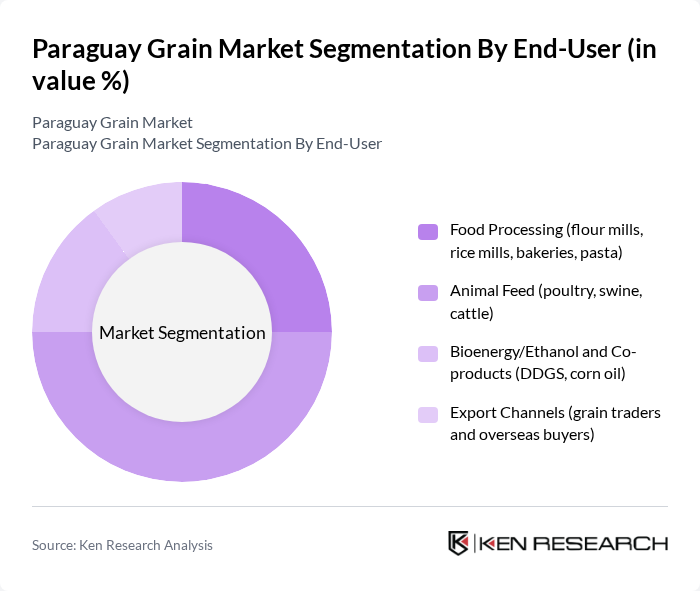
By End-User:The end-user segmentation of the grain market includes Food Processing, Animal Feed, Bioenergy/Ethanol and Co-products, and Export Channels. The Animal Feed segment is currently the most significant, as the livestock and poultry sectors rely heavily on corn-based rations, while food processing remains substantial for wheat flour and milled rice. Export channels have strengthened on the back of improved wheat and rice surpluses and strong regional demand, especially from Brazil .
Paraguay Grain Market Competitive Landscape
The Paraguay Grain Market is characterized by a dynamic mix of regional and international players. Leading participants such as Cargill Paraguay S.R.L., ADM Paraguay S.R.L. (Archer Daniels Midland), Agrofértil S.A. (Grupo Sarabia), Cooperativa Colonias Unidas Agropecuaria e Industrial, Grupo Los Trigales S.A., Agroganadera Itapúa S.A., Copagra S.A. (Comercial Paraguaya de Granos), Agrotec S.A.E., Louis Dreyfus Company Paraguay S.A., Bunge Paraguay S.A., ContiParaguay S.A. (Grupo ContiParaguay), Industrias Trociuk S.A. (Arroz Trociuk), Molino Harinero Clari S.A., Cooperativa La Holanda Ltda., Girassoil S.A. (aceites y granos) contribute to innovation, geographic expansion, and service delivery in this space.
Paraguay Grain Market Industry Analysis
Growth Drivers
- Increasing Domestic Consumption:Paraguay's domestic grain consumption has seen a significant rise, with an estimated increase to 3.5 million tons in future, up from 3.2 million tons in future. This growth is driven by a burgeoning population, projected to reach 7.5 million, and a shift towards more grain-based diets. The increase in local demand is further supported by rising incomes, with GDP per capita expected to hit $5,500, enhancing purchasing power and consumption patterns.
- Export Opportunities in Regional Markets:Paraguay's strategic location allows it to capitalize on export opportunities, particularly to neighboring countries like Brazil and Argentina. In future, grain exports are projected to reach 10 million tons, driven by favorable trade agreements and increasing demand in these markets. The country's grain production is expected to exceed 12 million tons, positioning it as a key player in the regional grain supply chain, enhancing its economic stability and growth prospects.
- Technological Advancements in Farming:The adoption of advanced agricultural technologies is transforming Paraguay's grain production landscape. In future, approximately 40% of farmers are expected to utilize precision farming techniques, leading to a projected 15% increase in crop yields. Investments in agri-tech solutions, such as drones and soil sensors, are estimated to reach $50 million, significantly improving efficiency and sustainability in grain farming, thus driving overall market growth.
Market Challenges
- Climate Change Impacts on Crop Yields:Climate change poses a significant threat to Paraguay's grain production, with projections indicating a potential yield reduction of 20% for key crops like soybeans and corn in future. Extreme weather events, such as droughts and floods, are becoming more frequent, adversely affecting agricultural output. The agricultural sector, which contributes 20% to the GDP, faces increasing pressure to adapt to these changing climatic conditions to maintain productivity.
- Infrastructure Limitations for Distribution:Paraguay's grain distribution infrastructure is underdeveloped, with only 30% of rural roads in good condition as of future. This hampers efficient transportation of grain to markets, leading to increased costs and potential losses. The lack of investment in logistics and storage facilities is estimated to result in a 10% loss of grain during transit, impacting overall market competitiveness and profitability for producers in the region.
Paraguay Grain Market Future Outlook
The Paraguay grain market is poised for significant transformation, driven by increasing domestic consumption and export opportunities. As the population grows and incomes rise, demand for grains is expected to escalate. Additionally, technological advancements will enhance productivity, while sustainable practices gain traction. However, challenges such as climate change and infrastructure limitations must be addressed. Overall, the market is likely to experience robust growth, supported by strategic investments and government initiatives aimed at bolstering the agricultural sector.
Market Opportunities
- Organic Grain Production:The demand for organic grains is on the rise, with an estimated market value of $100 million in future. This trend is driven by consumer preferences for healthier, sustainably sourced products. Paraguay's favorable climate conditions provide an excellent opportunity for farmers to transition to organic practices, potentially increasing their market share and profitability in both domestic and international markets.
- Investment in Agri-Tech Solutions:The agri-tech sector in Paraguay is expected to attract $50 million in investments in future. This influx of capital will facilitate the development of innovative farming technologies, enhancing productivity and sustainability. By adopting smart farming solutions, producers can optimize resource use, reduce costs, and improve crop yields, positioning themselves competitively in the evolving grain market landscape.
Scope of the Report
| Segment | Sub-Segments |
|---|---|
| By Type | Corn (Maize) Rice Wheat Sorghum Barley Oats Others (e.g., rye, triticale) |
| By End-User | Food Processing (flour mills, rice mills, bakeries, pasta) Animal Feed (poultry, swine, cattle) Bioenergy/Ethanol and Co-products (DDGS, corn oil) Export Channels (grain traders and overseas buyers) |
| By Distribution Channel | Direct Offtake (traders/exporters, crushers, mills) Cooperatives and Associations Wholesale/Bulk Trading Retail and E-commerce |
| By Quality Grade | Export Grade Milling Grade Feed Grade |
| By Packaging Type | Bulk (silos, containers, bulk vessels) Industrial Bags (25–50 kg) Retail Packs (?10 kg) |
| By Price Range | Low Price Mid Price High Price |
| By Region | Eastern Region (Itapúa, Alto Paraná, Canindeyú, Caaguazú) Central Region (Central, Cordillera, Paraguarí) Southern Region (Itapúa Sur, Misiones, Ñeembucú) Northern Region (San Pedro, Concepción, Amambay) Chaco/Western Region (Presidente Hayes, Boquerón, Alto Paraguay) Others |
Key Target Audience
Investors and Venture Capitalist Firms
Government and Regulatory Bodies (e.g., Ministry of Agriculture and Livestock, National Service for Quality and Animal Health)
Grain Producers and Farmers' Cooperatives
Exporters and Importers of Grains
Food Processing Companies
Logistics and Transportation Providers
Agri-tech Companies
Financial Institutions and Banks
Players Mentioned in the Report:
Cargill Paraguay S.R.L.
ADM Paraguay S.R.L. (Archer Daniels Midland)
Agrofertil S.A. (Grupo Sarabia)
Cooperativa Colonias Unidas Agropecuaria e Industrial
Grupo Los Trigales S.A.
Agroganadera Itapua S.A.
Copagra S.A. (Comercial Paraguaya de Granos)
Agrotec S.A.E.
Louis Dreyfus Company Paraguay S.A.
Bunge Paraguay S.A.
ContiParaguay S.A. (Grupo ContiParaguay)
Industrias Trociuk S.A. (Arroz Trociuk)
Molino Harinero Clari S.A.
Cooperativa La Holanda Ltda.
Girassoil S.A. (aceites y granos)
Table of Contents
Market Assessment Phase
1. Executive Summary and Approach
2. Paraguay Grain Market Overview
2.1 Key Insights and Strategic Recommendations
2.2 Paraguay Grain Market Overview
2.3 Definition and Scope
2.4 Evolution of Market Ecosystem
2.5 Timeline of Key Regulatory Milestones
2.6 Value Chain & Stakeholder Mapping
2.7 Business Cycle Analysis
2.8 Policy & Incentive Landscape
3. Paraguay Grain Market Analysis
3.1 Growth Drivers
3.1.1 Increasing domestic consumption
3.1.2 Export opportunities in regional markets
3.1.3 Technological advancements in farming
3.1.4 Government support for agricultural initiatives
3.2 Market Challenges
3.2.1 Climate change impacts on crop yields
3.2.2 Infrastructure limitations for distribution
3.2.3 Price volatility in global grain markets
3.2.4 Competition from other agricultural sectors
3.3 Market Opportunities
3.3.1 Organic grain production
3.3.2 Value-added grain products
3.3.3 Sustainable farming practices
3.3.4 Investment in agri-tech solutions
3.4 Market Trends
3.4.1 Shift towards sustainable agriculture
3.4.2 Increasing demand for gluten-free products
3.4.3 Growth in e-commerce for grain sales
3.4.4 Rising interest in local sourcing
3.5 Government Regulation
3.5.1 Agricultural subsidies
3.5.2 Export tariffs and quotas
3.5.3 Environmental regulations
3.5.4 Food safety standards
4. SWOT Analysis
5. Stakeholder Analysis
6. Porter's Five Forces Analysis
7. Paraguay Grain Market Market Size, 2019-2024
7.1 By Value
7.2 By Volume
7.3 By Average Selling Price
8. Paraguay Grain Market Segmentation
8.1 By Type
8.1.1 Corn (Maize)
8.1.2 Rice
8.1.3 Wheat
8.1.4 Sorghum
8.1.5 Barley
8.1.6 Oats
8.1.7 Others (e.g., rye, triticale)
8.2 By End-User
8.2.1 Food Processing (flour mills, rice mills, bakeries, pasta)
8.2.2 Animal Feed (poultry, swine, cattle)
8.2.3 Bioenergy/Ethanol and Co-products (DDGS, corn oil)
8.2.4 Export Channels (grain traders and overseas buyers)
8.3 By Distribution Channel
8.3.1 Direct Offtake (traders/exporters, crushers, mills)
8.3.2 Cooperatives and Associations
8.3.3 Wholesale/Bulk Trading
8.3.4 Retail and E-commerce
8.4 By Quality Grade
8.4.1 Export Grade
8.4.2 Milling Grade
8.4.3 Feed Grade
8.5 By Packaging Type
8.5.1 Bulk (silos, containers, bulk vessels)
8.5.2 Industrial Bags (25–50 kg)
8.5.3 Retail Packs (?10 kg)
8.6 By Price Range
8.6.1 Low Price
8.6.2 Mid Price
8.6.3 High Price
8.7 By Region
8.7.1 Eastern Region (Itapúa, Alto Paraná, Canindeyú, Caaguazú)
8.7.2 Central Region (Central, Cordillera, Paraguarí)
8.7.3 Southern Region (Itapúa Sur, Misiones, Ñeembucú)
8.7.4 Northern Region (San Pedro, Concepción, Amambay)
8.7.5 Chaco/Western Region (Presidente Hayes, Boquerón, Alto Paraguay)
8.7.6 Others
9. Paraguay Grain Market Competitive Analysis
9.1 Market Share of Key Players
9.2 Cross Comparison of Key Players
9.2.1 Company Name (local subsidiary where applicable)
9.2.2 Group Size (Global, Regional, or Local)
9.2.3 Paraguay Grain Procurement/Origination Volume (annual, MT)
9.2.4 Export Share from Paraguay Portfolio (% of sales)
9.2.5 Installed Storage Capacity in Paraguay (silo MT)
9.2.6 Crushing/Milling Capacity in Paraguay (TPD or MT/year)
9.2.7 Revenue Growth Rate in Paraguay (% YoY)
9.2.8 Market Access/Ports & Logistics Footprint (number of facilities, rail/river access)
9.2.9 Farmer Network/Contracted Producers (number of suppliers)
9.2.10 Quality Certifications (e.g., ISO, HACCP) and Compliance
9.2.11 Price Realization vs. Benchmark (basis to CBOT/local reference)
9.2.12 Working Capital Cycle (days)
9.2.13 Innovation/Traceability Adoption (e.g., digital origination, sustainability programs)
9.3 SWOT Analysis of Top Players
9.4 Pricing Analysis
9.5 Detailed Profile of Major Companies
9.5.1 Cargill Paraguay S.R.L.
9.5.2 ADM Paraguay S.R.L. (Archer Daniels Midland)
9.5.3 Agrofértil S.A. (Grupo Sarabia)
9.5.4 Cooperativa Colonias Unidas Agropecuaria e Industrial
9.5.5 Grupo Los Trigales S.A.
9.5.6 Agroganadera Itapúa S.A.
9.5.7 Copagra S.A. (Comercial Paraguaya de Granos)
9.5.8 Agrotec S.A.E.
9.5.9 Louis Dreyfus Company Paraguay S.A.
9.5.10 Bunge Paraguay S.A.
9.5.11 ContiParaguay S.A. (Grupo ContiParaguay)
9.5.12 Industrias Trociuk S.A. (Arroz Trociuk)
9.5.13 Molino Harinero Clari S.A.
9.5.14 Cooperativa La Holanda Ltda.
9.5.15 Girassoil S.A. (aceites y granos)
10. Paraguay Grain Market End-User Analysis
10.1 Procurement Behavior of Key Ministries
10.1.1 Ministry of Agriculture
10.1.2 Ministry of Industry
10.1.3 Ministry of Commerce
10.2 Corporate Spend on Infrastructure & Energy
10.2.1 Investment in storage facilities
10.2.2 Funding for transportation networks
10.2.3 Budget allocation for research and development
10.3 Pain Point Analysis by End-User Category
10.3.1 Supply chain disruptions
10.3.2 Quality assurance issues
10.3.3 Price fluctuations
10.4 User Readiness for Adoption
10.4.1 Awareness of sustainable practices
10.4.2 Access to financing options
10.4.3 Training and support availability
10.5 Post-Deployment ROI and Use Case Expansion
10.5.1 Measurement of yield improvements
10.5.2 Assessment of cost savings
10.5.3 Evaluation of market expansion opportunities
11. Paraguay Grain Market Future Size, 2025-2030
11.1 By Value
11.2 By Volume
11.3 By Average Selling Price
Go-To-Market Strategy Phase
1. Whitespace Analysis + Business Model Canvas
1.1 Market Gaps Identification
1.2 Value Proposition Development
1.3 Revenue Streams Analysis
1.4 Customer Segmentation
1.5 Key Partnerships
1.6 Cost Structure Analysis
1.7 Competitive Advantage
2. Marketing and Positioning Recommendations
2.1 Branding strategies
2.2 Product USPs
3. Distribution Plan
3.1 Urban retail vs rural NGO tie-ups
4. Channel & Pricing Gaps
4.1 Underserved routes
4.2 Pricing bands
5. Unmet Demand & Latent Needs
5.1 Category gaps
5.2 Consumer segments
6. Customer Relationship
6.1 Loyalty programs
6.2 After-sales service
7. Value Proposition
7.1 Sustainability
7.2 Integrated supply chains
8. Key Activities
8.1 Regulatory compliance
8.2 Branding
8.3 Distribution setup
9. Entry Strategy Evaluation
9.1 Domestic Market Entry Strategy
9.1.1 Product mix
9.1.2 Pricing band
9.1.3 Packaging
9.2 Export Entry Strategy
9.2.1 Target countries
9.2.2 Compliance roadmap
10. Entry Mode Assessment
10.1 JV
10.2 Greenfield
10.3 M&A
10.4 Distributor Model
11. Capital and Timeline Estimation
11.1 Capital requirements
11.2 Timelines
12. Control vs Risk Trade-Off
12.1 Ownership vs Partnerships
13. Profitability Outlook
13.1 Breakeven analysis
13.2 Long-term sustainability
14. Potential Partner List
14.1 Distributors
14.2 JVs
14.3 Acquisition targets
15. Execution Roadmap
15.1 Phased Plan for Market Entry
15.1.1 Market Setup
15.1.2 Market Entry
15.1.3 Growth Acceleration
15.1.4 Scale & Stabilize
15.2 Key Activities and Milestones
15.2.1 Activity Planning
15.2.2 Milestone Tracking
Research Methodology
Phase 1: Approach1
Desk Research
- Analysis of agricultural production statistics from the Paraguayan Ministry of Agriculture and Livestock
- Review of trade reports and export data from the National Institute of Statistics
- Examination of market trends and forecasts from industry publications and agricultural journals
Primary Research
- Interviews with key stakeholders in the grain supply chain, including farmers and distributors
- Surveys conducted with agronomists and agricultural economists to gather insights on market dynamics
- Field visits to grain production areas to observe practices and gather qualitative data
Validation & Triangulation
- Cross-validation of findings with historical data trends from multiple sources
- Triangulation of insights from primary interviews with secondary data findings
- Sanity checks through expert panel discussions with industry veterans
Phase 2: Market Size Estimation1
Top-down Assessment
- Estimation of total grain production based on national agricultural output reports
- Segmentation of the market by grain type, including soybeans, corn, and wheat
- Incorporation of export data to assess international market influence on local production
Bottom-up Modeling
- Collection of data on average yield per hectare from local agricultural studies
- Estimation of market size based on production volume and average market prices
- Analysis of input costs and profit margins for various grain types
Forecasting & Scenario Analysis
- Development of growth projections based on historical production trends and climatic factors
- Scenario modeling considering potential changes in trade policies and global market conditions
- Baseline, optimistic, and pessimistic forecasts through 2030 based on varying economic indicators
Phase 3: CATI Sample Composition1
| Scope Item/Segment | Sample Size | Target Respondent Profiles |
|---|---|---|
| Grain Producers | 150 | Farm Owners, Agricultural Managers |
| Grain Exporters | 100 | Export Managers, Trade Analysts |
| Supply Chain Stakeholders | 80 | Logistics Coordinators, Warehouse Managers |
| Agricultural Policy Makers | 60 | Government Officials, Policy Advisors |
| Market Analysts | 70 | Research Analysts, Economic Advisors |
Frequently Asked Questions
What is the current value of the Paraguay Grain Market?
The Paraguay Grain Market is valued at approximately USD 1.8 billion, reflecting significant growth driven by favorable agricultural conditions, technological advancements, and increasing global demand for key grains such as soybeans, corn, wheat, and rice.
Which regions in Paraguay are key for grain production?
What are the main types of grains produced in Paraguay?
How is the grain market in Paraguay segmented by end-user?
Other Regional/Country Reports
Indonesia Grain Market
Malaysia Grain Market
KSA Grain Market
APAC Grain Market
SEA Grain Market
Vietnam Grain Market
Why Buy From Us?

What makes us stand out is that our consultants follow Robust, Refine and Result (RRR) methodology. Robust for clear definitions, approaches and sanity checking, Refine for differentiating respondents' facts and opinions, and Result for presenting data with story.

We have set a benchmark in the industry by offering our clients with syndicated and customized market research reports featuring coverage of entire market as well as meticulous research and analyst insights.

While we don't replace traditional research, we flip the method upside down. Our dual approach of Top Bottom & Bottom Top ensures quality deliverable by not just verifying company fundamentals but also looking at the sector and macroeconomic factors.

With one step in the future, our research team constantly tries to show you the bigger picture. We help with some of the tough questions you may encounter along the way: How is the industry positioned? Best marketing channel? KPI's of competitors? By aligning every element, we help maximize success.

Our report gives you instant access to the answers and sources that other companies might choose to hide. We elaborate each steps of research methodology we have used and showcase you the sample size to earn your trust.

If you need any support, we are here! We pride ourselves on universe strength, data quality, and quick, friendly, and professional service.