About the Report
Base Year 2024Listen to the audio summary
Philippines Animation Software Market Overview
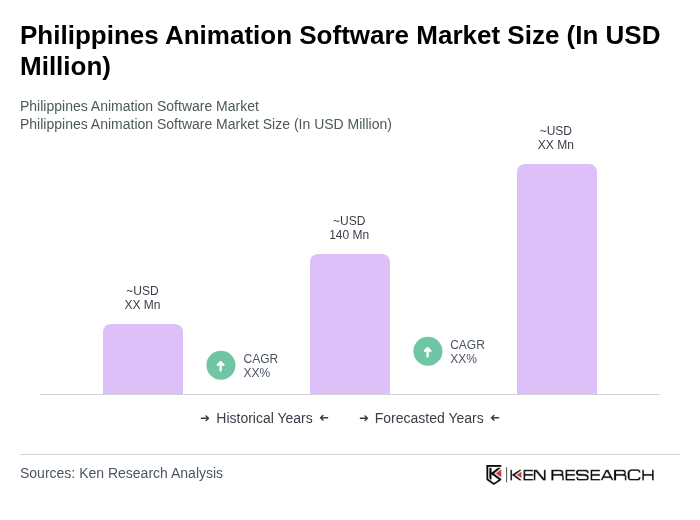
- The Philippines Animation Software Market is valued at USD 140 million, based on a five-year historical analysis. This growth is primarily driven by the increasing demand for high-quality animated content across media, entertainment, advertising, and education sectors. The proliferation of digital platforms, the rise of streaming services, and the growing popularity of animated films, series, and gaming have significantly contributed to the market's expansion. The country’s competitive edge lies in its skilled creative workforce and cost-effective production, attracting international outsourcing contracts and investments .
- Key cities such as Manila, Cebu, and Davao continue to dominate the market due to their robust creative industries, established animation studios, and educational institutions offering specialized training in animation and digital arts. Manila, in particular, serves as the primary hub for animation companies, drawing both local and international clients and fostering a collaborative ecosystem that enhances the city’s market position .
- In 2022, the Philippine government enacted Republic Act No. 11904, known as the “Philippine Creative Industries Development Act,” issued by the Congress of the Philippines. This legislation mandates the development and promotion of creative sectors, including animation, and provides operational incentives such as tax breaks, grants, and funding programs for local studios. The Act requires eligible animation enterprises to register with the Creative Industry Development Council to access these benefits, aiming to boost innovation, global competitiveness, and sustainable growth in the sector .
Philippines Animation Software Market Segmentation
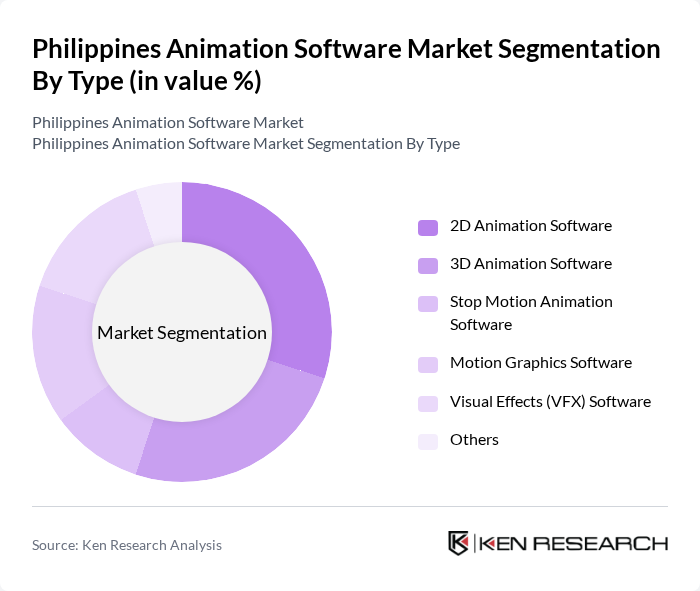
By Type:The animation software market is segmented into 2D Animation Software, 3D Animation Software, Stop Motion Animation Software, Motion Graphics Software, Visual Effects (VFX) Software, and Others. Each segment addresses distinct creative and technical requirements. 2D and 3D animation software remain the most widely adopted, especially in media, entertainment, and advertising, while VFX software is increasingly utilized in film production, gaming, and immersive digital experiences. The adoption of cloud-based animation tools and AI-driven features is also accelerating across all segments .
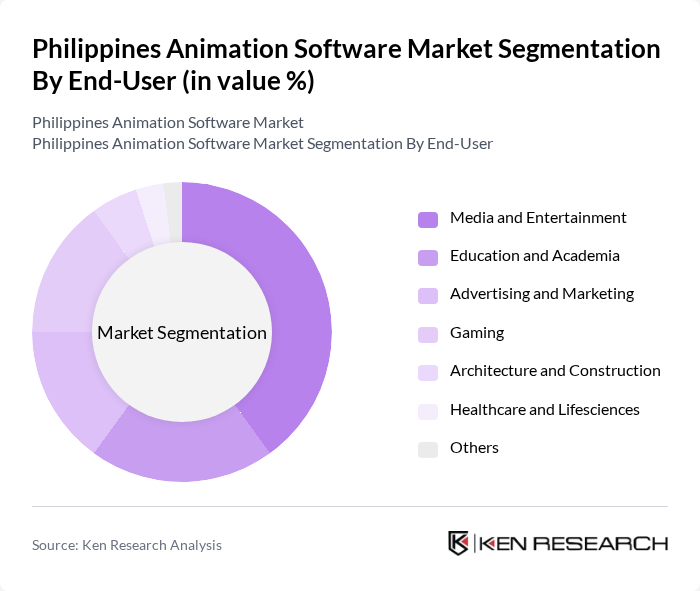
By End-User:End-user segments include Media and Entertainment, Education and Academia, Advertising and Marketing, Gaming, Architecture and Construction, Healthcare and Lifesciences, and Others. Media and entertainment is the largest consumer, driven by animated film and series production, as well as the expansion of digital content platforms. The education sector is also a significant user, leveraging animation for interactive and engaging learning materials. Gaming and advertising are rapidly growing end-user segments, reflecting the broader digital transformation in the Philippines .
Philippines Animation Software Market Competitive Landscape
The Philippines Animation Software Market is characterized by a dynamic mix of regional and international players. Leading participants such as Toon Boom Animation Inc., Adobe Systems Incorporated, Autodesk, Inc., Blender Foundation, Moho (formerly Anime Studio), Corel Corporation, TVPaint Développement, Smith Micro Software, Inc., OpenToonz, Clip Studio Paint (Celsys, Inc.), Wacom Co., Ltd., Celsys, Inc., Pixologic, Inc., Foundry (Nuke), Pixar Animation Studios (RenderMan), Toon City Animation (Philippines), Top Draw Animation (Philippines), Synergy88 Digital (Philippines) contribute to innovation, geographic expansion, and service delivery in this space.
Philippines Animation Software Market Industry Analysis
Growth Drivers
- Increasing Demand for Animated Content:The Philippines has seen a significant rise in demand for animated content, particularly in media and entertainment. In future, the local media industry generated approximately PHP 200 billion, with animation accounting for 15% of this revenue. This growth is driven by the increasing consumption of digital content, with over 76 million internet users in the country, leading to a surge in animated series and films tailored for local audiences.
- Growth of the Gaming Industry:The gaming industry in the Philippines is projected to reach PHP 30 billion in future, driven by a young, tech-savvy population. With over 43 million gamers in the country, the demand for animation software to create engaging game graphics and characters is on the rise. This growth is further supported by the increasing popularity of mobile gaming, which accounted for 60% of the total gaming revenue in future, highlighting the need for advanced animation tools.
- Rising Adoption in Education:The adoption of animation in education and e-learning is gaining momentum, particularly post-pandemic. In future, the e-learning market in the Philippines was valued at PHP 10 billion, with animation playing a crucial role in enhancing learning experiences. Schools and educational institutions are increasingly integrating animated content into their curricula, with over 50% of educators reporting improved student engagement through animated lessons, thus driving demand for animation software.
Market Challenges
- High Competition from International Providers:The Philippines faces intense competition from established international animation software providers, which dominate the market with advanced features and extensive resources. In future, over 70% of animation software used in the country was sourced from foreign companies. This competition poses a significant challenge for local developers, who struggle to compete on pricing and technological capabilities, limiting their market share and growth potential.
- Shortage of Skilled Professionals:The animation industry in the Philippines is hindered by a shortage of skilled professionals. According to the Department of Labor and Employment, there are approximately 5,000 job vacancies in the animation sector, with only 2,000 qualified graduates entering the workforce annually. This gap affects the quality of output and innovation in animation software development, as local companies find it challenging to recruit and retain talent in a competitive job market.
Philippines Animation Software Market Future Outlook
The future of the animation software market in the Philippines appears promising, driven by technological advancements and increasing digital content consumption. As the demand for high-quality animated content continues to rise, local developers are likely to innovate and adapt to emerging trends, such as cloud-based solutions and AI integration. Furthermore, the government's support for the creative industry is expected to foster a more conducive environment for growth, encouraging investment and collaboration among stakeholders in the animation sector.
Market Opportunities
- Collaboration with Local Content Creators:There is a significant opportunity for animation software providers to collaborate with local content creators. With the Philippine creative industry generating over PHP 50 billion in future, partnerships can enhance the quality and diversity of animated content, catering to both local and international markets, thus expanding the reach and impact of animation software.
- Growth in Virtual and Augmented Reality:The rise of virtual reality (VR) and augmented reality (AR) applications presents a lucrative opportunity for animation software development. The VR and AR market in the Philippines is expected to grow to PHP 5 billion in future, driven by increasing investments in technology and entertainment. This growth will necessitate advanced animation tools tailored for immersive experiences, creating demand for innovative software solutions.
Scope of the Report
| Segment | Sub-Segments |
|---|---|
| By Type | D Animation Software D Animation Software Stop Motion Animation Software Motion Graphics Software Visual Effects (VFX) Software Others |
| By End-User | Media and Entertainment Education and Academia Advertising and Marketing Gaming Architecture and Construction Healthcare and Lifesciences Others |
| By Industry Application | Film Production Television Broadcasting Online Content Creation Corporate Training Virtual Reality/Augmented Reality Others |
| By Distribution Channel | Direct Sales Online Platforms Resellers and Distributors Retail Outlets Others |
| By Pricing Model | Subscription-Based One-Time Purchase Freemium Model Pay-Per-Use Others |
| By User Type | Individual Users Small and Medium Enterprises Large Enterprises Educational Institutions Animation Studios Others |
| By Software Deployment | On-Premise Cloud-Based Hybrid Others |
Key Target Audience
Investors and Venture Capitalist Firms
Government and Regulatory Bodies (e.g., Department of Information and Communications Technology, National Commission for Culture and the Arts)
Animation Studios and Production Companies
Software Development Firms
Content Creators and Digital Artists
Television and Film Production Houses
Advertising and Marketing Agencies
Gaming Companies
Players Mentioned in the Report:
Toon Boom Animation Inc.
Adobe Systems Incorporated
Autodesk, Inc.
Blender Foundation
Moho (formerly Anime Studio)
Corel Corporation
TVPaint Developpement
Smith Micro Software, Inc.
OpenToonz
Clip Studio Paint (Celsys, Inc.)
Wacom Co., Ltd.
Celsys, Inc.
Pixologic, Inc.
Foundry (Nuke)
Pixar Animation Studios (RenderMan)
Toon City Animation (Philippines)
Top Draw Animation (Philippines)
Synergy88 Digital (Philippines)
Table of Contents
Market Assessment Phase
1. Executive Summary and Approach
2. Philippines Animation Software Market Overview
2.1 Key Insights and Strategic Recommendations
2.2 Philippines Animation Software Market Overview
2.3 Definition and Scope
2.4 Evolution of Market Ecosystem
2.5 Timeline of Key Regulatory Milestones
2.6 Value Chain & Stakeholder Mapping
2.7 Business Cycle Analysis
2.8 Policy & Incentive Landscape
3. Philippines Animation Software Market Analysis
3.1 Growth Drivers
3.1.1 Increasing demand for animated content in media and entertainment
3.1.2 Growth of the gaming industry in the Philippines
3.1.3 Rising adoption of animation in education and e-learning
3.1.4 Expansion of digital marketing and advertising sectors
3.2 Market Challenges
3.2.1 High competition from international animation software providers
3.2.2 Limited access to advanced technology and tools
3.2.3 Shortage of skilled professionals in animation
3.2.4 Economic fluctuations affecting investment in creative industries
3.3 Market Opportunities
3.3.1 Potential for collaboration with local content creators
3.3.2 Growth in virtual reality and augmented reality applications
3.3.3 Increasing government support for the creative industry
3.3.4 Expansion of online platforms for animation distribution
3.4 Market Trends
3.4.1 Shift towards cloud-based animation software solutions
3.4.2 Rising popularity of mobile animation applications
3.4.3 Integration of AI and machine learning in animation processes
3.4.4 Growing emphasis on sustainability in animation production
3.5 Government Regulation
3.5.1 Implementation of tax incentives for creative industries
3.5.2 Regulations on copyright and intellectual property rights
3.5.3 Support for local content development initiatives
3.5.4 Standards for software quality and user safety
4. SWOT Analysis
5. Stakeholder Analysis
6. Porter's Five Forces Analysis
7. Philippines Animation Software Market Market Size, 2019-2024
7.1 By Value
7.2 By Volume
7.3 By Average Selling Price
8. Philippines Animation Software Market Segmentation
8.1 By Type
8.1.1 2D Animation Software
8.1.2 3D Animation Software
8.1.3 Stop Motion Animation Software
8.1.4 Motion Graphics Software
8.1.5 Visual Effects (VFX) Software
8.1.6 Others
8.2 By End-User
8.2.1 Media and Entertainment
8.2.2 Education and Academia
8.2.3 Advertising and Marketing
8.2.4 Gaming
8.2.5 Architecture and Construction
8.2.6 Healthcare and Lifesciences
8.2.7 Others
8.3 By Industry Application
8.3.1 Film Production
8.3.2 Television Broadcasting
8.3.3 Online Content Creation
8.3.4 Corporate Training
8.3.5 Virtual Reality/Augmented Reality
8.3.6 Others
8.4 By Distribution Channel
8.4.1 Direct Sales
8.4.2 Online Platforms
8.4.3 Resellers and Distributors
8.4.4 Retail Outlets
8.4.5 Others
8.5 By Pricing Model
8.5.1 Subscription-Based
8.5.2 One-Time Purchase
8.5.3 Freemium Model
8.5.4 Pay-Per-Use
8.5.5 Others
8.6 By User Type
8.6.1 Individual Users
8.6.2 Small and Medium Enterprises
8.6.3 Large Enterprises
8.6.4 Educational Institutions
8.6.5 Animation Studios
8.6.6 Others
8.7 By Software Deployment
8.7.1 On-Premise
8.7.2 Cloud-Based
8.7.3 Hybrid
8.7.4 Others
9. Philippines Animation Software Market Competitive Analysis
9.1 Market Share of Key Players
9.2 KPIs for Cross Comparison of Key Players
9.2.1 Company Name
9.2.2 Market Share (%)
9.2.3 Annual Revenue (USD Million)
9.2.4 Revenue Growth Rate (%)
9.2.5 Number of Active Users (Philippines)
9.2.6 Customer Acquisition Cost (USD)
9.2.7 Customer Retention Rate (%)
9.2.8 Market Penetration Rate (%)
9.2.9 Pricing Strategy (Subscription, One-Time, Freemium)
9.2.10 Average Deal Size (USD)
9.2.11 Product Development Cycle Time (Months)
9.2.12 Brand Recognition Score (Survey-Based)
9.2.13 Local Partnership/Studio Count
9.2.14 Support for Filipino Language/Localization
9.3 SWOT Analysis of Top Players
9.4 Pricing Analysis
9.5 Detailed Profile of Major Companies
9.5.1 Toon Boom Animation Inc.
9.5.2 Adobe Systems Incorporated
9.5.3 Autodesk, Inc.
9.5.4 Blender Foundation
9.5.5 Moho (formerly Anime Studio)
9.5.6 Corel Corporation
9.5.7 TVPaint Développement
9.5.8 Smith Micro Software, Inc.
9.5.9 OpenToonz
9.5.10 Clip Studio Paint (Celsys, Inc.)
9.5.11 Wacom Co., Ltd.
9.5.12 Celsys, Inc.
9.5.13 Pixologic, Inc.
9.5.14 Foundry (Nuke)
9.5.15 Pixar Animation Studios (RenderMan)
9.5.16 Toon City Animation (Philippines)
9.5.17 Top Draw Animation (Philippines)
9.5.18 Synergy88 Digital (Philippines)
10. Philippines Animation Software Market End-User Analysis
10.1 Procurement Behavior of Key Ministries
10.1.1 Government funding for animation projects
10.1.2 Collaboration with local animation studios
10.1.3 Preference for locally developed software
10.1.4 Evaluation criteria for software procurement
10.2 Corporate Spend on Infrastructure & Energy
10.2.1 Budget allocation for animation software
10.2.2 Investment in training and development
10.2.3 Spending on hardware and software upgrades
10.2.4 Partnerships with educational institutions
10.3 Pain Point Analysis by End-User Category
10.3.1 Challenges faced by media companies
10.3.2 Issues in educational content creation
10.3.3 Barriers for small animation studios
10.3.4 Limitations in software accessibility
10.4 User Readiness for Adoption
10.4.1 Awareness of available animation tools
10.4.2 Training needs for effective software use
10.4.3 Willingness to invest in new technologies
10.4.4 Feedback from early adopters
10.5 Post-Deployment ROI and Use Case Expansion
10.5.1 Measurement of project success
10.5.2 Case studies of successful implementations
10.5.3 Opportunities for software upgrades
10.5.4 Expansion into new markets
11. Philippines Animation Software Market Future Size, 2025-2030
11.1 By Value
11.2 By Volume
11.3 By Average Selling Price
Go-To-Market Strategy Phase
1. Whitespace Analysis + Business Model Canvas
1.1 Market Gaps and Opportunities
2. Marketing and Positioning Recommendations
2.1 Branding strategies
2.2 Product USPs
3. Distribution Plan
3.1 Urban retail vs rural NGO tie-ups
4. Channel & Pricing Gaps
4.1 Underserved routes
4.2 Pricing bands
5. Unmet Demand & Latent Needs
5.1 Category gaps
5.2 Consumer segments
6. Customer Relationship
6.1 Loyalty programs
6.2 After-sales service
7. Value Proposition
7.1 Sustainability
7.2 Integrated supply chains
8. Key Activities
8.1 Regulatory compliance
8.2 Branding
8.3 Distribution setup
9. Entry Strategy Evaluation
9.1 Domestic Market Entry Strategy
9.1.1 Product mix
9.1.2 Pricing band
9.1.3 Packaging
9.2 Export Entry Strategy
9.2.1 Target countries
9.2.2 Compliance roadmap
10. Entry Mode Assessment
10.1 JV
10.2 Greenfield
10.3 M&A
10.4 Distributor Model
11. Capital and Timeline Estimation
11.1 Capital requirements
11.2 Timelines
12. Control vs Risk Trade-Off
12.1 Ownership vs Partnerships
13. Profitability Outlook
13.1 Breakeven analysis
13.2 Long-term sustainability
14. Potential Partner List
14.1 Distributors
14.2 JVs
14.3 Acquisition targets
15. Execution Roadmap
15.1 Phased Plan for Market Entry
15.1.1 Market Setup
15.1.2 Market Entry
15.1.3 Growth Acceleration
15.1.4 Scale & Stabilize
15.2 Key Activities and Milestones
15.2.1 Milestone Planning
Research Methodology
Phase 1: Approach1
Desk Research
- Industry reports from local and international market research firms focusing on animation software trends
- Government publications and statistics from the National Economic and Development Authority (NEDA) related to the digital economy
- Academic journals and white papers discussing the growth of the animation sector in the Philippines
Primary Research
- Interviews with key stakeholders in animation studios, including directors and lead animators
- Surveys targeting software developers and technology providers in the animation industry
- Focus group discussions with educators from animation schools to understand curriculum trends and industry needs
Validation & Triangulation
- Cross-validation of findings through multiple data sources, including trade associations and industry publications
- Triangulation of qualitative insights from interviews with quantitative data from surveys
- Sanity checks conducted through expert panel reviews comprising industry veterans and academic professionals
Phase 2: Market Size Estimation1
Top-down Assessment
- Analysis of the overall digital content market size in the Philippines as a basis for animation software market estimation
- Segmentation of the market by application areas such as film, gaming, and education
- Incorporation of growth rates from related sectors, such as gaming and e-learning, to project animation software demand
Bottom-up Modeling
- Estimation of software sales based on the number of active animation studios and freelance animators in the Philippines
- Operational cost analysis of leading animation software providers to determine pricing strategies
- Volume x price calculations to derive revenue estimates for various software categories
Forecasting & Scenario Analysis
- Multi-factor regression analysis incorporating variables such as technological advancements and consumer preferences
- Scenario modeling based on potential regulatory changes affecting the digital content industry
- Development of baseline, optimistic, and pessimistic forecasts through 2030 based on market dynamics
Phase 3: CATI Sample Composition1
| Scope Item/Segment | Sample Size | Target Respondent Profiles |
|---|---|---|
| Animation Studios | 60 | Studio Owners, Creative Directors |
| Freelance Animators | 50 | Independent Artists, Animation Specialists |
| Educational Institutions | 40 | Program Coordinators, Faculty Members |
| Software Developers | 45 | Product Managers, Technical Leads |
| Industry Experts | 40 | Consultants, Market Analysts |
Frequently Asked Questions
What is the current value of the Philippines Animation Software Market?
The Philippines Animation Software Market is valued at approximately USD 140 million, driven by the increasing demand for high-quality animated content across various sectors, including media, entertainment, advertising, and education.
What factors are driving the growth of the animation software market in the Philippines?
Which cities are the primary hubs for animation software in the Philippines?
What is the impact of the Philippine Creative Industries Development Act on the animation sector?
Other Regional/Country Reports
Indonesia Animation Software Market
Malaysia Animation Software Market
KSA Animation Software Market
APAC Animation Software Market
SEA Animation Software Market
Vietnam Animation Software Market
Other Adjacent Reports
Kuwait 3D Modeling Software Market
Philippines Visual Effects Software Market
Oman Game Development Software Market
Vietnam Video Editing Software Market
Japan Graphic Design Software Market
Japan Motion Graphics Software Market
Bahrain Virtual Reality Software Market
Kuwait Augmented Reality Software Market
Singapore E-Learning Content Market
South Africa Digital Media Production Market
Why Buy From Us?

What makes us stand out is that our consultants follow Robust, Refine and Result (RRR) methodology. Robust for clear definitions, approaches and sanity checking, Refine for differentiating respondents' facts and opinions, and Result for presenting data with story.

We have set a benchmark in the industry by offering our clients with syndicated and customized market research reports featuring coverage of entire market as well as meticulous research and analyst insights.

While we don't replace traditional research, we flip the method upside down. Our dual approach of Top Bottom & Bottom Top ensures quality deliverable by not just verifying company fundamentals but also looking at the sector and macroeconomic factors.

With one step in the future, our research team constantly tries to show you the bigger picture. We help with some of the tough questions you may encounter along the way: How is the industry positioned? Best marketing channel? KPI's of competitors? By aligning every element, we help maximize success.

Our report gives you instant access to the answers and sources that other companies might choose to hide. We elaborate each steps of research methodology we have used and showcase you the sample size to earn your trust.

If you need any support, we are here! We pride ourselves on universe strength, data quality, and quick, friendly, and professional service.