About the Report
Base Year 2024Philippines Automotive Acoustic Engineering Services Market Overview
- The Philippines Automotive Acoustic Engineering Services Market is valued at USD 55 million, based on a five-year historical analysis. This growth is primarily driven by the increasing demand for noise reduction in vehicles, influenced by consumer preferences for quieter rides and stricter noise regulations, alongside rising electric vehicle adoption and advancements in NVH technologies. The automotive sector's expansion, coupled with advancements in acoustic technologies, has significantly contributed to the market's growth.
- Metro Manila, Cebu, and Davao are the dominant regions in the Philippines Automotive Acoustic Engineering Services Market. Metro Manila leads due to its concentration of automotive manufacturers and suppliers, while Cebu and Davao benefit from growing automotive industries and infrastructure development. These cities are pivotal in driving innovation and service delivery in the acoustic engineering sector.
- The Philippine Clean Air Act of 1999 (Republic Act No. 8749), issued by the Department of Environment and Natural Resources, establishes emission standards for motor vehicles including noise limits, requiring compliance testing for registration and operation, with thresholds set at 90 dB(A) for light vehicles and mandatory periodic inspections for all registered vehicles. This initiative includes incentives for companies investing in noise reduction technologies, promoting sustainable practices, and improving vehicle quality standards, thereby fostering growth in the automotive acoustic engineering services market.

Philippines Automotive Acoustic Engineering Services Market Segmentation
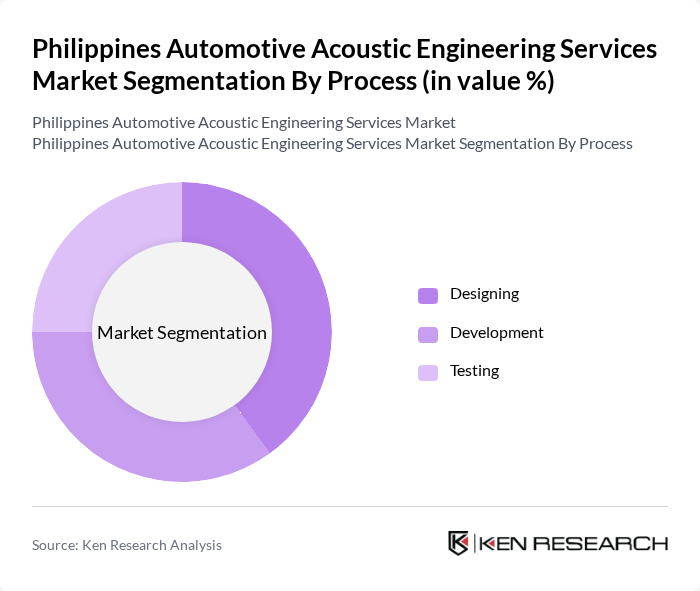
By Process:The market is segmented into three key processes: Designing, Development, and Testing. Each of these processes plays a crucial role in ensuring that vehicles meet the required acoustic standards. The Designing phase focuses on creating innovative solutions to minimize noise, while Development involves the practical application of these designs. Testing is essential for validating the effectiveness of the acoustic solutions implemented.
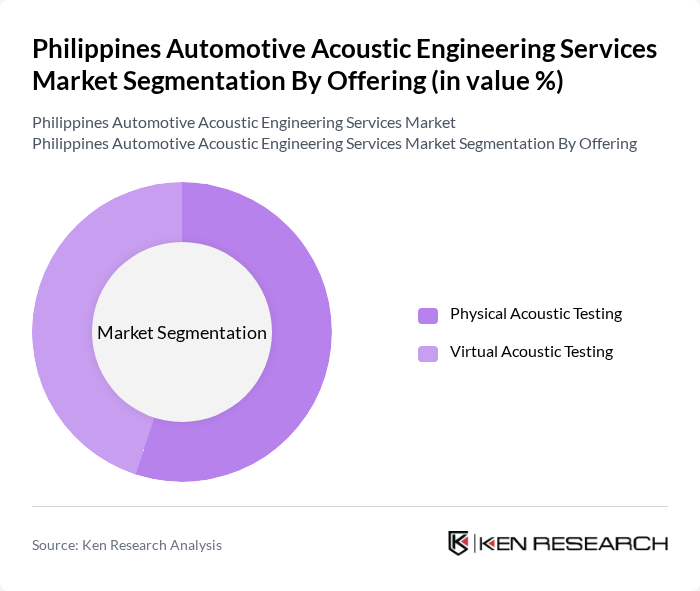
By Offering:The offerings in the market include Physical Acoustic Testing and Virtual Acoustic Testing. Physical Acoustic Testing involves real-world assessments of noise levels and sound quality in vehicles, while Virtual Acoustic Testing utilizes advanced simulation technologies to predict acoustic performance. The increasing adoption of virtual testing methods is reshaping the landscape, providing cost-effective and efficient solutions for manufacturers.
Philippines Automotive Acoustic Engineering Services Market Competitive Landscape
The Philippines Automotive Acoustic Engineering Services Market is characterized by a dynamic mix of regional and international players. Leading participants such as Aisin Seiki Co., Ltd., Faurecia, BASF SE, 3M Company, Continental AG, Johnson Controls International plc, Knauf Insulation, Saint-Gobain, Sika AG, Trelleborg AB, Soundcoat Company, Acoustical Solutions, Inc., E-A-R Specialty Composites, Mapei S.p.A., Rockwool International A/S contribute to innovation, geographic expansion, and service delivery in this space.
Philippines Automotive Acoustic Engineering Services Market Industry Analysis
Growth Drivers
- Increasing Demand for Noise Reduction:The Philippines automotive sector is witnessing a surge in demand for noise reduction technologies, driven by consumer preferences for quieter vehicles. In future, the automotive industry is projected to produce approximately 350,000 vehicles, with a significant portion requiring advanced acoustic solutions. This demand is further supported by a 20% increase in vehicle sales from 2023, highlighting the growing consumer focus on comfort and noise management in vehicles.
- Stringent Government Regulations:The Philippine government has implemented strict regulations on vehicle noise levels, mandating compliance with noise emission standards. In future, the Department of Transportation aims to enforce noise limits that reduce permissible levels to 70 decibels for passenger vehicles. This regulatory environment is pushing manufacturers to invest in acoustic engineering services to meet compliance, thereby driving market growth and innovation in noise reduction technologies.
- Technological Advancements in Acoustic Materials:The automotive industry is experiencing rapid advancements in acoustic materials, enhancing noise reduction capabilities. In future, the market for advanced acoustic materials is expected to reach $1.5 billion, driven by innovations such as lightweight composites and sound-absorbing foams. These materials not only improve vehicle performance but also align with sustainability goals, making them attractive to manufacturers aiming to enhance their product offerings.
Market Challenges
- High Costs of Advanced Solutions:The implementation of advanced acoustic engineering solutions often comes with high costs, which can deter smaller manufacturers from investing. In future, the average cost of integrating state-of-the-art acoustic materials is estimated at $600 per vehicle. This financial barrier limits market participation and innovation, particularly among local firms that may struggle to absorb these expenses while remaining competitive.
- Limited Availability of Skilled Professionals:The automotive acoustic engineering sector faces a shortage of skilled professionals, which hampers growth. In future, it is estimated that only 25% of engineering graduates in the Philippines specialize in automotive acoustics. This skills gap poses a significant challenge for companies seeking to implement advanced acoustic solutions, as they struggle to find qualified personnel to drive innovation and meet market demands.
Philippines Automotive Acoustic Engineering Services Market Future Outlook
The future of the Philippines automotive acoustic engineering services market appears promising, driven by increasing consumer expectations for vehicle comfort and noise reduction. As the automotive sector continues to expand, particularly with the rise of electric vehicles, manufacturers will increasingly prioritize acoustic engineering. Additionally, collaboration with international firms is likely to enhance local expertise and technology transfer, fostering innovation and competitiveness in the market. The focus on sustainable materials will also shape future developments, aligning with global trends toward eco-friendly practices.
Market Opportunities
- Expansion of Electric Vehicle Market:The growing electric vehicle (EV) market presents significant opportunities for acoustic engineering services. With the Philippine government targeting 1.5 million EVs on the road in future, manufacturers will require specialized acoustic solutions to address unique noise characteristics of electric drivetrains, creating a niche for innovative engineering firms.
- Collaboration with International Firms:There is substantial potential for collaboration with international firms specializing in acoustic technologies. Such partnerships can facilitate knowledge transfer and access to advanced materials and techniques. In future, the Philippine government is expected to promote joint ventures, enhancing local capabilities and positioning the country as a regional hub for automotive acoustic engineering.
Scope of the Report
| Segment | Sub-Segments |
|---|---|
| By Process | Designing Development Testing |
| By Offering | Physical Acoustic Testing Virtual Acoustic Testing |
| By Application | Interior Powertrain Drivetrain Body and Structure Others |
| By Vehicle Type | Passenger Cars Commercial Vehicles Electric and Hybrid Vehicles |
| By Propulsion Type | Internal Combustion Engine (ICE) Electric |
| By Software | Calibration Signal Analysis Simulation Vibration |
| By Region | Luzon Visayas Mindanao Others |
Key Target Audience
Investors and Venture Capitalist Firms
Government and Regulatory Bodies (e.g., Department of Trade and Industry, Department of Transportation)
Automotive Manufacturers and Producers
Automotive Component Suppliers
Acoustic Engineering Service Providers
Industry Associations (e.g., Chamber of Automotive Manufacturers of the Philippines, Inc.)
Financial Institutions
Automotive Research and Development Organizations
Players Mentioned in the Report:
Aisin Seiki Co., Ltd.
Faurecia
BASF SE
3M Company
Continental AG
Johnson Controls International plc
Knauf Insulation
Saint-Gobain
Sika AG
Trelleborg AB
Soundcoat Company
Acoustical Solutions, Inc.
E-A-R Specialty Composites
Mapei S.p.A.
Rockwool International A/S
Table of Contents
Market Assessment Phase
1. Executive Summary and Approach
2. Philippines Automotive Acoustic Engineering Services Market Overview
2.1 Key Insights and Strategic Recommendations
2.2 Philippines Automotive Acoustic Engineering Services Market Overview
2.3 Definition and Scope
2.4 Evolution of Market Ecosystem
2.5 Timeline of Key Regulatory Milestones
2.6 Value Chain & Stakeholder Mapping
2.7 Business Cycle Analysis
2.8 Policy & Incentive Landscape
3. Philippines Automotive Acoustic Engineering Services Market Analysis
3.1 Growth Drivers
3.1.1 Increasing demand for noise reduction in vehicles
3.1.2 Stringent government regulations on vehicle noise levels
3.1.3 Technological advancements in acoustic materials
3.1.4 Rising consumer awareness regarding vehicle comfort
3.2 Market Challenges
3.2.1 High costs of advanced acoustic engineering solutions
3.2.2 Limited availability of skilled professionals
3.2.3 Competition from low-cost alternatives
3.2.4 Fluctuating raw material prices
3.3 Market Opportunities
3.3.1 Expansion of electric vehicle market
3.3.2 Growing automotive manufacturing sector in the Philippines
3.3.3 Potential for collaboration with international firms
3.3.4 Development of innovative acoustic solutions
3.4 Market Trends
3.4.1 Increasing integration of acoustic engineering in vehicle design
3.4.2 Shift towards sustainable and eco-friendly materials
3.4.3 Adoption of advanced simulation technologies
3.4.4 Rising focus on customer experience and comfort
3.5 Government Regulation
3.5.1 Implementation of noise pollution control regulations
3.5.2 Standards for vehicle noise emissions
3.5.3 Incentives for using eco-friendly materials
3.5.4 Regulations promoting electric vehicle adoption
4. SWOT Analysis
5. Stakeholder Analysis
6. Porter's Five Forces Analysis
7. Philippines Automotive Acoustic Engineering Services Market Size, 2019-2024
7.1 By Value
7.2 By Volume
7.3 By Average Selling Price
8. Philippines Automotive Acoustic Engineering Services Market Segmentation
8.1 By Process
8.1.1 Designing
8.1.2 Development
8.1.3 Testing
8.2 By Offering
8.2.1 Physical Acoustic Testing
8.2.2 Virtual Acoustic Testing
8.3 By Application
8.3.1 Interior
8.3.2 Powertrain
8.3.3 Drivetrain
8.3.4 Body and Structure
8.3.5 Others
8.4 By Vehicle Type
8.4.1 Passenger Cars
8.4.2 Commercial Vehicles
8.4.3 Electric and Hybrid Vehicles
8.5 By Propulsion Type
8.5.1 Internal Combustion Engine (ICE)
8.5.2 Electric
8.6 By Software
8.6.1 Calibration
8.6.2 Signal Analysis
8.6.3 Simulation
8.6.4 Vibration
8.7 By Region
8.7.1 Luzon
8.7.2 Visayas
8.7.3 Mindanao
8.7.4 Others
9. Philippines Automotive Acoustic Engineering Services Market Competitive Analysis
9.1 Market Share of Key Players
9.2 Cross Comparison of Key Players
9.2.1 Company Name
9.2.2 Revenue Growth Rate (%)
9.2.3 Market Share (%)
9.2.4 Customer Retention Rate (%)
9.2.5 Market Penetration Rate (%)
9.2.6 Pricing Strategy
9.2.7 Product Development Cycle Time (months)
9.2.8 Customer Satisfaction Score (1-10)
9.2.9 Sales Conversion Rate (%)
9.2.10 Brand Recognition Index
9.3 SWOT Analysis of Top Players
9.4 Pricing Analysis
9.5 Detailed Profile of Major Companies
9.5.1 Aisin Seiki Co., Ltd.
9.5.2 Faurecia
9.5.3 BASF SE
9.5.4 3M Company
9.5.5 Continental AG
9.5.6 Johnson Controls International plc
9.5.7 Knauf Insulation
9.5.8 Saint-Gobain
9.5.9 Sika AG
9.5.10 Trelleborg AB
9.5.11 Soundcoat Company
9.5.12 Acoustical Solutions, Inc.
9.5.13 E-A-R Specialty Composites
9.5.14 Mapei S.p.A.
9.5.15 Rockwool International A/S
10. Philippines Automotive Acoustic Engineering Services Market End-User Analysis
10.1 Procurement Behavior of Key Ministries
10.1.1 Government procurement policies
10.1.2 Budget allocation for automotive projects
10.1.3 Evaluation criteria for suppliers
10.1.4 Others
10.2 Corporate Spend on Infrastructure & Energy
10.2.1 Investment trends in automotive sector
10.2.2 Budgeting for acoustic solutions
10.2.3 Cost-benefit analysis of acoustic engineering
10.2.4 Others
10.3 Pain Point Analysis by End-User Category
10.3.1 Noise pollution concerns
10.3.2 Cost of acoustic solutions
10.3.3 Availability of skilled labor
10.3.4 Others
10.4 User Readiness for Adoption
10.4.1 Awareness of acoustic engineering benefits
10.4.2 Readiness to invest in solutions
10.4.3 Training and support needs
10.4.4 Others
10.5 Post-Deployment ROI and Use Case Expansion
10.5.1 Measurement of ROI
10.5.2 Case studies of successful implementations
10.5.3 Potential for scaling solutions
10.5.4 Others
11. Philippines Automotive Acoustic Engineering Services Market Future Size, 2025-2030
11.1 By Value
11.2 By Volume
11.3 By Average Selling Price
Go-To-Market Strategy Phase
1. Whitespace Analysis + Business Model Canvas
1.1 Market gaps identification
1.2 Value proposition development
1.3 Revenue model exploration
1.4 Customer segmentation analysis
1.5 Competitive landscape overview
1.6 Key partnerships identification
1.7 Business model validation
2. Marketing and Positioning Recommendations
2.1 Branding strategies
2.2 Product USPs
2.3 Target audience identification
2.4 Marketing channels selection
2.5 Messaging and communication strategy
2.6 Performance metrics definition
2.7 Budget allocation for marketing
3. Distribution Plan
3.1 Urban retail vs rural NGO tie-ups
3.2 Distribution channel optimization
3.3 Logistics and supply chain management
3.4 Partnership with local distributors
3.5 E-commerce strategy
3.6 Inventory management practices
3.7 Customer service and support
4. Channel & Pricing Gaps
4.1 Underserved routes
4.2 Pricing bands
4.3 Competitor pricing analysis
4.4 Value-based pricing strategy
4.5 Discounts and promotions
4.6 Pricing transparency
4.7 Customer feedback on pricing
5. Unmet Demand & Latent Needs
5.1 Category gaps
5.2 Consumer segments
5.3 Emerging trends analysis
5.4 Product development opportunities
5.5 Customer pain points
5.6 Market research insights
5.7 Future demand forecasting
6. Customer Relationship
6.1 Loyalty programs
6.2 After-sales service
6.3 Customer engagement strategies
6.4 Feedback and improvement loops
6.5 Community building initiatives
6.6 Customer education and training
6.7 Relationship management tools
7. Value Proposition
7.1 Sustainability
7.2 Integrated supply chains
7.3 Unique selling points
7.4 Customer-centric approach
7.5 Competitive advantages
7.6 Long-term value creation
7.7 Brand loyalty enhancement
8. Key Activities
8.1 Regulatory compliance
8.2 Branding
8.3 Distribution setup
8.4 Market research and analysis
8.5 Product development
8.6 Training and development
8.7 Performance monitoring
9. Entry Strategy Evaluation
9.1 Domestic Market Entry Strategy
9.1.1 Product mix
9.1.2 Pricing band
9.1.3 Packaging
9.2 Export Entry Strategy
9.2.1 Target countries
9.2.2 Compliance roadmap
10. Entry Mode Assessment
10.1 JV
10.2 Greenfield
10.3 M&A
10.4 Distributor Model
11. Capital and Timeline Estimation
11.1 Capital requirements
11.2 Timelines
12. Control vs Risk Trade-Off
12.1 Ownership vs Partnerships
13. Profitability Outlook
13.1 Breakeven analysis
13.2 Long-term sustainability
14. Potential Partner List
14.1 Distributors
14.2 JVs
14.3 Acquisition targets
15. Execution Roadmap
15.1 Phased Plan for Market Entry
15.1.1 Market Setup
15.1.2 Market Entry
15.1.3 Growth Acceleration
15.1.4 Scale & Stabilize
15.2 Key Activities and Milestones
15.2.1 Milestone tracking
15.2.2 Activity scheduling
15.2.3 Resource allocation
Research Methodology
Phase 1: Approach1
Desk Research
- Industry reports from automotive associations and engineering bodies in the Philippines
- Market analysis publications focusing on acoustic engineering trends and technologies
- Government publications on automotive regulations and standards affecting acoustic performance
Primary Research
- Interviews with acoustic engineers and consultants specializing in automotive applications
- Surveys with automotive manufacturers regarding their acoustic engineering needs and challenges
- Field visits to automotive production facilities to observe acoustic engineering practices
Validation & Triangulation
- Cross-validation of findings through multiple expert interviews and industry reports
- Triangulation of data from primary interviews with secondary research insights
- Sanity checks through feedback from industry panels and focus groups
Phase 2: Market Size Estimation1
Top-down Assessment
- Analysis of the overall automotive market size in the Philippines and its growth trajectory
- Segmentation of the market by vehicle type and acoustic engineering service demand
- Incorporation of government initiatives promoting noise reduction and environmental standards
Bottom-up Modeling
- Estimation of service demand based on the number of vehicles produced and sold annually
- Cost analysis of acoustic engineering services provided by leading firms in the market
- Volume x cost calculations for various acoustic engineering services offered
Forecasting & Scenario Analysis
- Multi-factor regression analysis considering factors like vehicle sales growth and regulatory changes
- Scenario planning based on potential shifts in consumer preferences towards quieter vehicles
- Baseline, optimistic, and pessimistic forecasts through 2030 based on market dynamics
Phase 3: CATI Sample Composition1
| Scope Item/Segment | Sample Size | Target Respondent Profiles |
|---|---|---|
| Automotive Manufacturers | 120 | Production Managers, Quality Assurance Engineers |
| Acoustic Engineering Firms | 100 | Lead Acoustic Engineers, Project Managers |
| Regulatory Bodies | 40 | Policy Makers, Environmental Compliance Officers |
| Automotive Component Suppliers | 90 | Supply Chain Managers, Product Development Engineers |
| Research Institutions | 50 | Academic Researchers, Industry Analysts |
Frequently Asked Questions
What is the current value of the Philippines Automotive Acoustic Engineering Services Market?
The Philippines Automotive Acoustic Engineering Services Market is valued at approximately USD 55 million, reflecting a significant growth driven by increasing demand for noise reduction technologies and advancements in NVH (Noise, Vibration, and Harshness) technologies.
Which regions dominate the Philippines Automotive Acoustic Engineering Services Market?
What are the key drivers of growth in the Philippines Automotive Acoustic Engineering Services Market?
What regulations impact the automotive acoustic engineering sector in the Philippines?
Other Regional/Country Reports
Other Adjacent Reports
Germany Automotive Acoustic Materials Market
Qatar NVH Testing Services Market
Indonesia Electric Vehicle Components Market
Malaysia Automotive Insulation Market
Brazil Vehicle Soundproofing Market
Singapore Acoustic Simulation Software Market
Brazil Automotive Engineering Services Market
Brazil Noise Control Systems Market
KSA Sustainable Automotive Materials Market
Egypt Vibration Damping Market
Why Buy From Us?

What makes us stand out is that our consultants follow Robust, Refine and Result (RRR) methodology. Robust for clear definitions, approaches and sanity checking, Refine for differentiating respondents' facts and opinions, and Result for presenting data with story.

We have set a benchmark in the industry by offering our clients with syndicated and customized market research reports featuring coverage of entire market as well as meticulous research and analyst insights.

While we don't replace traditional research, we flip the method upside down. Our dual approach of Top Bottom & Bottom Top ensures quality deliverable by not just verifying company fundamentals but also looking at the sector and macroeconomic factors.

With one step in the future, our research team constantly tries to show you the bigger picture. We help with some of the tough questions you may encounter along the way: How is the industry positioned? Best marketing channel? KPI's of competitors? By aligning every element, we help maximize success.

Our report gives you instant access to the answers and sources that other companies might choose to hide. We elaborate each steps of research methodology we have used and showcase you the sample size to earn your trust.

If you need any support, we are here! We pride ourselves on universe strength, data quality, and quick, friendly, and professional service.