Philippines Bioresorbable Vascular Scaffold Market Report Size Share Growth Drivers Trends Opportunities & Forecast 2025–2030

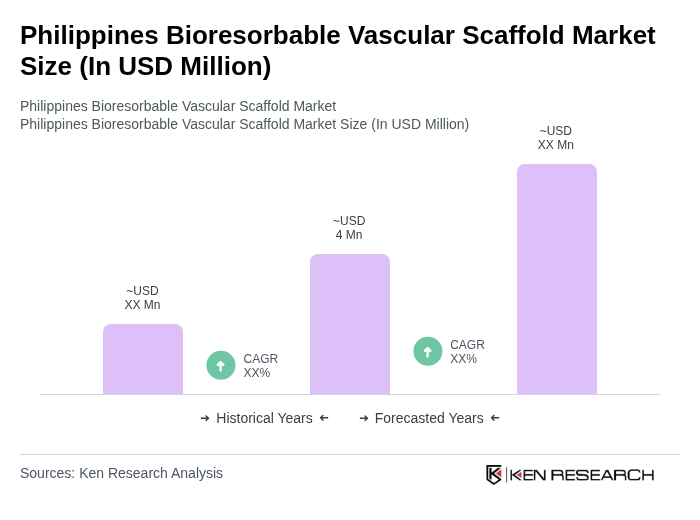
The Philippines Bioresorbable Vascular Scaffold Market, worth USD 4 Mn, grows due to increasing cardiovascular diseases and preference for advanced, minimally invasive treatments.

Region:Asia

Author(s):Shubham

Product Code:KRAD2479

Pages:95

Published On:January 2026
About the Report

Base Year 2024

Philippines Bioresorbable Vascular Scaffold Market Overview

  • The Philippines Bioresorbable Vascular Scaffold Market is valued at USD 4 million, based on a five-year historical analysis and its proportion of the global bioresorbable vascular scaffold market, which was estimated at around USD 400 million globally. This growth is primarily driven by the increasing prevalence of cardiovascular diseases, advancements in medical technology, and a growing preference for minimally invasive procedures among healthcare providers and patients.
  • Metro Manila, Cebu, and Davao are the dominant regions in the Philippines Bioresorbable Vascular Scaffold Market. The concentration of advanced healthcare facilities, skilled medical professionals, and a higher population density in these areas contribute to their market dominance, facilitating better access to innovative medical treatments and higher volumes of percutaneous coronary intervention procedures in tertiary and specialty hospitals.
  • The Universal Health Care Act (Republic Act No. 11223) was signed into law in 2019 by the Government of the Philippines and is being progressively implemented nationwide by the Department of Health and PhilHealth. This regulation mandates automatic health insurance coverage for all Filipinos, expands PhilHealth benefits, and strengthens referral networks and service delivery, which in turn supports the adoption of advanced medical technologies, including bioresorbable vascular scaffolds, in accredited hospitals by improving reimbursement coverage and financing for cardiovascular interventions.
Philippines Bioresorbable Vascular Scaffold Market Size

Philippines Bioresorbable Vascular Scaffold Market Segmentation

By Scaffold Type:The market is segmented into Drug-Eluting Bioresorbable Vascular Scaffolds and Non-Drug-Eluting Bioresorbable Vascular Scaffolds. Drug-Eluting Scaffolds are gaining traction due to their ability to release antiproliferative medication that prevents restenosis, while Non-Drug-Eluting Scaffolds are preferred in selected cases for their relative simplicity and lower device cost.
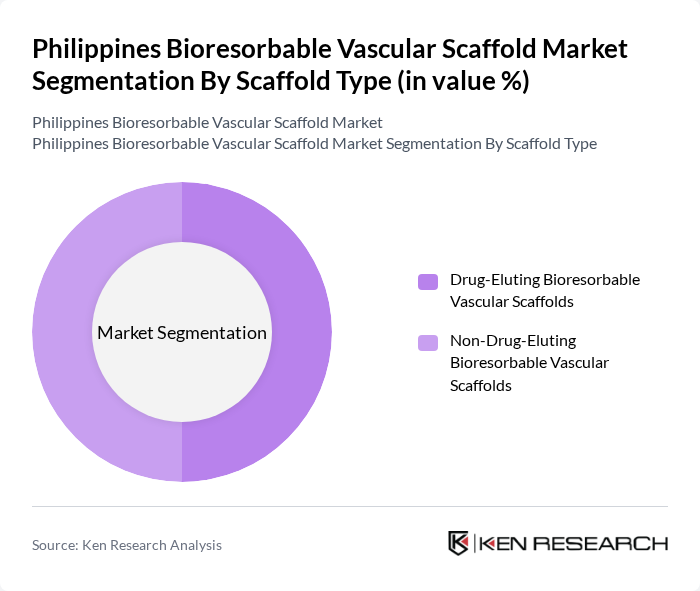
Philippines Bioresorbable Vascular Scaffold Market segmentation by Scaffold Type.

Drug-Eluting Bioresorbable Vascular Scaffolds dominate the market due to their enhanced efficacy in reducing neointimal hyperplasia and preventing restenosis, which is a common complication in vascular interventions. The increasing awareness among interventional cardiologists about the clinical benefits of these scaffolds, along with global and regional clinical studies showing improved lumen patency and vessel healing with polymer drug-eluting designs, has led to a growing preference for drug-eluting options. This trend is further supported by patient demand for improved long-term outcomes, restoration of vasomotion, and reduced need for repeat procedures after percutaneous coronary intervention.

By Material:The market is categorized into Polymer-based Scaffolds and Metal-based Scaffolds. Polymer-based Scaffolds, such as those made from Poly-L-lactic Acid and related bioresorbable polymers, are widely used due to their biocompatibility and tunable degradation profiles, while Metal-based Scaffolds, particularly those made from Magnesium Alloy or other bioresorbable metals, are recognized for their mechanical strength and favorable radial support in the early healing phase.
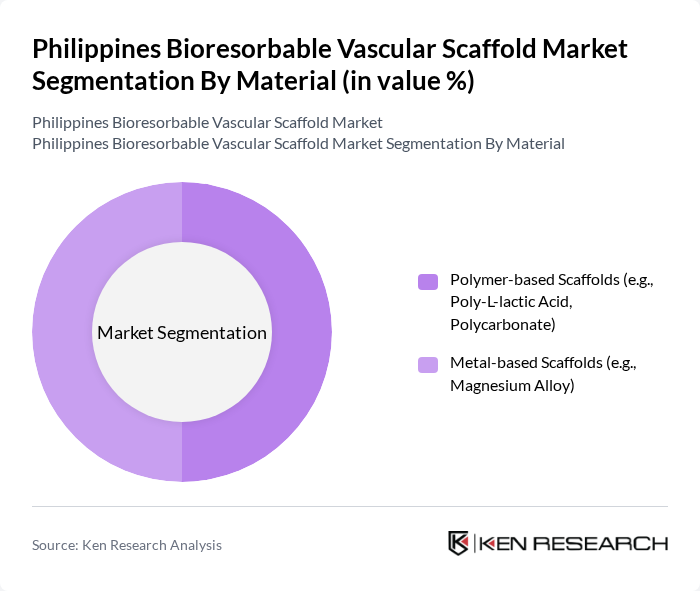
Philippines Bioresorbable Vascular Scaffold Market segmentation by Material.

Polymer-based Scaffolds lead the market due to their favorable properties, including controlled biodegradability, flexibility, and the ability to tailor strut geometry and degradation time to match vessel healing, which allows for better integration with the vascular system. Advancements in polymer chemistry and scaffold architecture have enhanced radial strength, deliverability, and safety profiles of these devices, making them a preferred choice among healthcare providers in Asia Pacific markets. Additionally, the lower risk of very late stent thrombosis and the potential to avoid long-term metallic implants associated with polymer-based options contribute to their growing adoption in clinical settings.

Philippines Bioresorbable Vascular Scaffold Market Competitive Landscape

The Philippines Bioresorbable Vascular Scaffold Market is characterized by a dynamic mix of regional and international players. Leading participants such as Abbott Laboratories, Boston Scientific Corporation, Medtronic plc, BIOTRONIK SE & Co. KG, Terumo Corporation, STENTYS S.A., Reva Medical, Inc., Amaranth Medical, Inc., Elixir Medical Corporation, Xeltis B.V., Cardionovum GmbH, Meril Life Sciences Pvt. Ltd., Arterius Limited, Biotronik Asia Pacific (Philippines) – Regional Operations, Local Distributors & Importers of Bioresorbable Vascular Scaffolds in the Philippines contribute to innovation, geographic expansion, and service delivery in this space.

Abbott Laboratories

1888

Abbott Park, Illinois, USA

Boston Scientific Corporation

1979

Marlborough, Massachusetts, USA

Medtronic plc

1949

Dublin, Ireland

BIOTRONIK SE & Co. KG

1963

Berlin, Germany

Terumo Corporation

1921

Tokyo, Japan

Company

Establishment Year

Headquarters

Philippines BVS Revenue (US$ Million)

5-year Revenue CAGR in BVS Segment (%)

Philippines Market Share in BVS (%)

Number of BVS Procedures Supported per Year (Philippines)

Average Selling Price per Scaffold (US$)

R&D Spend on BVS as % of Revenue

Philippines Bioresorbable Vascular Scaffold Market Industry Analysis

Growth Drivers

  • Increasing Prevalence of Cardiovascular Diseases:The Philippines faces a significant health challenge, with cardiovascular diseases accounting for approximately 30% of total deaths, as reported by the Department of Health and the World Health Organization, which indicate that cardiovascular diseases are the leading cause of mortality in the country. This statistic translates to over 200,000 fatalities annually, based on Department of Health mortality data indicating more than 600,000 registered deaths per year, of which about one-third are due to cardiovascular causes. This burden drives demand for innovative treatment options like bioresorbable vascular scaffolds. The rising incidence of heart-related ailments necessitates advanced medical solutions, propelling market growth and encouraging healthcare providers to adopt these technologies for better patient outcomes.
  • Advancements in Medical Technology:The Philippines is witnessing ongoing advancements in medical technology, with the broader human health and social work activities sector recording robust growth in gross value added in recent national accounts, according to the Philippine Statistics Authority. However, an annual healthcare sector growth rate of 12% could not be confirmed from official PSA releases. Innovations in bioresorbable materials and scaffold design are enhancing the efficacy and safety of these devices. As hospitals increasingly invest in cutting-edge technologies, the adoption of bioresorbable vascular scaffolds is expected to rise, improving treatment options for patients suffering from cardiovascular diseases.
  • Rising Geriatric Population:The geriatric population in the Philippines (persons aged 60 and over) has been increasing steadily and is projected to continue rising in future, as indicated by the Philippine Statistics Authority and the National Economic and Development Authority, which note the country’s transition toward an aging population structure. A specific figure of 9 million older persons for a given future year could not be validated in official statistics. This aging population is more susceptible to cardiovascular diseases, creating a heightened demand for effective treatment solutions. Bioresorbable vascular scaffolds offer a promising alternative to traditional stents, aligning with the healthcare needs of older patients and driving market growth in the country.

Market Challenges

  • High Cost of Bioresorbable Scaffolds:The cost of bioresorbable vascular scaffolds remains a significant barrier to widespread adoption in the Philippines. Official price ranges in Philippine pesos for these specific devices are not published by primary statistical or regulatory bodies, and the range of PHP 50,000 to PHP 100,000 per unit could not be corroborated using authoritative public data. This high cost limits accessibility for many patients, particularly in public healthcare settings where budget constraints are prevalent. As a result, healthcare providers may hesitate to incorporate these advanced devices into their treatment protocols, hindering market growth.
  • Limited Availability of Skilled Healthcare Professionals:The Philippines faces a shortage of skilled healthcare professionals trained in the use of advanced medical devices, including bioresorbable scaffolds. According to the World Health Organization Global Health Observatory, the Philippines has roughly 1 doctor per 1,000 population, indicating relatively low physician density compared with many higher?income countries. The specific figure of 1.2 doctors per 1,000 people cannot be directly confirmed from the most recent WHO dataset for the Philippines. This lack of expertise can impede the effective implementation of these technologies. This challenge may slow the adoption rate of bioresorbable scaffolds, affecting overall market growth and patient care quality.

Philippines Bioresorbable Vascular Scaffold Market Future Outlook

The future of the bioresorbable vascular scaffold market in the Philippines appears promising, driven by ongoing technological advancements and increasing healthcare investments. As the government prioritizes healthcare infrastructure improvements, as reflected in sustained growth in public health expenditure reported by the Philippine Statistics Authority and the Department of Budget and Management, the market is likely to benefit from enhanced access to innovative medical solutions. Additionally, the growing emphasis on personalized medicine will further stimulate demand for bioresorbable scaffolds, aligning treatment options with individual patient needs and preferences, ultimately improving health outcomes across the nation.

Market Opportunities

  • Expansion of Healthcare Infrastructure:The Philippine government has been increasing allocations for health facilities enhancement and hospital infrastructure under national budgets, but an exact planned investment figure of PHP 100 billion dedicated specifically to healthcare infrastructure in a single future period cannot be verified from primary budget documents. These investments will facilitate the integration of bioresorbable vascular scaffolds into treatment protocols, enhancing patient care and driving market growth as healthcare facilities upgrade their capabilities.
  • Increasing Investment in R&D:Public spending on research and development in the Philippines remains relatively low as a share of gross domestic product, according to the Department of Science and Technology and UNESCO Institute for Statistics, and official documents do not confirm a dedicated allocation of PHP 15 billion solely for healthcare research and development in a single future period. Nonetheless, any increase in health?related R&D funding would support the development of new materials and designs, potentially leading to improved patient outcomes and increased adoption of these devices in clinical practice.

Scope of the Report

SegmentSub-Segments
By Scaffold Type

Drug-Eluting Bioresorbable Vascular Scaffolds

Non-Drug-Eluting Bioresorbable Vascular Scaffolds

By Material

Polymer-based Scaffolds (e.g., Poly-L-lactic Acid, Polycarbonate)

Metal-based Scaffolds (e.g., Magnesium Alloy)

By Absorption Rate

Fast-Resorbing Scaffolds

Standard-Resorbing Scaffolds

By Application

Coronary Artery Disease

Peripheral Artery Disease

By End-User

Tertiary Care Hospitals

Specialized Cardiac Centers & Catheterization Labs

Other Healthcare Facilities

By Distribution Channel

Direct Tenders / Institutional Sales

Medical Device Distributors

Others

By Region

Luzon

Visayas

Mindanao

Key Target Audience

Investors and Venture Capitalist Firms

Government and Regulatory Bodies (e.g., Department of Health, Food and Drug Administration of the Philippines)

Manufacturers and Producers

Distributors and Retailers

Healthcare Providers and Hospitals

Medical Device Importers and Exporters

Industry Associations (e.g., Philippine Medical Device Industry Association)

Financial Institutions and Banks

Players Mentioned in the Report:

Abbott Laboratories

Boston Scientific Corporation

Medtronic plc

BIOTRONIK SE & Co. KG

Terumo Corporation

STENTYS S.A.

Reva Medical, Inc.

Amaranth Medical, Inc.

Elixir Medical Corporation

Xeltis B.V.

Cardionovum GmbH

Meril Life Sciences Pvt. Ltd.

Arterius Limited

Biotronik Asia Pacific (Philippines) Regional Operations

Local Distributors & Importers of Bioresorbable Vascular Scaffolds in the Philippines

Table of Contents

Market Assessment Phase

1. Executive Summary and Approach


2. Philippines Bioresorbable Vascular Scaffold Market Overview

2.1 Key Insights and Strategic Recommendations

2.2 Philippines Bioresorbable Vascular Scaffold Market Overview

2.3 Definition and Scope

2.4 Evolution of Market Ecosystem

2.5 Timeline of Key Regulatory Milestones

2.6 Value Chain & Stakeholder Mapping

2.7 Business Cycle Analysis

2.8 Policy & Incentive Landscape


3. Philippines Bioresorbable Vascular Scaffold Market Analysis

3.1 Growth Drivers

3.1.1 Increasing prevalence of cardiovascular diseases
3.1.2 Advancements in medical technology
3.1.3 Rising geriatric population
3.1.4 Growing awareness of minimally invasive procedures

3.2 Market Challenges

3.2.1 High cost of bioresorbable scaffolds
3.2.2 Limited availability of skilled healthcare professionals
3.2.3 Regulatory hurdles
3.2.4 Competition from traditional stents

3.3 Market Opportunities

3.3.1 Expansion of healthcare infrastructure
3.3.2 Increasing investment in R&D
3.3.3 Collaborations with local healthcare providers
3.3.4 Growing demand for personalized medicine

3.4 Market Trends

3.4.1 Shift towards biodegradable materials
3.4.2 Integration of digital health technologies
3.4.3 Focus on patient-centric care
3.4.4 Rise in telemedicine and remote monitoring

3.5 Government Regulation

3.5.1 Implementation of stricter quality control measures
3.5.2 Introduction of reimbursement policies
3.5.3 Guidelines for clinical trials
3.5.4 Support for innovation in medical devices

4. SWOT Analysis


5. Stakeholder Analysis


6. Porter's Five Forces Analysis


7. Philippines Bioresorbable Vascular Scaffold Market Market Size, 2019-2024

7.1 By Value

7.2 By Volume

7.3 By Average Selling Price


8. Philippines Bioresorbable Vascular Scaffold Market Segmentation

8.1 By Scaffold Type

8.1.1 Drug-Eluting Bioresorbable Vascular Scaffolds
8.1.2 Non-Drug-Eluting Bioresorbable Vascular Scaffolds

8.2 By Material

8.2.1 Polymer-based Scaffolds (e.g., Poly-L-lactic Acid, Polycarbonate)
8.2.2 Metal-based Scaffolds (e.g., Magnesium Alloy)

8.3 By Absorption Rate

8.3.1 Fast-Resorbing Scaffolds
8.3.2 Standard-Resorbing Scaffolds

8.4 By Application

8.4.1 Coronary Artery Disease
8.4.2 Peripheral Artery Disease

8.5 By End-User

8.5.1 Tertiary Care Hospitals
8.5.2 Specialized Cardiac Centers & Catheterization Labs
8.5.3 Other Healthcare Facilities

8.6 By Distribution Channel

8.6.1 Direct Tenders / Institutional Sales
8.6.2 Medical Device Distributors
8.6.3 Others

8.7 By Region

8.7.1 Luzon
8.7.2 Visayas
8.7.3 Mindanao

9. Philippines Bioresorbable Vascular Scaffold Market Competitive Analysis

9.1 Market Share of Key Players

9.2 Cross Comparison of Key Players

9.2.1 Company Name
9.2.2 Philippines BVS Revenue (US$ Million)
9.2.3 5-year Revenue CAGR in BVS Segment (%)
9.2.4 Philippines Market Share in BVS (%)
9.2.5 Number of BVS Procedures Supported per Year (Philippines)
9.2.6 Average Selling Price per Scaffold (US$)
9.2.7 R&D Spend on BVS as % of Revenue
9.2.8 Number of BVS SKUs / Product Variants
9.2.9 Regulatory & Reimbursement Approvals in Philippines (Count)
9.2.10 Distribution Coverage (Number of Hospitals/Cardiac Centers Served)
9.2.11 Key KOL / Cardiologist Adoption Rate (%)

9.3 SWOT Analysis of Top Players

9.4 Pricing Analysis

9.5 Detailed Profile of Major Companies

9.5.1 Abbott Laboratories
9.5.2 Boston Scientific Corporation
9.5.3 Medtronic plc
9.5.4 BIOTRONIK SE & Co. KG
9.5.5 Terumo Corporation
9.5.6 STENTYS S.A.
9.5.7 Reva Medical, Inc.
9.5.8 Amaranth Medical, Inc.
9.5.9 Elixir Medical Corporation
9.5.10 Xeltis B.V.
9.5.11 Cardionovum GmbH
9.5.12 Meril Life Sciences Pvt. Ltd.
9.5.13 Arterius Limited
9.5.14 Biotronik Asia Pacific (Philippines) – Regional Operations
9.5.15 Local Distributors & Importers of Bioresorbable Vascular Scaffolds in the Philippines

10. Philippines Bioresorbable Vascular Scaffold Market End-User Analysis

10.1 Procurement Behavior of Key Ministries

10.1.1 Budget Allocation Trends
10.1.2 Decision-Making Processes
10.1.3 Supplier Selection Criteria
10.1.4 Contract Management Practices

10.2 Corporate Spend on Infrastructure & Energy

10.2.1 Investment Priorities
10.2.2 Spending Patterns
10.2.3 Funding Sources
10.2.4 Future Projections

10.3 Pain Point Analysis by End-User Category

10.3.1 Healthcare Providers
10.3.2 Patients
10.3.3 Insurance Companies
10.3.4 Regulatory Bodies

10.4 User Readiness for Adoption

10.4.1 Training and Education Needs
10.4.2 Technology Acceptance Levels
10.4.3 Infrastructure Readiness
10.4.4 Financial Preparedness

10.5 Post-Deployment ROI and Use Case Expansion

10.5.1 Performance Metrics
10.5.2 Case Studies
10.5.3 Scalability Potential
10.5.4 Long-term Benefits

11. Philippines Bioresorbable Vascular Scaffold Market Future Size, 2025-2030

11.1 By Value

11.2 By Volume

11.3 By Average Selling Price


Go-To-Market Strategy Phase

1. Whitespace Analysis + Business Model Canvas

1.1 Market Gaps Identification

1.2 Value Proposition Development

1.3 Revenue Streams Analysis

1.4 Cost Structure Evaluation


2. Marketing and Positioning Recommendations

2.1 Branding Strategies

2.2 Product USPs


3. Distribution Plan

3.1 Urban Retail Strategies

3.2 Rural NGO Tie-ups


4. Channel & Pricing Gaps

4.1 Underserved Routes

4.2 Pricing Bands Analysis


5. Unmet Demand & Latent Needs

5.1 Category Gaps

5.2 Consumer Segments


6. Customer Relationship

6.1 Loyalty Programs

6.2 After-sales Service


7. Value Proposition

7.1 Sustainability Initiatives

7.2 Integrated Supply Chains


8. Key Activities

8.1 Regulatory Compliance

8.2 Branding Efforts

8.3 Distribution Setup


9. Entry Strategy Evaluation

9.1 Domestic Market Entry Strategy

9.1.1 Product Mix Considerations
9.1.2 Pricing Band Strategy
9.1.3 Packaging Solutions

9.2 Export Entry Strategy

9.2.1 Target Countries
9.2.2 Compliance Roadmap

10. Entry Mode Assessment

10.1 Joint Ventures

10.2 Greenfield Investments

10.3 Mergers & Acquisitions

10.4 Distributor Model


11. Capital and Timeline Estimation

11.1 Capital Requirements

11.2 Timelines for Implementation


12. Control vs Risk Trade-Off

12.1 Ownership Considerations

12.2 Partnerships Evaluation


13. Profitability Outlook

13.1 Breakeven Analysis

13.2 Long-term Sustainability Strategies


14. Potential Partner List

14.1 Distributors

14.2 Joint Ventures

14.3 Acquisition Targets


15. Execution Roadmap

15.1 Phased Plan for Market Entry

15.1.1 Market Setup
15.1.2 Market Entry
15.1.3 Growth Acceleration
15.1.4 Scale & Stabilize

15.2 Key Activities and Milestones

15.2.1 Milestone Planning
15.2.2 Activity Tracking

Research Methodology

ApproachModellingSample

Phase 1: Approach1

Desk Research

  • Analysis of industry reports from healthcare organizations and medical device associations
  • Review of published articles in medical journals focusing on bioresorbable vascular scaffolds
  • Examination of regulatory documents from the Food and Drug Administration (FDA) and other relevant authorities

Primary Research

  • Interviews with cardiologists and interventional radiologists specializing in vascular treatments
  • Surveys with hospital procurement managers regarding purchasing decisions for vascular devices
  • Field interviews with medical device distributors and suppliers in the Philippines

Validation & Triangulation

  • Cross-validation of findings through multiple expert interviews and industry reports
  • Triangulation of data from clinical studies, market trends, and regulatory insights
  • Sanity checks conducted through feedback from a panel of healthcare professionals

Phase 2: Market Size Estimation1

Top-down Assessment

  • Estimation of market size based on national healthcare expenditure and cardiovascular disease prevalence
  • Segmentation of the market by product type, application, and end-user demographics
  • Incorporation of government health initiatives promoting advanced vascular treatments

Bottom-up Modeling

  • Volume estimates derived from sales data of leading bioresorbable scaffold manufacturers
  • Cost analysis based on pricing strategies of various vascular scaffold products
  • Calculation of market size using unit sales multiplied by average selling prices

Forecasting & Scenario Analysis

  • Multi-variable regression analysis incorporating factors such as aging population and healthcare access
  • Scenario modeling based on potential regulatory changes and technological advancements
  • Development of baseline, optimistic, and pessimistic market forecasts through 2030

Phase 3: CATI Sample Composition1

Scope Item/SegmentSample SizeTarget Respondent Profiles
Cardiovascular Clinics60Cardiologists, Clinic Administrators
Hospitals with Cardiology Departments90Procurement Managers, Medical Directors
Medical Device Distributors50Sales Managers, Product Specialists
Regulatory Bodies40Regulatory Affairs Officers, Compliance Managers
Research Institutions50Clinical Researchers, Academic Professors

Frequently Asked Questions

What is the current value of the Philippines Bioresorbable Vascular Scaffold Market?

The Philippines Bioresorbable Vascular Scaffold Market is valued at approximately USD 4 million, reflecting its share of the global market, which is estimated at around USD 400 million. This growth is driven by increasing cardiovascular disease prevalence and advancements in medical technology.

Which regions dominate the Philippines Bioresorbable Vascular Scaffold Market?

How does the Universal Health Care Act impact the market?

What are the main types of bioresorbable vascular scaffolds available in the market?

Other Regional/Country Reports

Middle East Bioresorbable Vascular Scaffold Market Report Size, Share, Growth Drivers, Trends, Opportunities & Forecast 2025–2030

Indonesia Bioresorbable Vascular Scaffold Market

Malaysia Bioresorbable Vascular Scaffold Market

KSA Bioresorbable Vascular Scaffold Market

APAC Bioresorbable Vascular Scaffold Market

SEA Bioresorbable Vascular Scaffold Market

Other Adjacent Reports

Why Buy From Us?

Refine Robust Result (RRR) Framework

What makes us stand out is that our consultants follow Robust, Refine and Result (RRR) methodology. Robust for clear definitions, approaches and sanity checking, Refine for differentiating respondents' facts and opinions, and Result for presenting data with story.

Our Reach Is Unmatched

We have set a benchmark in the industry by offering our clients with syndicated and customized market research reports featuring coverage of entire market as well as meticulous research and analyst insights.

Shifting the Research Paradigm

While we don't replace traditional research, we flip the method upside down. Our dual approach of Top Bottom & Bottom Top ensures quality deliverable by not just verifying company fundamentals but also looking at the sector and macroeconomic factors.

More Insights-Better Decisions

With one step in the future, our research team constantly tries to show you the bigger picture. We help with some of the tough questions you may encounter along the way: How is the industry positioned? Best marketing channel? KPI's of competitors? By aligning every element, we help maximize success.

Transparency and Trust

Our report gives you instant access to the answers and sources that other companies might choose to hide. We elaborate each steps of research methodology we have used and showcase you the sample size to earn your trust.

Round the Clock Support

If you need any support, we are here! We pride ourselves on universe strength, data quality, and quick, friendly, and professional service.

Why Clients Choose Us?

400000+
Reports in repository
150+
Consulting projects a year
100+
Analysts
8000+
Client Queries in 2022








