Region:Asia
Author(s):Geetanshi
Product Code:KRAC2318
Pages:95
Published On:October 2025
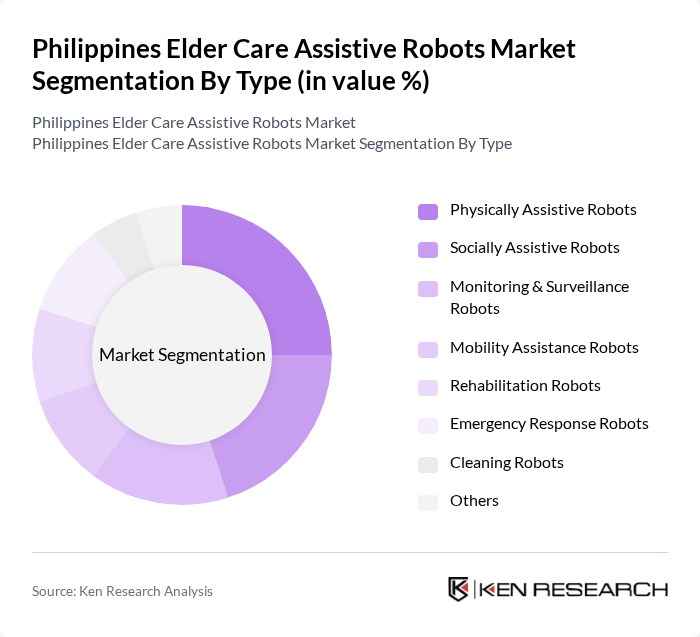
By Type:The market is segmented into various types of elder care assistive robots, including Physically Assistive Robots, Socially Assistive Robots, Monitoring & Surveillance Robots, Mobility Assistance Robots, Rehabilitation Robots, Emergency Response Robots, Cleaning Robots, and Others. Each type serves a unique purpose in enhancing the quality of life for the elderly. Physically assistive robots provide mobility and lifting support, socially assistive robots offer companionship and cognitive engagement, monitoring and surveillance robots ensure safety, and mobility assistance robots aid in navigation and fall prevention. Rehabilitation robots facilitate physical therapy, emergency response robots assist during health crises, and cleaning robots support hygiene and daily living needs .
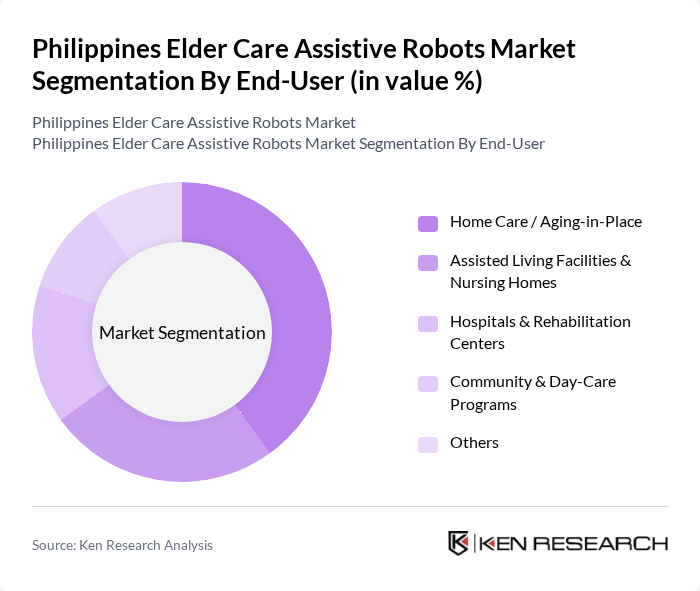
By End-User:The end-user segmentation includes Home Care / Aging-in-Place, Assisted Living Facilities & Nursing Homes, Hospitals & Rehabilitation Centers, Community & Day-Care Programs, and Others. This segmentation highlights the various environments where elder care assistive robots are utilized. Home care and aging-in-place dominate due to the preference for independent living, while assisted living facilities and nursing homes increasingly adopt robotics for safety and efficiency. Hospitals and rehabilitation centers use robots for patient monitoring and therapy, and community programs leverage robotics for group activities and outreach .
The Philippines Elder Care Assistive Robots Market is characterized by a dynamic mix of regional and international players. Leading participants such as SoftBank Robotics, Panasonic Holdings Corporation, Intuition Robotics, Blue Frog Robotics, PARO Robots U.S., Inc., Toyota Motor Corporation, LG Electronics, Samsung Electronics, YUJIN ROBOT Co., Ltd., Kompai Robotics, ZoraBots NV, Robot Care Systems, iRobot Corporation, Qolo Inc., RoboKind contribute to innovation, geographic expansion, and service delivery in this space.
The future of the elder care assistive robots market in the Philippines appears promising, driven by technological advancements and a growing elderly population. As the government increases funding for research and development, innovations in AI and robotics are expected to enhance the functionality of assistive devices. Additionally, partnerships with healthcare providers will likely facilitate the integration of these technologies into existing care frameworks, improving accessibility and user experience for families and caregivers alike.
| Segment | Sub-Segments |
|---|---|
| By Type | Physically Assistive Robots Socially Assistive Robots Monitoring & Surveillance Robots Mobility Assistance Robots Rehabilitation Robots Emergency Response Robots Cleaning Robots Others |
| By End-User | Home Care / Aging-in-Place Assisted Living Facilities & Nursing Homes Hospitals & Rehabilitation Centers Community & Day-Care Programs Others |
| By Application | Daily Living Assistance Health Monitoring Social Interaction & Companionship Fall Prevention & Emergency Response Medication Management Cognitive Stimulation Others |
| By Distribution Channel | Direct Sales Online Retail Distributors Partnerships with Healthcare Providers Others |
| By Price Range | Budget-Friendly Mid-Range Premium Others |
| By Technology | AI-Driven Robots Sensor-Based Robots Remote-Controlled Robots IoT-Integrated Robots Others |
| By User Demographics | Seniors Living Alone Seniors with Disabilities Caregivers Family Members Others |
| Scope Item/Segment | Sample Size | Target Respondent Profiles |
|---|---|---|
| Healthcare Facilities | 100 | Facility Managers, Geriatric Care Specialists |
| Family Caregivers | 80 | Family Members of Elderly Individuals, Caregivers |
| Technology Providers | 60 | Product Managers, Sales Executives in Robotics |
| Government Agencies | 50 | Policy Makers, Health Program Coordinators |
| Research Institutions | 40 | Academics, Researchers in Elder Care Technology |
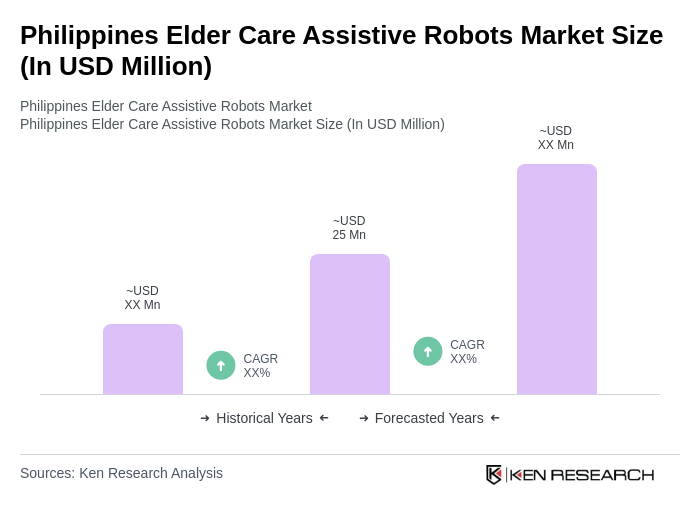
The Philippines Elder Care Assistive Robots Market is valued at approximately USD 25 million, based on a five-year historical analysis. This valuation considers the country's share of the regional elderly population and healthcare robotics adoption rates.

What makes us stand out is that our consultants follow Robust, Refine and Result (RRR) methodology. Robust for clear definitions, approaches and sanity checking, Refine for differentiating respondents' facts and opinions, and Result for presenting data with story.

We have set a benchmark in the industry by offering our clients with syndicated and customized market research reports featuring coverage of entire market as well as meticulous research and analyst insights.

While we don't replace traditional research, we flip the method upside down. Our dual approach of Top Bottom & Bottom Top ensures quality deliverable by not just verifying company fundamentals but also looking at the sector and macroeconomic factors.

With one step in the future, our research team constantly tries to show you the bigger picture. We help with some of the tough questions you may encounter along the way: How is the industry positioned? Best marketing channel? KPI's of competitors? By aligning every element, we help maximize success.

Our report gives you instant access to the answers and sources that other companies might choose to hide. We elaborate each steps of research methodology we have used and showcase you the sample size to earn your trust.

If you need any support, we are here! We pride ourselves on universe strength, data quality, and quick, friendly, and professional service.













