About the Report
Base Year 2024Philippines Fire Safety Equipment Market Overview
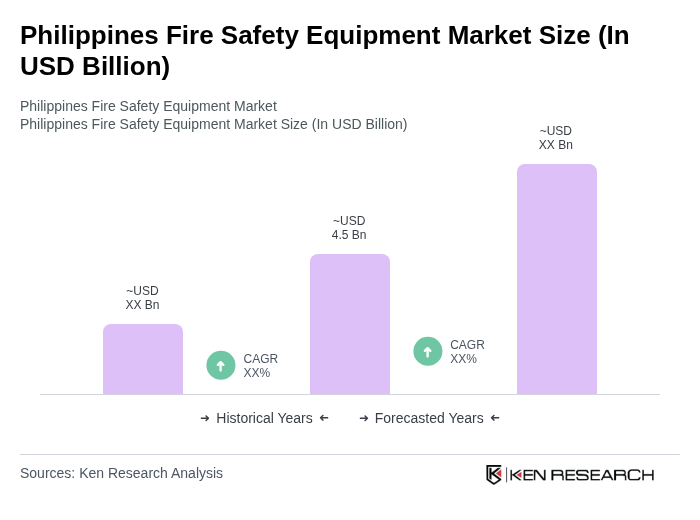
- The Philippines Fire Safety Equipment Market is valued at USD 4.5 billion, based on a five-year historical analysis. This growth is primarily driven by increasing urbanization, expansion of commercial and industrial infrastructure, stricter enforcement of safety regulations, and rising awareness of fire safety among businesses and households. The demand for fire safety equipment has surged as the country continues to develop high?rise buildings, industrial parks, and mixed?use developments, alongside stronger compliance requirements for detection, suppression, and emergency communication systems across various sectors.
- Metro Manila, Cebu, and Davao are the dominant cities in the Philippines Fire Safety Equipment Market, reflecting the concentration of construction and economic activity in Luzon, Visayas, and Mindanao. Metro Manila, being the capital region and a major business hub, has a high concentration of commercial, industrial, and high?density residential buildings, necessitating robust fire detection, alarm, and suppression measures. Cebu and Davao are also experiencing rapid urban and industrial growth, supported by business parks, logistics facilities, and mixed?use developments, leading to increased investments in fire safety solutions to protect lives, property, and critical infrastructure.
- The Philippine government has implemented the Fire Code of the Philippines (Republic Act No. 9514) and its Implementing Rules and Regulations, issued by the Department of the Interior and Local Government and enforced by the Bureau of Fire Protection, which mandate the provision, installation, and maintenance of fire safety equipment and systems in all buildings and structures, including requirements for fire detection and alarm systems, fire extinguishers, automatic suppression systems, emergency lighting, and means of egress. These regulations aim to enhance fire safety standards, require regular inspection and compliance certificates, and ensure that establishments across residential, commercial, industrial, and public sectors adopt appropriate fire protection measures, thereby driving sustained demand for fire safety equipment nationwide.
Philippines Fire Safety Equipment Market Segmentation
By Type:The market is segmented into various types of fire safety equipment, including fire extinguishers, fire alarms, fire suppression systems, fire blankets, fire hoses, fire safety apparel, and others. Each of these subsegments plays a crucial role in ensuring safety and compliance with regulations, and aligns with the wider fire protection offerings in the country, such as fire detection systems, fire suppression systems, sprinkler systems, emergency lighting, passive protection components, and portable equipment.
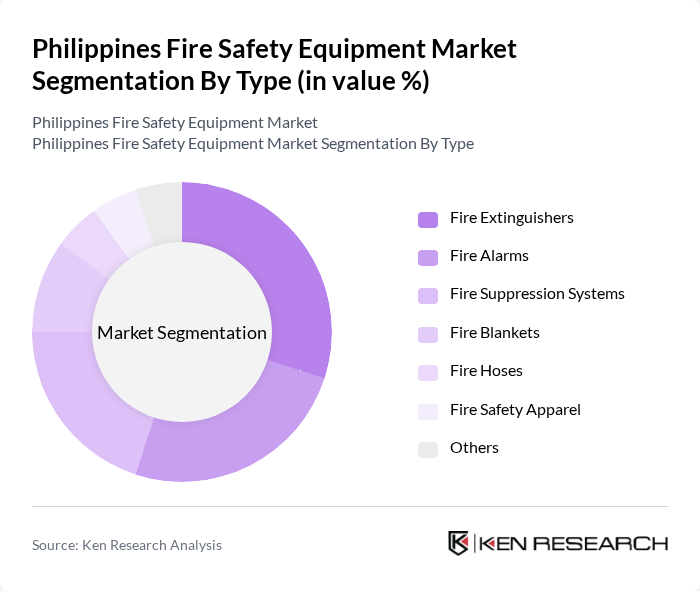
The fire extinguishers segment dominates the market due to their essential role in first-response fire control, portability, and explicit requirements for extinguishers and portable equipment under national fire safety standards for most occupancies. They are widely used in residential, commercial, and industrial settings, making them a staple in fire safety protocols. The increasing awareness of fire hazards, frequent inspections by the Bureau of Fire Protection, and the necessity for immediate response measures have led to a consistent demand for fire extinguishers, further solidifying their market leadership in the broader fire suppression solutions space.
By End-User:The market is segmented by end-user into residential, commercial, industrial, government & utilities, and others. Each segment has unique risk profiles, occupancy loads, and regulatory obligations that drive the demand for fire safety equipment, similar to global and regional patterns where commercial and industrial facilities account for a substantial share of fire detection and suppression installations.
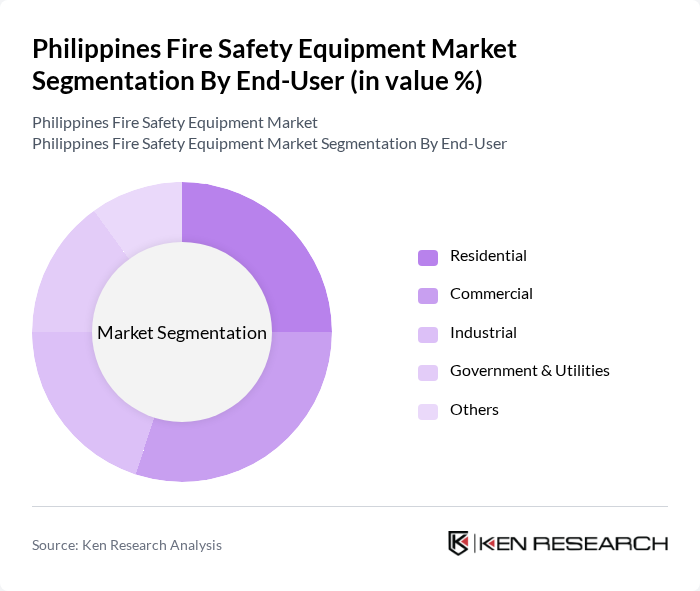
The commercial segment leads the market, driven by the increasing number of offices, shopping malls, hospitality properties, logistics hubs, and mixed?use commercial developments, all of which must comply with fire detection, alarm, suppression, and emergency egress requirements. Commercial establishments, including offices, retail spaces, and restaurants, require comprehensive fire safety solutions to protect their assets and ensure the safety of employees and customers. This segment's growth is further supported by government regulations mandating fire safety measures in commercial buildings and by increasing adoption of integrated, technology?enabled systems such as addressable alarms, centralized monitoring, and emergency communication solutions.
Philippines Fire Safety Equipment Market Competitive Landscape
The Philippines Fire Safety Equipment Market is characterized by a dynamic mix of regional and international players. Leading participants such as AEGIS Fire Solutions, Fire Safety Philippines, AFS Fire Protection, FirePro Systems, Safety First Fire Protection, FireGuard Philippines, A1 Fire Safety Equipment, Fire Safety Solutions, Inc., FireTech Systems, BlazeGuard Fire Protection, PyroShield Fire Safety, SafeGuard Fire Equipment, FlameStop Fire Safety, FireSafe Technologies, FireWatch Systems contribute to innovation, geographic expansion, and service delivery in this space.
Philippines Fire Safety Equipment Market Industry Analysis
Growth Drivers
- Increasing Awareness of Fire Safety Regulations:The Philippines has seen a significant rise in awareness regarding fire safety regulations, particularly following the implementation of the Fire Code of the Philippines. The Bureau of Fire Protection reported over 1,500 fire incidents, prompting local governments to enhance compliance measures. This has led to a 35% increase in fire safety equipment purchases among businesses, driven by the need to adhere to stricter regulations and avoid penalties.
- Rising Urbanization and Infrastructure Development:The Philippines is experiencing rapid urbanization, with urban areas projected to grow by 4 million people annually. This urban expansion necessitates improved fire safety measures in new buildings and infrastructure. The government allocated PHP 2 billion for urban development projects, which includes fire safety systems, resulting in a projected 30% increase in demand for fire safety equipment in urban centers.
- Government Initiatives and Funding for Fire Safety:The Philippine government has initiated various programs to enhance fire safety, including funding for fire safety training and equipment. The government allocated PHP 600 million specifically for fire safety initiatives, which has led to a 45% increase in the adoption of fire safety equipment among small and medium enterprises (SMEs). This funding is crucial for improving overall safety standards across the nation.
Market Challenges
- High Initial Investment Costs:One of the significant barriers to fire safety equipment adoption in the Philippines is the high initial investment required. For instance, a comprehensive fire alarm system can cost upwards of PHP 250,000, which is prohibitive for many small businesses. This financial burden limits the ability of SMEs to invest in necessary fire safety measures, resulting in inadequate protection against fire hazards.
- Lack of Awareness Among Small Businesses:Many small businesses in the Philippines remain unaware of the importance of fire safety regulations and equipment. A survey conducted revealed that 65% of SMEs had no fire safety plan in place. This lack of awareness not only increases the risk of fire incidents but also hampers the growth of the fire safety equipment market, as these businesses are less likely to invest in necessary solutions.
Philippines Fire Safety Equipment Market Future Outlook
The future of the fire safety equipment market in the Philippines appears promising, driven by increasing regulatory compliance and urban development. As the government continues to enforce fire safety regulations, businesses will be compelled to invest in advanced fire safety solutions. Additionally, the integration of smart technologies and IoT in fire safety systems is expected to enhance efficiency and effectiveness, further driving market growth. The focus on sustainable practices will also shape future innovations in this sector.
Market Opportunities
- Expansion of E-commerce Platforms for Fire Safety Products:The rise of e-commerce in the Philippines presents a significant opportunity for fire safety equipment suppliers. With online sales projected to reach PHP 400 billion, businesses can leverage digital platforms to reach a broader audience, increasing accessibility to fire safety products and services.
- Development of Smart Fire Safety Solutions:The growing demand for smart technologies in fire safety presents an opportunity for innovation. The market for smart fire detection systems is expected to grow significantly, driven by advancements in IoT and AI technologies. This trend will enable more efficient monitoring and response to fire incidents, enhancing overall safety.
Scope of the Report
| Segment | Sub-Segments |
|---|---|
| By Type | Fire Extinguishers Fire Alarms Fire Suppression Systems Fire Blankets Fire Hoses Fire Safety Apparel Others |
| By End-User | Residential Commercial Industrial Government & Utilities Others |
| By Application | Fire Prevention Fire Detection Fire Suppression Emergency Response Others |
| By Distribution Channel | Online Retail Offline Retail Direct Sales Distributors Others |
| By Region | Luzon Visayas Mindanao |
| By Product Certification | ISO Certified Products Non-ISO Certified Products Others |
| By Price Range | Budget Mid-Range Premium Others |
Key Target Audience
Investors and Venture Capitalist Firms
Government and Regulatory Bodies (e.g., Bureau of Fire Protection, Department of the Interior and Local Government)
Manufacturers and Producers
Distributors and Retailers
Fire Safety Equipment Installers and Service Providers
Industry Associations (e.g., Philippine Fire Protection Association)
Insurance Companies
Construction and Real Estate Developers
Players Mentioned in the Report:
AEGIS Fire Solutions
Fire Safety Philippines
AFS Fire Protection
FirePro Systems
Safety First Fire Protection
FireGuard Philippines
A1 Fire Safety Equipment
Fire Safety Solutions, Inc.
FireTech Systems
BlazeGuard Fire Protection
PyroShield Fire Safety
SafeGuard Fire Equipment
FlameStop Fire Safety
FireSafe Technologies
FireWatch Systems
Table of Contents
Market Assessment Phase
1. Executive Summary and Approach
2. Philippines Fire Safety Equipment Market Overview
2.1 Key Insights and Strategic Recommendations
2.2 Philippines Fire Safety Equipment Market Overview
2.3 Definition and Scope
2.4 Evolution of Market Ecosystem
2.5 Timeline of Key Regulatory Milestones
2.6 Value Chain & Stakeholder Mapping
2.7 Business Cycle Analysis
2.8 Policy & Incentive Landscape
3. Philippines Fire Safety Equipment Market Analysis
3.1 Growth Drivers
3.1.1 Increasing awareness of fire safety regulations
3.1.2 Rising urbanization and infrastructure development
3.1.3 Government initiatives and funding for fire safety
3.1.4 Technological advancements in fire safety equipment
3.2 Market Challenges
3.2.1 High initial investment costs
3.2.2 Lack of awareness among small businesses
3.2.3 Inconsistent enforcement of regulations
3.2.4 Limited access to advanced technology
3.3 Market Opportunities
3.3.1 Expansion of e-commerce platforms for fire safety products
3.3.2 Development of smart fire safety solutions
3.3.3 Partnerships with local governments for safety programs
3.3.4 Increased demand for training and certification services
3.4 Market Trends
3.4.1 Growing emphasis on sustainable fire safety solutions
3.4.2 Integration of IoT in fire safety systems
3.4.3 Shift towards automated fire detection systems
3.4.4 Rising demand for portable fire safety equipment
3.5 Government Regulation
3.5.1 Implementation of the Fire Code of the Philippines
3.5.2 Compliance with international fire safety standards
3.5.3 Regular inspections and certifications for fire safety equipment
3.5.4 Incentives for businesses adopting fire safety measures
4. SWOT Analysis
5. Stakeholder Analysis
6. Porter's Five Forces Analysis
7. Philippines Fire Safety Equipment Market Market Size, 2019-2024
7.1 By Value
7.2 By Volume
7.3 By Average Selling Price
8. Philippines Fire Safety Equipment Market Segmentation
8.1 By Type
8.1.1 Fire Extinguishers
8.1.2 Fire Alarms
8.1.3 Fire Suppression Systems
8.1.4 Fire Blankets
8.1.5 Fire Hoses
8.1.6 Fire Safety Apparel
8.1.7 Others
8.2 By End-User
8.2.1 Residential
8.2.2 Commercial
8.2.3 Industrial
8.2.4 Government & Utilities
8.2.5 Others
8.3 By Application
8.3.1 Fire Prevention
8.3.2 Fire Detection
8.3.3 Fire Suppression
8.3.4 Emergency Response
8.3.5 Others
8.4 By Distribution Channel
8.4.1 Online Retail
8.4.2 Offline Retail
8.4.3 Direct Sales
8.4.4 Distributors
8.4.5 Others
8.5 By Region
8.5.1 Luzon
8.5.2 Visayas
8.5.3 Mindanao
8.6 By Product Certification
8.6.1 ISO Certified Products
8.6.2 Non-ISO Certified Products
8.6.3 Others
8.7 By Price Range
8.7.1 Budget
8.7.2 Mid-Range
8.7.3 Premium
8.7.4 Others
9. Philippines Fire Safety Equipment Market Competitive Analysis
9.1 Market Share of Key Players
9.2 Cross Comparison of Key Players
9.2.1 Company Name
9.2.2 Group Size (Large, Medium, or Small as per industry convention)
9.2.3 Revenue Growth Rate
9.2.4 Market Penetration Rate
9.2.5 Customer Retention Rate
9.2.6 Pricing Strategy
9.2.7 Product Diversification
9.2.8 Brand Recognition
9.2.9 Distribution Network Efficiency
9.2.10 Customer Satisfaction Score
9.3 SWOT Analysis of Top Players
9.4 Pricing Analysis
9.5 Detailed Profile of Major Companies
9.5.1 AEGIS Fire Solutions
9.5.2 Fire Safety Philippines
9.5.3 AFS Fire Protection
9.5.4 FirePro Systems
9.5.5 Safety First Fire Protection
9.5.6 FireGuard Philippines
9.5.7 A1 Fire Safety Equipment
9.5.8 Fire Safety Solutions, Inc.
9.5.9 FireTech Systems
9.5.10 BlazeGuard Fire Protection
9.5.11 PyroShield Fire Safety
9.5.12 SafeGuard Fire Equipment
9.5.13 FlameStop Fire Safety
9.5.14 FireSafe Technologies
9.5.15 FireWatch Systems
10. Philippines Fire Safety Equipment Market End-User Analysis
10.1 Procurement Behavior of Key Ministries
10.1.1 Budget Allocation for Fire Safety
10.1.2 Decision-Making Process
10.1.3 Preferred Suppliers
10.1.4 Compliance Requirements
10.2 Corporate Spend on Infrastructure & Energy
10.2.1 Investment Trends in Fire Safety
10.2.2 Budgeting for Safety Equipment
10.2.3 Long-term Contracts
10.2.4 Emergency Preparedness Spending
10.3 Pain Point Analysis by End-User Category
10.3.1 Common Challenges Faced
10.3.2 Equipment Reliability Issues
10.3.3 Training Gaps
10.3.4 Regulatory Compliance Difficulties
10.4 User Readiness for Adoption
10.4.1 Awareness Levels
10.4.2 Training and Support Needs
10.4.3 Technology Adoption Rates
10.4.4 Budget Constraints
10.5 Post-Deployment ROI and Use Case Expansion
10.5.1 Measurement of Effectiveness
10.5.2 Case Studies of Successful Implementations
10.5.3 Feedback Mechanisms
10.5.4 Future Investment Plans
11. Philippines Fire Safety Equipment Market Future Size, 2025-2030
11.1 By Value
11.2 By Volume
11.3 By Average Selling Price
Go-To-Market Strategy Phase
1. Whitespace Analysis + Business Model Canvas
1.1 Market Gaps Identification
1.2 Value Proposition Development
1.3 Revenue Streams
1.4 Key Resources
1.5 Key Activities
1.6 Key Partnerships
1.7 Cost Structure
2. Marketing and Positioning Recommendations
2.1 Branding Strategies
2.2 Product USPs
3. Distribution Plan
3.1 Urban retail vs rural NGO tie-ups
4. Channel & Pricing Gaps
4.1 Underserved routes
4.2 Pricing bands
5. Unmet Demand & Latent Needs
5.1 Category gaps
5.2 Consumer segments
6. Customer Relationship
6.1 Loyalty programs
6.2 After-sales service
7. Value Proposition
7.1 Sustainability
7.2 Integrated supply chains
8. Key Activities
8.1 Regulatory compliance
8.2 Branding
8.3 Distribution setup
9. Entry Strategy Evaluation
9.1 Domestic Market Entry Strategy
9.1.1 Product mix
9.1.2 Pricing band
9.1.3 Packaging
9.2 Export Entry Strategy
9.2.1 Target countries
9.2.2 Compliance roadmap
10. Entry Mode Assessment
10.1 JV
10.2 Greenfield
10.3 M&A
10.4 Distributor Model
11. Capital and Timeline Estimation
11.1 Capital requirements
11.2 Timelines
12. Control vs Risk Trade-Off
12.1 Ownership vs Partnerships
13. Profitability Outlook
13.1 Breakeven analysis
13.2 Long-term sustainability
14. Potential Partner List
14.1 Distributors
14.2 JVs
14.3 Acquisition targets
15. Execution Roadmap
15.1 Phased Plan for Market Entry
15.1.1 Market Setup
15.1.2 Market Entry
15.1.3 Growth Acceleration
15.1.4 Scale & Stabilize
15.2 Key Activities and Milestones
15.2.1 Milestone Planning
15.2.2 Activity Tracking
Research Methodology
Phase 1: Approach1
Desk Research
- Analysis of fire safety regulations and compliance standards from the Bureau of Fire Protection (BFP)
- Review of industry reports and publications from the Philippine Chamber of Commerce and Industry
- Examination of market trends and forecasts from trade associations and government agencies
Primary Research
- Interviews with fire safety equipment manufacturers and distributors in the Philippines
- Surveys with end-users, including commercial and residential property managers
- Field interviews with fire safety consultants and regulatory officials
Validation & Triangulation
- Cross-validation of data through multiple sources, including industry reports and expert opinions
- Triangulation of findings from primary interviews and secondary data sources
- Sanity checks conducted through expert panel reviews and feedback sessions
Phase 2: Market Size Estimation1
Top-down Assessment
- Estimation of total market size based on national fire safety equipment spending
- Segmentation by product categories such as extinguishers, alarms, and protective gear
- Incorporation of growth rates from historical data and projected regulatory changes
Bottom-up Modeling
- Collection of sales data from leading fire safety equipment suppliers
- Estimation of market share based on firm-level performance metrics
- Volume and pricing analysis to derive revenue estimates for each product segment
Forecasting & Scenario Analysis
- Multi-factor regression analysis incorporating economic indicators and urbanization rates
- Scenario modeling based on potential changes in fire safety regulations and enforcement
- Development of baseline, optimistic, and pessimistic market growth projections through 2030
Phase 3: CATI Sample Composition1
| Scope Item/Segment | Sample Size | Target Respondent Profiles |
|---|---|---|
| Commercial Fire Safety Equipment | 100 | Facility Managers, Safety Officers |
| Residential Fire Safety Solutions | 80 | Homeowners, Property Managers |
| Industrial Fire Safety Systems | 70 | Plant Managers, Safety Compliance Officers |
| Fire Safety Training Programs | 60 | Training Coordinators, HR Managers |
| Fire Safety Equipment Distribution | 90 | Distributors, Retail Managers |
Frequently Asked Questions
What is the current value of the Philippines Fire Safety Equipment Market?
The Philippines Fire Safety Equipment Market is valued at approximately USD 4.5 billion, driven by urbanization, infrastructure expansion, and increased awareness of fire safety regulations among businesses and households.
Which cities dominate the Philippines Fire Safety Equipment Market?
What are the key regulations governing fire safety in the Philippines?
What types of fire safety equipment are most commonly used in the Philippines?
Other Regional/Country Reports
Other Adjacent Reports
UAE Emergency Response Equipment Market
Saudi Arabia Building Automation Systems Market Size, Share, Trends & Forecast 2025–2030Brazil Security Systems Market
Southeast Asia Personal Protective Equipment Market Outlook to 2030: Size, Share, Growth and TrendsSouth Africa Industrial Safety Gear Market
India Construction Materials Market Outlook to 2030Bahrain Smart Building Technologies Market
Bahrain Disaster Management Services Market
South Korea Insurance Services Market
Why Buy From Us?

What makes us stand out is that our consultants follow Robust, Refine and Result (RRR) methodology. Robust for clear definitions, approaches and sanity checking, Refine for differentiating respondents' facts and opinions, and Result for presenting data with story.

We have set a benchmark in the industry by offering our clients with syndicated and customized market research reports featuring coverage of entire market as well as meticulous research and analyst insights.

While we don't replace traditional research, we flip the method upside down. Our dual approach of Top Bottom & Bottom Top ensures quality deliverable by not just verifying company fundamentals but also looking at the sector and macroeconomic factors.

With one step in the future, our research team constantly tries to show you the bigger picture. We help with some of the tough questions you may encounter along the way: How is the industry positioned? Best marketing channel? KPI's of competitors? By aligning every element, we help maximize success.

Our report gives you instant access to the answers and sources that other companies might choose to hide. We elaborate each steps of research methodology we have used and showcase you the sample size to earn your trust.

If you need any support, we are here! We pride ourselves on universe strength, data quality, and quick, friendly, and professional service.