About the Report
Base Year 2024Philippines Hazmat Suits Market Overview
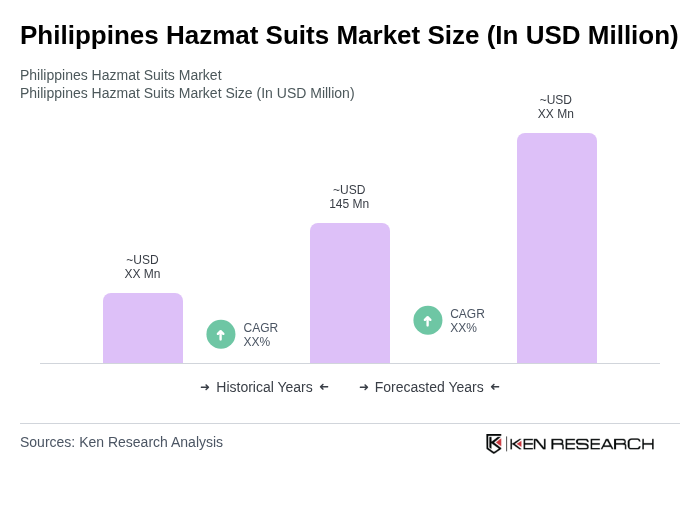
- The Philippines Hazmat Suits Market is valued at USD 145 million, based on a five-year historical analysis. This growth is primarily driven by increasing industrial activities, heightened awareness of safety protocols, ongoing need for personal protective equipment in various sectors particularly healthcare and emergency services, rapid industrialization in chemical manufacturing and mining, and rising government focus on safety regulations.
- Metro Manila, Cebu, and Davao are the dominant regions in the Philippines Hazmat Suits Market. Metro Manila leads due to its concentration of healthcare facilities and industrial operations, while Cebu and Davao benefit from their strategic locations and growing economic activities, making them key players in the distribution and usage of hazmat suits.
- The Department of Labor and Employment (DOLE) Administrative Order No. 136-14 Series of 2014, issued by the Department of Labor and Employment, mandates employers to provide appropriate personal protective equipment including suits resistant to hazardous materials for workers exposed to chemical, biological, radiological, or other hazards. This regulation requires risk assessments, certification of PPE by competent authorities, training on proper use, and maintenance to ensure compliance in workplaces handling hazardous substances across industries.
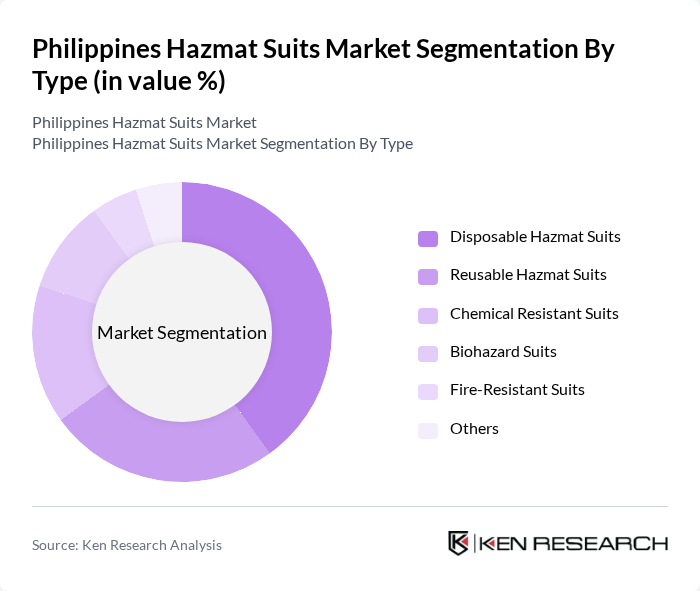
Philippines Hazmat Suits Market Segmentation
By Type:The market is segmented into various types of hazmat suits, including Disposable Hazmat Suits, Reusable Hazmat Suits, Chemical Resistant Suits, Biohazard Suits, Fire-Resistant Suits, and Others. Among these, Disposable Hazmat Suits are gaining significant traction due to their convenience and cost-effectiveness, especially in healthcare settings where contamination risks are high. Reusable Hazmat Suits are also popular in industrial applications where durability is essential. The demand for Chemical Resistant and Biohazard Suits is driven by stringent safety regulations in chemical processing and healthcare sectors.
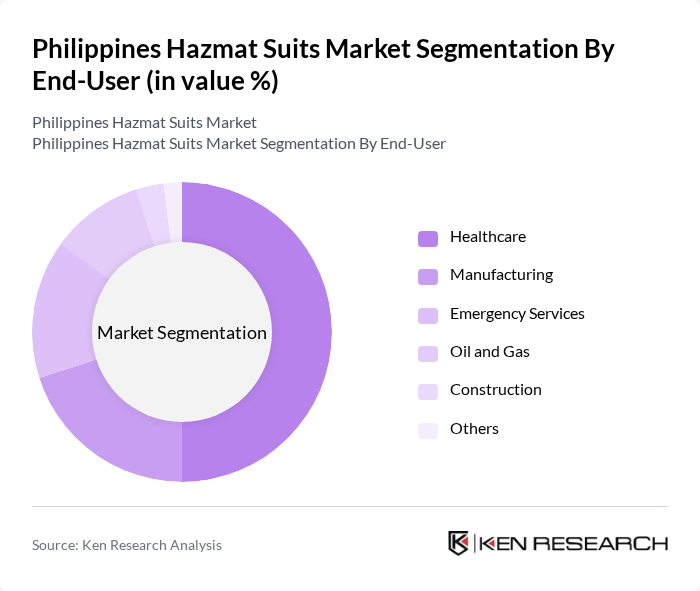
By End-User:The end-user segmentation includes Healthcare, Manufacturing, Emergency Services, Oil and Gas, Construction, and Others. The Healthcare sector is the largest consumer of hazmat suits, driven by the ongoing need for protective gear in hospitals and clinics, especially during health crises. Emergency Services also represent a significant portion of the market, as first responders require reliable protection against hazardous materials. The Manufacturing and Oil and Gas sectors are increasingly adopting hazmat suits due to stringent safety regulations and the need for worker protection.
Philippines Hazmat Suits Market Competitive Landscape
The Philippines Hazmat Suits Market is characterized by a dynamic mix of regional and international players. Leading participants such as DuPont de Nemours, Inc., 3M Company, Honeywell International Inc., Lakeland Industries, Inc., Ansell Limited, MCR Safety, R.S. Hughes Company, Inc., International Enviroguard, Protective Industrial Products, Inc., Medline Industries, Inc., Cintas Corporation, Alpha Pro Tech, Ltd., Safety Products, Inc., Trelleborg AB, Aearo Technologies LLC contribute to innovation, geographic expansion, and service delivery in this space.
Philippines Hazmat Suits Market Industry Analysis
Growth Drivers
- Increasing Industrial Accidents and Safety Regulations:The Philippines has seen a rise in industrial accidents, with over 1,200 reported incidents in the recent past, prompting stricter safety regulations. The Department of Labor and Employment (DOLE) has implemented new guidelines, increasing compliance costs for companies. This regulatory environment drives demand for high-quality hazmat suits, as businesses prioritize employee safety and legal compliance, leading to an estimated 15% increase in hazmat suit purchases in the industrial sector.
- Rising Awareness of Hazardous Materials:Public awareness regarding hazardous materials has surged, particularly following several high-profile chemical spills in urban areas. In the recent past, the Environmental Management Bureau reported a 30% increase in community training programs focused on hazardous material handling. This heightened awareness is translating into increased demand for hazmat suits, as both individuals and organizations seek to protect themselves from potential exposure, resulting in a projected 20% growth in personal protective equipment sales.
- Government Initiatives for Disaster Preparedness:The Philippine government has intensified its disaster preparedness initiatives, allocating approximately PHP 5 billion (USD 100 million) for emergency response training and equipment procurement in the near future. This funding is aimed at enhancing the capabilities of local government units and emergency responders, thereby increasing the demand for hazmat suits. As a result, the market is expected to see a significant uptick in orders from government agencies and NGOs focused on disaster response.
Market Challenges
- High Cost of Quality Hazmat Suits:The average cost of high-quality hazmat suits in the Philippines ranges from PHP 10,000 to PHP 30,000 (USD 200 to USD 600), which can be prohibitive for smaller businesses and organizations. This high price point limits market penetration, particularly in sectors with tight budgets. Consequently, many companies opt for lower-quality alternatives, which may not meet safety standards, posing a significant challenge to market growth and consumer safety.
- Limited Local Manufacturing Capabilities:The Philippines currently has only a handful of manufacturers producing hazmat suits, with local production accounting for less than 20% of total market supply. This reliance on imports, which can be subject to tariffs and shipping delays, creates vulnerabilities in the supply chain. As a result, the market faces challenges in meeting increasing demand, particularly during emergencies when rapid deployment of protective gear is critical.
Philippines Hazmat Suits Market Future Outlook
The Philippines hazmat suits market is poised for significant growth, driven by increasing industrial safety regulations and heightened awareness of hazardous materials. As the government continues to invest in disaster preparedness, the demand for high-quality protective gear will likely rise. Additionally, advancements in technology and materials will enhance product offerings, making them more appealing to consumers. The market is expected to evolve, with a focus on sustainability and customization, catering to diverse industry needs while addressing safety concerns effectively.
Market Opportunities
- Expansion of the Healthcare Sector:The healthcare sector in the Philippines is projected to grow by 12% annually, driven by increased investments in medical infrastructure. This growth presents a significant opportunity for hazmat suit manufacturers to supply hospitals and clinics with essential protective gear, ensuring the safety of healthcare workers and patients alike.
- Development of Eco-Friendly Materials:With rising environmental concerns, there is a growing demand for eco-friendly hazmat suits made from sustainable materials. Manufacturers who invest in research and development of biodegradable or recyclable options can tap into this emerging market segment, appealing to environmentally conscious consumers and organizations.
Scope of the Report
| Segment | Sub-Segments |
|---|---|
| By Type | Disposable Hazmat Suits Reusable Hazmat Suits Chemical Resistant Suits Biohazard Suits Fire-Resistant Suits Others |
| By End-User | Healthcare Manufacturing Emergency Services Oil and Gas Construction Others |
| By Industry Application | Chemical Processing Waste Management Pharmaceutical Food Processing Others |
| By Material Type | Polyethylene Tyvek PVC Neoprene Others |
| By Distribution Channel | Direct Sales Online Retail Distributors Retail Stores Others |
| By Region | Luzon Visayas Mindanao |
| By Policy Support | Government Subsidies Tax Incentives Compliance Assistance Others |
Key Target Audience
Investors and Venture Capitalist Firms
Government and Regulatory Bodies (e.g., Department of Health, Department of Environment and Natural Resources)
Manufacturers and Producers
Distributors and Retailers
Emergency Response Organizations
Healthcare Facilities and Hospitals
Industrial Safety and Compliance Agencies
Non-Governmental Organizations (NGOs) focused on health and safety
Players Mentioned in the Report:
DuPont de Nemours, Inc.
3M Company
Honeywell International Inc.
Lakeland Industries, Inc.
Ansell Limited
MCR Safety
R.S. Hughes Company, Inc.
International Enviroguard
Protective Industrial Products, Inc.
Medline Industries, Inc.
Cintas Corporation
Alpha Pro Tech, Ltd.
Safety Products, Inc.
Trelleborg AB
Aearo Technologies LLC
Table of Contents
Market Assessment Phase
1. Executive Summary and Approach
2. Philippines Hazmat Suits Market Overview
2.1 Key Insights and Strategic Recommendations
2.2 Philippines Hazmat Suits Market Overview
2.3 Definition and Scope
2.4 Evolution of Market Ecosystem
2.5 Timeline of Key Regulatory Milestones
2.6 Value Chain & Stakeholder Mapping
2.7 Business Cycle Analysis
2.8 Policy & Incentive Landscape
3. Philippines Hazmat Suits Market Analysis
3.1 Growth Drivers
3.1.1 Increasing industrial accidents and safety regulations
3.1.2 Rising awareness of hazardous materials
3.1.3 Government initiatives for disaster preparedness
3.1.4 Growth in healthcare and emergency response sectors
3.2 Market Challenges
3.2.1 High cost of quality hazmat suits
3.2.2 Limited local manufacturing capabilities
3.2.3 Regulatory compliance complexities
3.2.4 Competition from low-cost imports
3.3 Market Opportunities
3.3.1 Expansion of the healthcare sector
3.3.2 Development of eco-friendly materials
3.3.3 Increasing demand from the oil and gas industry
3.3.4 Technological advancements in protective gear
3.4 Market Trends
3.4.1 Shift towards lightweight and breathable materials
3.4.2 Integration of smart technology in hazmat suits
3.4.3 Growing focus on sustainability and recyclability
3.4.4 Increased customization options for end-users
3.5 Government Regulation
3.5.1 Implementation of stricter safety standards
3.5.2 Mandatory training for hazmat suit usage
3.5.3 Certification requirements for manufacturers
3.5.4 Incentives for local production of safety gear
4. SWOT Analysis
5. Stakeholder Analysis
6. Porter's Five Forces Analysis
7. Philippines Hazmat Suits Market Market Size, 2019-2024
7.1 By Value
7.2 By Volume
7.3 By Average Selling Price
8. Philippines Hazmat Suits Market Segmentation
8.1 By Type
8.1.1 Disposable Hazmat Suits
8.1.2 Reusable Hazmat Suits
8.1.3 Chemical Resistant Suits
8.1.4 Biohazard Suits
8.1.5 Fire-Resistant Suits
8.1.6 Others
8.2 By End-User
8.2.1 Healthcare
8.2.2 Manufacturing
8.2.3 Emergency Services
8.2.4 Oil and Gas
8.2.5 Construction
8.2.6 Others
8.3 By Industry Application
8.3.1 Chemical Processing
8.3.2 Waste Management
8.3.3 Pharmaceutical
8.3.4 Food Processing
8.3.5 Others
8.4 By Material Type
8.4.1 Polyethylene
8.4.2 Tyvek
8.4.3 PVC
8.4.4 Neoprene
8.4.5 Others
8.5 By Distribution Channel
8.5.1 Direct Sales
8.5.2 Online Retail
8.5.3 Distributors
8.5.4 Retail Stores
8.5.5 Others
8.6 By Region
8.6.1 Luzon
8.6.2 Visayas
8.6.3 Mindanao
8.7 By Policy Support
8.7.1 Government Subsidies
8.7.2 Tax Incentives
8.7.3 Compliance Assistance
8.7.4 Others
9. Philippines Hazmat Suits Market Competitive Analysis
9.1 Market Share of Key Players
9.2 Cross Comparison of Key Players
9.2.1 Company Name
9.2.2 Group Size (Large, Medium, or Small as per industry convention)
9.2.3 Revenue Growth Rate
9.2.4 Market Penetration Rate
9.2.5 Customer Retention Rate
9.2.6 Product Quality Index
9.2.7 Distribution Efficiency
9.2.8 Pricing Strategy
9.2.9 Brand Recognition Score
9.2.10 Innovation Rate
9.3 SWOT Analysis of Top Players
9.4 Pricing Analysis
9.5 Detailed Profile of Major Companies
9.5.1 DuPont de Nemours, Inc.
9.5.2 3M Company
9.5.3 Honeywell International Inc.
9.5.4 Lakeland Industries, Inc.
9.5.5 Ansell Limited
9.5.6 MCR Safety
9.5.7 R.S. Hughes Company, Inc.
9.5.8 International Enviroguard
9.5.9 Protective Industrial Products, Inc.
9.5.10 Medline Industries, Inc.
9.5.11 Cintas Corporation
9.5.12 Alpha Pro Tech, Ltd.
9.5.13 Safety Products, Inc.
9.5.14 Trelleborg AB
9.5.15 Aearo Technologies LLC
10. Philippines Hazmat Suits Market End-User Analysis
10.1 Procurement Behavior of Key Ministries
10.1.1 Ministry of Health
10.1.2 Department of Labor and Employment
10.1.3 Department of Environment and Natural Resources
10.1.4 Others
10.2 Corporate Spend on Infrastructure & Energy
10.2.1 Healthcare Sector Investments
10.2.2 Industrial Safety Budgets
10.2.3 Emergency Response Funding
10.2.4 Others
10.3 Pain Point Analysis by End-User Category
10.3.1 Healthcare Providers
10.3.2 Industrial Manufacturers
10.3.3 Emergency Services
10.3.4 Others
10.4 User Readiness for Adoption
10.4.1 Training and Awareness Levels
10.4.2 Budget Allocations
10.4.3 Regulatory Compliance Readiness
10.4.4 Others
10.5 Post-Deployment ROI and Use Case Expansion
10.5.1 Cost Savings Analysis
10.5.2 Performance Metrics
10.5.3 User Feedback and Adaptation
10.5.4 Others
11. Philippines Hazmat Suits Market Future Size, 2025-2030
11.1 By Value
11.2 By Volume
11.3 By Average Selling Price
Go-To-Market Strategy Phase
1. Whitespace Analysis + Business Model Canvas
1.1 Market Gaps Identification
1.2 Business Model Development
2. Marketing and Positioning Recommendations
2.1 Branding Strategies
2.2 Product USPs
3. Distribution Plan
3.1 Urban Retail Strategies
3.2 Rural NGO Tie-ups
4. Channel & Pricing Gaps
4.1 Underserved Routes
4.2 Pricing Bands Analysis
5. Unmet Demand & Latent Needs
5.1 Category Gaps
5.2 Consumer Segments
6. Customer Relationship
6.1 Loyalty Programs
6.2 After-sales Service
7. Value Proposition
7.1 Sustainability Initiatives
7.2 Integrated Supply Chains
8. Key Activities
8.1 Regulatory Compliance
8.2 Branding Efforts
8.3 Distribution Setup
9. Entry Strategy Evaluation
9.1 Domestic Market Entry Strategy
9.1.1 Product Mix Considerations
9.1.2 Pricing Band Strategy
9.1.3 Packaging Solutions
9.2 Export Entry Strategy
9.2.1 Target Countries Identification
9.2.2 Compliance Roadmap Development
10. Entry Mode Assessment
10.1 Joint Ventures
10.2 Greenfield Investments
10.3 Mergers & Acquisitions
10.4 Distributor Model Evaluation
11. Capital and Timeline Estimation
11.1 Capital Requirements
11.2 Timelines for Implementation
12. Control vs Risk Trade-Off
12.1 Ownership Considerations
12.2 Partnerships Evaluation
13. Profitability Outlook
13.1 Breakeven Analysis
13.2 Long-term Sustainability Strategies
14. Potential Partner List
14.1 Distributors
14.2 Joint Ventures
14.3 Acquisition Targets
15. Execution Roadmap
15.1 Phased Plan for Market Entry
15.1.1 Market Setup
15.1.2 Market Entry
15.1.3 Growth Acceleration
15.1.4 Scale & Stabilize
15.2 Key Activities and Milestones
15.2.1 Milestone Planning
15.2.2 Activity Tracking
Research Methodology
Phase 1: Approach1
Desk Research
- Analysis of industry reports from government agencies and health organizations
- Review of market studies and publications from safety equipment associations
- Examination of import/export data and trade statistics related to hazmat suits
Primary Research
- Interviews with safety equipment distributors and manufacturers in the Philippines
- Surveys targeting healthcare professionals and emergency response teams
- Field interviews with procurement managers in industrial sectors requiring hazmat suits
Validation & Triangulation
- Cross-validation of findings through multiple data sources including trade publications
- Triangulation of market insights from primary interviews and secondary data
- Sanity checks conducted through expert panel reviews and feedback sessions
Phase 2: Market Size Estimation1
Top-down Assessment
- Estimation of market size based on national safety equipment expenditure trends
- Segmentation by end-user industries such as healthcare, manufacturing, and emergency services
- Incorporation of government regulations and safety mandates influencing hazmat suit usage
Bottom-up Modeling
- Volume estimates derived from sales data of leading hazmat suit manufacturers
- Operational cost analysis based on pricing strategies of various product lines
- Calculation of market size based on unit sales and average selling prices
Forecasting & Scenario Analysis
- Multi-factor regression analysis considering factors like industrial growth and regulatory changes
- Scenario planning based on potential shifts in safety standards and market demand
- Development of baseline, optimistic, and pessimistic forecasts through 2030
Phase 3: CATI Sample Composition1
| Scope Item/Segment | Sample Size | Target Respondent Profiles |
|---|---|---|
| Healthcare Sector Hazmat Suit Usage | 120 | Medical Directors, Safety Officers |
| Industrial Applications of Hazmat Suits | 100 | Plant Managers, Safety Compliance Officers |
| Emergency Response Team Equipment Needs | 80 | Fire Chiefs, Emergency Management Coordinators |
| Government Procurement for Safety Equipment | 60 | Procurement Officers, Policy Makers |
| Training and Certification Providers | 90 | Training Coordinators, Safety Trainers |
Frequently Asked Questions
What is the current value of the Philippines Hazmat Suits Market?
The Philippines Hazmat Suits Market is valued at approximately USD 145 million, reflecting a five-year historical analysis. This growth is attributed to increasing industrial activities and heightened safety awareness across various sectors, particularly healthcare and emergency services.
Which regions dominate the Philippines Hazmat Suits Market?
What types of hazmat suits are available in the Philippines?
Who are the major players in the Philippines Hazmat Suits Market?
Other Regional/Country Reports
Indonesia Hazmat Suits Market
Malaysia Hazmat Suits Market
KSA Hazmat Suits Market
APAC Hazmat Suits Market
SEA Hazmat Suits Market
Vietnam Hazmat Suits Market
Other Adjacent Reports
Indonesia Biohazard Protection Equipment Market
Egypt Fire-Resistant Apparel Market
Brazil Industrial Safety Gear Market
Brazil Healthcare Protective Gear Market
Brazil Emergency Response Equipment Market
Mexico Oil and Gas Safety Equipment Market
GCC Construction Safety Equipment Market Size, Share, Trends & Forecast 2025–2030Kuwait Disaster Preparedness Equipment Market
Why Buy From Us?

What makes us stand out is that our consultants follow Robust, Refine and Result (RRR) methodology. Robust for clear definitions, approaches and sanity checking, Refine for differentiating respondents' facts and opinions, and Result for presenting data with story.

We have set a benchmark in the industry by offering our clients with syndicated and customized market research reports featuring coverage of entire market as well as meticulous research and analyst insights.

While we don't replace traditional research, we flip the method upside down. Our dual approach of Top Bottom & Bottom Top ensures quality deliverable by not just verifying company fundamentals but also looking at the sector and macroeconomic factors.

With one step in the future, our research team constantly tries to show you the bigger picture. We help with some of the tough questions you may encounter along the way: How is the industry positioned? Best marketing channel? KPI's of competitors? By aligning every element, we help maximize success.

Our report gives you instant access to the answers and sources that other companies might choose to hide. We elaborate each steps of research methodology we have used and showcase you the sample size to earn your trust.

If you need any support, we are here! We pride ourselves on universe strength, data quality, and quick, friendly, and professional service.