About the Report
Base Year 2024Thailand Chemical Protective Clothing Market Overview
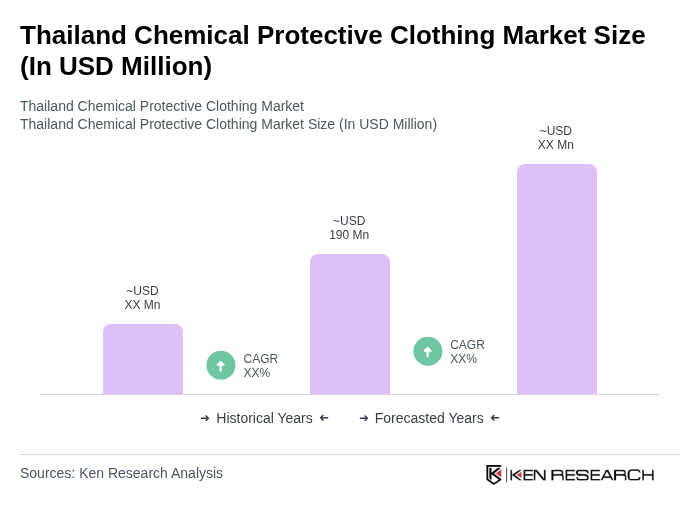
- The Thailand Chemical Protective Clothing market is valued at USD 190 million, based on a five-year historical analysis, aligned with the share of chemical-defending garments within the broader Thailand industrial protective clothing market.This growth is primarily driven by increasing industrial activities, stricter enforcement of occupational safety laws, and heightened awareness regarding worker safety in hazardous environments across sectors such as petrochemicals, pharmaceuticals, oil and gas, and manufacturing.The demand for chemical protective clothing has surged particularly in oil and gas, healthcare, chemical manufacturing, and food and beverage processing, where exposure to corrosive, toxic, or infectious substances is prevalent.
- Key cities such as Bangkok, Chonburi, and Rayong dominate the market due to their industrial significance and concentration of manufacturing and petrochemical facilities. Bangkok serves as the economic and logistics hub with a dense cluster of healthcare, pharmaceuticals, and general manufacturing, while Chonburi and Rayong anchor the Eastern Economic Corridor and host major refining, petrochemical, and heavy industrial estates such as Map Ta Phut.The presence of multinational corporations, large industrial estates, and a robust PPE distribution and import network in these regions further enhances their market dominance for chemical protective clothing.
- The regulatory framework governing chemical protective clothing use in Thailand is underpinned by the Occupational Safety, Health and Environment Act B.E. 2554 (2011), issued by the Ministry of Labour, which requires employers to assess hazards and provide suitable personal protective equipment for workers exposed to chemical and other risks, and to train workers in its correct use.In addition, ministerial regulations and standards such as the Ministry of Industry’s rules on hazardous substances, and Thai Industrial Standards (TIS) that reference international PPE performance standards, reinforce mandatory provision and proper selection of chemical protective clothing in workplaces handling hazardous materials.These binding requirements to supply certified PPE, maintain safe working conditions, and document compliance continue to drive demand for high-quality chemical protective clothing in Thailand.
Thailand Chemical Protective Clothing Market Segmentation
By Product Type:The product type segmentation includes various forms of chemical protective clothing designed for specific applications and user needs. The subsegments are as follows:
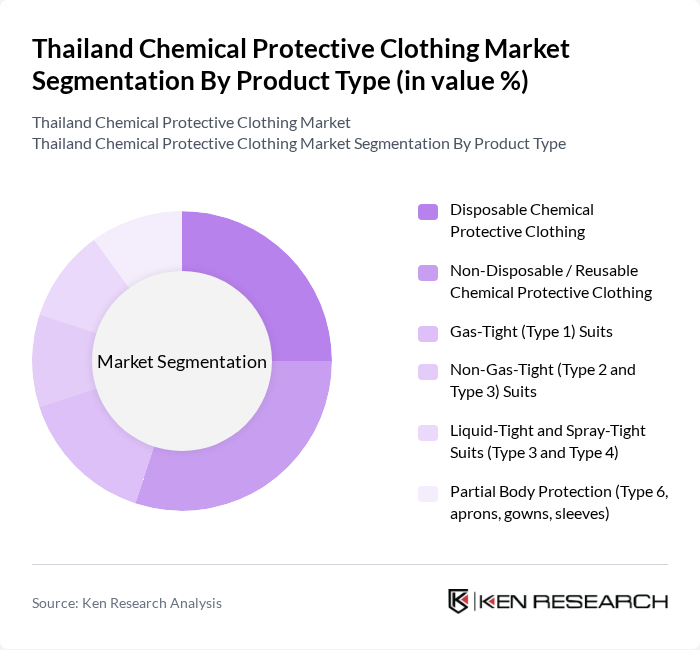
The market for chemical protective clothing is significantly influenced by the demand for non-disposable or reusable options, which account for a substantial share, especially in industrial, oil and gas, and manufacturing environments where garments are used repeatedly under rigorous conditions.This preference is driven by cost-effectiveness over the life cycle of the garment, higher durability, and environmental considerations as industries seek to reduce solid waste volumes and disposal costs.Disposable clothing, while convenient for short-term tasks, pharmaceutical operations, and infection control in healthcare, is often seen as less sustainable but continues to grow rapidly where contamination risk and hygiene requirements are critical.The increasing focus on compliance with safety standards, incident prevention, and the need for durable, high-performance materials further bolster the demand for non-disposable options, making them the leading subsegment in the market.
By Material Type:The material type segmentation encompasses various fabrics and composites used in the manufacturing of chemical protective clothing. The subsegments are as follows:
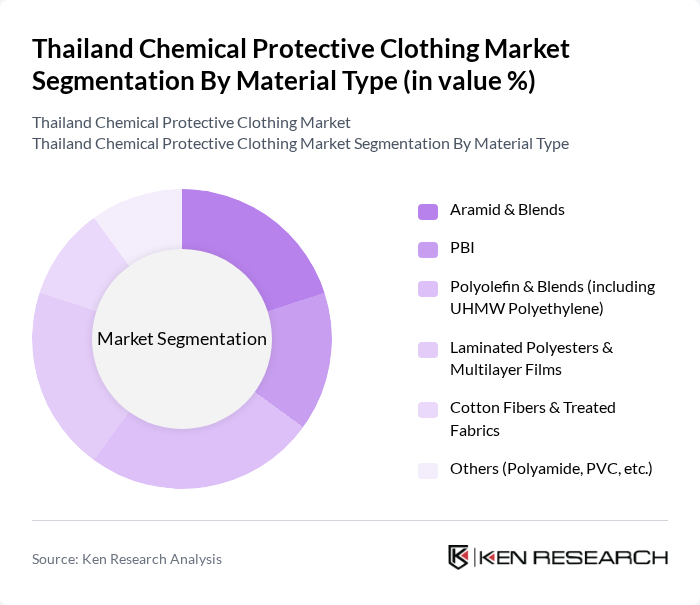
In the material type segmentation, polyolefin and blends dominate the market due to their excellent chemical resistance, barrier properties, and lightweight characteristics, which align with the global shift toward polyethylene and polypropylene-based protective garments for chemical handling and clean environments.The versatility of polyolefin materials allows for the production of garments that are both protective and comfortable, including breathable laminates and multilayer films, appealing to a wide range of industries from pharmaceuticals to electronics and food processing.Aramid and blends also hold a significant share, particularly in high-temperature and flame-exposed environments such as refining, petrochemicals, and emergency response, where thermal and mechanical strength are critical.Laminated polyesters and multilayer films are favored for their waterproof and liquid-tight capabilities in applications such as spray-tight and liquid-tight suits, while treated cotton and other fibers are used where comfort, limited chemical exposure, and cost optimization are priorities. The growing emphasis on safety, regulatory compliance, and performance in hazardous work environments continues to drive the demand for these advanced materials.
Thailand Chemical Protective Clothing Market Competitive Landscape
The Thailand Chemical Protective Clothing Market is characterized by a dynamic mix of regional and international players. Leading participants such as DuPont de Nemours, Inc., 3M Company, Honeywell International Inc., Ansell Limited, Lakeland Industries, Inc., MCR Safety, Kimberly-Clark Corporation, Delta Plus Group, R.S. Hughes Company, Inc., Protective Industrial Products, Inc., International Enviroguard, Medline Industries, LP, Cintas Corporation, Uvex Safety Group, National and Regional Thai PPE Manufacturers and Distributors contribute to innovation, geographic expansion, and service delivery in this space.
Thailand Chemical Protective Clothing Market Industry Analysis
Growth Drivers
- Increasing Industrial Safety Regulations:The Thai government has implemented stringent industrial safety regulations, leading to a significant rise in demand for chemical protective clothing. In future, the Ministry of Labor reported that over 1,200 new safety regulations were introduced, impacting various sectors, including manufacturing and construction. This regulatory environment is expected to drive the market, as companies invest in protective gear to comply with safety standards and avoid penalties, thereby enhancing worker safety.
- Rising Awareness of Workplace Safety:There is a growing recognition of the importance of workplace safety among employers and employees in Thailand. According to the National Institute for Occupational Safety and Health, workplace accidents decreased by 15% from the previous year due to increased safety training and awareness campaigns. This heightened focus on safety is propelling the demand for chemical protective clothing, as businesses prioritize employee well-being and seek to minimize risks associated with hazardous materials.
- Growth in the Chemical Manufacturing Sector:Thailand's chemical manufacturing sector is projected to grow at a rate of 6% annually, driven by increased domestic and international demand. The Thai Chemical Industry Association reported that the sector generated approximately THB 1.5 trillion in revenue recently. This growth is stimulating the need for protective clothing, as companies in this sector require advanced safety gear to protect workers from exposure to harmful chemicals, thereby boosting market prospects.
Market Challenges
- High Cost of Advanced Protective Clothing:The cost of advanced chemical protective clothing remains a significant barrier for many businesses in Thailand. High-quality materials and innovative designs can lead to prices exceeding THB 5,000 per suit. This financial burden disproportionately affects small and medium-sized enterprises (SMEs), which may struggle to allocate budgets for essential safety gear, potentially compromising worker safety and compliance with regulations.
- Limited Awareness Among Small Businesses:Many small businesses in Thailand lack awareness of the importance of chemical protective clothing, which poses a challenge for market growth. A survey by the Thai Chamber of Commerce indicated that only 30% of SMEs are familiar with the latest safety regulations and protective gear options. This knowledge gap can lead to inadequate safety measures, increasing the risk of workplace accidents and limiting the overall market potential for protective clothing.
Thailand Chemical Protective Clothing Market Future Outlook
The future of the Thailand chemical protective clothing market appears promising, driven by ongoing advancements in material technology and increasing regulatory pressures. As industries evolve, the demand for innovative and sustainable protective solutions is expected to rise. Companies are likely to invest in smart textiles and IoT-enabled safety gear, enhancing worker protection. Additionally, the government's commitment to improving workplace safety standards will further stimulate market growth, creating a robust environment for manufacturers and suppliers in the coming years.
Market Opportunities
- Expansion in Emerging Industries:The rise of emerging industries, such as renewable energy and biotechnology, presents significant opportunities for the chemical protective clothing market. As these sectors grow, the demand for specialized protective gear tailored to unique hazards will increase, allowing manufacturers to diversify their product offerings and capture new market segments.
- Development of Eco-Friendly Materials:There is a growing trend towards sustainability in the protective clothing market. The development of eco-friendly materials, such as biodegradable fabrics, is gaining traction. Companies that invest in sustainable production methods can appeal to environmentally conscious consumers and businesses, positioning themselves favorably in a competitive market landscape.
Scope of the Report
| Segment | Sub-Segments |
|---|---|
| By Product Type | Disposable Chemical Protective Clothing Non-Disposable / Reusable Chemical Protective Clothing Gas-Tight (Type 1) Suits Non-Gas-Tight (Type 2 and Type 3) Suits Liquid-Tight and Spray-Tight Suits (Type 3 and Type 4) Partial Body Protection (Type 6, aprons, gowns, sleeves) |
| By Material Type | Aramid & Blends PBI Polyolefin & Blends (including UHMW Polyethylene) Laminated Polyesters & Multilayer Films Cotton Fibers & Treated Fabrics Others (Polyamide, PVC, etc.) |
| By Application | Chemical Handling & Processing Hazardous Material (HAZMAT) & Spill Response Pharmaceutical & Laboratory Protection Industrial Cleaning & Maintenance Oil & Gas and Petrochemicals Others |
| By End-Use Industry | Construction & Manufacturing Oil & Gas and Petrochemicals Healthcare & Medical Firefighting & Law Enforcement Chemicals & Pharmaceuticals Mining & Metals Others |
| By User Type | Industrial / Institutional Users Personal / Individual Users |
| By Distribution Channel | Direct Sales to Enterprises Specialized Safety Distributors Industrial Retailers & Dealers E-commerce and Online Platforms Others |
| By Region | Central Thailand Northern Thailand Northeastern Thailand Southern Thailand |
Key Target Audience
Investors and Venture Capitalist Firms
Government and Regulatory Bodies (e.g., Ministry of Industry, Department of Industrial Works)
Manufacturers and Producers
Distributors and Retailers
Occupational Safety and Health Administration (OSHA)
Industry Associations (e.g., Thai Chemical Industry Association)
Environmental Protection Agencies (e.g., Pollution Control Department)
Financial Institutions
Players Mentioned in the Report:
DuPont de Nemours, Inc.
3M Company
Honeywell International Inc.
Ansell Limited
Lakeland Industries, Inc.
MCR Safety
Kimberly-Clark Corporation
Delta Plus Group
R.S. Hughes Company, Inc.
Protective Industrial Products, Inc.
International Enviroguard
Medline Industries, LP
Cintas Corporation
Uvex Safety Group
National and Regional Thai PPE Manufacturers and Distributors
Table of Contents
Market Assessment Phase
1. Executive Summary and Approach
2. Thailand Chemical Protective Clothing Market Overview
2.1 Key Insights and Strategic Recommendations
2.2 Thailand Chemical Protective Clothing Market Overview
2.3 Definition and Scope
2.4 Evolution of Market Ecosystem
2.5 Timeline of Key Regulatory Milestones
2.6 Value Chain & Stakeholder Mapping
2.7 Business Cycle Analysis
2.8 Policy & Incentive Landscape
3. Thailand Chemical Protective Clothing Market Analysis
3.1 Growth Drivers
3.1.1 Increasing industrial safety regulations
3.1.2 Rising awareness of workplace safety
3.1.3 Growth in the chemical manufacturing sector
3.1.4 Technological advancements in fabric materials
3.2 Market Challenges
3.2.1 High cost of advanced protective clothing
3.2.2 Limited awareness among small businesses
3.2.3 Stringent compliance requirements
3.2.4 Competition from low-cost alternatives
3.3 Market Opportunities
3.3.1 Expansion in emerging industries
3.3.2 Development of eco-friendly materials
3.3.3 Increasing demand for customized solutions
3.3.4 Government initiatives for safety training
3.4 Market Trends
3.4.1 Adoption of smart textiles
3.4.2 Growth of e-commerce in protective gear
3.4.3 Focus on sustainability in production
3.4.4 Integration of IoT in safety equipment
3.5 Government Regulation
3.5.1 Occupational Safety and Health Act
3.5.2 Standards for Personal Protective Equipment
3.5.3 Chemical Safety Regulations
3.5.4 Environmental Protection Laws
4. SWOT Analysis
5. Stakeholder Analysis
6. Porter's Five Forces Analysis
7. Thailand Chemical Protective Clothing Market Market Size, 2019-2024
7.1 By Value
7.2 By Volume
7.3 By Average Selling Price
8. Thailand Chemical Protective Clothing Market Segmentation
8.1 By Product Type
8.1.1 Disposable Chemical Protective Clothing
8.1.2 Non-Disposable / Reusable Chemical Protective Clothing
8.1.3 Gas-Tight (Type 1) Suits
8.1.4 Non-Gas-Tight (Type 2 and Type 3) Suits
8.1.5 Liquid-Tight and Spray-Tight Suits (Type 3 and Type 4)
8.1.6 Partial Body Protection (Type 6, aprons, gowns, sleeves)
8.2 By Material Type
8.2.1 Aramid & Blends
8.2.2 PBI
8.2.3 Polyolefin & Blends (including UHMW Polyethylene)
8.2.4 Laminated Polyesters & Multilayer Films
8.2.5 Cotton Fibers & Treated Fabrics
8.2.6 Others (Polyamide, PVC, etc.)
8.3 By Application
8.3.1 Chemical Handling & Processing
8.3.2 Hazardous Material (HAZMAT) & Spill Response
8.3.3 Pharmaceutical & Laboratory Protection
8.3.4 Industrial Cleaning & Maintenance
8.3.5 Oil & Gas and Petrochemicals
8.3.6 Others
8.4 By End-Use Industry
8.4.1 Construction & Manufacturing
8.4.2 Oil & Gas and Petrochemicals
8.4.3 Healthcare & Medical
8.4.4 Firefighting & Law Enforcement
8.4.5 Chemicals & Pharmaceuticals
8.4.6 Mining & Metals
8.4.7 Others
8.5 By User Type
8.5.1 Industrial / Institutional Users
8.5.2 Personal / Individual Users
8.6 By Distribution Channel
8.6.1 Direct Sales to Enterprises
8.6.2 Specialized Safety Distributors
8.6.3 Industrial Retailers & Dealers
8.6.4 E-commerce and Online Platforms
8.6.5 Others
8.7 By Region
8.7.1 Central Thailand
8.7.2 Northern Thailand
8.7.3 Northeastern Thailand
8.7.4 Southern Thailand
9. Thailand Chemical Protective Clothing Market Competitive Analysis
9.1 Market Share of Key Players
9.2 Cross Comparison of Key Players
9.2.1 Company Name
9.2.2 Group Size (Large, Medium, or Small as per industry convention)
9.2.3 Thailand Chemical Protective Clothing Revenue (THB / USD)
9.2.4 3-Year Revenue CAGR in Chemical Protective Clothing
9.2.5 EBITDA Margin (%) for Chemical Protective Clothing Business
9.2.6 Market Share in Thailand Chemical Protective Clothing (%)
9.2.7 Installed Production Capacity in Thailand (Units / Garments per Year)
9.2.8 Capacity Utilization Rate (%)
9.2.9 Average Realization per Unit (THB / Garment)
9.2.10 R&D Intensity (% of Revenue Spent on R&D)
9.2.11 New Product Launches (Number in Last 3 Years)
9.2.12 Export Share of Sales (%)
9.2.13 Key Local and Regional Distribution Coverage (Number of Distributors / Provinces Covered)
9.2.14 Average Days Sales Outstanding (DSO)
9.2.15 Customer Concentration (Top 5 Customers as % of Revenue)
9.3 SWOT Analysis of Top Players
9.4 Pricing Analysis
9.5 Detailed Profile of Major Companies
9.5.1 DuPont de Nemours, Inc.
9.5.2 3M Company
9.5.3 Honeywell International Inc.
9.5.4 Ansell Limited
9.5.5 Lakeland Industries, Inc.
9.5.6 MCR Safety
9.5.7 Kimberly-Clark Corporation
9.5.8 Delta Plus Group
9.5.9 R.S. Hughes Company, Inc.
9.5.10 Protective Industrial Products, Inc.
9.5.11 International Enviroguard
9.5.12 Medline Industries, LP
9.5.13 Cintas Corporation
9.5.14 Uvex Safety Group
9.5.15 National and Regional Thai PPE Manufacturers and Distributors
10. Thailand Chemical Protective Clothing Market End-User Analysis
10.1 Procurement Behavior of Key Ministries
10.1.1 Ministry of Industry
10.1.2 Ministry of Public Health
10.1.3 Ministry of Labor
10.1.4 Ministry of Agriculture and Cooperatives
10.2 Corporate Spend on Infrastructure & Energy
10.2.1 Investment in Safety Equipment
10.2.2 Budget Allocation for Training
10.2.3 Expenditure on Compliance
10.2.4 Spending on Emergency Preparedness
10.3 Pain Point Analysis by End-User Category
10.3.1 Manufacturing Sector
10.3.2 Healthcare Sector
10.3.3 Construction Sector
10.3.4 Agriculture Sector
10.4 User Readiness for Adoption
10.4.1 Awareness Levels
10.4.2 Training Needs
10.4.3 Budget Constraints
10.4.4 Compliance Readiness
10.5 Post-Deployment ROI and Use Case Expansion
10.5.1 Performance Metrics
10.5.2 User Feedback
10.5.3 Expansion Opportunities
10.5.4 Long-term Benefits
11. Thailand Chemical Protective Clothing Market Future Size, 2025-2030
11.1 By Value
11.2 By Volume
11.3 By Average Selling Price
Go-To-Market Strategy Phase
1. Whitespace Analysis + Business Model Canvas
1.1 Market Gaps Identification
1.2 Business Model Framework
2. Marketing and Positioning Recommendations
2.1 Branding Strategies
2.2 Product USPs
3. Distribution Plan
3.1 Urban Retail vs Rural NGO Tie-ups
4. Channel & Pricing Gaps
4.1 Underserved Routes
4.2 Pricing Bands
5. Unmet Demand & Latent Needs
5.1 Category Gaps
5.2 Consumer Segments
6. Customer Relationship
6.1 Loyalty Programs
6.2 After-sales Service
7. Value Proposition
7.1 Sustainability
7.2 Integrated Supply Chains
8. Key Activities
8.1 Regulatory Compliance
8.2 Branding
8.3 Distribution Setup
9. Entry Strategy Evaluation
9.1 Domestic Market Entry Strategy
9.1.1 Product Mix
9.1.2 Pricing Band
9.1.3 Packaging
9.2 Export Entry Strategy
9.2.1 Target Countries
9.2.2 Compliance Roadmap
10. Entry Mode Assessment
10.1 JV
10.2 Greenfield
10.3 M&A
10.4 Distributor Model
11. Capital and Timeline Estimation
11.1 Capital Requirements
11.2 Timelines
12. Control vs Risk Trade-Off
12.1 Ownership vs Partnerships
13. Profitability Outlook
13.1 Breakeven Analysis
13.2 Long-term Sustainability
14. Potential Partner List
14.1 Distributors
14.2 JVs
14.3 Acquisition Targets
15. Execution Roadmap
15.1 Phased Plan for Market Entry
15.1.1 Market Setup
15.1.2 Market Entry
15.1.3 Growth Acceleration
15.1.4 Scale & Stabilize
15.2 Key Activities and Milestones
15.2.1 Milestone Planning
15.2.2 Activity Tracking
Research Methodology
Phase 1: Approach1
Desk Research
- Analysis of industry reports from the Thailand Ministry of Industry and relevant trade associations
- Review of market trends and forecasts from academic journals and publications focused on chemical safety
- Examination of regulatory frameworks and compliance guidelines from the Thai Department of Industrial Works
Primary Research
- Interviews with safety officers and procurement managers in chemical manufacturing firms
- Surveys conducted with end-users in industries such as oil & gas, pharmaceuticals, and construction
- Field visits to manufacturing plants to gather insights on current usage and needs for protective clothing
Validation & Triangulation
- Cross-validation of findings through multiple data sources including government publications and industry reports
- Triangulation of qualitative insights from interviews with quantitative data from surveys
- Sanity checks performed by consulting with industry experts and stakeholders
Phase 2: Market Size Estimation1
Top-down Assessment
- Estimation of market size based on national chemical production statistics and protective clothing adoption rates
- Segmentation of the market by end-user industries and types of protective clothing
- Incorporation of growth rates from government initiatives promoting workplace safety
Bottom-up Modeling
- Collection of sales data from leading manufacturers of chemical protective clothing in Thailand
- Estimation of market demand based on the number of employees in high-risk sectors
- Calculation of average spending on protective clothing per employee in various industries
Forecasting & Scenario Analysis
- Development of forecasting models using historical data and projected growth in the chemical sector
- Scenario analysis based on potential regulatory changes and shifts in industry standards
- Creation of baseline, optimistic, and pessimistic forecasts through 2030
Phase 3: CATI Sample Composition1
| Scope Item/Segment | Sample Size | Target Respondent Profiles |
|---|---|---|
| Chemical Manufacturing Sector | 120 | Safety Managers, Production Supervisors |
| Oil & Gas Industry | 90 | Health and Safety Officers, Operations Managers |
| Pharmaceuticals Sector | 70 | Quality Assurance Managers, Compliance Officers |
| Construction Industry | 60 | Site Managers, Safety Coordinators |
| Research and Development Facilities | 50 | Lab Managers, R&D Scientists |
Frequently Asked Questions
What is the current value of the Thailand Chemical Protective Clothing market?
The Thailand Chemical Protective Clothing market is valued at approximately USD 190 million, reflecting a significant share within the broader industrial protective clothing sector, driven by increasing industrial activities and heightened safety awareness.
What factors are driving the growth of the chemical protective clothing market in Thailand?
Which industries are the largest consumers of chemical protective clothing in Thailand?
What are the main types of chemical protective clothing available in Thailand?
Other Regional/Country Reports
Other Adjacent Reports
Brazil Chemical Resistant Gloves Market
Qatar Respiratory Protection Equipment Market
KSA flame retardant apparel market size, share, growth drivers, trends, opportunities & forecast 2025–2030South Korea Hazardous Material Handling Market
Germany Petrochemical Safety Equipment Market
Oman Pharmaceutical Safety Gear Market
Philippines Oil and Gas Protective Gear Market
Belgium Workplace Safety Training Market
Why Buy From Us?

What makes us stand out is that our consultants follow Robust, Refine and Result (RRR) methodology. Robust for clear definitions, approaches and sanity checking, Refine for differentiating respondents' facts and opinions, and Result for presenting data with story.

We have set a benchmark in the industry by offering our clients with syndicated and customized market research reports featuring coverage of entire market as well as meticulous research and analyst insights.

While we don't replace traditional research, we flip the method upside down. Our dual approach of Top Bottom & Bottom Top ensures quality deliverable by not just verifying company fundamentals but also looking at the sector and macroeconomic factors.

With one step in the future, our research team constantly tries to show you the bigger picture. We help with some of the tough questions you may encounter along the way: How is the industry positioned? Best marketing channel? KPI's of competitors? By aligning every element, we help maximize success.

Our report gives you instant access to the answers and sources that other companies might choose to hide. We elaborate each steps of research methodology we have used and showcase you the sample size to earn your trust.

If you need any support, we are here! We pride ourselves on universe strength, data quality, and quick, friendly, and professional service.