Philippines Online Car Finance Platforms Market

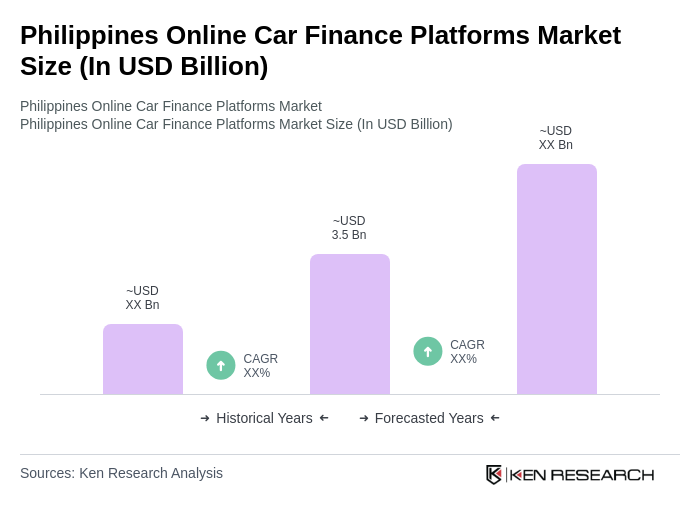
Philippines online car finance platforms market, valued at USD 3.5 billion, is growing due to digital financial services, EV incentives, and demand for passenger cars and personal mobility.

Region:Asia

Author(s):Geetanshi

Product Code:KRAB4648

Pages:93

Published On:October 2025
About the Report

Base Year 2024

Philippines Online Car Finance Platforms Market Overview

  • The Philippines Online Car Finance Platforms Market is valued at USD 3.5 billion, based on a five-year historical analysis. This growth is primarily driven by the increasing adoption of digital financial services, a growing middle class, and the rising demand for personal and commercial vehicles. The convenience of online platforms has made car financing more accessible to consumers, contributing to the market's expansion. The market is further supported by the digitalization of loan processing, with around 45% of auto loans processed digitally, reflecting a shift to more efficient, paperless systems.
  • Metro Manila, Cebu, and Davao are the dominant regions in the Philippines for online car finance platforms. Metro Manila leads due to its high population density, economic activity, and infrastructure development. Cebu and Davao follow, benefiting from urbanization and increasing vehicle ownership rates, which drive demand for financing options. The presence of major automotive manufacturers and higher disposable incomes in these areas further strengthen their position in the market.
  • The "Electric Vehicle Industry Development Act" (Republic Act No. 11697), issued by the Philippine Congress in 2022, mandates incentives for electric vehicle purchases and requires financial institutions to develop accessible financing products for EVs. This law aims to promote sustainable transportation and streamline financing processes for consumers, thereby boosting the online car finance market. The Act covers tax incentives, non-fiscal benefits, and the development of charging infrastructure, directly impacting the growth of digital auto loan offerings for electric vehicles.
Philippines Online Car Finance Platforms Market Size

Philippines Online Car Finance Platforms Market Segmentation

By Vehicle Type:The vehicle type segmentation includes various categories such as passenger cars, commercial vehicles, two-wheelers, electric vehicles, and luxury vehicles. Among these,passenger cars dominate the marketdue to their widespread use for personal transportation. The increasing number of families and young professionals seeking affordable financing options for personal vehicles drives this segment's growth. Commercial vehicles also show significant demand, particularly for businesses requiring logistics and transportation solutions. The rise of ride-hailing and delivery services has further increased demand for commercial vehicle financing. Electric vehicle financing is expanding, supported by government incentives and the introduction of specialized loan products for EVs.
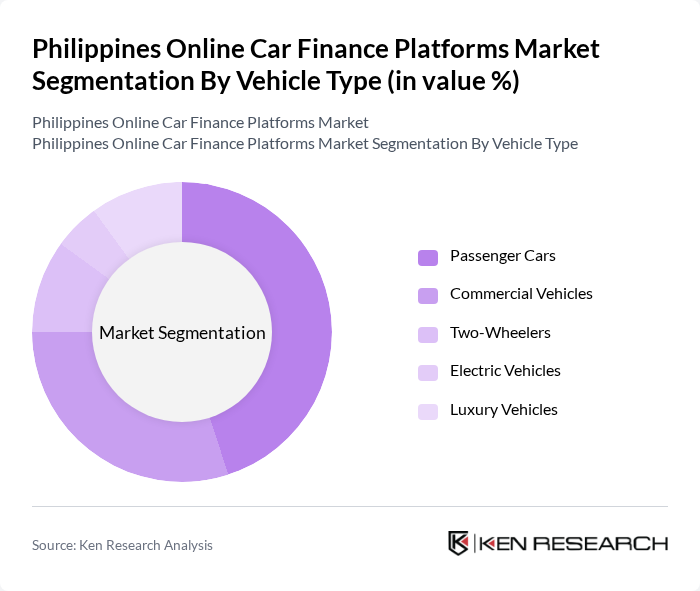
Philippines Online Car Finance Platforms Market segmentation by Vehicle Type.

By End-User:The end-user segmentation consists of individual consumers, small and medium enterprises (SMEs), and corporations.Individual consumers represent the largest segment, driven by the increasing need for personal mobility and the availability of tailored financing solutions. SMEs are also significant contributors, as they often require vehicles for operational purposes, particularly in logistics and delivery sectors. Corporations, while smaller in number, tend to seek larger financing amounts for fleet purchases, thus impacting the overall market.
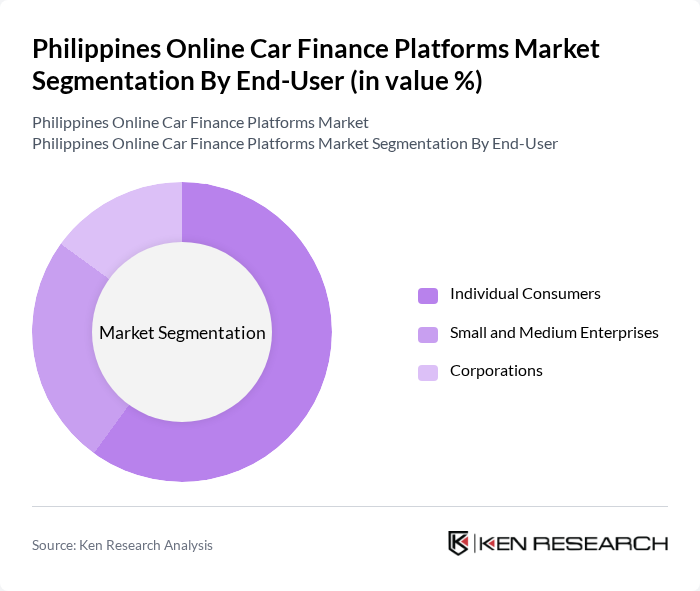
Philippines Online Car Finance Platforms Market segmentation by End-User.

Philippines Online Car Finance Platforms Market Competitive Landscape

The Philippines Online Car Finance Platforms Market is characterized by a dynamic mix of regional and international players. Leading participants such as BPI Family Savings Bank, RCBC Auto Loans, UnionBank Auto Loans, EastWest Bank Auto Loan, Security Bank Auto Loan, Philippine National Bank Auto Loan, Metrobank Car Loan, Maybank Philippines Auto Loan, Toyota Financial Services Philippines, PSBank Auto Loan, AUB (Asia United Bank) Auto Loan, Land Bank of the Philippines Auto Loan, Philippine Bank of Communications Auto Loan, China Bank Savings Auto Loan, UCPB (United Coconut Planters Bank) Auto Loan contribute to innovation, geographic expansion, and service delivery in this space.

BPI Family Savings Bank

2000

Makati, Philippines

RCBC Auto Loans

1960

Makati, Philippines

UnionBank Auto Loans

1982

Paco, Manila, Philippines

EastWest Bank Auto Loan

1994

Makati, Philippines

Security Bank Auto Loan

1951

Makati, Philippines

Company

Establishment Year

Headquarters

Group Size (Large, Medium, or Small as per industry convention)

Number of Loans Disbursed

Total Loan Book Value

Customer Acquisition Cost

Average Loan Processing Time

Customer Satisfaction Score (NPS or equivalent)

Philippines Online Car Finance Platforms Market Industry Analysis

Growth Drivers

  • Increasing Digital Adoption Among Consumers:The Philippines has seen a significant rise in internet penetration, reachingapproximately 73%in future, with over84 millionactive internet users. This digital shift has led to a growing preference for online services, including car financing. The increasing use of smartphones, which accounted forabout 97%of internet access, further supports this trend, enabling consumers to easily compare financing options and complete transactions online, thus driving market growth.
  • Rise in Car Ownership Rates:The Philippines recorded aapproximately 7% increasein car ownership in future, withabout 1 millionnew vehicles registered. This surge is attributed to rising disposable incomes, which reached an average ofPeso 27,000 per monthin future. As more Filipinos aspire to own vehicles, the demand for accessible financing options has intensified, propelling the online car finance platforms market forward as consumers seek convenient solutions.
  • Expansion of Financing Options:The Philippine banking sector has expanded its offerings, withover 40 banksnow providing online car financing solutions. In future, the total value of car loans issued is estimated to bePeso 180 billion, reflecting a growing trend towards flexible payment terms and competitive interest rates. This diversification of financing options caters to a broader audience, enhancing accessibility and encouraging more consumers to utilize online platforms for their financing needs.

Market Challenges

  • High Competition Among Platforms:The online car finance market in the Philippines is characterized by intense competition, withover 20 platformsvying for market share. This saturation has led to aggressive marketing strategies and price wars, which can erode profit margins. In future, the average customer acquisition cost is estimated to bePeso 4,500, making it challenging for new entrants to establish a foothold in this competitive landscape.
  • Regulatory Hurdles:The regulatory environment for online financial services in the Philippines is complex, with stringent requirements imposed by the Bangko Sentral ng Pilipinas (BSP). In future, compliance costs for financial platforms are expected to rise byabout 10%, impacting operational efficiency. Additionally, navigating these regulations can be time-consuming, delaying the launch of new services and hindering innovation within the online car finance sector.

Philippines Online Car Finance Platforms Market Future Outlook

The future of the online car finance platforms market in the Philippines appears promising, driven by technological advancements and evolving consumer preferences. As digital literacy continues to improve, more consumers are likely to embrace online financing solutions. Additionally, the integration of artificial intelligence and machine learning in customer service is expected to enhance user experience, making platforms more efficient and responsive. This trend, coupled with a growing focus on sustainability, will shape the market landscape in the coming years.

Market Opportunities

  • Growth in E-commerce and Online Transactions:The e-commerce sector in the Philippines is projected to reachPeso 800 billionin future, creating a fertile ground for online car finance platforms. This growth presents an opportunity for platforms to integrate financing options directly into e-commerce transactions, streamlining the purchasing process for consumers and enhancing overall market penetration.
  • Partnerships with Automotive Dealers:Collaborations between online finance platforms and automotive dealers can significantly enhance market reach. In future, approximately50%of car sales are expected to occur through dealerships, making partnerships essential for platforms to tap into this lucrative market. Such alliances can facilitate bundled offers, attracting more customers seeking comprehensive financing solutions.

Scope of the Report

SegmentSub-Segments
By Vehicle Type

Passenger Cars

Commercial Vehicles

Two-Wheelers

Electric Vehicles

Luxury Vehicles

By End-User

Individual Consumers

Small and Medium Enterprises

Corporations

By Financing Type

Secured Financing

Unsecured Financing

By Application

New Car Purchases

Used Car Purchases

By Sales Channel

Online Platforms

Direct Sales

By Customer Segment

First-Time Buyers

Repeat Buyers

By Region

Luzon

Visayas

Mindanao

Others

Key Target Audience

Investors and Venture Capitalist Firms

Government and Regulatory Bodies (e.g., Bangko Sentral ng Pilipinas, Department of Trade and Industry)

Automobile Manufacturers

Online Payment Solution Providers

Insurance Companies

Automotive Dealerships

Financial Technology Startups

Consumer Advocacy Groups

Players Mentioned in the Report:

BPI Family Savings Bank

RCBC Auto Loans

UnionBank Auto Loans

EastWest Bank Auto Loan

Security Bank Auto Loan

Philippine National Bank Auto Loan

Metrobank Car Loan

Maybank Philippines Auto Loan

Toyota Financial Services Philippines

PSBank Auto Loan

AUB (Asia United Bank) Auto Loan

Land Bank of the Philippines Auto Loan

Philippine Bank of Communications Auto Loan

China Bank Savings Auto Loan

UCPB (United Coconut Planters Bank) Auto Loan

Table of Contents

Market Assessment Phase

1. Executive Summary and Approach


2. Philippines Online Car Finance Platforms Market Overview

2.1 Key Insights and Strategic Recommendations

2.2 Philippines Online Car Finance Platforms Market Overview

2.3 Definition and Scope

2.4 Evolution of Market Ecosystem

2.5 Timeline of Key Regulatory Milestones

2.6 Value Chain & Stakeholder Mapping

2.7 Business Cycle Analysis

2.8 Policy & Incentive Landscape


3. Philippines Online Car Finance Platforms Market Analysis

3.1 Growth Drivers

3.1.1 Increasing digital adoption among consumers
3.1.2 Rise in car ownership rates
3.1.3 Expansion of financing options
3.1.4 Government initiatives promoting online services

3.2 Market Challenges

3.2.1 High competition among platforms
3.2.2 Regulatory hurdles
3.2.3 Consumer trust issues
3.2.4 Economic fluctuations affecting consumer spending

3.3 Market Opportunities

3.3.1 Growth in e-commerce and online transactions
3.3.2 Partnerships with automotive dealers
3.3.3 Introduction of innovative financing products
3.3.4 Expansion into underserved regions

3.4 Market Trends

3.4.1 Shift towards mobile-first solutions
3.4.2 Increasing use of AI in customer service
3.4.3 Focus on sustainability in financing options
3.4.4 Personalization of financial products

3.5 Government Regulation

3.5.1 Data privacy regulations
3.5.2 Consumer protection laws
3.5.3 Licensing requirements for financial platforms
3.5.4 Tax incentives for digital finance initiatives

4. SWOT Analysis


5. Stakeholder Analysis


6. Porter's Five Forces Analysis


7. Philippines Online Car Finance Platforms Market Market Size, 2019-2024

7.1 By Value

7.2 By Volume

7.3 By Average Selling Price


8. Philippines Online Car Finance Platforms Market Segmentation

8.1 By Vehicle Type

8.1.1 Passenger Cars
8.1.2 Commercial Vehicles
8.1.3 Two-Wheelers
8.1.4 Electric Vehicles
8.1.5 Luxury Vehicles

8.2 By End-User

8.2.1 Individual Consumers
8.2.2 Small and Medium Enterprises
8.2.3 Corporations

8.3 By Financing Type

8.3.1 Secured Financing
8.3.2 Unsecured Financing

8.4 By Application

8.4.1 New Car Purchases
8.4.2 Used Car Purchases

8.5 By Sales Channel

8.5.1 Online Platforms
8.5.2 Direct Sales

8.6 By Customer Segment

8.6.1 First-Time Buyers
8.6.2 Repeat Buyers

8.7 By Region

8.7.1 Luzon
8.7.2 Visayas
8.7.3 Mindanao
8.7.4 Others

9. Philippines Online Car Finance Platforms Market Competitive Analysis

9.1 Market Share of Key Players

9.2 Cross Comparison of Key Players

9.2.1 Company Name
9.2.2 Group Size (Large, Medium, or Small as per industry convention)
9.2.3 Number of Loans Disbursed
9.2.4 Total Loan Book Value
9.2.5 Customer Acquisition Cost
9.2.6 Average Loan Processing Time
9.2.7 Customer Satisfaction Score (NPS or equivalent)
9.2.8 Market Penetration Rate
9.2.9 Average Interest Rate Offered
9.2.10 Loan Default Rate
9.2.11 Revenue Growth Rate
9.2.12 Digital Engagement Metrics (e.g., Monthly Active Users, App Downloads)

9.3 SWOT Analysis of Top Players

9.4 Pricing Analysis

9.5 Detailed Profile of Major Companies

9.5.1 BPI Family Savings Bank
9.5.2 RCBC Auto Loans
9.5.3 UnionBank Auto Loans
9.5.4 EastWest Bank Auto Loan
9.5.5 Security Bank Auto Loan
9.5.6 Philippine National Bank Auto Loan
9.5.7 Metrobank Car Loan
9.5.8 Maybank Philippines Auto Loan
9.5.9 Toyota Financial Services Philippines
9.5.10 PSBank Auto Loan
9.5.11 AUB (Asia United Bank) Auto Loan
9.5.12 Land Bank of the Philippines Auto Loan
9.5.13 Philippine Bank of Communications Auto Loan
9.5.14 China Bank Savings Auto Loan
9.5.15 UCPB (United Coconut Planters Bank) Auto Loan

10. Philippines Online Car Finance Platforms Market End-User Analysis

10.1 Procurement Behavior of Key Ministries

10.1.1 Budget Allocation for Vehicle Financing
10.1.2 Decision-Making Processes
10.1.3 Preferred Financing Options

10.2 Corporate Spend on Infrastructure & Energy

10.2.1 Investment in Fleet Management
10.2.2 Financing for Electric Vehicles

10.3 Pain Point Analysis by End-User Category

10.3.1 Accessibility of Financing Options
10.3.2 Complexity of Loan Processes

10.4 User Readiness for Adoption

10.4.1 Awareness of Online Financing Platforms
10.4.2 Trust in Digital Transactions

10.5 Post-Deployment ROI and Use Case Expansion

10.5.1 Evaluation of Financing Outcomes
10.5.2 Opportunities for Upselling

11. Philippines Online Car Finance Platforms Market Future Size, 2025-2030

11.1 By Value

11.2 By Volume

11.3 By Average Selling Price


Go-To-Market Strategy Phase

1. Whitespace Analysis + Business Model Canvas

1.1 Market Gaps Identification

1.2 Value Proposition Development

1.3 Revenue Streams Analysis

1.4 Cost Structure Evaluation

1.5 Key Partnerships Exploration

1.6 Customer Segments Definition

1.7 Channels Strategy


2. Marketing and Positioning Recommendations

2.1 Branding Strategies

2.2 Product USPs


3. Distribution Plan

3.1 Urban Retail vs Rural NGO Tie-ups


4. Channel & Pricing Gaps

4.1 Underserved Routes

4.2 Pricing Bands


5. Unmet Demand & Latent Needs

5.1 Category Gaps

5.2 Consumer Segments


6. Customer Relationship

6.1 Loyalty Programs

6.2 After-sales Service


7. Value Proposition

7.1 Sustainability

7.2 Integrated Supply Chains


8. Key Activities

8.1 Regulatory Compliance

8.2 Branding

8.3 Distribution Setup


9. Entry Strategy Evaluation

9.1 Domestic Market Entry Strategy

9.1.1 Product Mix
9.1.2 Pricing Band
9.1.3 Packaging

9.2 Export Entry Strategy

9.2.1 Target Countries
9.2.2 Compliance Roadmap

10. Entry Mode Assessment

10.1 JV

10.2 Greenfield

10.3 M&A

10.4 Distributor Model


11. Capital and Timeline Estimation

11.1 Capital Requirements

11.2 Timelines


12. Control vs Risk Trade-Off

12.1 Ownership vs Partnerships


13. Profitability Outlook

13.1 Breakeven Analysis

13.2 Long-term Sustainability


14. Potential Partner List

14.1 Distributors

14.2 JVs

14.3 Acquisition Targets


15. Execution Roadmap

15.1 Phased Plan for Market Entry

15.1.1 Market Setup
15.1.2 Market Entry
15.1.3 Growth Acceleration
15.1.4 Scale & Stabilize

15.2 Key Activities and Milestones


Research Methodology

ApproachModellingSample

Phase 1: Approach1

Desk Research

  • Analysis of industry reports from financial institutions and market research firms
  • Review of government publications and regulatory frameworks related to online finance
  • Examination of consumer behavior studies and trends in the automotive financing sector

Primary Research

  • Interviews with executives from leading online car finance platforms
  • Surveys targeting potential car buyers to understand financing preferences
  • Focus group discussions with automotive industry stakeholders and financial advisors

Validation & Triangulation

  • Cross-validation of findings through multiple data sources including financial reports and consumer surveys
  • Triangulation of insights from primary interviews with secondary data trends
  • Sanity checks conducted through expert panel reviews and feedback sessions

Phase 2: Market Size Estimation1

Top-down Assessment

  • Estimation of total market size based on national automotive sales data and financing rates
  • Segmentation of the market by vehicle type and financing options available
  • Incorporation of macroeconomic indicators such as GDP growth and consumer credit trends

Bottom-up Modeling

  • Collection of data from individual finance platforms regarding loan volumes and average ticket sizes
  • Analysis of customer demographics and their financing behavior
  • Calculation of market share based on platform-specific performance metrics

Forecasting & Scenario Analysis

  • Development of predictive models using historical data and market growth rates
  • Scenario analysis based on potential regulatory changes and economic conditions
  • Creation of baseline, optimistic, and pessimistic forecasts through 2028

Phase 3: CATI Sample Composition1

Scope Item/SegmentSample SizeTarget Respondent Profiles
Online Car Finance Platforms100Product Managers, Marketing Directors
Potential Car Buyers150First-time Buyers, Young Professionals
Automotive Dealerships80Sales Managers, Finance Officers
Financial Institutions60Loan Officers, Risk Assessment Managers
Consumer Advocacy Groups40Consumer Rights Advocates, Financial Educators

Frequently Asked Questions

What is the current value of the Philippines Online Car Finance Platforms Market?

The Philippines Online Car Finance Platforms Market is valued at approximately USD 3.5 billion, reflecting significant growth driven by increased digital financial service adoption and rising vehicle demand among consumers.

Which regions in the Philippines dominate the online car finance market?

What factors are driving the growth of online car finance platforms in the Philippines?

How has the Electric Vehicle Industry Development Act impacted car financing?

Other Regional/Country Reports

Indonesia Online Car Finance Platforms Market

Malaysia Online Car Finance Platforms Market

KSA Online Car Finance Platforms Market

APAC Online Car Finance Platforms Market

SEA Online Car Finance Platforms Market

Vietnam Online Car Finance Platforms Market

Other Adjacent Reports

Philippines Automotive Insurance Market

Kuwait Vehicle Leasing Market Outlook to 2026F

Egypt Used Car Sales Market

Singapore Electric Vehicle Charging Market

Egypt Digital Banking Services Market

Belgium Fintech Lending Market

Mexico Personal Credit Market

Malaysia Automotive E-commerce Market

Egypt Ride-Hailing Platforms Market

UAE Credit Assessment Services Market

Why Buy From Us?

Refine Robust Result (RRR) Framework

What makes us stand out is that our consultants follow Robust, Refine and Result (RRR) methodology. Robust for clear definitions, approaches and sanity checking, Refine for differentiating respondents' facts and opinions, and Result for presenting data with story.

Our Reach Is Unmatched

We have set a benchmark in the industry by offering our clients with syndicated and customized market research reports featuring coverage of entire market as well as meticulous research and analyst insights.

Shifting the Research Paradigm

While we don't replace traditional research, we flip the method upside down. Our dual approach of Top Bottom & Bottom Top ensures quality deliverable by not just verifying company fundamentals but also looking at the sector and macroeconomic factors.

More Insights-Better Decisions

With one step in the future, our research team constantly tries to show you the bigger picture. We help with some of the tough questions you may encounter along the way: How is the industry positioned? Best marketing channel? KPI's of competitors? By aligning every element, we help maximize success.

Transparency and Trust

Our report gives you instant access to the answers and sources that other companies might choose to hide. We elaborate each steps of research methodology we have used and showcase you the sample size to earn your trust.

Round the Clock Support

If you need any support, we are here! We pride ourselves on universe strength, data quality, and quick, friendly, and professional service.

Why Clients Choose Us?

400000+
Reports in repository
150+
Consulting projects a year
100+
Analysts
8000+
Client Queries in 2022








