About the Report
Base Year 2024Philippines Portable Air Purifier Market Overview
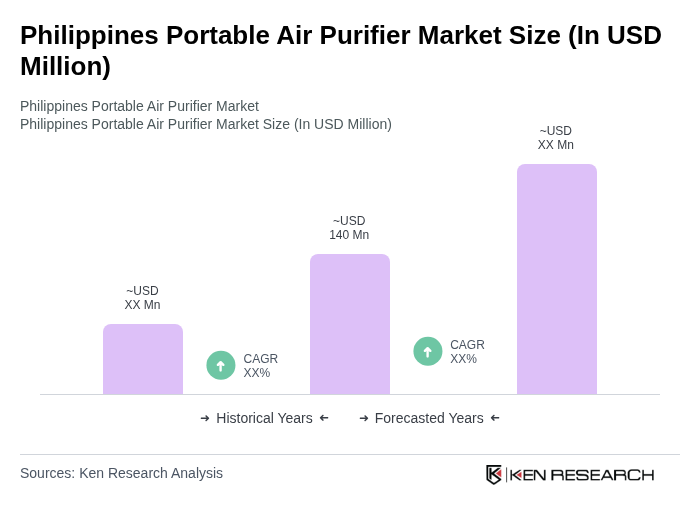
- The Philippines Portable Air Purifier Market is valued at USD 140 million, based on a five-year historical analysis. This growth is primarily driven by increasing awareness of air quality issues, particularly in urban areas, and the rising prevalence of respiratory diseases. The demand for portable air purifiers has surged as consumers seek solutions to combat air pollution and allergens in their living environments. Recent drivers include heightened concern about airborne pathogens, urban congestion, and the adoption of smart and energy-efficient air purification technologies .
- Metro Manila, Cebu, and Davao are the dominant cities in the Philippines Portable Air Purifier Market. Metro Manila, being the capital and a highly urbanized area, faces significant air quality challenges, leading to a higher demand for air purification solutions. Cebu and Davao also experience similar urbanization trends, contributing to the growing market for portable air purifiers in these regions. Urbanization, increased disposable income, and frequent haze events further support demand in these metropolitan centers .
- The Clean Air Act of 1999 (Republic Act No. 8749), issued by the Department of Environment and Natural Resources, is the primary binding regulation governing air quality standards in the Philippines. This legislation mandates strict ambient air quality standards, regular monitoring, and the implementation of emission reduction strategies in both residential and commercial settings. The Act has driven increased adoption of air purification technologies as part of compliance and public health initiatives .
Philippines Portable Air Purifier Market Segmentation
By Type:The market is segmented into various types of air purifiers, including HEPA filters, activated carbon filters, UV light purifiers, ionizers, ozone generators, hybrid purifiers, and others. Among these, HEPA filters are the most popular due to their efficiency in capturing airborne particles, making them a preferred choice for consumers concerned about allergens and pollutants. Activated carbon filters also hold a significant share, particularly for their ability to remove odors and volatile organic compounds (VOCs). The increasing consumer preference for healthier indoor air quality drives the demand for these types of purifiers. Hybrid models that combine HEPA and activated carbon technologies are gaining traction due to their enhanced performance and energy efficiency .

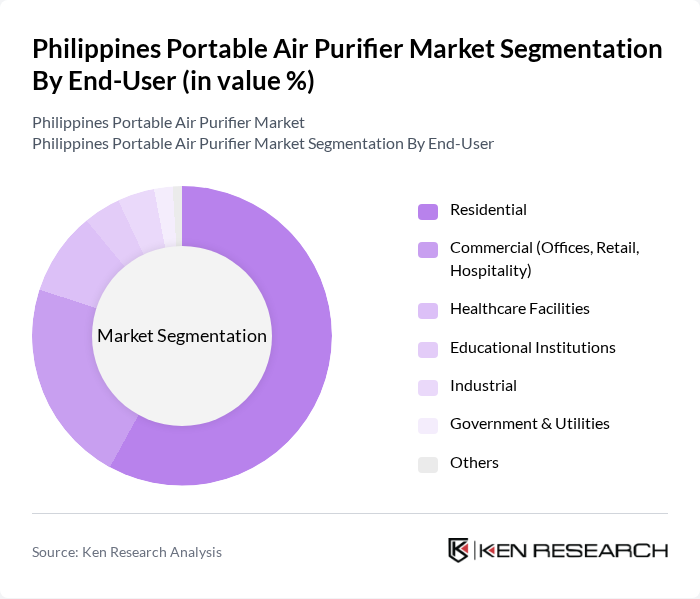
By End-User:The end-user segmentation includes residential, commercial (offices, retail, hospitality), healthcare facilities, educational institutions, industrial, government & utilities, and others. The residential segment dominates the market, driven by increasing consumer awareness of indoor air quality and health concerns. Commercial establishments are also significant users, as businesses seek to provide healthier environments for employees and customers. The healthcare sector's stringent air quality requirements further bolster the demand for air purifiers in hospitals and clinics. Demand from educational institutions and government facilities is rising as public sector investments in air quality infrastructure increase .
Philippines Portable Air Purifier Market Competitive Landscape
The Philippines Portable Air Purifier Market is characterized by a dynamic mix of regional and international players. Leading participants such as Xiaomi Corporation, Philips Electronics, Dyson Ltd., Sharp Corporation, Honeywell International Inc., LG Electronics, Coway Co., Ltd., Blueair AB, Levoit, Winix Inc., Daikin Industries, Ltd., Panasonic Corporation, Airfree Produtos Eletrônicos S.A., Guardian Technologies LLC (GermGuardian), Tenda Technology Inc., Samsung Electronics Co., Ltd., Carrier Philippines (Carrier Global Corporation), Asahi Home Appliances (Philippines), Imarflex Philippines Inc., Eureka Electric Appliances Philippines Corp. contribute to innovation, geographic expansion, and service delivery in this space.
Philippines Portable Air Purifier Market Industry Analysis
Growth Drivers
- Increasing Air Pollution Levels:The Philippines faces significant air quality challenges, with the World Bank reporting that urban areas like Metro Manila experience PM2.5 levels exceeding25 µg/m³, well above the WHO guideline of 10 µg/m³. This alarming pollution level drives consumer demand for portable air purifiers, as individuals seek solutions to mitigate health risks associated with poor air quality. The urgency for cleaner air is further emphasized by the Philippine government's commitment to improving air quality standards, fostering a favorable market environment for air purification technologies.
- Rising Health Awareness Among Consumers:A growing awareness of health issues related to air quality is evident in the Philippines, with a recent survey indicating that68%of urban residents are concerned about respiratory diseases linked to air pollution. This heightened awareness is prompting consumers to invest in portable air purifiers, which are perceived as essential for maintaining indoor air quality. The increasing prevalence of respiratory conditions, such as asthma and allergies, further fuels the demand for effective air purification solutions, creating a robust market opportunity.
- Technological Advancements in Air Purification:The air purification sector is witnessing rapid technological innovations, with advancements in filtration systems and smart technologies. For instance, the introduction of HEPA filters and UV-C light technology has significantly improved air purification efficiency. In future, the market is expected to see a25%increase in the adoption of smart air purifiers equipped with IoT capabilities, allowing users to monitor air quality in real-time. These innovations not only enhance product effectiveness but also attract tech-savvy consumers, driving market growth.
Market Challenges
- High Initial Investment Costs:The cost of high-quality portable air purifiers can be a barrier for many consumers in the Philippines. Premium models often range fromPHP 15,000 to PHP 30,000, which may be prohibitive for average households. This high initial investment can deter potential buyers, especially in a market where disposable income levels are still recovering post-pandemic. As a result, manufacturers must find ways to offer more affordable options without compromising on quality to expand their customer base.
- Limited Consumer Awareness:Despite the growing health concerns, a significant portion of the population remains unaware of the benefits of portable air purifiers. A recent study revealed that only40%of urban residents could identify the advantages of using air purifiers. This lack of awareness hampers market growth, as many consumers do not recognize the importance of investing in air quality solutions. Effective marketing strategies and educational campaigns are essential to bridge this knowledge gap and stimulate demand in the market.
Philippines Portable Air Purifier Market Future Outlook
The future of the portable air purifier market in the Philippines appears promising, driven by increasing urbanization and a growing middle class. As more consumers prioritize health and wellness, the demand for air purification solutions is expected to rise. Additionally, the integration of smart technologies and energy-efficient designs will likely enhance product appeal. Companies that focus on educating consumers about air quality benefits and offer affordable, innovative solutions will be well-positioned to capture market share in the coming years.
Market Opportunities
- Expansion of E-commerce Platforms:The rise of e-commerce in the Philippines presents a significant opportunity for portable air purifier manufacturers. With online sales projected to grow by20%in future, brands can reach a broader audience, particularly in remote areas. This shift allows consumers to access a variety of products and price points, enhancing market penetration and driving sales growth.
- Government Initiatives for Clean Air:The Philippine government is increasingly focused on improving air quality through various initiatives, including the Clean Air Act. In future, government funding for air quality improvement projects is expected to exceedPHP 1 billion. This financial support can lead to increased public awareness and demand for air purifiers, creating a favorable environment for manufacturers to thrive and innovate.
Scope of the Report
| Segment | Sub-Segments |
|---|---|
| By Type | HEPA Filters Activated Carbon Filters UV Light Purifiers Ionizers Ozone Generators Hybrid Purifiers Others |
| By End-User | Residential Commercial (Offices, Retail, Hospitality) Healthcare Facilities Educational Institutions Industrial Government & Utilities Others |
| By Application | Room Air Purification Vehicle/Transport Use Personal/Wearable Use Specialized Use (e.g. Laboratories) Others |
| By Filter Technology | Mechanical Filters (HEPA, Pre-filters) Chemical Filters (Activated Carbon, Zeolite) Photocatalytic Filters Electrostatic Filters Hybrid Filters Others |
| By Distribution Channel | Online Retail (E-commerce) Offline Retail (Supermarkets, Specialty Stores) Direct Sales Distributors/Dealers Others |
| By Price Range | Budget Mid-Range Premium Others |
| By Brand Preference | Local Brands International Brands Others |
Key Target Audience
Investors and Venture Capitalist Firms
Government and Regulatory Bodies (e.g., Department of Health, Department of Environment and Natural Resources)
Manufacturers and Producers
Distributors and Retailers
Importers and Exporters
Industry Associations (e.g., Philippine Chamber of Commerce and Industry)
Health and Wellness Organizations
Environmental NGOs
Players Mentioned in the Report:
Xiaomi Corporation
Philips Electronics
Dyson Ltd.
Sharp Corporation
Honeywell International Inc.
LG Electronics
Coway Co., Ltd.
Blueair AB
Levoit
Winix Inc.
Daikin Industries, Ltd.
Panasonic Corporation
Airfree Produtos Eletronicos S.A.
Guardian Technologies LLC (GermGuardian)
Tenda Technology Inc.
Samsung Electronics Co., Ltd.
Carrier Philippines (Carrier Global Corporation)
Asahi Home Appliances (Philippines)
Imarflex Philippines Inc.
Eureka Electric Appliances Philippines Corp.
Table of Contents
Market Assessment Phase
1. Executive Summary and Approach
2. Philippines Portable Air Purifier Market Overview
2.1 Key Insights and Strategic Recommendations
2.2 Philippines Portable Air Purifier Market Overview
2.3 Definition and Scope
2.4 Evolution of Market Ecosystem
2.5 Timeline of Key Regulatory Milestones
2.6 Value Chain & Stakeholder Mapping
2.7 Business Cycle Analysis
2.8 Policy & Incentive Landscape
3. Philippines Portable Air Purifier Market Analysis
3.1 Growth Drivers
3.1.1 Increasing Air Pollution Levels
3.1.2 Rising Health Awareness Among Consumers
3.1.3 Growth in Urbanization and Population Density
3.1.4 Technological Advancements in Air Purification
3.2 Market Challenges
3.2.1 High Initial Investment Costs
3.2.2 Limited Consumer Awareness
3.2.3 Competition from Low-Cost Alternatives
3.2.4 Regulatory Compliance Issues
3.3 Market Opportunities
3.3.1 Expansion of E-commerce Platforms
3.3.2 Increasing Demand in Commercial Spaces
3.3.3 Government Initiatives for Clean Air
3.3.4 Development of Smart Air Purifiers
3.4 Market Trends
3.4.1 Growing Popularity of Portable Devices
3.4.2 Integration of IoT in Air Purifiers
3.4.3 Focus on Energy Efficiency
3.4.4 Customization and Personalization of Products
3.5 Government Regulation
3.5.1 Air Quality Standards Enforcement
3.5.2 Import Tariffs on Air Purifiers
3.5.3 Certification Requirements for Products
3.5.4 Incentives for Eco-Friendly Products
4. SWOT Analysis
5. Stakeholder Analysis
6. Porter's Five Forces Analysis
7. Philippines Portable Air Purifier Market Market Size, 2019-2024
7.1 By Value
7.2 By Volume
7.3 By Average Selling Price
8. Philippines Portable Air Purifier Market Segmentation
8.1 By Type
8.1.1 HEPA Filters
8.1.2 Activated Carbon Filters
8.1.3 UV Light Purifiers
8.1.4 Ionizers
8.1.5 Ozone Generators
8.1.6 Hybrid Purifiers
8.1.7 Others
8.2 By End-User
8.2.1 Residential
8.2.2 Commercial (Offices, Retail, Hospitality)
8.2.3 Healthcare Facilities
8.2.4 Educational Institutions
8.2.5 Industrial
8.2.6 Government & Utilities
8.2.7 Others
8.3 By Application
8.3.1 Room Air Purification
8.3.2 Vehicle/Transport Use
8.3.3 Personal/Wearable Use
8.3.4 Specialized Use (e.g. Laboratories)
8.3.5 Others
8.4 By Filter Technology
8.4.1 Mechanical Filters (HEPA, Pre-filters)
8.4.2 Chemical Filters (Activated Carbon, Zeolite)
8.4.3 Photocatalytic Filters
8.4.4 Electrostatic Filters
8.4.5 Hybrid Filters
8.4.6 Others
8.5 By Distribution Channel
8.5.1 Online Retail (E-commerce)
8.5.2 Offline Retail (Supermarkets, Specialty Stores)
8.5.3 Direct Sales
8.5.4 Distributors/Dealers
8.5.5 Others
8.6 By Price Range
8.6.1 Budget
8.6.2 Mid-Range
8.6.3 Premium
8.6.4 Others
8.7 By Brand Preference
8.7.1 Local Brands
8.7.2 International Brands
8.7.3 Others
9. Philippines Portable Air Purifier Market Competitive Analysis
9.1 Market Share of Key Players
9.2 KPIs for Cross Comparison of Key Players
9.2.1 Company Name
9.2.2 Group Size (Large, Medium, or Small as per industry convention)
9.2.3 Revenue Growth Rate (YoY %)
9.2.4 Market Share (%)
9.2.5 Sales Volume (Units)
9.2.6 Average Selling Price (PHP)
9.2.7 Distribution Channel Coverage (Online/Offline Presence)
9.2.8 Product Portfolio Breadth (Number of Models/Variants)
9.2.9 Brand Recognition Index (Survey/Market Data)
9.2.10 Customer Satisfaction Score (NPS or Equivalent)
9.2.11 After-Sales Service Coverage
9.2.12 Innovation Index (Patents, New Features Introduced)
9.3 SWOT Analysis of Top Players
9.4 Pricing Analysis
9.5 List of Major Companies
9.5.1 Xiaomi Corporation
9.5.2 Philips Electronics
9.5.3 Dyson Ltd.
9.5.4 Sharp Corporation
9.5.5 Honeywell International Inc.
9.5.6 LG Electronics
9.5.7 Coway Co., Ltd.
9.5.8 Blueair AB
9.5.9 Levoit
9.5.10 Winix Inc.
9.5.11 Daikin Industries, Ltd.
9.5.12 Panasonic Corporation
9.5.13 Airfree Produtos Eletrônicos S.A.
9.5.14 Guardian Technologies LLC (GermGuardian)
9.5.15 Tenda Technology Inc.
9.5.16 Samsung Electronics Co., Ltd.
9.5.17 Carrier Philippines (Carrier Global Corporation)
9.5.18 Asahi Home Appliances (Philippines)
9.5.19 Imarflex Philippines Inc.
9.5.20 Eureka Electric Appliances Philippines Corp.
10. Philippines Portable Air Purifier Market End-User Analysis
10.1 Procurement Behavior of Key Ministries
10.1.1 Government Procurement Policies
10.1.2 Budget Allocations for Air Quality Improvement
10.1.3 Supplier Selection Criteria
10.1.4 Contract Management Practices
10.2 Corporate Spend on Infrastructure & Energy
10.2.1 Investment Trends in Air Quality Solutions
10.2.2 Budgeting for Sustainability Initiatives
10.2.3 Corporate Social Responsibility Spending
10.2.4 Energy Efficiency Investments
10.3 Pain Point Analysis by End-User Category
10.3.1 Residential Concerns
10.3.2 Commercial Space Challenges
10.3.3 Industrial Air Quality Issues
10.3.4 Government Facility Requirements
10.4 User Readiness for Adoption
10.4.1 Awareness Levels Among Consumers
10.4.2 Willingness to Invest in Air Purification
10.4.3 Adoption Barriers
10.4.4 Education and Training Needs
10.5 Post-Deployment ROI and Use Case Expansion
10.5.1 Measurement of Effectiveness
10.5.2 Long-term Cost Savings
10.5.3 Expansion into New Applications
10.5.4 User Feedback and Improvement
11. Philippines Portable Air Purifier Market Future Size, 2025-2030
11.1 By Value
11.2 By Volume
11.3 By Average Selling Price
Go-To-Market Strategy Phase
1. Whitespace Analysis + Business Model Canvas
1.1 Market Gaps Identification
1.2 Business Model Framework
2. Marketing and Positioning Recommendations
2.1 Branding Strategies
2.2 Product USPs
3. Distribution Plan
3.1 Urban Retail vs Rural NGO Tie-ups
4. Channel & Pricing Gaps
4.1 Underserved Routes
4.2 Pricing Bands
5. Unmet Demand & Latent Needs
5.1 Category Gaps
5.2 Consumer Segments
6. Customer Relationship
6.1 Loyalty Programs
6.2 After-sales Service
7. Value Proposition
7.1 Sustainability
7.2 Integrated Supply Chains
8. Key Activities
8.1 Regulatory Compliance
8.2 Branding
8.3 Distribution Setup
9. Entry Strategy Evaluation
9.1 Domestic Market Entry Strategy
9.1.1 Product Mix
9.1.2 Pricing Band
9.1.3 Packaging
9.2 Export Entry Strategy
9.2.1 Target Countries
9.2.2 Compliance Roadmap
10. Entry Mode Assessment
10.1 JV
10.2 Greenfield
10.3 M&A
10.4 Distributor Model
11. Capital and Timeline Estimation
11.1 Capital Requirements
11.2 Timelines
12. Control vs Risk Trade-Off
12.1 Ownership vs Partnerships
13. Profitability Outlook
13.1 Breakeven Analysis
13.2 Long-term Sustainability
14. Potential Partner List
14.1 Distributors
14.2 JVs
14.3 Acquisition Targets
15. Execution Roadmap
15.1 Phased Plan for Market Entry
15.1.1 Market Setup
15.1.2 Market Entry
15.1.3 Growth Acceleration
15.1.4 Scale & Stabilize
15.2 Key Activities and Milestones
15.2.1 Activity Timeline
15.2.2 Milestone Tracking
Research Methodology
Phase 1: Approach1
Desk Research
- Analysis of market reports from industry associations and government publications
- Review of academic journals and white papers on air quality and health impacts
- Examination of online databases for sales data and consumer trends in air purification
Primary Research
- Interviews with manufacturers and distributors of portable air purifiers in the Philippines
- Surveys targeting end-users, including households and businesses, to gauge purchasing behavior
- Focus group discussions with health professionals regarding air quality concerns and product efficacy
Validation & Triangulation
- Cross-validation of findings with multiple data sources, including sales figures and consumer feedback
- Triangulation of qualitative insights from interviews with quantitative data from surveys
- Sanity checks through expert reviews from environmental scientists and market analysts
Phase 2: Market Size Estimation1
Top-down Assessment
- Estimation of total addressable market based on national air quality statistics and health reports
- Segmentation of market size by residential, commercial, and industrial usage
- Incorporation of government initiatives promoting air quality improvement and public health
Bottom-up Modeling
- Collection of sales data from key retailers and e-commerce platforms for portable air purifiers
- Estimation of average selling prices and unit sales across different product categories
- Analysis of consumer purchasing patterns and frequency of replacement purchases
Forecasting & Scenario Analysis
- Development of market forecasts using historical growth rates and emerging trends in health awareness
- Scenario modeling based on potential regulatory changes and economic conditions
- Creation of best-case, worst-case, and most-likely scenarios through 2030
Phase 3: CATI Sample Composition1
| Scope Item/Segment | Sample Size | Target Respondent Profiles |
|---|---|---|
| Residential Air Purifier Users | 100 | Homeowners, Renters |
| Commercial Establishments | 80 | Office Managers, Facility Managers |
| Healthcare Facilities | 60 | Hospital Administrators, Clinic Managers |
| Retail Sector Insights | 50 | Store Managers, Sales Managers |
| Environmental Health Experts | 40 | Public Health Officials, Environmental Scientists |
Frequently Asked Questions
What is the current value of the Philippines Portable Air Purifier Market?
The Philippines Portable Air Purifier Market is valued at approximately USD 140 million, reflecting a significant increase driven by rising awareness of air quality issues and health concerns related to air pollution and allergens in urban areas.
What factors are driving the growth of the portable air purifier market in the Philippines?
Which cities in the Philippines have the highest demand for portable air purifiers?
What types of air purifiers are most popular in the Philippines?
Other Regional/Country Reports
Indonesia Portable Air Purifier Market
Malaysia Portable Air Purifier Market
KSA Portable Air Purifier Market
APAC Portable Air Purifier Market
SEA Portable Air Purifier Market
Vietnam Portable Air Purifier Market
Other Adjacent Reports
South Korea Air Filter Market
Belgium Indoor Air Quality Monitoring Market
US hvac systems market Size, Share, Growth Drivers, Trends, Opportunities & Forecast 2025–2030Oman Smart Home Devices Market
Germany Respiratory Protection Equipment Market
Singapore Environmental Sensors Market
Italy Home Appliances MarketMexico Pollution Control Devices Market
Japan HEPA Technology Market
Philippines UV Disinfection Systems Market
Why Buy From Us?

What makes us stand out is that our consultants follow Robust, Refine and Result (RRR) methodology. Robust for clear definitions, approaches and sanity checking, Refine for differentiating respondents' facts and opinions, and Result for presenting data with story.

We have set a benchmark in the industry by offering our clients with syndicated and customized market research reports featuring coverage of entire market as well as meticulous research and analyst insights.

While we don't replace traditional research, we flip the method upside down. Our dual approach of Top Bottom & Bottom Top ensures quality deliverable by not just verifying company fundamentals but also looking at the sector and macroeconomic factors.

With one step in the future, our research team constantly tries to show you the bigger picture. We help with some of the tough questions you may encounter along the way: How is the industry positioned? Best marketing channel? KPI's of competitors? By aligning every element, we help maximize success.

Our report gives you instant access to the answers and sources that other companies might choose to hide. We elaborate each steps of research methodology we have used and showcase you the sample size to earn your trust.

If you need any support, we are here! We pride ourselves on universe strength, data quality, and quick, friendly, and professional service.