Region:Asia
Author(s):Shubham
Product Code:KRAA8713
Pages:97
Published On:November 2025
By Type:
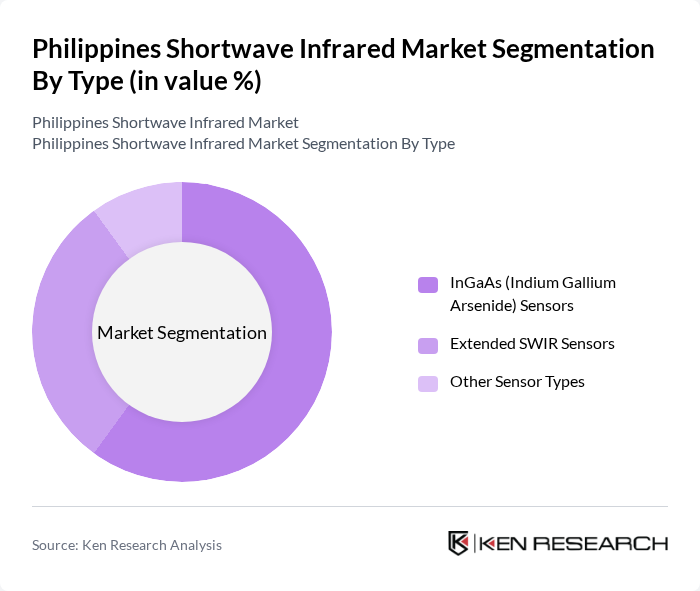
The market is segmented into three main types: InGaAs (Indium Gallium Arsenide) Sensors, Extended SWIR Sensors, and Other Sensor Types. Among these, InGaAs sensors dominate the market due to their superior sensitivity and performance in low-light conditions, making them ideal for applications in defense, security, and industrial inspection. The growing need for high-resolution imaging in manufacturing, food processing, and scientific research has led to increased adoption of these sensors, driving their market share significantly .
By End-User Industry:
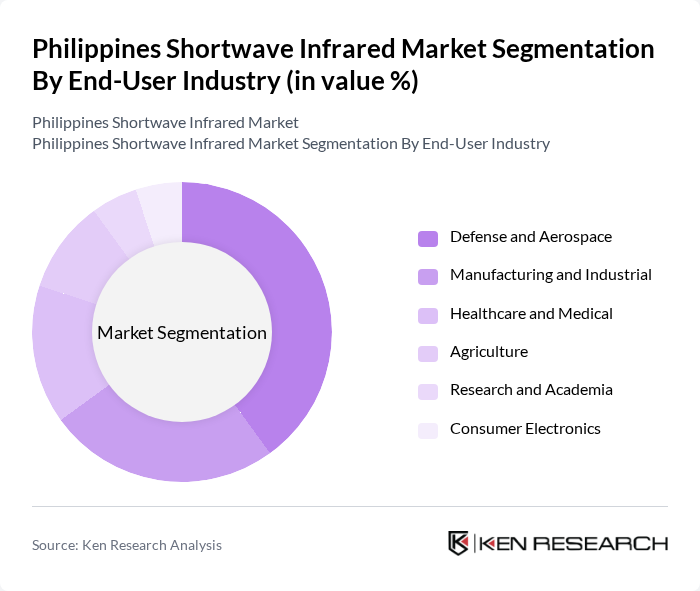
The end-user industries for shortwave infrared technology include Defense and Aerospace, Manufacturing and Industrial, Healthcare and Medical, Agriculture, Research and Academia, and Consumer Electronics. The Defense and Aerospace sector is the leading segment, driven by the increasing need for advanced surveillance and reconnaissance capabilities. The growing focus on national security, defense modernization, and border security has significantly boosted the demand for SWIR technologies in this sector. Manufacturing and Industrial applications are also expanding rapidly, leveraging SWIR for quality inspection, process monitoring, and automation .
The Philippines Shortwave Infrared Market is characterized by a dynamic mix of regional and international players. Leading participants such as Hamamatsu Photonics K.K., Teledyne FLIR LLC, Xenics NV, Allied Vision Technologies GmbH, Sensors Unlimited (a division of Collins Aerospace), New Imaging Technologies (NIT), Raptor Photonics Ltd., SWIR Vision Systems Inc., Photonic Science Ltd., Infrared Cameras Inc., Princeton Infrared Technologies, Inc., IRCameras LLC, FluxData, Inc., Photon etc., Opto Engineering S.p.A. contribute to innovation, geographic expansion, and service delivery in this space.
The future of the Philippines shortwave infrared market appears promising, driven by increasing investments in renewable energy and technological advancements. As the government continues to implement supportive policies, the market is expected to expand significantly. The integration of smart energy solutions and hybrid systems will likely enhance the appeal of infrared technologies. Furthermore, the growing emphasis on sustainability and carbon neutrality will create additional demand, positioning the market for substantial growth in the coming years.
| Segment | Sub-Segments |
|---|---|
| By Type | InGaAs (Indium Gallium Arsenide) Sensors Extended SWIR Sensors Other Sensor Types |
| By End-User Industry | Defense and Aerospace Manufacturing and Industrial Healthcare and Medical Agriculture Research and Academia Consumer Electronics |
| By Application | Surveillance and Security Industrial Inspection Biomedical and Life Sciences Agriculture and Food Processing Military and Defense Telecommunications Environmental Monitoring Automotive |
| By Technology | Photodetectors Imaging Sensors Filters and Optics SWIR Cameras Others |
| By Imaging Type | Spectral Imaging Thermal Imaging Hyperspectral Imaging |
| By Region | Luzon Visayas Mindanao |
| Scope Item/Segment | Sample Size | Target Respondent Profiles |
|---|---|---|
| Agricultural Applications | 100 | Agronomists, Farm Managers |
| Healthcare Diagnostics | 80 | Medical Technologists, Laboratory Managers |
| Industrial Quality Control | 70 | Quality Assurance Managers, Production Supervisors |
| Research and Development | 50 | R&D Scientists, Product Development Engineers |
| Environmental Monitoring | 40 | Environmental Scientists, Compliance Officers |
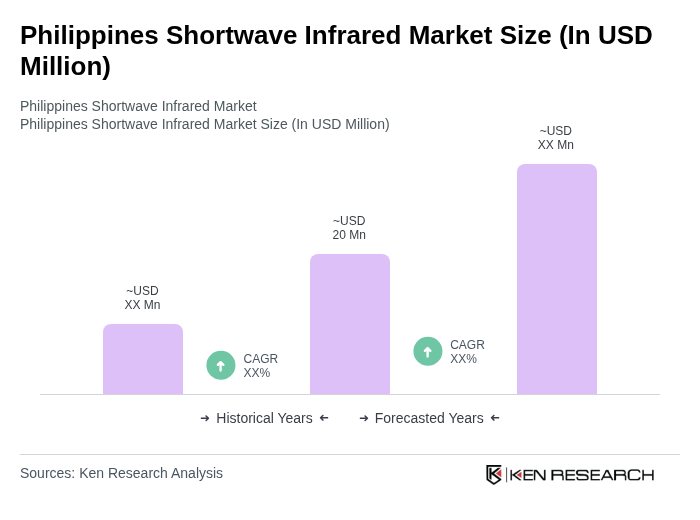
The Philippines Shortwave Infrared Market is valued at approximately USD 20 million, driven by advancements in sensor technology and increasing demand across various sectors, including healthcare, agriculture, and manufacturing.

What makes us stand out is that our consultants follow Robust, Refine and Result (RRR) methodology. Robust for clear definitions, approaches and sanity checking, Refine for differentiating respondents' facts and opinions, and Result for presenting data with story.

We have set a benchmark in the industry by offering our clients with syndicated and customized market research reports featuring coverage of entire market as well as meticulous research and analyst insights.

While we don't replace traditional research, we flip the method upside down. Our dual approach of Top Bottom & Bottom Top ensures quality deliverable by not just verifying company fundamentals but also looking at the sector and macroeconomic factors.

With one step in the future, our research team constantly tries to show you the bigger picture. We help with some of the tough questions you may encounter along the way: How is the industry positioned? Best marketing channel? KPI's of competitors? By aligning every element, we help maximize success.

Our report gives you instant access to the answers and sources that other companies might choose to hide. We elaborate each steps of research methodology we have used and showcase you the sample size to earn your trust.

If you need any support, we are here! We pride ourselves on universe strength, data quality, and quick, friendly, and professional service.













