About the Report
Base Year 2024Philippines Watermelon Seeds Market Overview
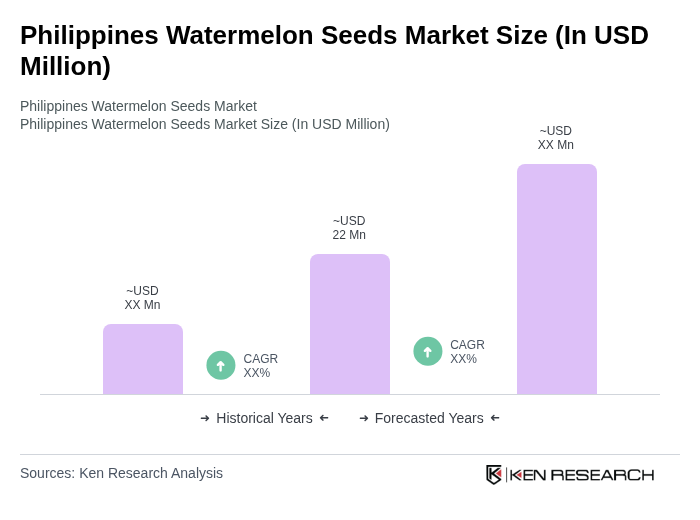
- The Philippines Watermelon Seeds Market is valued at approximately USD 22 million, based on a five-year historical analysis and its share within the broader Asia–Pacific and global watermelon seeds market. This growth is primarily driven by increasing consumer demand for high-value vegetable seeds, supported by rising disposable incomes and shifts in urban dietary preferences. The expansion of protected cultivation systems and government initiatives promoting certified seed programs, such as subsidies and support under the High Value Crops Development Program and the National Seed Industry Council (NSIC) certification framework, further bolster market growth.
- Key regions dominating the market include Luzon, Visayas, and Mindanao. Luzon leads due to its relatively stronger irrigation infrastructure and concentration of research and seed industry institutions, including breeding and trial sites supported by the Bureau of Plant Industry (BPI) and private seed companies. Meanwhile, Visayas and Mindanao are experiencing growth through the adoption of improved seed varieties, protected cultivation techniques in pockets (such as greenhouse and net-house vegetable production), and a diversified crop portfolio that caters to both local and export-oriented value chains.
- In 2024, the Philippine government, through the Bureau of Plant Industry of the Department of Agriculture, moved to further align domestic seed movement and phytosanitary measures with international standards by implementing updated guidelines consistent with the Plant Quarantine Law and its implementing rules and regulations, and the Philippine Plant Quarantine Regulations issued under Presidential Decree No. 1433 and related administrative circulars. This initiative supports safer seed trade, improved pest risk management, and ecosystem protection while underpinning local agricultural development and compliance with International Plant Protection Convention (IPPC) standards.
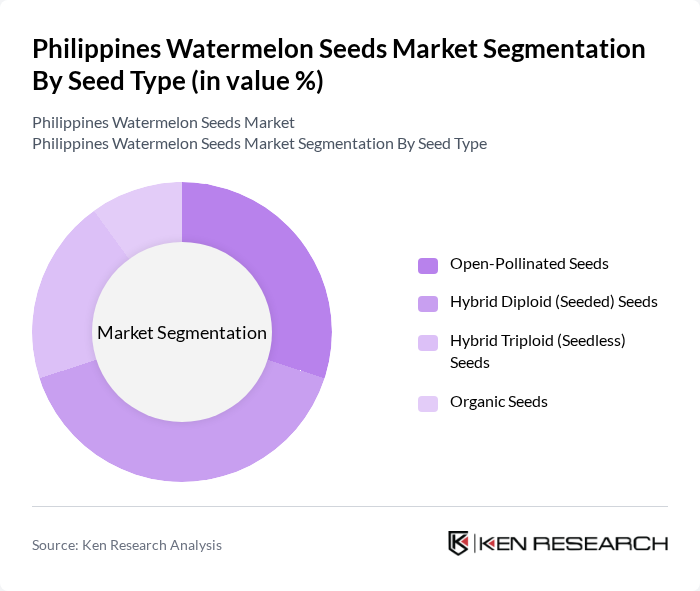
Philippines Watermelon Seeds Market Segmentation
By Seed Type:The watermelon seeds market is segmented into various types, including Open-Pollinated Seeds, Hybrid Diploid (Seeded) Seeds, Hybrid Triploid (Seedless) Seeds, and Organic Seeds. This structure aligns with global watermelon seed classifications that distinguish between open-pollinated, hybrid diploid (seeded), and triploid (seedless) segments. Among these, Hybrid Diploid Seeds are gaining traction due to their higher yield potential, improved fruit uniformity, and disease resistance, making them a preferred choice for commercial farmers and integrated supply chains. Open-Pollinated Seeds remain significant, particularly among smallholder and resource-constrained farmers who value their lower seed cost, ability to save seed, and familiarity with traditional production practices.
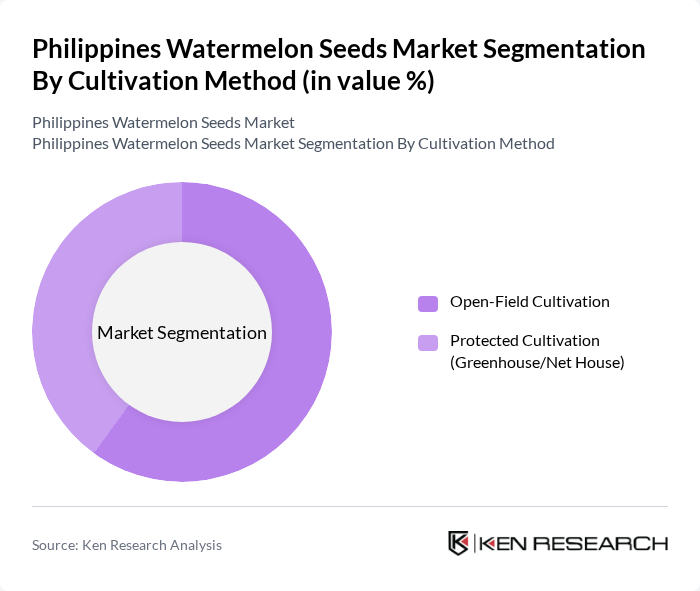
By Cultivation Method:The market is also segmented based on cultivation methods, which include Open-Field Cultivation and Protected Cultivation (Greenhouse/Net House). This reflects the broader regional pattern in Asia–Pacific, where open-field systems still dominate melon and watermelon production, while protected cultivation is growing from a smaller base. Protected cultivation is becoming increasingly popular in high-value vegetable clusters because it provides a more controlled environment, supports better pest and disease management, allows more consistent quality, and extends growing seasons, which in turn supports the uptake of high-performance hybrid seeds. Open-field cultivation remains prevalent, especially among traditional farmers relying on rainfed and conventional systems, where input costs must be kept low and simple production practices are preferred.
Philippines Watermelon Seeds Market Competitive Landscape
The Philippines Watermelon Seeds Market is characterized by a dynamic mix of regional and international players. Leading participants such as East-West Seed Philippines, Syngenta Philippines, Inc., Bayer Crop Science (Seminis Philippines), Corteva Agriscience (Pioneer Hi-Bred Philippines), SeedWorks Philippines, Inc., Allied Botanical Corporation, Kaneko Seeds Philippines, Known-You Seed Philippines, Ramgo International Corporation, Philippine Seed Industry Association (PSIA), Condor Seed / Sakata Seed Philippines, Agri Gold / Bioseed Research Philippines, CropLife Philippines, Provincial and Local Agri-Input Distributors, Emerging Local Seed Startups contribute to innovation, geographic expansion, and service delivery in this space.
Philippines Watermelon Seeds Market Industry Analysis
Growth Drivers
- Elevated National GDP (Nominal):The Philippines' GDP reached USD 487.5 billion, reflecting a robust economic environment. This growth supports increased disposable incomes, which in turn enhances consumer spending on fresh produce, including watermelon. As agricultural demand rises, the market for watermelon seeds is positively impacted, encouraging local farmers to invest in quality seeds to meet consumer preferences for fresh and healthy options.
- Average Monthly Gross Salary:In future, the average gross salary in the Philippines was USD 392 per month (?22,000). This increase in household income boosts purchasing power, allowing consumers to spend more on higher-value agricultural products like watermelon. As demand for fresh produce escalates, farmers are incentivized to procure quality watermelon seeds, thereby stimulating growth in the seed market and enhancing overall agricultural productivity.
- Government Seed Distribution Initiatives:The Bureau of Plant Industry (BPI) distributed 30,000 kg of vegetable seeds, which includes watermelon seeds. This initiative enhances farmers' access to quality seeds, promoting better crop yields. Although specific watermelon seed data is limited, the overall distribution indicates a supportive environment for local agriculture, encouraging farmers to adopt improved seed varieties and practices, ultimately benefiting the watermelon seed market.
Market Challenges
- Frequent Climate Disasters:In future, Bani town experienced a production decline of 120 metric tons, dropping from 2,500 metric tons to 2,380 metric tons due to climate-related disasters. Such events directly threaten crop yields and disrupt the supply chain, leading to reduced demand for watermelon seeds. The increasing frequency of climate disasters poses a significant challenge to maintaining stable production levels and meeting market demand.
- Logistics and Cold-Chain Limitations (Seed Sector):The seed sector faces significant challenges due to inadequate cold-chain logistics, which are crucial for preserving seed quality. Limited infrastructure hampers the distribution of high-quality watermelon seeds, affecting farmers' ability to access the best inputs for their crops. This logistical barrier can lead to increased costs and reduced competitiveness in the market, ultimately impacting overall seed sales.
Philippines Watermelon Seeds Market Future Outlook
The future of the Philippines watermelon seeds market appears promising, driven by innovations in agricultural practices and increasing consumer demand for fresh produce. The trialing of 30 climate-smart watermelon varieties indicates a shift towards resilience in farming. Additionally, the preservation of genetic diversity through extensive seed repositories will support the development of stress-tolerant varieties, ensuring that farmers can adapt to changing environmental conditions while maintaining productivity and quality.
Market Opportunities
- Export-Oriented and Protected Cultivation Segments:The vegetable seed sector is projected to grow at a CAGR of 6.07%, with protected cultivation expanding at double-digit rates. Targeting export markets, particularly in tourism hubs, presents significant growth potential for watermelon seeds, as they are considered high-value crops that can meet international quality standards.
- Government-Enhanced Storage Infrastructure:A new seed storage facility constructed in Calabarzon by the Department of Agriculture will improve seed preservation and distribution. This infrastructure investment is expected to enhance the availability of quality watermelon seeds, supporting farmers in maintaining consistent production levels and meeting market demands effectively.
Scope of the Report
| Segment | Sub-Segments |
|---|---|
| By Seed Type | Open-Pollinated Seeds Hybrid Diploid (Seeded) Seeds Hybrid Triploid (Seedless) Seeds Organic Seeds |
| By Cultivation Method | Open-Field Cultivation Protected Cultivation (Greenhouse/Net House) |
| By Farm Size / Application | Smallholder Farms (<2 hectares) Medium and Large Commercial Farms Contract Farming and Corporate Farms |
| By Fruit Size Class | Mini (<3 kg) Standard (3–9 kg) Large (>9 kg) |
| By Treatment | Untreated Seeds Treated / Film-Coated / Pelleted Seeds |
| By Distribution Channel | Agri-Input Retailers and Co-ops Company / Dealer Direct Sales Online and E-commerce Platforms |
| By Region | Luzon Visayas Mindanao |
Key Target Audience
Investors and Venture Capitalist Firms
Government and Regulatory Bodies (e.g., Department of Agriculture, Bureau of Plant Industry)
Seed Manufacturers and Producers
Distributors and Retailers
Exporters and Importers
Agricultural Cooperatives
Food Processing Companies
Agri-tech Startups
Players Mentioned in the Report:
East-West Seed Philippines
Syngenta Philippines, Inc.
Bayer Crop Science (Seminis Philippines)
Corteva Agriscience (Pioneer Hi-Bred Philippines)
SeedWorks Philippines, Inc.
Allied Botanical Corporation
Kaneko Seeds Philippines
Known-You Seed Philippines
Ramgo International Corporation
Philippine Seed Industry Association (PSIA)
Condor Seed / Sakata Seed Philippines
Agri Gold / Bioseed Research Philippines
CropLife Philippines
Provincial and Local Agri-Input Distributors
Emerging Local Seed Startups
Table of Contents
Market Assessment Phase
1. Executive Summary and Approach
2. Philippines Watermelon Seeds Market Overview
2.1 Key Insights and Strategic Recommendations
2.2 Philippines Watermelon Seeds Market Overview
2.3 Definition and Scope
2.4 Evolution of Market Ecosystem
2.5 Timeline of Key Regulatory Milestones
2.6 Value Chain & Stakeholder Mapping
2.7 Business Cycle Analysis
2.8 Policy & Incentive Landscape
3. Philippines Watermelon Seeds Market Analysis
3.1 Growth Drivers
3.1.1 Increasing consumer demand for fresh produce
3.1.2 Rising health consciousness among consumers
3.1.3 Expansion of agricultural technology
3.1.4 Government support for local agriculture
3.2 Market Challenges
3.2.1 Climate change impacts on crop yield
3.2.2 Competition from imported seeds
3.2.3 Limited access to advanced farming techniques
3.2.4 Fluctuating market prices
3.3 Market Opportunities
3.3.1 Export potential to neighboring countries
3.3.2 Development of organic watermelon seeds
3.3.3 Collaboration with agricultural research institutions
3.3.4 Increasing online sales channels
3.4 Market Trends
3.4.1 Growing popularity of hybrid watermelon varieties
3.4.2 Shift towards sustainable farming practices
3.4.3 Rise in direct-to-consumer sales models
3.4.4 Increased focus on seed quality and certification
3.5 Government Regulation
3.5.1 Seed certification requirements
3.5.2 Import regulations for foreign seeds
3.5.3 Subsidies for local farmers
3.5.4 Environmental regulations affecting farming practices
4. SWOT Analysis
5. Stakeholder Analysis
6. Porter's Five Forces Analysis
7. Philippines Watermelon Seeds Market Market Size, 2019-2024
7.1 By Value
7.2 By Volume
7.3 By Average Selling Price
8. Philippines Watermelon Seeds Market Segmentation
8.1 By Seed Type
8.1.1 Open-Pollinated Seeds
8.1.2 Hybrid Diploid (Seeded) Seeds
8.1.3 Hybrid Triploid (Seedless) Seeds
8.1.4 Organic Seeds
8.2 By Cultivation Method
8.2.1 Open-Field Cultivation
8.2.2 Protected Cultivation (Greenhouse/Net House)
8.3 By Farm Size / Application
8.3.1 Smallholder Farms (<2 hectares)
8.3.2 Medium and Large Commercial Farms
8.3.3 Contract Farming and Corporate Farms
8.4 By Fruit Size Class
8.4.1 Mini (<3 kg)
8.4.2 Standard (3–9 kg)
8.4.3 Large (>9 kg)
8.5 By Treatment
8.5.1 Untreated Seeds
8.5.2 Treated / Film-Coated / Pelleted Seeds
8.6 By Distribution Channel
8.6.1 Agri-Input Retailers and Co-ops
8.6.2 Company / Dealer Direct Sales
8.6.3 Online and E-commerce Platforms
8.7 By Region
8.7.1 Luzon
8.7.2 Visayas
8.7.3 Mindanao
9. Philippines Watermelon Seeds Market Competitive Analysis
9.1 Market Share of Key Players
9.2 Cross Comparison of Key Players
9.2.1 Company Name
9.2.2 Group Size (Large, Medium, or Small as per industry convention)
9.2.3 Philippines Watermelon Seed Revenue (USD, Latest Year)
9.2.4 3-Year Revenue CAGR in Philippines Watermelon Seeds (%)
9.2.5 Market Share in Philippines Watermelon Seeds (%)
9.2.6 EBITDA Margin from Seed Operations (%)
9.2.7 R&D Intensity (% of Revenue Spent on R&D)
9.2.8 Average Realized Seed Price per kg (PHP/kg)
9.2.9 Distribution Reach (Number of Provinces / Active Dealers)
9.2.10 Portfolio Mix (Share of Hybrid / Seedless / Organic in Sales %)
9.2.11 Credit Days Offered to Channel Partners (Days)
9.3 SWOT Analysis of Top Players
9.4 Pricing Analysis
9.5 Detailed Profile of Major Companies
9.5.1 East-West Seed Philippines
9.5.2 Syngenta Philippines, Inc.
9.5.3 Bayer Crop Science (Seminis Philippines)
9.5.4 Corteva Agriscience (Pioneer Hi-Bred Philippines)
9.5.5 SeedWorks Philippines, Inc.
9.5.6 Allied Botanical Corporation
9.5.7 Kaneko Seeds Philippines
9.5.8 Known-You Seed Philippines
9.5.9 Ramgo International Corporation
9.5.10 Philippine Seed Industry Association (PSIA)
9.5.11 Condor Seed / Sakata Seed Philippines
9.5.12 Agri Gold / Bioseed Research Philippines
9.5.13 CropLife Philippines
9.5.14 Provincial and Local Agri-Input Distributors
9.5.15 Emerging Local Seed Startups
10. Philippines Watermelon Seeds Market End-User Analysis
10.1 Procurement Behavior of Key Ministries
10.1.1 Ministry of Agriculture
10.1.2 Department of Trade and Industry
10.1.3 Local Government Units
10.1.4 Others
10.2 Corporate Spend on Infrastructure & Energy
10.2.1 Investment in Agricultural Technology
10.2.2 Funding for Research and Development
10.2.3 Expenditure on Seed Quality Improvement
10.2.4 Others
10.3 Pain Point Analysis by End-User Category
10.3.1 Farmers
10.3.2 Retailers
10.3.3 Exporters
10.3.4 Others
10.4 User Readiness for Adoption
10.4.1 Awareness of New Seed Varieties
10.4.2 Training and Support Needs
10.4.3 Financial Readiness
10.4.4 Others
10.5 Post-Deployment ROI and Use Case Expansion
10.5.1 Yield Improvement
10.5.2 Cost Reduction
10.5.3 Market Expansion
10.5.4 Others
11. Philippines Watermelon Seeds Market Future Size, 2025-2030
11.1 By Value
11.2 By Volume
11.3 By Average Selling Price
Go-To-Market Strategy Phase
1. Whitespace Analysis + Business Model Canvas
1.1 Market Gaps Identification
1.2 Business Model Development
2. Marketing and Positioning Recommendations
2.1 Branding Strategies
2.2 Product USPs
3. Distribution Plan
3.1 Urban Retail Strategies
3.2 Rural NGO Tie-ups
4. Channel & Pricing Gaps
4.1 Underserved Routes
4.2 Pricing Bands
5. Unmet Demand & Latent Needs
5.1 Category Gaps
5.2 Consumer Segments
6. Customer Relationship
6.1 Loyalty Programs
6.2 After-sales Service
7. Value Proposition
7.1 Sustainability Initiatives
7.2 Integrated Supply Chains
8. Key Activities
8.1 Regulatory Compliance
8.2 Branding Efforts
8.3 Distribution Setup
9. Entry Strategy Evaluation
9.1 Domestic Market Entry Strategy
9.1.1 Product Mix
9.1.2 Pricing Band
9.1.3 Packaging
9.2 Export Entry Strategy
9.2.1 Target Countries
9.2.2 Compliance Roadmap
10. Entry Mode Assessment
10.1 Joint Ventures
10.2 Greenfield Investments
10.3 Mergers & Acquisitions
10.4 Distributor Model
11. Capital and Timeline Estimation
11.1 Capital Requirements
11.2 Timelines
12. Control vs Risk Trade-Off
12.1 Ownership vs Partnerships
13. Profitability Outlook
13.1 Breakeven Analysis
13.2 Long-term Sustainability
14. Potential Partner List
14.1 Distributors
14.2 Joint Ventures
14.3 Acquisition Targets
15. Execution Roadmap
15.1 Phased Plan for Market Entry
15.1.1 Market Setup
15.1.2 Market Entry
15.1.3 Growth Acceleration
15.1.4 Scale & Stabilize
15.2 Key Activities and Milestones
15.2.1 Activity Planning
15.2.2 Milestone Tracking
Research Methodology
Phase 1: Approach1
Desk Research
- Analysis of agricultural production statistics from the Philippine Statistics Authority
- Review of market reports and publications from agricultural trade associations
- Examination of import/export data from the Bureau of Customs and trade databases
Primary Research
- Interviews with watermelon seed suppliers and distributors in the Philippines
- Surveys conducted with farmers and agricultural cooperatives regarding seed preferences
- Field visits to agricultural markets to gather firsthand insights on consumer behavior
Validation & Triangulation
- Cross-validation of findings with data from agricultural extension services and NGOs
- Triangulation of market insights from interviews with industry experts and stakeholders
- Sanity checks through comparison with historical market trends and growth rates
Phase 2: Market Size Estimation1
Top-down Assessment
- Estimation of total market size based on national agricultural output and seed consumption rates
- Segmentation of market by seed variety and geographic distribution across regions
- Incorporation of government agricultural programs and initiatives promoting watermelon cultivation
Bottom-up Modeling
- Collection of sales data from major seed distributors and retailers in the Philippines
- Estimation of average seed prices and volume sold per transaction
- Analysis of farmer adoption rates and planting area dedicated to watermelon cultivation
Forecasting & Scenario Analysis
- Multi-variable forecasting using historical growth rates and market drivers such as climate change
- Scenario analysis based on potential shifts in consumer preferences and agricultural practices
- Development of baseline, optimistic, and pessimistic market projections through 2030
Phase 3: CATI Sample Composition1
| Scope Item/Segment | Sample Size | Target Respondent Profiles |
|---|---|---|
| Watermelon Seed Suppliers | 60 | Sales Managers, Product Development Heads |
| Farmers Cultivating Watermelon | 120 | Smallholder Farmers, Cooperative Leaders |
| Agricultural Extension Officers | 50 | Agronomists, Field Technicians |
| Retailers of Agricultural Inputs | 50 | Store Managers, Procurement Officers |
| Market Analysts in Agriculture | 40 | Market Researchers, Policy Advisors |
Frequently Asked Questions
What is the current value of the Philippines Watermelon Seeds Market?
The Philippines Watermelon Seeds Market is valued at approximately USD 22 million, reflecting a growing demand for high-value vegetable seeds driven by rising disposable incomes and changing dietary preferences among consumers.
What factors are driving the growth of the watermelon seeds market in the Philippines?
Which regions in the Philippines dominate the watermelon seeds market?
What types of watermelon seeds are available in the Philippines?
Other Regional/Country Reports
Indonesia Watermelon Seeds Market
Malaysia Watermelon Seeds Market
KSA Watermelon Seeds Market
APAC Watermelon Seeds Market
SEA Watermelon Seeds Market
Vietnam Watermelon Seeds Market
Other Adjacent Reports
South Africa Vegetable Seeds Market
Australia Agricultural Equipment Market Outlook to 2026South Africa Protected Cultivation Market
UAE Hybrid Seeds Market Report Size Share Growth Drivers Trends Opportunities & Forecast 2025–2030Bahrain Organic Farming Market
Thailand Irrigation Systems MarketFrance Crop Protection Market Outlook to 2030: Size, Share, Growth and TrendsSouth Africa Seed Distribution Market
Japan Cold Chain Logistics MarketBahrain Climate-Resilient Agriculture Market
Why Buy From Us?

What makes us stand out is that our consultants follow Robust, Refine and Result (RRR) methodology. Robust for clear definitions, approaches and sanity checking, Refine for differentiating respondents' facts and opinions, and Result for presenting data with story.

We have set a benchmark in the industry by offering our clients with syndicated and customized market research reports featuring coverage of entire market as well as meticulous research and analyst insights.

While we don't replace traditional research, we flip the method upside down. Our dual approach of Top Bottom & Bottom Top ensures quality deliverable by not just verifying company fundamentals but also looking at the sector and macroeconomic factors.

With one step in the future, our research team constantly tries to show you the bigger picture. We help with some of the tough questions you may encounter along the way: How is the industry positioned? Best marketing channel? KPI's of competitors? By aligning every element, we help maximize success.

Our report gives you instant access to the answers and sources that other companies might choose to hide. We elaborate each steps of research methodology we have used and showcase you the sample size to earn your trust.

If you need any support, we are here! We pride ourselves on universe strength, data quality, and quick, friendly, and professional service.