Battery Storage 2.0: Catalyzing India’s Clean Energy Transition with Advanced Storage Solutions
India’s battery storage sector is powering decarbonization and net-zero goals—driven by policy support across technologies.


Built For Leaders Across
- Energy transition strategists and grid infrastructure developers
- Battery OEMs, material scientists, and storage startups
- Policymakers working on net-zero, energy security, and electrification
- Investors focused on cleantech, EV, and distributed energy solutions
Request the Full Briefing to Explore Growth and Risk Exposure Across Battery Segments
Executive Summary
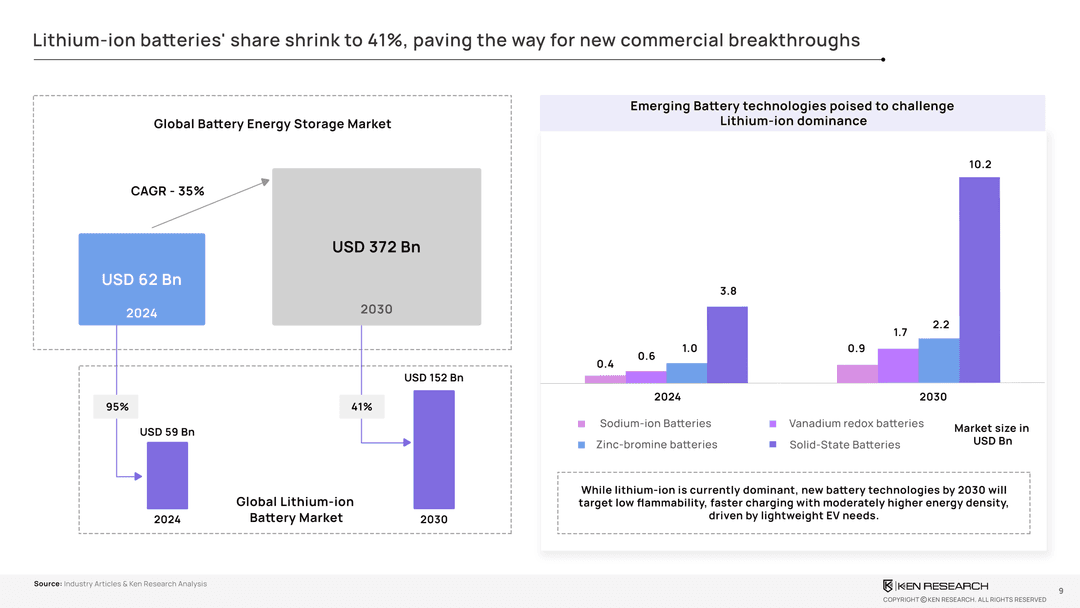
Batteryenergy storageis at a tipping point. While lithium-ion batteries remain dominant, a growing set of alternative chemistries is emerging—offering scalability, safety, and cost flexibility. The global battery energy storage market is projected to grow fromUSD 62 billion in 2024 to USD 372 billion in 2030, at aCAGR of 35%.

Key global indicators:
- Lithium-ion share to drop to41%by 2030 as new chemistries scale
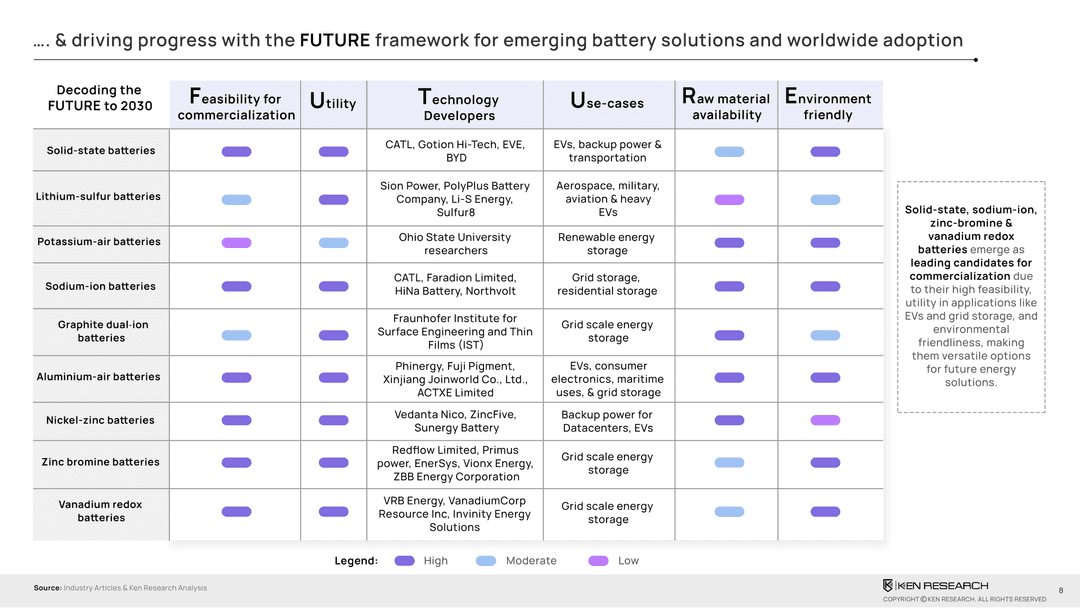
- Rapid R&D in solid-state, sodium-ion, vanadium redox, and zinc-bromine
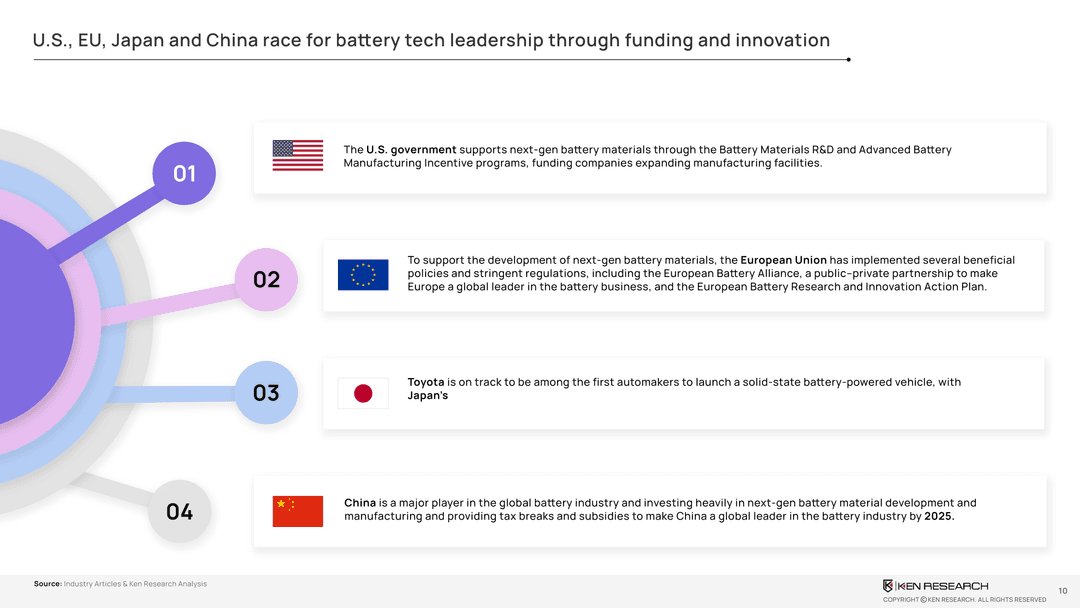
- Policy-driven demand across the U.S., EU, Japan, and China
Access Our Slide Deck to Benchmark Against Global Storage Trends and Growth Models
MARKET SNAPSHOT – STORAGE CAPACITY, DEMAND, AND COST TRENDS
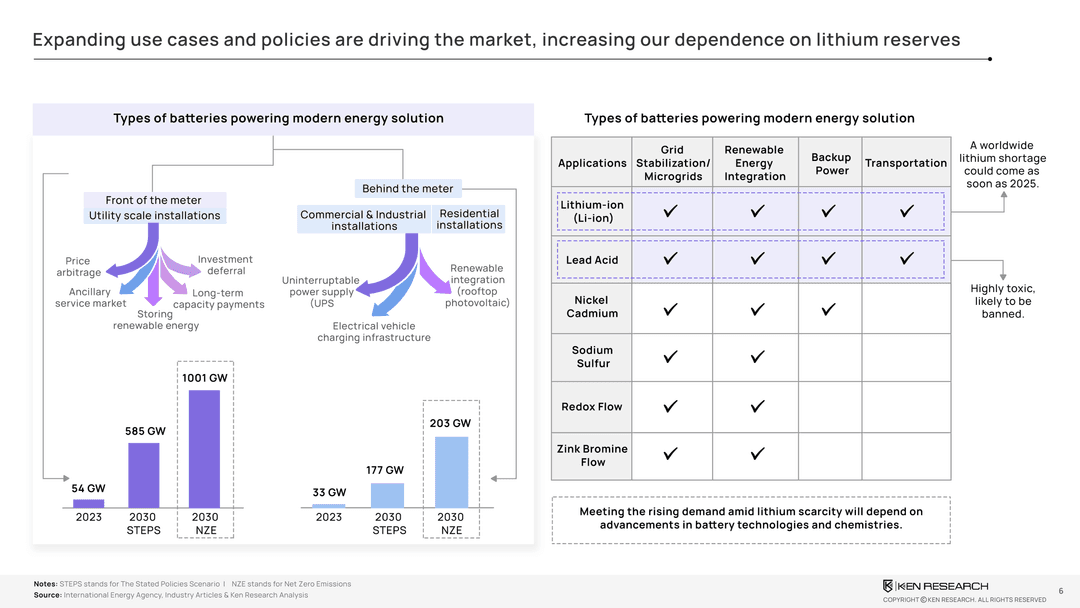
Battery storage is expanding across use cases:
- Behind-the-meter systems
- Residential solar integration
- Commercial and industrial (C&I) use
- Grid-level renewable balancing
- Telecom infrastructure, replacing legacy lead-acid setups
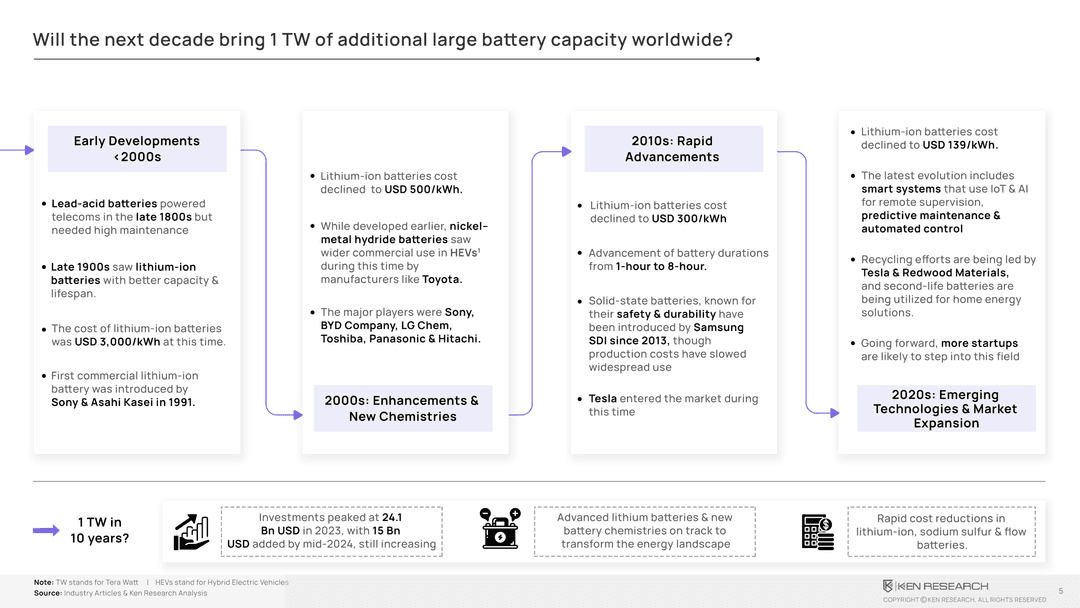
Global capacity is projected to grow by1 terawatt (TW)over the next 10 years. Battery costs have declined significantly—from$3,000/kWh in the late 1900sto$139/kWh in 2024, making storage financially viable across applications.
Download Market Segmentation and Levelized Cost of Storage Benchmarks
TECHNOLOGY LANDSCAPE – BEYOND LITHIUM: NEXT-GEN CHEMISTRIES
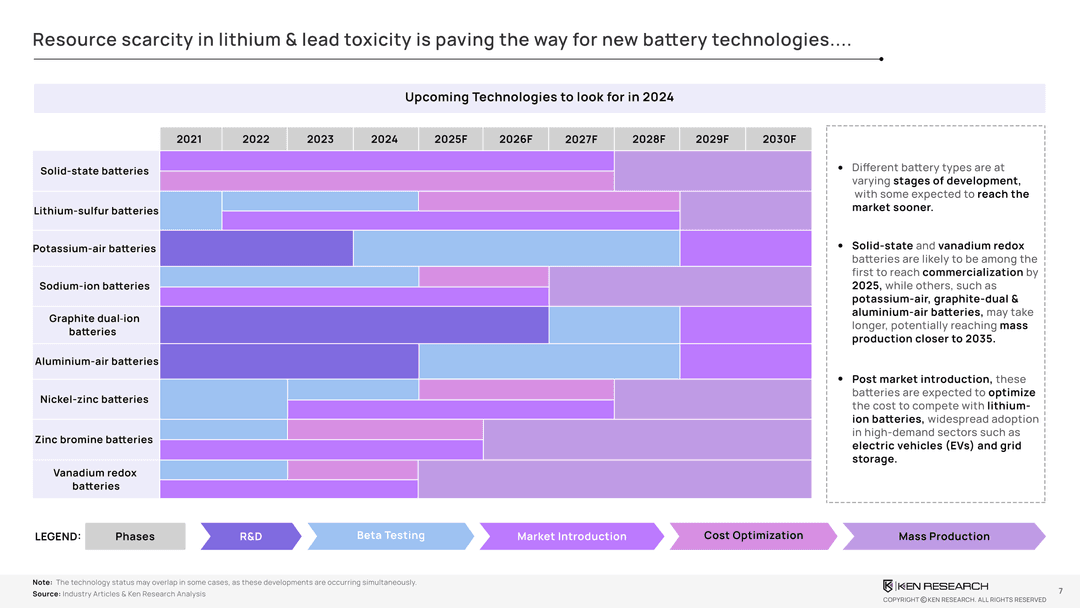
The industry is preparing for post-lithium innovation:
By 2025:
- Solid-state(higher safety, energy density)
- Vanadium redox(long cycle life, grid storage focus)
- Sodium-ion(abundant material, lower cost)
- Zinc-bromine(non-flammable, sustainable)
By 2030–2035:
- Potassium-air
- Aluminum-air
- Graphite dual-carbon
Access Chemistry Comparison Matrix and Commercialization Horizon Map
COMPETITIVE ADVANTAGE – REGIONAL LEADERSHIP AND FIRST MOVERS
Governments are positioning themselves to capture value:
- United States→ Battery Materials R&D under the Inflation Reduction Act
- European Union→Alliance and R&I Action Plan
- Japan→ MoEJ and Toyota investing in solid-state battery scale-up
- China→ Domestic capacity building and tax-backed manufacturing expansion
Compare Country Incentive Structures and Ecosystem Maturity Ratings
POLICY & REGULATORY SIGNALS – SHIFTING FROM INCENTIVES TO STANDARDS
Policy instruments are evolving beyond subsidies:
- Focus onchemistry-specific mandates
- Push forcircular battery ecosystems, including second-life and recycling
- Phase-outs forlead-aciddue to health and environmental concerns
India, the U.S., EU, and China are aligning storage with broader climate finance, manufacturing incentives, and clean energy targets.
Download Global Storage Policy Tracker and Compliance Timelines
APPLICATION CASES – STORAGE ACROSS ENERGY ECOSYSTEMS
Battery storage is being deployed in:
- Telecom towers(as lead-acid replacements)
- Residential rooftops(solar+storage models)
- Commercial/industrial zones(peak shaving, grid stability)
- Grid-connected systems(energy arbitrage, balancing renewables)
- EV ecosystem pilots(battery reuse in Southeast Asia and India)
STRATEGIC IMPERATIVES – EXECUTION PATHWAYS FOR STORAGE 2.0
- Invest in diversified chemistries to avoid raw material dependency
- Integrate lifecycle design, including reuse and end-of-life planning
- Align tech scale-up with regional policy tailwinds
- Develop modular storage offerings for cross-sector adoption
- Leverage AI for performance management in large deployments
STORAGE IS THE FOUNDATION OF ENERGY TRANSFORMATION
Battery energy storage is no longer a support system—it is the central enabler of electrification, decarbonization, and energy decentralization. The years between 2024 and 2030 will define the chemistry, cost structure, and geopolitical alignment of future energy systems. Leaders that act now will build durable advantages in the clean energy value chain.
Download the Full Battery Storage 2.0 Roadmap for Tech and Investment Teams
FAQ's
Still Got Questions? Connect Via Mail
How large is the battery storage market expected to be by 2030?
The global market is forecast to reach USD 372 billion by 2030, with annual installed capacity exceeding 3,000 GWh.
Which battery technologies are closest to mass-market deployment?
Solid-state, vanadium redox, and sodium-ion batteries are projected to reach scaled commercial readiness by 2027.
How is lithium-ion expected to evolve?
Its share is expected to fall from over 70% today to 41% by 2030 as performance, policy, and pricing favor alternatives.
What role does policy play in commercialization?
A decisive one. National incentive structures are already shaping investor flows and manufacturing locations. Alignment with policy will define competitive advantage.
What are the key risks to battery storage growth?
Material supply bottlenecks, poor alignment between technology development and deployment incentives, and fragmented recycling infrastructure.