About the Report
Base Year 2024Qatar Assets Under Management Market Overview
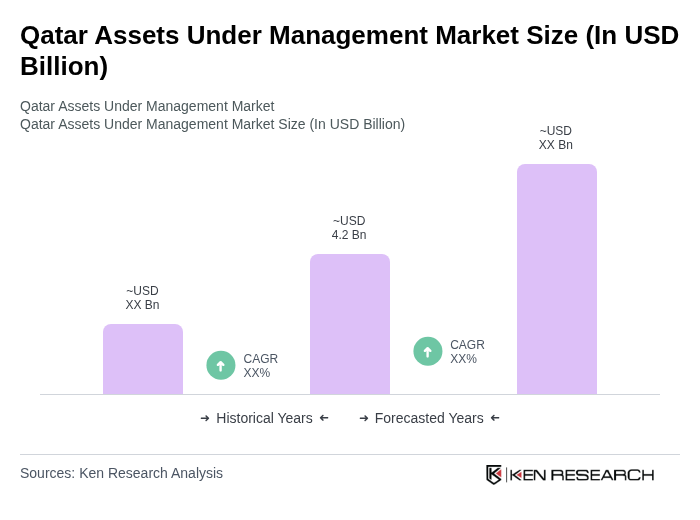
- The Qatar Assets Under Management market is valued at USD 4.2 billion, based on a five-year historical analysis. This growth is primarily driven by increasing foreign investments, a robust banking sector, the rising demand for diversified investment portfolios among local and international investors, rapid expansion of family offices supporting intergenerational wealth transfer, accelerated digital transformation enabling fintech-powered wealth services, and growing adoption of Sharia-compliant investment solutions aligned with Islamic finance principles. The market has seen a significant influx of capital, particularly in real estate and infrastructure projects, which are pivotal to Qatar's economic diversification strategy.
- Key players in this market include Doha, which serves as the financial hub of Qatar, and other cities like Al Rayyan and Lusail, which are emerging as significant centers for investment activities. The dominance of these cities is attributed to their strategic location, advanced financial infrastructure, and government support for investment initiatives, making them attractive destinations for both local and foreign investors.
- The Financial Services Regulatory Authority Rules, 2010 issued by the Qatar Financial Centre Regulatory Authority (QFCRA) governs asset management activities, requiring all licensed firms to maintain adequate capital, implement robust risk management systems, conduct regular independent audits, and provide detailed client disclosures including performance reports and fee structures to ensure transparency and investor protection.
Qatar Assets Under Management Market Segmentation
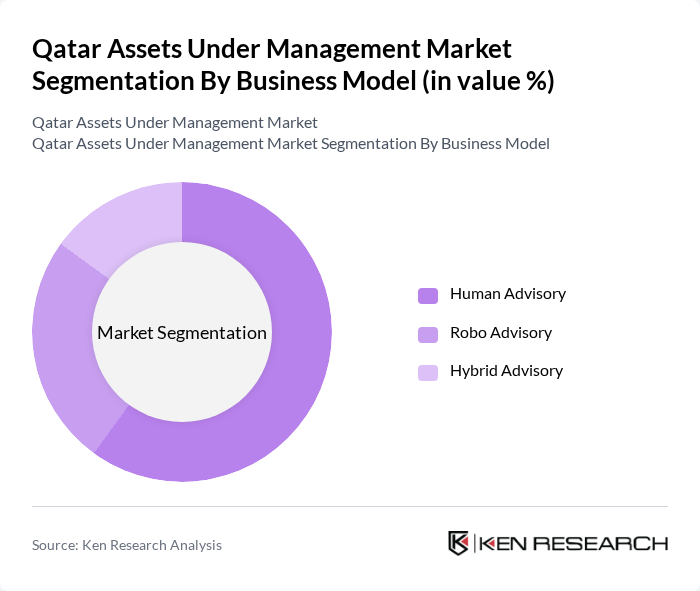
By Business Model:The market is segmented into three primary business models: Human Advisory, Robo Advisory, and Hybrid Advisory. Human Advisory remains the most dominant model, as many investors prefer personalized services and face-to-face interactions with financial advisors. Robo Advisory is gaining traction, particularly among tech-savvy younger investors seeking cost-effective solutions. Hybrid Advisory combines the strengths of both human and digital services, catering to a diverse clientele.
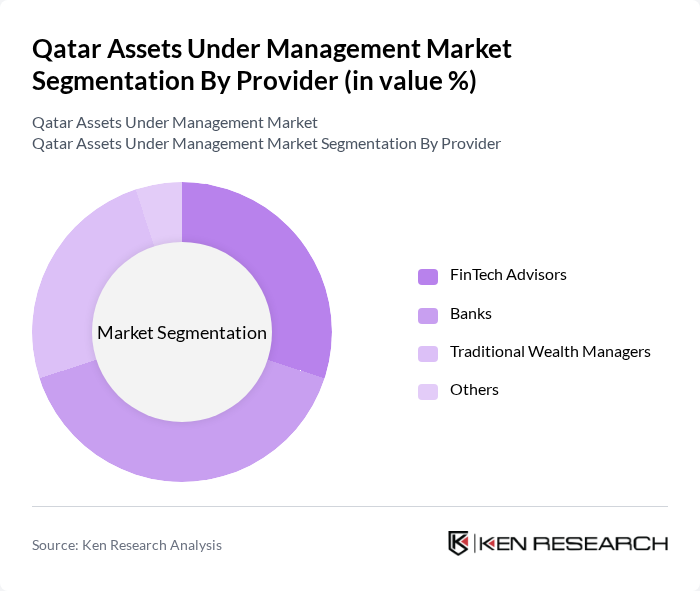
By Provider:The market is categorized into four main providers: FinTech Advisors, Banks, Traditional Wealth Managers, and Others. FinTech Advisors are rapidly gaining market share due to their innovative technology solutions and lower fees. Banks leverage their established customer bases and trust to offer comprehensive asset management services. Traditional Wealth Managers continue to play a crucial role, especially among high-net-worth individuals seeking personalized investment strategies.
Qatar Assets Under Management Market Competitive Landscape
The Qatar Assets Under Management Market is characterized by a dynamic mix of regional and international players. Leading participants such as Qatar National Bank (QNB), Doha Bank, Qatar Islamic Bank (QIB), Masraf Al Rayan, Commercial Bank of Qatar, QInvest, Al Rayan Investment, Amwal, Qatar Investment Authority (QIA), Barwa Bank, Qatar Financial Centre (QFC), QNB Capital, Dlala Brokerage and Investment Holding Company, Al Khaliji France Bank, Qatar Development Bank contribute to innovation, geographic expansion, and service delivery in this space.
Qatar Assets Under Management Market Industry Analysis
Growth Drivers
- Increasing Foreign Investment:Qatar has seen a significant influx of foreign direct investment (FDI), reaching approximately $25 billion in future. This surge is driven by the country’s strategic location and favorable business environment, which attract global investors. The Qatar Investment Authority (QIA) has been actively seeking international partnerships, further enhancing the appeal of the local asset management sector. As a result, the assets under management (AUM) in Qatar are expected to benefit from this growing foreign interest, bolstering market growth.
- Government Initiatives for Economic Diversification:The Qatari government has implemented various initiatives aimed at diversifying its economy away from oil dependency. The National Vision 2030 outlines plans to develop sectors such as finance, tourism, and technology. In future, the government allocated $15 billion for infrastructure projects, which is expected to stimulate economic activity and increase the demand for asset management services. This proactive approach is likely to enhance the overall investment landscape in Qatar, driving AUM growth.
- Rising Demand for Wealth Management Services:As Qatar's population grows and affluence increases, the demand for wealth management services is on the rise. The number of high-net-worth individuals (HNWIs) in Qatar is projected to reach 30,000 in future, up from 20,000 in future. This demographic shift is prompting financial institutions to expand their wealth management offerings, catering to the sophisticated needs of affluent clients. Consequently, this trend is expected to significantly boost the assets under management in the region.
Market Challenges
- Regulatory Compliance Issues:The asset management industry in Qatar faces stringent regulatory compliance requirements, which can pose challenges for firms operating in the market. In future, the Qatar Financial Centre (QFC) introduced new regulations that increased compliance costs by approximately 20%. These regulations aim to enhance transparency and protect investors but can also deter smaller firms from entering the market, limiting competition and innovation in the sector.
- Market Volatility:The Qatari financial market has experienced significant volatility, particularly due to fluctuations in global oil prices. In future, oil prices dropped by 25%, impacting investor confidence and leading to a decline in asset valuations. This volatility creates uncertainty for asset managers, making it challenging to attract and retain clients. As a result, firms must navigate these market dynamics carefully to maintain their AUM levels and ensure sustainable growth.
Qatar Assets Under Management Market Future Outlook
The future of the Qatar assets under management market appears promising, driven by ongoing economic diversification and increasing foreign investments. As the government continues to implement strategic initiatives, the financial services sector is expected to expand, attracting more affluent clients. Additionally, the rise of digital financial services and innovative investment products will likely enhance market accessibility. Overall, these trends indicate a robust growth trajectory for the AUM sector in Qatar, positioning it as a competitive player in the regional financial landscape.
Market Opportunities
- Expansion of Digital Financial Services:The digital transformation in Qatar's financial sector presents a significant opportunity for asset managers. With over 95% of the population using the internet, firms can leverage digital platforms to enhance service delivery and reach a broader client base. This shift is expected to increase AUM as more investors seek convenient and accessible wealth management solutions.
- Development of Sustainable Investment Products:There is a growing interest in sustainable and socially responsible investments in Qatar. In future, the market for green bonds is projected to reach $2 billion, reflecting a shift towards environmentally conscious investing. Asset managers who develop sustainable investment products can tap into this emerging trend, attracting environmentally aware investors and expanding their AUM significantly.
Scope of the Report
| Segment | Sub-Segments |
|---|---|
| By Business Model | Human Advisory Robo Advisory Hybrid Advisory |
| By Provider | FinTech Advisors Banks Traditional Wealth Managers Others |
| By End User | Retail Investors High Net Worth Individuals (HNIs) |
| By Asset Class | Equities Fixed Income Sharia-Compliant Investments Alternatives Others |
Key Target Audience
Investors and Venture Capitalist Firms
Government and Regulatory Bodies (e.g., Qatar Financial Centre Regulatory Authority, Qatar Central Bank)
Private Equity Firms
Wealth Management Firms
Family Offices
Real Estate Investment Trusts (REITs)
Insurance Companies
Pension Funds
Players Mentioned in the Report:
Qatar National Bank (QNB)
Doha Bank
Qatar Islamic Bank (QIB)
Masraf Al Rayan
Commercial Bank of Qatar
QInvest
Al Rayan Investment
Amwal
Qatar Investment Authority (QIA)
Barwa Bank
Qatar Financial Centre (QFC)
QNB Capital
Dlala Brokerage and Investment Holding Company
Al Khaliji France Bank
Qatar Development Bank
Table of Contents
Market Assessment Phase
1. Executive Summary and Approach
2. Qatar Assets Under Management Market Overview
2.1 Key Insights and Strategic Recommendations
2.2 Qatar Assets Under Management Market Overview
2.3 Definition and Scope
2.4 Evolution of Market Ecosystem
2.5 Timeline of Key Regulatory Milestones
2.6 Value Chain & Stakeholder Mapping
2.7 Business Cycle Analysis
2.8 Policy & Incentive Landscape
3. Qatar Assets Under Management Market Analysis
3.1 Growth Drivers
3.1.1 Increasing Foreign Investment
3.1.2 Government Initiatives for Economic Diversification
3.1.3 Rising Demand for Wealth Management Services
3.1.4 Growth of the Financial Services Sector
3.2 Market Challenges
3.2.1 Regulatory Compliance Issues
3.2.2 Market Volatility
3.2.3 Limited Awareness Among Retail Investors
3.2.4 Competition from Global Financial Centers
3.3 Market Opportunities
3.3.1 Expansion of Digital Financial Services
3.3.2 Increasing Affluence of the Population
3.3.3 Development of Sustainable Investment Products
3.3.4 Strategic Partnerships with Global Firms
3.4 Market Trends
3.4.1 Shift Towards ESG Investments
3.4.2 Growth of Robo-Advisory Services
3.4.3 Increasing Use of AI in Asset Management
3.4.4 Focus on Personalized Investment Solutions
3.5 Government Regulation
3.5.1 New Investment Laws
3.5.2 Tax Incentives for Asset Managers
3.5.3 Enhanced Consumer Protection Regulations
3.5.4 Licensing Requirements for Foreign Firms
4. SWOT Analysis
5. Stakeholder Analysis
6. Porter's Five Forces Analysis
7. Qatar Assets Under Management Market Market Size, 2019-2024
7.1 By Value
7.2 By Volume
7.3 By Average Selling Price
8. Qatar Assets Under Management Market Segmentation
8.1 By Business Model
8.1.1 Human Advisory
8.1.2 Robo Advisory
8.1.3 Hybrid Advisory
8.2 By Provider
8.2.1 FinTech Advisors
8.2.2 Banks
8.2.3 Traditional Wealth Managers
8.2.4 Others
8.3 By End User
8.3.1 Retail Investors
8.3.2 High Net Worth Individuals (HNIs)
8.4 By Asset Class
8.4.1 Equities
8.4.2 Fixed Income
8.4.3 Sharia-Compliant Investments
8.4.4 Alternatives
8.4.5 Others
9. Qatar Assets Under Management Market Competitive Analysis
9.1 Market Share of Key Players
9.2 Cross Comparison of Key Players
9.2.1 Company Name
9.2.2 Assets Under Management (AUM)
9.2.3 Annualized Return on Investment (ROI)
9.2.4 Sharpe Ratio
9.2.5 Alpha Generation
9.2.6 Client Retention Rate
9.2.7 Revenue Growth Rate (YoY)
9.2.8 Market Share (%)
9.2.9 Net Promoter Score (NPS)
9.2.10 Regulatory Compliance Score
9.3 SWOT Analysis of Top Players
9.4 Pricing Analysis
9.5 Detailed Profile of Major Companies
9.5.1 Qatar National Bank (QNB)
9.5.2 Doha Bank
9.5.3 Qatar Islamic Bank (QIB)
9.5.4 Masraf Al Rayan
9.5.5 Commercial Bank of Qatar
9.5.6 QInvest
9.5.7 Al Rayan Investment
9.5.8 Amwal
9.5.9 Qatar Investment Authority (QIA)
9.5.10 Barwa Bank
9.5.11 Qatar Financial Centre (QFC)
9.5.12 QNB Capital
9.5.13 Dlala Brokerage and Investment Holding Company
9.5.14 Al Khaliji France Bank
9.5.15 Qatar Development Bank
10. Qatar Assets Under Management Market End-User Analysis
10.1 Procurement Behavior of Key Ministries
10.1.1 Investment Priorities
10.1.2 Budget Allocation Trends
10.1.3 Decision-Making Processes
10.1.4 Vendor Selection Criteria
10.2 Corporate Spend on Infrastructure & Energy
10.2.1 Investment Trends
10.2.2 Sector-Specific Spending
10.2.3 Long-Term Financial Commitments
10.3 Pain Point Analysis by End-User Category
10.3.1 Challenges Faced by Individual Investors
10.3.2 Institutional Investor Concerns
10.3.3 Corporate Investment Hurdles
10.4 User Readiness for Adoption
10.4.1 Awareness Levels
10.4.2 Technology Adoption Rates
10.4.3 Training and Support Needs
10.5 Post-Deployment ROI and Use Case Expansion
10.5.1 Performance Metrics
10.5.2 Case Studies of Successful Deployments
10.5.3 Future Investment Plans
11. Qatar Assets Under Management Market Future Size, 2025-2030
11.1 By Value
11.2 By Volume
11.3 By Average Selling Price
Go-To-Market Strategy Phase
1. Whitespace Analysis + Business Model Canvas
1.1 Market Gaps Identification
1.2 Business Model Development
2. Marketing and Positioning Recommendations
2.1 Branding Strategies
2.2 Product USPs
3. Distribution Plan
3.1 Urban Retail vs Rural NGO Tie-ups
4. Channel & Pricing Gaps
4.1 Underserved Routes
4.2 Pricing Bands
5. Unmet Demand & Latent Needs
5.1 Category Gaps
5.2 Consumer Segments
6. Customer Relationship
6.1 Loyalty Programs
6.2 After-sales Service
7. Value Proposition
7.1 Sustainability
7.2 Integrated Supply Chains
8. Key Activities
8.1 Regulatory Compliance
8.2 Branding
8.3 Distribution Setup
9. Entry Strategy Evaluation
9.1 Domestic Market Entry Strategy
9.1.1 Product Mix
9.1.2 Pricing Band
9.1.3 Packaging
9.2 Export Entry Strategy
9.2.1 Target Countries
9.2.2 Compliance Roadmap
10. Entry Mode Assessment
10.1 JV
10.2 Greenfield
10.3 M&A
10.4 Distributor Model
11. Capital and Timeline Estimation
11.1 Capital Requirements
11.2 Timelines
12. Control vs Risk Trade-Off
12.1 Ownership vs Partnerships
13. Profitability Outlook
13.1 Breakeven Analysis
13.2 Long-term Sustainability
14. Potential Partner List
14.1 Distributors
14.2 JVs
14.3 Acquisition Targets
15. Execution Roadmap
15.1 Phased Plan for Market Entry
15.1.1 Market Setup
15.1.2 Market Entry
15.1.3 Growth Acceleration
15.1.4 Scale & Stabilize
15.2 Key Activities and Milestones
15.2.1 Milestone Planning
15.2.2 Activity Tracking
Research Methodology
Phase 1: Approach1
Desk Research
- Analysis of financial reports from major asset management firms operating in Qatar
- Review of market studies and white papers published by financial institutions and consultancy firms
- Examination of regulatory frameworks and guidelines from the Qatar Financial Centre and Qatar Central Bank
Primary Research
- Interviews with senior executives at leading asset management companies in Qatar
- Surveys targeting institutional investors and high-net-worth individuals
- Focus group discussions with financial advisors and wealth management professionals
Validation & Triangulation
- Cross-validation of findings through multiple data sources including market reports and expert opinions
- Triangulation of quantitative data with qualitative insights from industry experts
- Sanity checks through peer reviews and feedback from financial analysts
Phase 2: Market Size Estimation1
Top-down Assessment
- Estimation of total assets under management based on national economic indicators and GDP growth
- Segmentation of the market by asset classes such as equities, fixed income, and alternative investments
- Incorporation of trends in foreign direct investment and local investor behavior
Bottom-up Modeling
- Collection of data on AUM from individual asset management firms through surveys and interviews
- Analysis of client portfolios to determine average investment sizes and growth rates
- Estimation of market share for each firm based on client acquisition and retention metrics
Forecasting & Scenario Analysis
- Development of predictive models using historical AUM growth rates and economic forecasts
- Scenario analysis based on potential regulatory changes and market disruptions
- Creation of best-case, worst-case, and most-likely scenarios through 2030
Phase 3: CATI Sample Composition1
| Scope Item/Segment | Sample Size | Target Respondent Profiles |
|---|---|---|
| Institutional Investors | 120 | Pension Fund Managers, Insurance Executives |
| High-Net-Worth Individuals | 100 | High-Net-Worth Individuals |
| Asset Management Firms | 80 | CEOs, Portfolio Managers |
| Regulatory Bodies | 50 | Compliance Officers, Financial Regulators |
| Market Analysts | 60 | Financial Analysts, Economic Researchers |
Frequently Asked Questions
What is the current value of the Qatar Assets Under Management market?
The Qatar Assets Under Management market is valued at approximately USD 4.2 billion, reflecting a significant growth driven by increasing foreign investments and a robust banking sector, among other factors.
What factors are driving growth in the Qatar Assets Under Management market?
Which cities are prominent in the Qatar Assets Under Management market?
What regulatory framework governs the Qatar Assets Under Management market?
Other Regional/Country Reports
Other Adjacent Reports
Singapore Investment Management Market
Germany Fintech Advisory Market
Kuwait Islamic Finance Market Size, Share, Growth Drivers, Opportunities & Forecast 2025–2030Indonesia Private Banking MarketMexico Real Estate Investment Market
Brazil Infrastructure Finance Market
Saudi Arabia Private Equity MarketSingapore Sustainable Investment Market
GCC Robo-Advisory Market Size, Share, Trends, Growth Drivers & Forecast 2025–2030Why Buy From Us?

What makes us stand out is that our consultants follow Robust, Refine and Result (RRR) methodology. Robust for clear definitions, approaches and sanity checking, Refine for differentiating respondents' facts and opinions, and Result for presenting data with story.

We have set a benchmark in the industry by offering our clients with syndicated and customized market research reports featuring coverage of entire market as well as meticulous research and analyst insights.

While we don't replace traditional research, we flip the method upside down. Our dual approach of Top Bottom & Bottom Top ensures quality deliverable by not just verifying company fundamentals but also looking at the sector and macroeconomic factors.

With one step in the future, our research team constantly tries to show you the bigger picture. We help with some of the tough questions you may encounter along the way: How is the industry positioned? Best marketing channel? KPI's of competitors? By aligning every element, we help maximize success.

Our report gives you instant access to the answers and sources that other companies might choose to hide. We elaborate each steps of research methodology we have used and showcase you the sample size to earn your trust.

If you need any support, we are here! We pride ourselves on universe strength, data quality, and quick, friendly, and professional service.