About the Report
Base Year 2024Listen to the audio summary
Qatar Automotive Chromium Market Overview
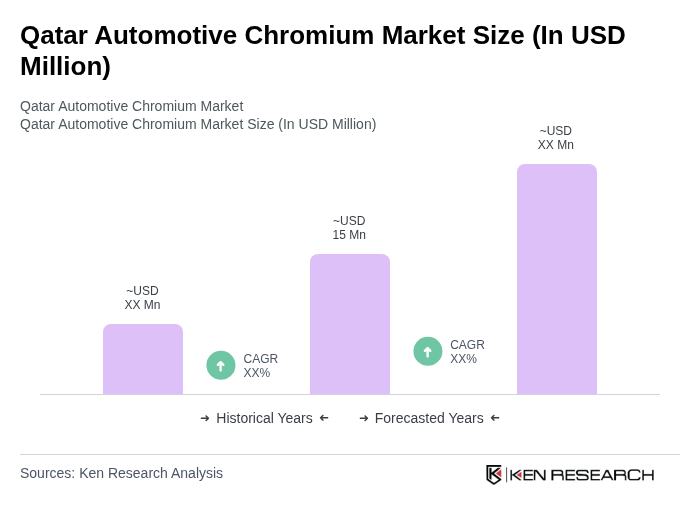
- The Qatar Automotive Chromium Market is valued at USD 15 million, based on a five-year historical analysis. This growth is primarily driven by the increasing demand for automotive components that require chromium plating for enhanced durability and aesthetic appeal, in line with global trends where chrome plating is widely used for corrosion resistance and decorative finishes in vehicles. The automotive sector's expansion, supported by rising vehicle parc and imports in Qatar, coupled with consumer preferences for high-quality exterior and interior finishes on premium and luxury vehicles, has significantly contributed to the market's growth.
- Doha is the dominant city in the Qatar Automotive Chromium Market due to its status as the capital and the hub of automotive activity in the country. The majority of automotive dealerships, distribution centers, and industrial workshops are concentrated in Doha and its surroundings, making it the focal point for vehicle sales, servicing, and customization. The presence of major automotive distributors and service providers in Doha, along with a growing population and high vehicle ownership rates, has positioned the city as a key player in the market, while other notable regions such as Al Rayyan and Al Wakrah contribute through industrial zones and logistics corridors that host metal finishing and fabrication activities.
- Environmental and occupational-health controls applicable to chromium plating activities in Qatar are governed by instruments such as the Environmental Protection Law No. 30 of 2002 issued by the Ministry of Municipality and Environment, which sets requirements for industrial emissions, hazardous substance management, and effluent discharge limits for facilities including metal finishing and plating plants. These provisions require operators to obtain environmental permits, implement pollution control measures, and manage hexavalent chromium and other hazardous chemicals in accordance with approved standards and monitoring regimes. In practice, many automotive-related platers and metal finishing workshops in Qatar are progressively adopting trivalent chromium and low-emission processes in line with global best practices and to support national sustainability objectives, even though the precise choice of technology is implemented at facility level under the broader regulatory framework.
Qatar Automotive Chromium Market Segmentation
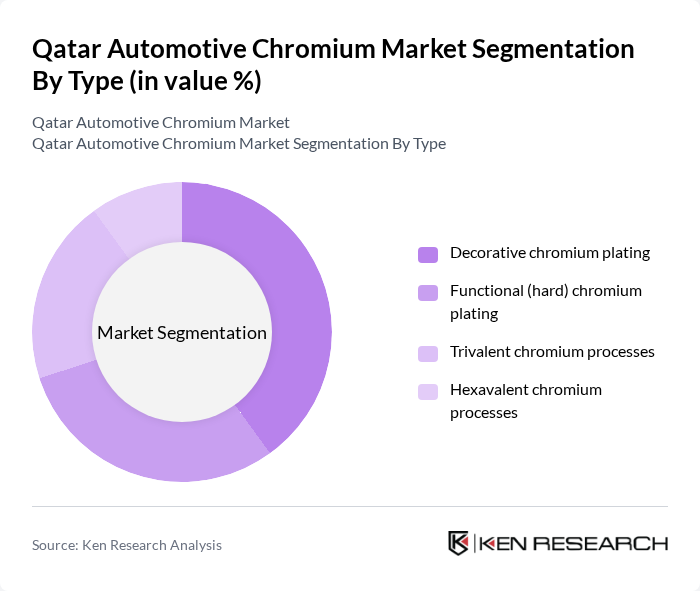
By Type:The market can be segmented into four types: Decorative chromium plating, Functional (hard) chromium plating, Trivalent chromium processes, and Hexavalent chromium processes. Each type serves different applications within the automotive industry, with decorative plating primarily used for aesthetic purposes on exterior trims, grills, badges, and interior accents, while functional plating is applied on components such as shafts, pistons, and tooling where wear resistance, low friction, and corrosion protection are critical. Trivalent chromium processes are increasingly used as an alternative technology to reduce environmental and health risks associated with hexavalent chromium baths while still providing high-quality decorative and protective coatings.
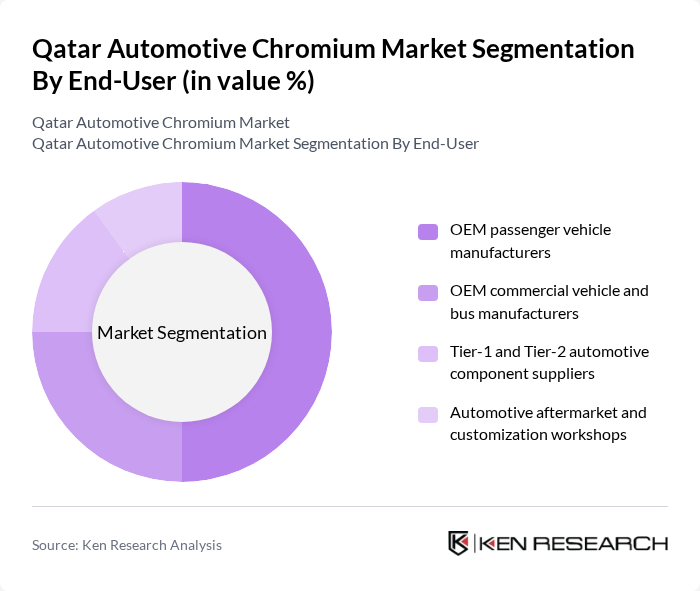
By End-User:The end-user segmentation includes OEM passenger vehicle manufacturers, OEM commercial vehicle and bus manufacturers, Tier-1 and Tier-2 automotive component suppliers, and automotive aftermarket and customization workshops. In Qatar, most demand is linked to global OEM brands represented through local distributors and service centers rather than full-scale vehicle manufacturing, meaning that a large portion of automotive chromium use is tied to imported components and local finishing, refurbishment, and customization. Each segment plays a crucial role in the demand for chromium plating, with OEM-linked dealer networks and their Tier-1/Tier-2 supply chains accounting for the bulk of high-specification plated parts, while the automotive aftermarket and customization workshops drive incremental demand for cosmetic upgrades, re-chroming, and personalization services.
Qatar Automotive Chromium Market Competitive Landscape
The Qatar Automotive Chromium Market is characterized by a dynamic mix of regional and international players. Leading participants such as Qatar Chrome & Electroplating W.L.L., Qatar Technical International Metal Industries (QTIMI), Qatar Galvanizing Company W.L.L., Qatar Industrial Manufacturing Company Q.P.S.C., Qatar Fuel Additives Company Limited (QAFAC), Qatar Steel Company Q.P.S.C., Baladna Automotive & Industrial Coatings (Qatar), Jaidah Automotive, Abdullah AbdulGhani & Bros. Co. W.L.L. (Toyota & Lexus Qatar), Saleh Al Hamad Al Mana Co. (Nissan, Renault, Infiniti Qatar), Al Fardan Automobiles (BMW & MINI Qatar), Nasser Bin Khaled Automobiles (Mercedes-Benz Qatar), United Cars Almana (FCA / Stellantis brands Qatar), Qatar Free Zones Authority (automotive and surface-finishing clusters), Qatar Science and Technology Park (advanced materials & surface technologies) contribute to innovation, geographic expansion, and service delivery in this space.
Qatar Automotive Chromium Market Industry Analysis
Growth Drivers
- Increasing Demand for Automotive Manufacturing:The automotive manufacturing sector in Qatar is projected to grow significantly, with production expected to reach 100,000 vehicles in future. This surge is driven by rising consumer demand and government initiatives to boost local manufacturing. The automotive industry contributes approximately QAR 2 billion to the national economy, highlighting the critical role of chromium in vehicle production, particularly in components requiring high durability and corrosion resistance.
- Rising Environmental Regulations:Qatar's commitment to environmental sustainability is reflected in its stringent regulations on emissions and waste management. The government aims to reduce carbon emissions by 25 percent from a business-as-usual scenario as part of its nationally determined contribution under the Paris Agreement, which includes measures in the transport and industrial sectors that indirectly affect automotive-related materials demand. This regulatory landscape is expected to drive the demand for chromium, as manufacturers seek compliant materials that meet these evolving standards.
- Technological Advancements in Chromium Processing:Innovations in chromium processing technologies are enhancing the efficiency and sustainability of chromium use in automotive applications. For instance, advanced extraction methods have reduced energy consumption by 20% and improved yield rates. These advancements not only lower production costs but also align with Qatar's vision for a technologically advanced automotive sector, fostering increased adoption of chromium in manufacturing processes.
Market Challenges
- Fluctuating Raw Material Prices:The automotive chromium market faces challenges due to the volatility of raw material prices, which can fluctuate significantly based on global supply and demand dynamics. In recent periods, chromium prices experienced a 15% increase due to supply chain disruptions and geopolitical tensions. Such fluctuations can impact production costs for automotive manufacturers, potentially leading to increased vehicle prices and reduced competitiveness in the market.
- Limited Local Production Capabilities:Qatar's automotive sector currently relies heavily on imported chromium, with local production capabilities estimated at only 30% of demand. This dependency poses risks related to supply chain disruptions and increases vulnerability to international market fluctuations. The lack of local processing facilities limits the ability to capitalize on the growing automotive market, hindering the sector's overall growth potential and sustainability.
Qatar Automotive Chromium Market Future Outlook
The future of the Qatar automotive chromium market appears promising, driven by increasing investments in electric vehicle production and advancements in recycling technologies. As the government prioritizes sustainable practices, the automotive sector is likely to see a shift towards more eco-friendly materials, including chromium. Additionally, strategic partnerships between local manufacturers and global automotive companies will enhance innovation and efficiency, positioning Qatar as a competitive player in the regional automotive landscape.
Market Opportunities
- Growth in Electric Vehicle Production:The electric vehicle (EV) market in Qatar is expected to expand, with projections indicating a rise to 20,000 EVs in future. This growth presents an opportunity for chromium applications in battery components and lightweight materials, enhancing performance and sustainability in EV manufacturing.
- Investment in Automotive Infrastructure:Qatar's government plans to invest QAR 5 billion in automotive infrastructure in future, focusing on manufacturing facilities and supply chain enhancements. This investment will create opportunities for local chromium suppliers to engage with automotive manufacturers, fostering a more resilient and integrated supply chain.
Scope of the Report
| Segment | Sub-Segments |
|---|---|
| By Type | Decorative chromium plating Functional (hard) chromium plating Trivalent chromium processes Hexavalent chromium processes |
| By End-User | OEM passenger vehicle manufacturers OEM commercial vehicle and bus manufacturers Tier-1 and Tier-2 automotive component suppliers Automotive aftermarket and customization workshops |
| By Application | Exterior trim (grilles, emblems, door handles, mirror housings) Interior trim (knobs, bezels, decorative inserts) Wheels, exhausts, and under-the-hood components Functional wear- and corrosion-resistant parts |
| By Substrate | ABS and other plastics Steel and stainless steel Aluminum and alloys Others |
| By Distribution Channel | Direct supply to OEMs Local chrome plating job shops Industrial chemical distributors Import-based traders |
| By Vehicle Category | Luxury and premium vehicles Mass-market passenger cars Light commercial vehicles Heavy commercial vehicles and buses |
| By Region | Doha Al Rayyan Al Wakrah & Mesaieed industrial area Rest of Qatar |
Key Target Audience
Investors and Venture Capitalist Firms
Government and Regulatory Bodies (e.g., Ministry of Transport and Communications, Qatar General Authority for Standards and Metrology)
Automotive Manufacturers and Producers
Automotive Component Suppliers
Distributors and Retailers of Automotive Parts
Industry Associations (e.g., Qatar Chamber of Commerce and Industry)
Financial Institutions and Banks
Importers and Exporters of Automotive Materials
Players Mentioned in the Report:
Qatar Chrome & Electroplating W.L.L.
Qatar Technical International Metal Industries (QTIMI)
Qatar Galvanizing Company W.L.L.
Qatar Industrial Manufacturing Company Q.P.S.C.
Qatar Fuel Additives Company Limited (QAFAC)
Qatar Steel Company Q.P.S.C.
Baladna Automotive & Industrial Coatings (Qatar)
Jaidah Automotive
Abdullah AbdulGhani & Bros. Co. W.L.L. (Toyota & Lexus Qatar)
Saleh Al Hamad Al Mana Co. (Nissan, Renault, Infiniti Qatar)
Al Fardan Automobiles (BMW & MINI Qatar)
Nasser Bin Khaled Automobiles (Mercedes-Benz Qatar)
United Cars Almana (FCA / Stellantis brands Qatar)
Qatar Free Zones Authority (automotive and surface-finishing clusters)
Qatar Science and Technology Park (advanced materials & surface technologies)
Table of Contents
Market Assessment Phase
1. Executive Summary and Approach
2. Qatar Automotive Chromium Market Overview
2.1 Key Insights and Strategic Recommendations
2.2 Qatar Automotive Chromium Market Overview
2.3 Definition and Scope
2.4 Evolution of Market Ecosystem
2.5 Timeline of Key Regulatory Milestones
2.6 Value Chain & Stakeholder Mapping
2.7 Business Cycle Analysis
2.8 Policy & Incentive Landscape
3. Qatar Automotive Chromium Market Analysis
3.1 Growth Drivers
3.1.1 Increasing demand for automotive manufacturing
3.1.2 Rising environmental regulations
3.1.3 Technological advancements in chromium processing
3.1.4 Expansion of the automotive sector in Qatar
3.2 Market Challenges
3.2.1 Fluctuating raw material prices
3.2.2 Stringent environmental regulations
3.2.3 Limited local production capabilities
3.2.4 Competition from alternative materials
3.3 Market Opportunities
3.3.1 Growth in electric vehicle production
3.3.2 Investment in automotive infrastructure
3.3.3 Development of recycling technologies
3.3.4 Strategic partnerships with automotive manufacturers
3.4 Market Trends
3.4.1 Shift towards sustainable materials
3.4.2 Increasing focus on supply chain transparency
3.4.3 Adoption of advanced manufacturing techniques
3.4.4 Growing consumer awareness of chromium's benefits
3.5 Government Regulation
3.5.1 Regulations on chromium emissions
3.5.2 Standards for automotive materials
3.5.3 Incentives for sustainable practices
3.5.4 Import/export regulations for chromium
4. SWOT Analysis
5. Stakeholder Analysis
6. Porter's Five Forces Analysis
7. Qatar Automotive Chromium Market Market Size, 2019-2024
7.1 By Value
7.2 By Volume
7.3 By Average Selling Price
8. Qatar Automotive Chromium Market Segmentation
8.1 By Type
8.1.1 Decorative chromium plating
8.1.2 Functional (hard) chromium plating
8.1.3 Trivalent chromium processes
8.1.4 Hexavalent chromium processes
8.2 By End-User
8.2.1 OEM passenger vehicle manufacturers
8.2.2 OEM commercial vehicle and bus manufacturers
8.2.3 Tier-1 and Tier-2 automotive component suppliers
8.2.4 Automotive aftermarket and customization workshops
8.3 By Application
8.3.1 Exterior trim (grilles, emblems, door handles, mirror housings)
8.3.2 Interior trim (knobs, bezels, decorative inserts)
8.3.3 Wheels, exhausts, and under-the-hood components
8.3.4 Functional wear- and corrosion-resistant parts
8.4 By Substrate
8.4.1 ABS and other plastics
8.4.2 Steel and stainless steel
8.4.3 Aluminum and alloys
8.4.4 Others
8.5 By Distribution Channel
8.5.1 Direct supply to OEMs
8.5.2 Local chrome plating job shops
8.5.3 Industrial chemical distributors
8.5.4 Import-based traders
8.6 By Vehicle Category
8.6.1 Luxury and premium vehicles
8.6.2 Mass-market passenger cars
8.6.3 Light commercial vehicles
8.6.4 Heavy commercial vehicles and buses
8.7 By Region
8.7.1 Doha
8.7.2 Al Rayyan
8.7.3 Al Wakrah & Mesaieed industrial area
8.7.4 Rest of Qatar
9. Qatar Automotive Chromium Market Competitive Analysis
9.1 Market Share of Key Players
9.2 Cross Comparison of Key Players
9.2.1 Company name
9.2.2 Primary role in value chain (OEM / Tier-1 / Tier-2 / Plater / Chemical supplier)
9.2.3 Qatar automotive chromium-related revenue (latest year, QAR million)
9.2.4 3-year CAGR of automotive chromium revenue in Qatar (%)
9.2.5 Share of automotive in total chrome plating/chemicals revenue (%)
9.2.6 Installed chrome plating capacity for automotive components in Qatar (m²/year)
9.2.7 Capacity utilization in automotive applications (%)
9.2.8 Number of automotive OEM / Tier-1 contracts in Qatar
9.2.9 Average contract tenure with automotive customers (years)
9.2.10 Average chromium plating thickness and defect rate (PPM)
9.2.11 Share of trivalent vs. hexavalent chromium processes (%)
9.2.12 Average price realization per plated automotive part (QAR/unit)
9.2.13 R&D and compliance spend related to automotive chromium (% of segment revenue)
9.2.14 On-time delivery performance to automotive customers (%)
9.3 SWOT Analysis of Top Players
9.4 Pricing Analysis
9.5 Detailed Profile of Major Companies
9.5.1 Qatar Chrome & Electroplating W.L.L.
9.5.2 Qatar Technical International Metal Industries (QTIMI)
9.5.3 Qatar Galvanizing Company W.L.L.
9.5.4 Qatar Industrial Manufacturing Company Q.P.S.C.
9.5.5 Qatar Fuel Additives Company Limited (QAFAC)
9.5.6 Qatar Steel Company Q.P.S.C.
9.5.7 Baladna Automotive & Industrial Coatings (Qatar)
9.5.8 Jaidah Automotive
9.5.9 Abdullah AbdulGhani & Bros. Co. W.L.L. (Toyota & Lexus Qatar)
9.5.10 Saleh Al Hamad Al Mana Co. (Nissan, Renault, Infiniti Qatar)
9.5.11 Al Fardan Automobiles (BMW & MINI Qatar)
9.5.12 Nasser Bin Khaled Automobiles (Mercedes-Benz Qatar)
9.5.13 United Cars Almana (FCA / Stellantis brands Qatar)
9.5.14 Qatar Free Zones Authority (automotive and surface-finishing clusters)
9.5.15 Qatar Science and Technology Park (advanced materials & surface technologies)
10. Qatar Automotive Chromium Market End-User Analysis
10.1 Procurement Behavior of Key Ministries
10.1.1 Ministry of Transport and Communications
10.1.2 Ministry of Municipality and Environment
10.1.3 Ministry of Commerce and Industry
10.1.4 Others
10.2 Corporate Spend on Infrastructure & Energy
10.2.1 Automotive infrastructure projects
10.2.2 Energy-efficient vehicle initiatives
10.2.3 Research and development investments
10.2.4 Others
10.3 Pain Point Analysis by End-User Category
10.3.1 Cost of raw materials
10.3.2 Supply chain disruptions
10.3.3 Quality assurance challenges
10.3.4 Others
10.4 User Readiness for Adoption
10.4.1 Awareness of chromium benefits
10.4.2 Training and skill development
10.4.3 Infrastructure readiness
10.4.4 Others
10.5 Post-Deployment ROI and Use Case Expansion
10.5.1 Performance metrics
10.5.2 Cost savings analysis
10.5.3 User feedback mechanisms
10.5.4 Others
11. Qatar Automotive Chromium Market Future Size, 2025-2030
11.1 By Value
11.2 By Volume
11.3 By Average Selling Price
Go-To-Market Strategy Phase
1. Whitespace Analysis + Business Model Canvas
1.1 Market gaps identification
1.2 Value proposition development
1.3 Revenue model exploration
1.4 Customer segmentation analysis
1.5 Competitive landscape overview
1.6 Key partnerships identification
1.7 Risk assessment
2. Marketing and Positioning Recommendations
2.1 Branding strategies
2.2 Product USPs
2.3 Target audience definition
2.4 Communication strategy
2.5 Digital marketing approach
2.6 Event marketing initiatives
2.7 Performance tracking
3. Distribution Plan
3.1 Urban retail strategy
3.2 Rural NGO tie-ups
3.3 E-commerce integration
3.4 Logistics optimization
3.5 Channel partner selection
3.6 Inventory management
3.7 Distribution cost analysis
4. Channel & Pricing Gaps
4.1 Underserved routes
4.2 Pricing bands analysis
4.3 Competitor pricing comparison
4.4 Customer willingness to pay
4.5 Pricing strategy recommendations
4.6 Discount structures
4.7 Price elasticity assessment
5. Unmet Demand & Latent Needs
5.1 Category gaps identification
5.2 Consumer segments analysis
5.3 Product development opportunities
5.4 Market entry barriers
5.5 Customer feedback incorporation
5.6 Future trends forecasting
5.7 Strategic recommendations
6. Customer Relationship
6.1 Loyalty programs
6.2 After-sales service
6.3 Customer engagement strategies
6.4 Feedback loops
6.5 Relationship management tools
6.6 Customer satisfaction metrics
6.7 Retention strategies
7. Value Proposition
7.1 Sustainability initiatives
7.2 Integrated supply chains
7.3 Cost-benefit analysis
7.4 Unique selling points
7.5 Market differentiation strategies
7.6 Customer value creation
7.7 Long-term vision alignment
8. Key Activities
8.1 Regulatory compliance
8.2 Branding efforts
8.3 Distribution setup
8.4 Market research
8.5 Training and development
8.6 Performance monitoring
8.7 Stakeholder engagement
9. Entry Strategy Evaluation
9.1 Domestic Market Entry Strategy
9.1.1 Product mix
9.1.2 Pricing band
9.1.3 Packaging
9.2 Export Entry Strategy
9.2.1 Target countries
9.2.2 Compliance roadmap
10. Entry Mode Assessment
10.1 JV opportunities
10.2 Greenfield investments
10.3 M&A potential
10.4 Distributor model evaluation
10.5 Risk assessment
10.6 Strategic fit analysis
10.7 Long-term sustainability
11. Capital and Timeline Estimation
11.1 Capital requirements
11.2 Timelines
11.3 Funding sources
11.4 Financial projections
11.5 Investment return analysis
11.6 Risk management strategies
11.7 Milestone tracking
12. Control vs Risk Trade-Off
12.1 Ownership vs Partnerships
12.2 Risk mitigation strategies
12.3 Control mechanisms
12.4 Partnership evaluation
12.5 Long-term implications
12.6 Strategic alignment
12.7 Performance metrics
13. Profitability Outlook
13.1 Breakeven analysis
13.2 Long-term sustainability
13.3 Profit margin analysis
13.4 Revenue forecasting
13.5 Cost management strategies
13.6 Financial health assessment
13.7 Investment attractiveness
14. Potential Partner List
14.1 Distributors
14.2 JVs
14.3 Acquisition targets
14.4 Strategic alliances
14.5 Industry collaborations
14.6 Research partnerships
14.7 Government partnerships
15. Execution Roadmap
15.1 Phased Plan for Market Entry
15.1.1 Market Setup
15.1.2 Market Entry
15.1.3 Growth Acceleration
15.
Research Methodology
Phase 1: Approach1
Desk Research
- Industry reports from automotive associations and market research firms
- Government publications on automotive regulations and chromium usage
- Academic journals and articles focusing on chromium applications in the automotive sector
Primary Research
- Interviews with automotive manufacturers and suppliers in Qatar
- Surveys targeting automotive industry experts and analysts
- Field visits to automotive production facilities to gather firsthand insights
Validation & Triangulation
- Cross-validation of data from multiple industry sources and reports
- Triangulation of findings from primary interviews and secondary data
- Expert panel reviews to ensure data accuracy and relevance
Phase 2: Market Size Estimation1
Top-down Assessment
- Analysis of total automotive market size in Qatar and chromium's share
- Segmentation by vehicle type and chromium application areas
- Incorporation of trends in automotive manufacturing and environmental regulations
Bottom-up Modeling
- Estimation of chromium consumption based on production volumes of automotive parts
- Cost analysis of chromium sourcing and processing in the automotive sector
- Volume x cost calculations for different automotive applications of chromium
Forecasting & Scenario Analysis
- Multi-factor regression analysis considering economic growth and automotive demand
- Scenario modeling based on regulatory changes and technological advancements
- Baseline, optimistic, and pessimistic forecasts through 2030
Phase 3: CATI Sample Composition1
| Scope Item/Segment | Sample Size | Target Respondent Profiles |
|---|---|---|
| Automotive Manufacturers | 100 | Production Managers, Quality Control Engineers |
| Suppliers of Chromium | 80 | Procurement Managers, Supply Chain Analysts |
| Automotive Industry Experts | 60 | Market Analysts, Industry Consultants |
| Regulatory Bodies | 50 | Policy Makers, Environmental Compliance Officers |
| Automotive Research Institutions | 40 | Research Scientists, Academic Professors |
Frequently Asked Questions
What is the current value of the Qatar Automotive Chromium Market?
The Qatar Automotive Chromium Market is valued at approximately USD 15 million, driven by the increasing demand for automotive components that utilize chromium plating for enhanced durability and aesthetic appeal, particularly in premium and luxury vehicles.
Which city dominates the Qatar Automotive Chromium Market?
What are the main types of chromium plating used in the automotive industry?
How does environmental regulation impact the automotive chromium market in Qatar?
Other Regional/Country Reports
Indonesia Automotive Chromium Market
Malaysia Automotive Chromium Market
KSA Automotive Chromium Market
APAC Automotive Chromium Market
SEA Automotive Chromium Market
Vietnam Automotive Chromium Market
Other Adjacent Reports
Belgium Automotive Plating Market
UAE Metal Finishing MarketSouth Africa Electroplating Chemicals Market
Belgium Corrosion Resistant Coatings Market
Germany Automotive Components Market
South Korea Vehicle Aesthetics Market
Mexico Industrial Surface Treatment Market
Europe Automotive Aftermarket MarketSize, Share & Forecast 2025-2032Egypt Luxury Vehicle Accessories Market
Bahrain Chromium Processing Market
Why Buy From Us?

What makes us stand out is that our consultants follow Robust, Refine and Result (RRR) methodology. Robust for clear definitions, approaches and sanity checking, Refine for differentiating respondents' facts and opinions, and Result for presenting data with story.

We have set a benchmark in the industry by offering our clients with syndicated and customized market research reports featuring coverage of entire market as well as meticulous research and analyst insights.

While we don't replace traditional research, we flip the method upside down. Our dual approach of Top Bottom & Bottom Top ensures quality deliverable by not just verifying company fundamentals but also looking at the sector and macroeconomic factors.

With one step in the future, our research team constantly tries to show you the bigger picture. We help with some of the tough questions you may encounter along the way: How is the industry positioned? Best marketing channel? KPI's of competitors? By aligning every element, we help maximize success.

Our report gives you instant access to the answers and sources that other companies might choose to hide. We elaborate each steps of research methodology we have used and showcase you the sample size to earn your trust.

If you need any support, we are here! We pride ourselves on universe strength, data quality, and quick, friendly, and professional service.