About the Report
Base Year 2024Qatar Barrier Systems Market Overview
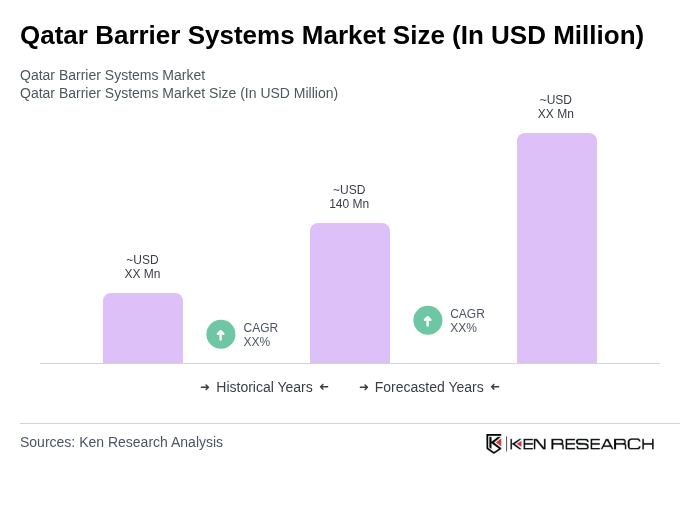
- The Qatar Barrier Systems Market is valued at USD 140 million, based on a five-year historical analysis and triangulation from regional barrier, parking barrier, and construction market data. This growth is primarily driven by the increasing focus on safety and security in urban infrastructure, coupled with the rapid development of transportation networks and commercial and industrial establishments under Qatar National Vision 2030. The demand for various barrier systems, including crash barriers, parking barriers, and safety fences, has surged as the government invests in enhancing public safety measures across highways, urban roads, logistics hubs, and critical facilities.
- Key demand centers in this market include Doha, Al Rayyan, and Al Wakrah, which lead in barrier deployment due to their concentration of large-scale infrastructure projects, expressways, industrial areas, stadiums, ports, and mixed-use urban developments. High population density, major commercial corridors, and ongoing construction in these municipalities drive sustained requirements for road safety barriers, perimeter fencing, and access-control bollards, making them critical hubs for market growth.
- Barrier design, installation, and performance in Qatar are guided by the Qatar Highway Design Manual and the Qatar Traffic Control Manual issued by the Public Works Authority (Ashghal), together with the Ministerial Resolution No. 9 of 2004 issuing the Implementing Regulations of Law No. 19 of 2007 on the Traffic Law. These binding instruments mandate the use of compliant safety barriers and guardrails on classified roads and public infrastructure, including requirements on barrier placement, impact performance, testing standards, and contractor compliance for new road and public works projects, which significantly supports demand for certified barrier systems in roadway, industrial, and commercial applications.
Qatar Barrier Systems Market Segmentation
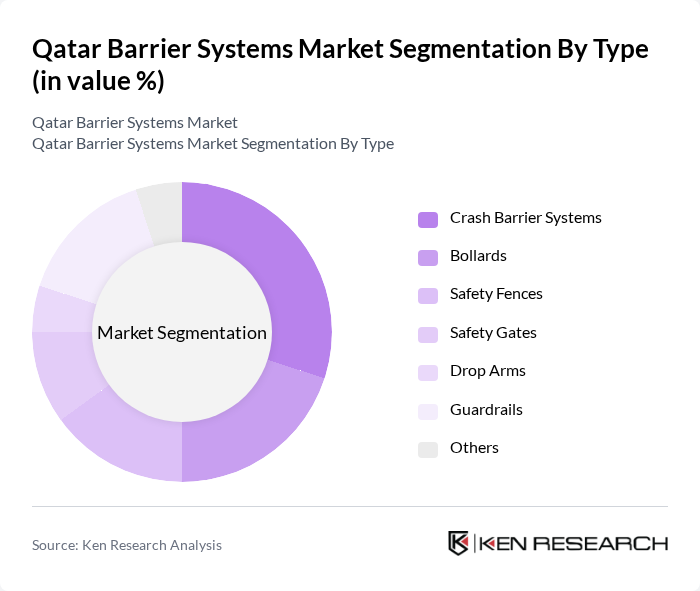
By Type:The market is segmented into various types of barrier systems, including crash barrier systems, bollards, safety fences, safety gates, drop arms, guardrails, and others. Each type serves specific safety and security functions, catering to different applications and environments such as highways and expressways (crash barriers and guardrails), parking and access control (bollards and drop arms), industrial and logistics facilities (safety fences and safety gates), and critical infrastructure protection (high-impact bollards and reinforced perimeter systems).
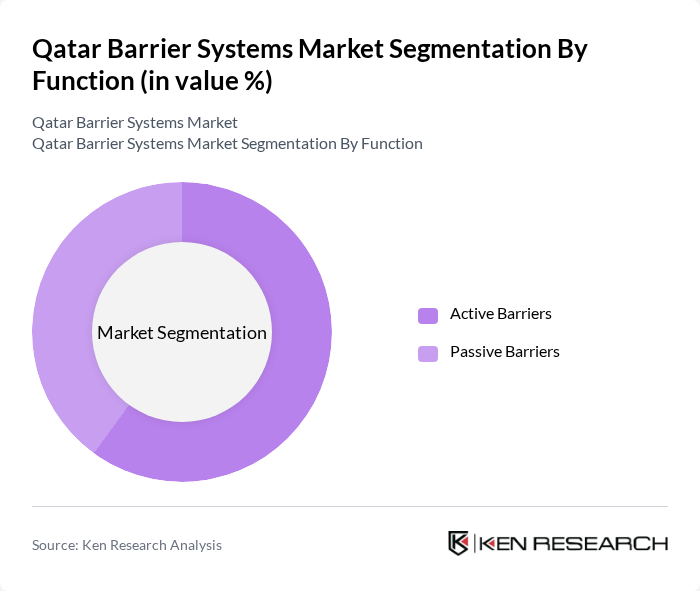
By Function:The market is categorized into active barriers and passive barriers. Active barriers are designed to respond dynamically to threats or access events (for example, automated gates, rising bollards, and motorized drop arms linked with access control and security systems), while passive barriers provide static protection (such as fixed guardrails, concrete barriers, and permanent safety fences). The choice between these types often depends on the specific security and traffic-management needs of the application, with active systems favored in high-security, high-traffic, and automated facility environments, and passive systems predominant along roads, perimeters, and industrial safety zones.
Qatar Barrier Systems Market Competitive Landscape
The Qatar Barrier Systems Market is characterized by a dynamic mix of regional and international players. Leading participants such as Qatar Beton, Qatar National Cement Company, Al Jaber Group, Kassem Darwish Fakhro & Sons (KDFS), Boom General Contractors, Redco Construction – Almana, HBK Contracting Company, Al Balagh Trading & Contracting, Galfar Al Misnad, Ashghal (Public Works Authority – as key procurer), Qatar Building Company, Qatari Diar, Qatari German Factory for Plastic Products, A-Safe, Hill & Smith Holdings PLC contribute to innovation, geographic expansion, and service delivery in this space.
Qatar Barrier Systems Market Industry Analysis
Growth Drivers
- Increasing Infrastructure Development:Qatar's infrastructure investment is projected to reach approximately $300 billion in future, driven by the Qatar National Vision 2030. This includes extensive road networks, bridges, and public transport systems, necessitating advanced barrier systems for safety and traffic management. The construction sector alone is expected to grow by 6.5% annually, creating a robust demand for effective barrier solutions to enhance safety and efficiency in urban planning and development.
- Rising Safety Regulations:The Qatari government has implemented stringent safety regulations, mandating the use of high-quality barrier systems on roads and construction sites. In future, the Ministry of Transport and Communications is expected to enforce new safety standards, which will require an estimated 15,000 kilometers of road barriers. This regulatory push is anticipated to drive the market for barrier systems, ensuring compliance and enhancing public safety across the nation.
- Growing Demand for Traffic Management Solutions:With Qatar's population projected to reach 3 million in future, traffic congestion has become a pressing issue. The government plans to invest $10 billion in smart traffic management systems, which will include advanced barrier technologies. This investment aims to reduce traffic delays by 30% and improve road safety, thereby increasing the demand for innovative barrier solutions that can effectively manage vehicular flow and enhance safety measures.
Market Challenges
- High Initial Investment Costs:The upfront costs associated with advanced barrier systems can be a significant barrier to market entry. For instance, the installation of high-performance barriers can exceed $1 million per kilometer, deterring smaller contractors from investing. This financial burden is compounded by the need for ongoing maintenance and upgrades, which can further strain budgets, particularly for public sector projects reliant on government funding.
- Limited Awareness of Advanced Barrier Systems:Despite the benefits, there remains a lack of awareness regarding the latest barrier technologies among stakeholders in Qatar. Many construction firms and local authorities are still utilizing outdated systems, which can lead to safety vulnerabilities. Educational initiatives and outreach programs are essential to bridge this knowledge gap, but currently, only 25% of industry players are informed about the latest innovations in barrier technology.
Qatar Barrier Systems Market Future Outlook
The Qatar Barrier Systems Market is poised for significant growth, driven by ongoing infrastructure projects and increasing safety regulations. As the government prioritizes smart city initiatives, the integration of advanced technologies in barrier systems will become essential. Additionally, public-private partnerships are expected to facilitate investment in innovative solutions, enhancing the overall safety and efficiency of transportation networks. The focus on sustainability will also shape future developments, leading to the adoption of eco-friendly materials in barrier manufacturing.
Market Opportunities
- Technological Advancements in Barrier Systems:The introduction of smart barrier technologies, such as automated and sensor-equipped systems, presents a significant opportunity. These innovations can enhance traffic management and safety, potentially reducing accidents by up to 40%. As urban areas expand, the demand for such advanced solutions is expected to rise, creating a lucrative market segment for manufacturers.
- Government Initiatives for Smart Cities:Qatar's commitment to developing smart cities offers a unique opportunity for barrier system providers. With an estimated $20 billion allocated for smart city projects in future, there is a growing need for integrated safety solutions. This initiative will likely drive demand for innovative barrier systems that align with smart city objectives, fostering a safer urban environment.
Scope of the Report
| Segment | Sub-Segments |
|---|---|
| By Type | Crash Barrier Systems Bollards Safety Fences Safety Gates Drop Arms Guardrails Others |
| By Function | Active Barriers Passive Barriers |
| By Application | Roadways Railways Airports Commercial & Residential Premises Industrial & Critical Infrastructure Events & Crowd Control Others |
| By Material | Concrete Metal Plastic Wood Composite & Other Materials |
| By Mobility | Permanent Barriers Temporary Barriers Portable/Movable Barriers Others |
| By Access Control Device | Token & Reader Technology Turnstiles Perimeter Security Systems & Alarms Biometric Systems Others |
| By Region | Doha Al Rayyan Al Wakrah Al Khor & Al Thakhira Others |
Key Target Audience
Investors and Venture Capitalist Firms
Government and Regulatory Bodies (e.g., Ministry of Transport and Communications, Qatar Civil Defence)
Manufacturers and Producers of Barrier Systems
Construction and Infrastructure Development Companies
Transportation Authorities
Safety and Security Equipment Suppliers
Industry Associations (e.g., Qatar Chamber of Commerce)
Financial Institutions and Banks
Players Mentioned in the Report:
Qatar Beton
Qatar National Cement Company
Al Jaber Group
Kassem Darwish Fakhro & Sons (KDFS)
Boom General Contractors
Redco Construction Almana
HBK Contracting Company
Al Balagh Trading & Contracting
Galfar Al Misnad
Ashghal (Public Works Authority as key procurer)
Qatar Building Company
Qatari Diar
Qatari German Factory for Plastic Products
A-Safe
Hill & Smith Holdings PLC
Table of Contents
Market Assessment Phase
1. Executive Summary and Approach
2. Qatar Barrier Systems Market Overview
2.1 Key Insights and Strategic Recommendations
2.2 Qatar Barrier Systems Market Overview
2.3 Definition and Scope
2.4 Evolution of Market Ecosystem
2.5 Timeline of Key Regulatory Milestones
2.6 Value Chain & Stakeholder Mapping
2.7 Business Cycle Analysis
2.8 Policy & Incentive Landscape
3. Qatar Barrier Systems Market Analysis
3.1 Growth Drivers
3.1.1 Increasing Infrastructure Development
3.1.2 Rising Safety Regulations
3.1.3 Growing Demand for Traffic Management Solutions
3.1.4 Expansion of Urban Areas
3.2 Market Challenges
3.2.1 High Initial Investment Costs
3.2.2 Limited Awareness of Advanced Barrier Systems
3.2.3 Regulatory Compliance Issues
3.2.4 Competition from Alternative Safety Solutions
3.3 Market Opportunities
3.3.1 Technological Advancements in Barrier Systems
3.3.2 Government Initiatives for Smart Cities
3.3.3 Increasing Public-Private Partnerships
3.3.4 Expansion into New Market Segments
3.4 Market Trends
3.4.1 Adoption of Smart Barrier Technologies
3.4.2 Integration of IoT in Barrier Systems
3.4.3 Focus on Sustainable Materials
3.4.4 Customization of Barrier Solutions
3.5 Government Regulation
3.5.1 Safety Standards for Road Barriers
3.5.2 Environmental Regulations
3.5.3 Import Tariffs on Barrier Materials
3.5.4 Incentives for Local Manufacturing
4. SWOT Analysis
5. Stakeholder Analysis
6. Porter's Five Forces Analysis
7. Qatar Barrier Systems Market Market Size, 2019-2024
7.1 By Value
7.2 By Volume
7.3 By Average Selling Price
8. Qatar Barrier Systems Market Segmentation
8.1 By Type
8.1.1 Crash Barrier Systems
8.1.2 Bollards
8.1.3 Safety Fences
8.1.4 Safety Gates
8.1.5 Drop Arms
8.1.6 Guardrails
8.1.7 Others
8.2 By Function
8.2.1 Active Barriers
8.2.2 Passive Barriers
8.3 By Application
8.3.1 Roadways
8.3.2 Railways
8.3.3 Airports
8.3.4 Commercial & Residential Premises
8.3.5 Industrial & Critical Infrastructure
8.3.6 Events & Crowd Control
8.3.7 Others
8.4 By Material
8.4.1 Concrete
8.4.2 Metal
8.4.3 Plastic
8.4.4 Wood
8.4.5 Composite & Other Materials
8.5 By Mobility
8.5.1 Permanent Barriers
8.5.2 Temporary Barriers
8.5.3 Portable/Movable Barriers
8.5.4 Others
8.6 By Access Control Device
8.6.1 Token & Reader Technology
8.6.2 Turnstiles
8.6.3 Perimeter Security Systems & Alarms
8.6.4 Biometric Systems
8.6.5 Others
8.7 By Region
8.7.1 Doha
8.7.2 Al Rayyan
8.7.3 Al Wakrah
8.7.4 Al Khor & Al Thakhira
8.7.5 Others
9. Qatar Barrier Systems Market Competitive Analysis
9.1 Market Share of Key Players
9.2 Cross Comparison of Key Players
9.2.1 Company Name
9.2.2 Qatar Barrier Systems Revenue (USD, latest FY)
9.2.3 Qatar Barrier Systems Revenue CAGR (3–5 Years)
9.2.4 Qatar Market Share (%)
9.2.5 Order Book / Backlog in Qatar (Value & Duration)
9.2.6 EBITDA Margin from Barrier Systems Business (%)
9.2.7 Capex Intensity (% of Sales)
9.2.8 R&D / Innovation Spend (% of Sales)
9.2.9 Average Selling Price Band & Pricing Positioning
9.2.10 Win Rate in Public Tenders (%)
9.2.11 Installed Base / Projects Executed in Qatar
9.2.12 Customer Concentration (Top-5 Share %)
9.2.13 Credit Profile / Leverage Metrics
9.3 SWOT Analysis of Top Players
9.4 Pricing Analysis
9.5 Detailed Profile of Major Companies
9.5.1 Qatar Beton
9.5.2 Qatar National Cement Company
9.5.3 Al Jaber Group
9.5.4 Kassem Darwish Fakhro & Sons (KDFS)
9.5.5 Boom General Contractors
9.5.6 Redco Construction – Almana
9.5.7 HBK Contracting Company
9.5.8 Al Balagh Trading & Contracting
9.5.9 Galfar Al Misnad
9.5.10 Ashghal (Public Works Authority – as key procurer)
9.5.11 Qatar Building Company
9.5.12 Qatari Diar
9.5.13 Qatari German Factory for Plastic Products
9.5.14 A-Safe
9.5.15 Hill & Smith Holdings PLC
10. Qatar Barrier Systems Market End-User Analysis
10.1 Procurement Behavior of Key Ministries
10.1.1 Ministry of Transport and Communications
10.1.2 Ministry of Interior
10.1.3 Ministry of Municipality and Environment
10.1.4 Others
10.2 Corporate Spend on Infrastructure & Energy
10.2.1 Major Infrastructure Projects
10.2.2 Investment in Safety Solutions
10.2.3 Budget Allocation Trends
10.2.4 Others
10.3 Pain Point Analysis by End-User Category
10.3.1 Transportation Sector Challenges
10.3.2 Construction Sector Challenges
10.3.3 Government Sector Challenges
10.3.4 Others
10.4 User Readiness for Adoption
10.4.1 Awareness Levels
10.4.2 Training and Support Needs
10.4.3 Financial Readiness
10.4.4 Others
10.5 Post-Deployment ROI and Use Case Expansion
10.5.1 Performance Metrics
10.5.2 Case Studies
10.5.3 User Feedback
10.5.4 Others
11. Qatar Barrier Systems Market Future Size, 2025-2030
11.1 By Value
11.2 By Volume
11.3 By Average Selling Price
Go-To-Market Strategy Phase
1. Whitespace Analysis + Business Model Canvas
1.1 Market Gaps Identification
1.2 Business Model Development
2. Marketing and Positioning Recommendations
2.1 Branding Strategies
2.2 Product USPs
3. Distribution Plan
3.1 Urban Retail vs Rural NGO Tie-ups
4. Channel & Pricing Gaps
4.1 Underserved Routes
4.2 Pricing Bands
5. Unmet Demand & Latent Needs
5.1 Category Gaps
5.2 Consumer Segments
6. Customer Relationship
6.1 Loyalty Programs
6.2 After-sales Service
7. Value Proposition
7.1 Sustainability
7.2 Integrated Supply Chains
8. Key Activities
8.1 Regulatory Compliance
8.2 Branding
8.3 Distribution Setup
9. Entry Strategy Evaluation
9.1 Domestic Market Entry Strategy
9.1.1 Product Mix
9.1.2 Pricing Band
9.1.3 Packaging
9.2 Export Entry Strategy
9.2.1 Target Countries
9.2.2 Compliance Roadmap
10. Entry Mode Assessment
10.1 JV
10.2 Greenfield
10.3 M&A
10.4 Distributor Model
11. Capital and Timeline Estimation
11.1 Capital Requirements
11.2 Timelines
12. Control vs Risk Trade-Off
12.1 Ownership vs Partnerships
13. Profitability Outlook
13.1 Breakeven Analysis
13.2 Long-term Sustainability
14. Potential Partner List
14.1 Distributors
14.2 JVs
14.3 Acquisition Targets
15. Execution Roadmap
15.1 Phased Plan for Market Entry
15.1.1 Market Setup
15.1.2 Market Entry
15.1.3 Growth Acceleration
15.1.4 Scale & Stabilize
15.2 Key Activities and Milestones
15.2.1 Milestone Planning
15.2.2 Activity Tracking
Research Methodology
Phase 1: Approach1
Desk Research
- Analysis of market reports from Qatar's Ministry of Transport and Communications
- Review of industry publications and white papers on barrier systems
- Examination of trade statistics and import/export data from Qatar Customs
Primary Research
- Interviews with key stakeholders in construction and infrastructure development
- Surveys targeting project managers and safety compliance officers
- Field visits to construction sites utilizing barrier systems for firsthand insights
Validation & Triangulation
- Cross-validation of findings with data from industry associations and regulatory bodies
- Triangulation of insights from primary interviews with secondary data trends
- Sanity checks through expert panels comprising industry veterans and consultants
Phase 2: Market Size Estimation1
Top-down Assessment
- Estimation of market size based on national infrastructure spending forecasts
- Segmentation by application areas such as road safety, construction, and event management
- Incorporation of government initiatives promoting safety and infrastructure development
Bottom-up Modeling
- Collection of sales data from leading barrier system manufacturers in Qatar
- Estimation of unit sales based on project tenders and contracts awarded
- Cost analysis based on material types and installation requirements
Forecasting & Scenario Analysis
- Multi-variable forecasting considering economic growth, urbanization rates, and safety regulations
- Scenario analysis based on potential changes in government policy and infrastructure projects
- Development of baseline, optimistic, and pessimistic market growth projections through 2030
Phase 3: CATI Sample Composition1
| Scope Item/Segment | Sample Size | Target Respondent Profiles |
|---|---|---|
| Construction Sector Barrier Systems | 120 | Project Managers, Site Engineers |
| Event Management Safety Barriers | 80 | Event Coordinators, Safety Officers |
| Road Safety Barrier Implementation | 100 | Traffic Safety Analysts, Urban Planners |
| Industrial Safety Barrier Usage | 70 | Facility Managers, Safety Compliance Officers |
| Government Infrastructure Projects | 90 | Public Works Officials, Procurement Managers |
Frequently Asked Questions
What is the current value of the Qatar Barrier Systems Market?
The Qatar Barrier Systems Market is valued at approximately USD 140 million, driven by increased safety and security measures in urban infrastructure and significant investments in transportation networks and commercial establishments under Qatar National Vision 2030.
What types of barrier systems are available in Qatar?
Which regions in Qatar are the primary demand centers for barrier systems?
What regulations govern barrier systems in Qatar?
Other Regional/Country Reports
Other Adjacent Reports
Singapore Road Safety Equipment Market
Oman Traffic Management Systems Market
India Construction Materials Market Outlook to 2030UAE Perimeter Security MarketQatar Access Control Systems Market
Oman Parking Management Systems Market
Oman Industrial Safety Equipment Market
Singapore Smart City Technologies Market
Philippines Infrastructure Construction Market
Middle East Building Materials Market Report Size Share Growth Drivers Trends Opportunities & Forecast 2025–2030Why Buy From Us?

What makes us stand out is that our consultants follow Robust, Refine and Result (RRR) methodology. Robust for clear definitions, approaches and sanity checking, Refine for differentiating respondents' facts and opinions, and Result for presenting data with story.

We have set a benchmark in the industry by offering our clients with syndicated and customized market research reports featuring coverage of entire market as well as meticulous research and analyst insights.

While we don't replace traditional research, we flip the method upside down. Our dual approach of Top Bottom & Bottom Top ensures quality deliverable by not just verifying company fundamentals but also looking at the sector and macroeconomic factors.

With one step in the future, our research team constantly tries to show you the bigger picture. We help with some of the tough questions you may encounter along the way: How is the industry positioned? Best marketing channel? KPI's of competitors? By aligning every element, we help maximize success.

Our report gives you instant access to the answers and sources that other companies might choose to hide. We elaborate each steps of research methodology we have used and showcase you the sample size to earn your trust.

If you need any support, we are here! We pride ourselves on universe strength, data quality, and quick, friendly, and professional service.