About the Report
Base Year 2024Qatar Coworking Spaces Market Overview
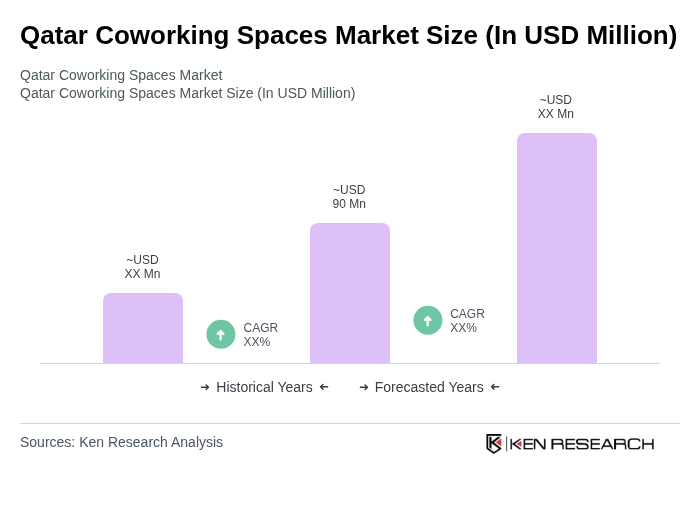
- The Qatar Coworking Spaces Market is valued at USD 90 million, based on a five-year historical analysis and regional benchmarks for Qatar’s share within the Middle East coworking space market. This growth is primarily driven by the increasing number of startups, freelancers, and remote workers seeking flexible workspace solutions, in line with the broader Middle East trend toward flexible offices. The demand for coworking spaces has surged as businesses adapt to changing work environments, emphasizing collaboration, hybrid work models, and access to fully serviced, tech-enabled offices.
- Doha is the dominant city in the Qatar Coworking Spaces Market due to its status as the capital and economic hub of the country. The concentration of businesses, government institutions, and educational organizations in Doha fosters a vibrant ecosystem for coworking spaces, supported by major office clusters in West Bay/Al Dafna and Lusail, which together account for a large share of Qatar’s purpose-built office stock. Additionally, Lusail and The Pearl are emerging as significant locations due to their modern infrastructure, mixed-use developments, and appeal to both local and international businesses looking for premium flexible office solutions.
- To support entrepreneurship, innovation, and flexible workspace models, coworking operators in Qatar typically operate under the general commercial and real estate framework established by instruments such as the Qatar Financial Centre Companies Regulations, issued by the Qatar Financial Centre Authority in 2005, and the Commercial Companies Law issued by the State of Qatar in 2015, which set out company formation, licensing, and operational requirements for service providers including office and business support services. In parallel, national initiatives such as the Qatar National Vision 2030 and programs led by entities like Qatar Development Bank and Qatar Business Incubation Center provide incentives and support mechanisms that indirectly benefit coworking operators serving startups and freelancers.
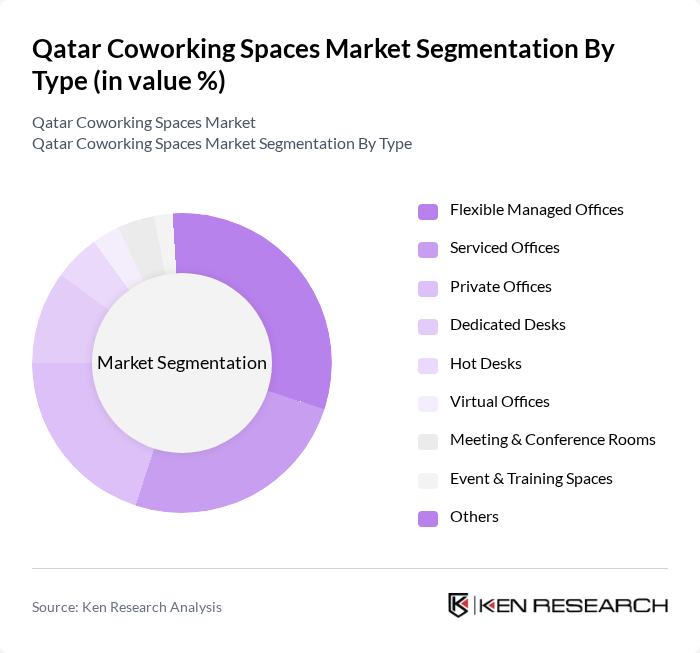
Qatar Coworking Spaces Market Segmentation
By Type:The coworking spaces market can be segmented into various types, including Flexible Managed Offices, Serviced Offices, Private Offices, Dedicated Desks, Hot Desks, Virtual Offices, Meeting & Conference Rooms, Event & Training Spaces, and Others. Flexible Managed Offices are gaining traction due to their adaptability, bundled services, and ability to scale space up or down in line with business needs, which aligns with regional demand for shorter lease terms and plug?and?play offices. Serviced Offices also hold a significant share, appealing to companies seeking fully equipped workspaces, reception and IT services, and prestigious business addresses without long-term commitments. The demand for Private Offices is rising as businesses prioritize privacy, data security, and dedicated spaces for their teams within larger shared facilities, particularly among SMEs and international firms entering the Qatari market.
By End-User:The end-user segmentation of the coworking spaces market includes Freelancers and Remote Workers, Startups, Small and Medium Enterprises (SMEs), Large Enterprises and Multinationals, Government-Backed Innovation & Incubation Programs, Non-Profit and Community Organizations, and Others. Freelancers and Remote Workers are the largest segment, supported by the global shift toward hybrid and remote work and the preference for flexible, on-demand work environments. Startups also represent a significant portion of the market, as they often seek cost-effective solutions, shared amenities, and networking opportunities to establish and scale their operations, which is consistent with Qatar’s focus on SME and startup development. SMEs are increasingly utilizing coworking spaces to foster collaboration, manage real estate costs more efficiently, and access prime business districts without committing to traditional long-term leases.

Qatar Coworking Spaces Market Competitive Landscape
The Qatar Coworking Spaces Market is characterized by a dynamic mix of regional and international players. Leading participants such as Regus (International Workplace Group), Servcorp, Workinton Qatar, Regus Spaces, QBIC – Qatar Business Incubation Center, Workinton Alfardan Centre, Servcorp – Tornado Tower, West Bay, Regus – Doha West Bay, Regus – Lusail Marina, Regus – The Pearl-Qatar, Servcorp – Qatar Financial Centre, Maktab Qatar, Global Business Centre Doha, Alliance Business Centers Network – Qatar, and other emerging local coworking operators contribute to innovation, geographic expansion, and service delivery in this space.
Qatar Coworking Spaces Market Industry Analysis
Growth Drivers
- Increasing Demand for Flexible Workspaces:The demand for flexible workspaces in Qatar has surged, with over 30% of companies in Doha adopting coworking solutions in future. This shift is driven by the need for cost-effective office solutions, as traditional office rents in prime areas can exceed QAR 1,800 per square meter annually. The flexibility offered by coworking spaces allows businesses to scale operations without long-term commitments, aligning with the evolving work culture in the region.
- Rise of the Gig Economy:Qatar's gig economy is projected to grow significantly, with an estimated 25,000 freelancers operating in various sectors in future. This trend is supported by the Qatar National Vision 2030, which encourages entrepreneurship and innovation. As more individuals seek freelance opportunities, the demand for coworking spaces that provide networking and collaboration opportunities is expected to increase, fostering a vibrant community of independent professionals.
- Government Initiatives Promoting Entrepreneurship:The Qatari government has launched several initiatives to support startups, including the Qatar Business Incubation Center, which has facilitated the establishment of over 200 startups since its inception. By 2024, these initiatives are expected to create an additional 6,000 jobs, further driving the need for coworking spaces that cater to new businesses. Such government support enhances the entrepreneurial ecosystem, making coworking spaces an attractive option for emerging companies.
Market Challenges
- High Competition Among Coworking Spaces:The coworking space market in Qatar is becoming increasingly saturated, with over 60 established providers competing for a limited customer base. This intense competition has led to price wars, with some spaces offering discounts of up to 35% to attract clients. As a result, maintaining profitability while providing quality services is a significant challenge for operators in this crowded market.
- Economic Fluctuations Affecting Occupancy Rates:Qatar's economy is sensitive to fluctuations in oil prices, which can impact occupancy rates in coworking spaces. For instance, a decline in oil prices by 15% could lead to a 20% drop in demand for office space, as companies may reduce operational costs. This volatility poses a challenge for coworking operators, who must adapt to changing economic conditions to maintain occupancy and revenue stability.
Qatar Coworking Spaces Market Future Outlook
The future of coworking spaces in Qatar appears promising, driven by the increasing adoption of hybrid work models and a growing emphasis on community engagement. As businesses continue to embrace flexible work arrangements, the demand for coworking spaces that foster collaboration and innovation is expected to rise. Additionally, the integration of advanced technology in these environments will enhance user experience, making coworking spaces more appealing to a diverse range of professionals and businesses.
Market Opportunities
- Expansion into Suburban Areas:There is a significant opportunity for coworking spaces to expand into suburban regions, where demand is rising due to lower rental costs and increased remote work. In future, suburban coworking spaces could attract up to 30% of the market share, appealing to professionals seeking convenience and affordability outside urban centers.
- Collaboration with Local Businesses:Partnering with local businesses can create unique offerings that enhance the coworking experience. In future, collaborations could lead to the establishment of specialized coworking spaces that cater to specific industries, potentially increasing membership by 20% as businesses seek tailored environments that foster innovation and networking.
Scope of the Report
| Segment | Sub-Segments |
|---|---|
| By Type | Flexible Managed Offices Serviced Offices Private Offices Dedicated Desks Hot Desks Virtual Offices Meeting & Conference Rooms Event & Training Spaces Others |
| By End-User | Freelancers and Remote Workers Startups Small and Medium Enterprises (SMEs) Large Enterprises and Multinationals Government-Backed Innovation & Incubation Programs Non-Profit and Community Organizations Others |
| By Location | Doha Central Business District (West Bay, Al Dafna) Lusail The Pearl and Waterfront Developments Secondary Urban Areas (e.g., Al Sadd, Al Waab) Other Cities and Suburban Areas Others |
| By Service Offering | Workspace Access (Desks, Offices, Meeting Rooms) Business Support Services (Reception, Mail Handling, PRO/Company Setup) Technology & Connectivity (High-Speed Internet, IT Support) Community & Networking Programs Ancillary Services (Parking, F&B, Printing, Event Hosting) Others |
| By Duration of Use | Hourly and Daily Passes Weekly Passes Monthly Memberships Long-Term Contracts (6–24 Months) Others |
| By Industry Focus | Technology & Startups Creative & Media Professional Services (Legal, Consulting, Finance) Education, Training & EdTech Public Sector & NGOs Others |
| By Policy Support | Government Grants & Subsidies (e.g., QDB, QF programs) Tax and Fee Incentives for Tenants Rent Support and Incubation Schemes Free Zone & Special Economic Zone Incentives Others |
Key Target Audience
Investors and Venture Capitalist Firms
Government and Regulatory Bodies (e.g., Qatar Financial Centre, Ministry of Commerce and Industry)
Real Estate Developers
Corporate Clients and Enterprises
Freelancers and Remote Workers
Startup Incubators and Accelerators
Technology Providers
Local Business Associations
Players Mentioned in the Report:
Regus (International Workplace Group)
Servcorp
Workinton Qatar
Regus Spaces
QBIC Qatar Business Incubation Center
Workinton Alfardan Centre
Servcorp Tornado Tower, West Bay
Regus Doha West Bay
Regus Lusail Marina
Regus The Pearl-Qatar
Servcorp Qatar Financial Centre
Maktab Qatar
Global Business Centre Doha
Alliance Business Centers Network Qatar
Other Emerging Local Coworking Operators
Table of Contents
Market Assessment Phase
1. Executive Summary and Approach
2. Qatar Coworking Spaces Market Overview
2.1 Key Insights and Strategic Recommendations
2.2 Qatar Coworking Spaces Market Overview
2.3 Definition and Scope
2.4 Evolution of Market Ecosystem
2.5 Timeline of Key Regulatory Milestones
2.6 Value Chain & Stakeholder Mapping
2.7 Business Cycle Analysis
2.8 Policy & Incentive Landscape
3. Qatar Coworking Spaces Market Analysis
3.1 Growth Drivers
3.1.1 Increasing demand for flexible workspaces
3.1.2 Rise of the gig economy
3.1.3 Government initiatives promoting entrepreneurship
3.1.4 Technological advancements in workspace management
3.2 Market Challenges
3.2.1 High competition among coworking spaces
3.2.2 Economic fluctuations affecting occupancy rates
3.2.3 Limited awareness of coworking benefits
3.2.4 Regulatory hurdles in real estate leasing
3.3 Market Opportunities
3.3.1 Expansion into suburban areas
3.3.2 Collaboration with local businesses
3.3.3 Offering specialized services for startups
3.3.4 Integration of wellness and sustainability features
3.4 Market Trends
3.4.1 Increased focus on community-building activities
3.4.2 Adoption of hybrid work models
3.4.3 Growth of niche coworking spaces
3.4.4 Enhanced technology integration in coworking environments
3.5 Government Regulation
3.5.1 Licensing requirements for coworking spaces
3.5.2 Tax incentives for startups
3.5.3 Zoning laws affecting coworking space locations
3.5.4 Health and safety regulations in shared workspaces
4. SWOT Analysis
5. Stakeholder Analysis
6. Porter's Five Forces Analysis
7. Qatar Coworking Spaces Market Market Size, 2019-2024
7.1 By Value
7.2 By Volume
7.3 By Average Selling Price
8. Qatar Coworking Spaces Market Segmentation
8.1 By Type
8.1.1 Flexible Managed Offices
8.1.2 Serviced Offices
8.1.3 Private Offices
8.1.4 Dedicated Desks
8.1.5 Hot Desks
8.1.6 Virtual Offices
8.1.7 Meeting & Conference Rooms
8.1.8 Event & Training Spaces
8.1.9 Others
8.2 By End-User
8.2.1 Freelancers and Remote Workers
8.2.2 Startups
8.2.3 Small and Medium Enterprises (SMEs)
8.2.4 Large Enterprises and Multinationals
8.2.5 Government-Backed Innovation & Incubation Programs
8.2.6 Non-Profit and Community Organizations
8.2.7 Others
8.3 By Location
8.3.1 Doha Central Business District (West Bay, Al Dafna)
8.3.2 Lusail
8.3.3 The Pearl and Waterfront Developments
8.3.4 Secondary Urban Areas (e.g., Al Sadd, Al Waab)
8.3.5 Other Cities and Suburban Areas
8.3.6 Others
8.4 By Service Offering
8.4.1 Workspace Access (Desks, Offices, Meeting Rooms)
8.4.2 Business Support Services (Reception, Mail Handling, PRO/Company Setup)
8.4.3 Technology & Connectivity (High-Speed Internet, IT Support)
8.4.4 Community & Networking Programs
8.4.5 Ancillary Services (Parking, F&B, Printing, Event Hosting)
8.4.6 Others
8.5 By Duration of Use
8.5.1 Hourly and Daily Passes
8.5.2 Weekly Passes
8.5.3 Monthly Memberships
8.5.4 Long-Term Contracts (6–24 Months)
8.5.5 Others
8.6 By Industry Focus
8.6.1 Technology & Startups
8.6.2 Creative & Media
8.6.3 Professional Services (Legal, Consulting, Finance)
8.6.4 Education, Training & EdTech
8.6.5 Public Sector & NGOs
8.6.6 Others
8.7 By Policy Support
8.7.1 Government Grants & Subsidies (e.g., QDB, QF programs)
8.7.2 Tax and Fee Incentives for Tenants
8.7.3 Rent Support and Incubation Schemes
8.7.4 Free Zone & Special Economic Zone Incentives
8.7.5 Others
9. Qatar Coworking Spaces Market Competitive Analysis
9.1 Market Share of Key Players
9.2 Cross Comparison of Key Players
9.2.1 Number of Centers in Qatar
9.2.2 Total Workstations/Seating Capacity
9.2.3 Average Occupancy Rate (%)
9.2.4 Average Revenue per Workstation (QAR/Month)
9.2.5 Average Desk Price (Hot Desk / Dedicated Desk)
9.2.6 Share of Corporate vs. Individual Members
9.2.7 Average Contract Tenure (Months)
9.2.8 Center-Level EBITDA Margin (%)
9.2.9 Space per Member (Sq. m per Member)
9.2.10 Ancillary Revenue Share (Meeting Rooms, Events, Services)
9.2.11 Digital Platform Adoption (Online Booking, App Usage)
9.2.12 Community & Program Intensity (Events per Month per Center)
9.3 SWOT Analysis of Top Players
9.4 Pricing Analysis
9.5 Detailed Profile of Major Companies
9.5.1 Regus (International Workplace Group)
9.5.2 Servcorp
9.5.3 Workinton Qatar
9.5.4 Regus Spaces
9.5.5 QBIC – Qatar Business Incubation Center
9.5.6 Workinton Alfardan Centre
9.5.7 Servcorp – Tornado Tower, West Bay
9.5.8 Regus – Doha West Bay
9.5.9 Regus – Lusail Marina
9.5.10 Regus – The Pearl-Qatar
9.5.11 Servcorp – Qatar Financial Centre
9.5.12 Maktab Qatar
9.5.13 Global Business Centre Doha
9.5.14 Alliance Business Centers Network – Qatar
9.5.15 Other Emerging Local Coworking Operators
10. Qatar Coworking Spaces Market End-User Analysis
10.1 Procurement Behavior of Key Ministries
10.1.1 Ministry of Economy and Commerce
10.1.2 Ministry of Transport and Communications
10.1.3 Ministry of Education and Higher Education
10.1.4 Ministry of Public Health
10.2 Corporate Spend on Infrastructure & Energy
10.2.1 Investment in Office Space
10.2.2 Budget Allocation for Flexible Workspaces
10.2.3 Expenditure on Technology Integration
10.2.4 Others
10.3 Pain Point Analysis by End-User Category
10.3.1 Cost of Membership
10.3.2 Availability of Amenities
10.3.3 Location Accessibility
10.3.4 Community Engagement
10.4 User Readiness for Adoption
10.4.1 Awareness of Coworking Benefits
10.4.2 Flexibility in Work Arrangements
10.4.3 Technology Adoption
10.4.4 Others
10.5 Post-Deployment ROI and Use Case Expansion
10.5.1 Measurement of Productivity Gains
10.5.2 Cost Savings Analysis
10.5.3 User Satisfaction Surveys
10.5.4 Others
11. Qatar Coworking Spaces Market Future Size, 2025-2030
11.1 By Value
11.2 By Volume
11.3 By Average Selling Price
Go-To-Market Strategy Phase
1. Whitespace Analysis + Business Model Canvas
1.1 Market Gaps Identification
1.2 Value Proposition Development
1.3 Revenue Streams Analysis
1.4 Cost Structure Evaluation
1.5 Key Partnerships Exploration
1.6 Customer Segments Definition
1.7 Channels for Delivery
2. Marketing and Positioning Recommendations
2.1 Branding Strategies
2.2 Product USPs
2.3 Target Audience Identification
2.4 Communication Strategy
2.5 Digital Marketing Tactics
2.6 Offline Marketing Strategies
2.7 Performance Metrics
3. Distribution Plan
3.1 Urban Retail vs Rural NGO Tie-Ups
3.2 Distribution Channels Analysis
3.3 Logistics and Supply Chain Considerations
3.4 Partnership Opportunities
3.5 Customer Access Strategies
3.6 Performance Evaluation
4. Channel & Pricing Gaps
4.1 Underserved Routes
4.2 Pricing Bands Analysis
4.3 Competitor Pricing Comparison
4.4 Customer Willingness to Pay
4.5 Pricing Strategy Recommendations
4.6 Performance Metrics
5. Unmet Demand & Latent Needs
5.1 Category Gaps Identification
5.2 Consumer Segments Analysis
5.3 Future Trends Exploration
5.4 Customer Feedback Mechanisms
5.5 Performance Metrics
6. Customer Relationship
6.1 Loyalty Programs
6.2 After-Sales Service
6.3 Customer Engagement Strategies
6.4 Feedback and Improvement Processes
6.5 Performance Metrics
7. Value Proposition
7.1 Sustainability Initiatives
7.2 Integrated Supply Chains
7.3 Unique Selling Points
7.4 Customer-Centric Approach
7.5 Performance Metrics
8. Key Activities
8.1 Regulatory Compliance
8.2 Branding
8.3 Distribution Setup
8.4 Community Engagement
8.5 Performance Metrics
9. Entry Strategy Evaluation
9.1 Domestic Market Entry Strategy
9.1.1 Product Mix
9.1.2 Pricing Band
9.1.3 Packaging
9.2 Export Entry Strategy
9.2.1 Target Countries
9.2.2 Compliance Roadmap
10. Entry Mode Assessment
10.1 Joint Ventures
10.2 Greenfield Investments
10.3 Mergers & Acquisitions
10.4 Distributor Model
10.5 Performance Metrics
11. Capital and Timeline Estimation
11.1 Capital Requirements
11.2 Timelines
11.3 Risk Assessment
11.4 Performance Metrics
12. Control vs Risk Trade-Off
12.1 Ownership vs Partnerships
12.2 Risk Mitigation Strategies
12.3 Performance Metrics
13. Profitability Outlook
13.1 Breakeven Analysis
13.2 Long-Term Sustainability
13.3 Performance Metrics
14. Potential Partner List
14.1 Distributors
14.2 Joint Ventures
14.3 Acquisition Targets
14.4 Performance Metrics
15. Execution Roadmap
15.1 Phased Plan for Market Entry
15.1.1 Market Setup
15.1.2 Market Entry
15.1.3 Growth Acceleration
15.1.4 Scale & Stabilize
15.2 Key Activities and Milestones
15.2.1 Activity Planning
15.2.2 Milestone Tracking
Research Methodology
Phase 1: Approach1
Desk Research
- Analysis of industry reports from local business councils and economic development agencies in Qatar
- Review of coworking space listings and occupancy rates from real estate platforms and coworking directories
- Examination of government publications on entrepreneurship and innovation initiatives in Qatar
Primary Research
- Interviews with founders and managers of leading coworking spaces in Qatar
- Surveys targeting freelancers and remote workers to understand their preferences and usage patterns
- Focus groups with startup incubators and accelerators to gauge the demand for coworking facilities
Validation & Triangulation
- Cross-validation of findings through multiple data sources, including real estate trends and user feedback
- Triangulation of qualitative insights from interviews with quantitative data from surveys
- Sanity checks conducted through expert panel reviews comprising industry veterans and market analysts
Phase 2: Market Size Estimation1
Top-down Assessment
- Estimation of total addressable market based on Qatar's economic growth and urbanization rates
- Segmentation of the market by industry verticals utilizing coworking spaces, such as tech startups and creative industries
- Incorporation of government initiatives promoting entrepreneurship and innovation in the region
Bottom-up Modeling
- Collection of occupancy rates and pricing models from various coworking spaces across Qatar
- Estimation of revenue streams based on membership types, event hosting, and additional services offered
- Volume x pricing analysis to derive potential revenue for different coworking space models
Forecasting & Scenario Analysis
- Multi-factor regression analysis incorporating economic indicators, remote work trends, and demographic shifts
- Scenario planning based on potential impacts of global economic conditions and local policy changes
- Development of baseline, optimistic, and pessimistic forecasts through 2030
Phase 3: CATI Sample Composition1
| Scope Item/Segment | Sample Size | Target Respondent Profiles |
|---|---|---|
| Freelancer Usage Patterns | 120 | Freelancers, Remote Workers |
| Startup Incubator Feedback | 80 | Startup Founders, Program Managers |
| Corporate Clients of Coworking Spaces | 70 | HR Managers, Office Space Planners |
| Event Hosting in Coworking Spaces | 60 | Event Coordinators, Marketing Managers |
| Real Estate Insights on Coworking | 50 | Real Estate Analysts, Property Managers |
Frequently Asked Questions
What is the current value of the Qatar Coworking Spaces Market?
The Qatar Coworking Spaces Market is valued at approximately USD 90 million, reflecting a significant growth trend driven by the increasing demand for flexible workspace solutions among startups, freelancers, and remote workers in the region.
Which city dominates the Qatar Coworking Spaces Market?
What types of coworking spaces are available in Qatar?
Who are the primary end-users of coworking spaces in Qatar?
Other Regional/Country Reports
Indonesia Coworking Spaces Market
Malaysia Coworking Spaces Market
KSA Coworking Spaces Market
APAC Coworking Spaces Market
SEA Coworking Spaces Market
Other Adjacent Reports
Singapore Serviced Office Market
Vietnam Business Incubation Market
Thailand Virtual Office Market
Saudi Arabia Commercial Real Estate MarketThailand Remote Work Technology Market
Qatar Freelance Services Market
KSA Startup Ecosystem Market
Japan Co-living Spaces Market
Malaysia Event Space Rental Market
Why Buy From Us?

What makes us stand out is that our consultants follow Robust, Refine and Result (RRR) methodology. Robust for clear definitions, approaches and sanity checking, Refine for differentiating respondents' facts and opinions, and Result for presenting data with story.

We have set a benchmark in the industry by offering our clients with syndicated and customized market research reports featuring coverage of entire market as well as meticulous research and analyst insights.

While we don't replace traditional research, we flip the method upside down. Our dual approach of Top Bottom & Bottom Top ensures quality deliverable by not just verifying company fundamentals but also looking at the sector and macroeconomic factors.

With one step in the future, our research team constantly tries to show you the bigger picture. We help with some of the tough questions you may encounter along the way: How is the industry positioned? Best marketing channel? KPI's of competitors? By aligning every element, we help maximize success.

Our report gives you instant access to the answers and sources that other companies might choose to hide. We elaborate each steps of research methodology we have used and showcase you the sample size to earn your trust.

If you need any support, we are here! We pride ourselves on universe strength, data quality, and quick, friendly, and professional service.