About the Report
Base Year 2024Qatar Industrial Oil Water Separators Market Overview
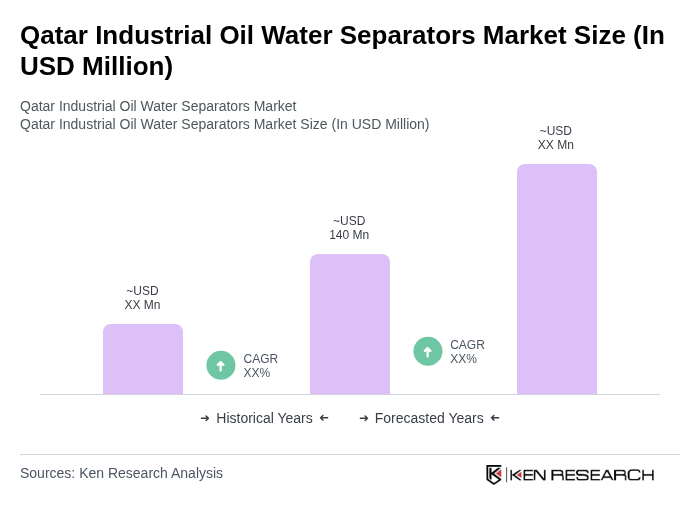
- The Qatar Industrial Oil Water Separators Market is valued at USD 140 million, based on a five-year historical analysis and benchmarked against the share of oil and gas, marine, and industrial wastewater treatment within the global industrial oil water separators market. This growth is primarily driven by the increasing demand for effective wastewater treatment solutions in the oil and gas sector, including produced water and refinery effluents, along with environmental standards that limit oily discharges to very low parts?per?million (ppm) levels. The rising industrial activities and urbanization in Qatar, supported by ongoing investments in petrochemicals, power and desalination, and industrial zones, further contribute to the market's expansion through higher volumes of industrial wastewater requiring treatment and reuse.
- Key demand centers in this market include industrial clusters around Doha, Al Rayyan, and Lusail, which dominate due to their strategic locations, proximity to major logistics corridors, and concentration of oil and gas support services, manufacturing facilities, ports, and infrastructure projects. The concentration of upstream, midstream, and downstream oil and gas activities, along with large construction, transport, and commercial developments in and around these cities, enhances the demand for oil water separators in applications such as industrial plants, service stations, workshops, ports, and centralized wastewater treatment plants, making these areas pivotal in the regional market.
- Qatar regulates wastewater and oily discharges from industrial facilities through instruments such as Law No. 30 of 2002 on the Environment Protection, issued by the State of Qatar, which requires establishments to treat wastewater before discharge and comply with effluent quality standards set by the Ministry of Environment and Climate Change. In practice, these rules are implemented via discharge permits, limits on oil and grease concentrations, and monitoring obligations for facilities in sectors such as oil and gas, power, desalination, and industrial manufacturing, thereby supporting the adoption of oil water separators and other advanced separation technologies in the market.
Qatar Industrial Oil Water Separators Market Segmentation
By Separator Configuration:This segmentation includes various types of oil water separators based on their design and installation. The subsegments are: Above-Ground Oil Water Separators, Below-Ground Oil Water Separators, Marine Oil Water Separators (MARPOL-Compliant), Containerized / Skid-Mounted Systems, and Custom Engineered & Retrofit Solutions. The market is primarily driven by the need for efficient and compliant separation technologies in various industrial applications, with growing emphasis on compact, energy?efficient systems that are easy to integrate into existing plants and meet tighter discharge limits.
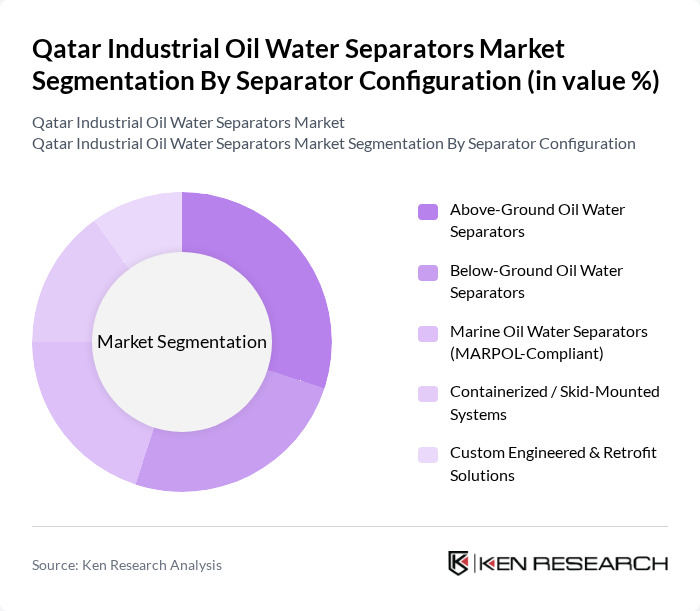
The Above-Ground Oil Water Separators segment is currently leading the market due to their ease of installation and maintenance, making them a preferred choice for many industrial applications, especially in retrofit projects and facilities with space constraints. These systems are particularly favored in the oil and gas sector, workshops, and service areas where rapid deployment, flexibility in capacity expansion, and operational efficiency are critical. The growing awareness of environmental compliance, rising penalties for non?compliant discharges, and the need for effective wastewater management further bolster the demand for above-ground solutions, positioning them as the dominant subsegment in the market.
By End-User Industry:This segmentation categorizes the market based on the industries that utilize oil water separators. The subsegments include Upstream Oil & Gas (Onshore and Offshore), Midstream & Downstream (Refining, Pipelines, Terminals), Petrochemicals & Chemicals, Power & Desalination Plants, Marine, Ports & Shipyards, Manufacturing & Industrial Zones, and Municipal & Centralized Wastewater Treatment. The demand from these sectors is driven by regulatory requirements on oil and grease discharge, corporate sustainability targets, and the push to reduce fresh?water intake through greater reuse of treated wastewater.
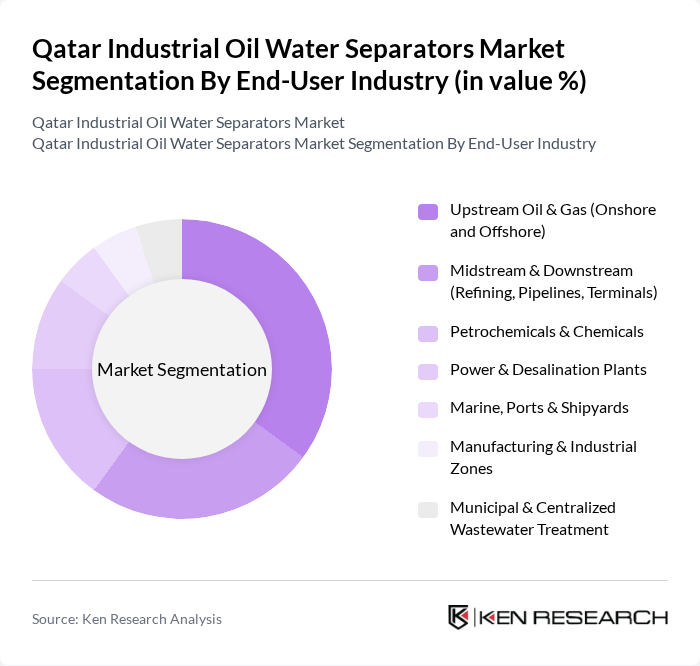
The Upstream Oil & Gas segment is the largest end-user of oil water separators, driven by the high volume of produced water and oily slops generated during drilling, production, and well?testing operations. The stringent regulations regarding wastewater treatment in this sector, together with industry standards that limit oil in water discharge from offshore and onshore fields, necessitate the use of advanced separation technologies, including API separators, coalescing plate units, and compact modular treatment packages. Additionally, the ongoing expansion and brownfield optimization of oil and gas activities in Qatar, particularly associated with gas processing and related infrastructure, further enhances the demand for effective oil water separation solutions, solidifying its position as the leading subsegment in the market.
Qatar Industrial Oil Water Separators Market Competitive Landscape
The Qatar Industrial Oil Water Separators Market is characterized by a dynamic mix of regional and international players. Leading participants such as Veolia Water Technologies & Solutions Qatar, SUEZ – Water Technologies & Solutions (SUEZ Qatar), Alfa Laval Middle East Ltd. (Qatar Operations), Wartsila Qatar WLL (Marine Oil Water Separators), Prominent Fluid Controls Middle East (Qatar), Enviro-Tech Systems LLC (Gulf & Qatar Projects), Hydro International Ltd. (Regional Projects in Qatar), Ecolog International Qatar, Pentair Middle East (Qatar), Ecolab Gulf FZE (Qatar Branch), Qatar Engineering & Construction Company (Qcon), Petrofac Qatar (Water Treatment & Produced Water Separation), Schlumberger Limited (SLB Qatar – Produced Water & Separation Systems), Halliburton Qatar (Produced Water & Separation Solutions), Siemens Energy Qatar (Industrial Water & Wastewater Solutions) contribute to innovation, geographic expansion, and service delivery in this space.
Qatar Industrial Oil Water Separators Market Industry Analysis
Growth Drivers
- Increasing Environmental Regulations:Qatar's commitment to environmental sustainability is evident in its National Development Strategy, which allocates approximately QAR 1.8 billion for environmental protection initiatives in the future. This regulatory framework mandates industries to adopt oil water separators to comply with stringent waste management laws, thereby driving market growth. The Qatar Ministry of Environment has set specific targets for reducing water pollution, which further incentivizes the adoption of advanced separation technologies in various sectors, including oil and gas.
- Rising Industrialization:Qatar's industrial sector is projected to contribute around QAR 120 billion to the national GDP in the future, driven by the expansion of industries such as oil and gas, construction, and manufacturing. This industrial growth necessitates effective water management solutions, including oil water separators, to mitigate environmental impacts. The increasing number of industrial facilities, estimated to reach over 1,500 in the future, creates a robust demand for efficient water treatment technologies, further propelling market expansion.
- Technological Advancements in Separation Technologies:The Qatar Industrial Oil Water Separators market is witnessing rapid technological advancements, with investments in R&D expected to exceed QAR 250 million in the future. Innovations such as membrane filtration and advanced coalescing technologies enhance the efficiency of oil water separators, making them more attractive to industries. These advancements not only improve separation efficiency but also reduce operational costs, thereby encouraging widespread adoption across various sectors, including municipal and industrial applications.
Market Challenges
- High Initial Investment Costs:The initial capital required for installing advanced oil water separators can be substantial, often exceeding QAR 600,000 for large-scale systems. This high upfront cost poses a significant barrier for small and medium-sized enterprises (SMEs) in Qatar, which may struggle to allocate sufficient budgets for such investments. Consequently, many SMEs may delay or forgo the adoption of necessary water treatment technologies, hindering overall market growth and environmental compliance.
- Regulatory Compliance Complexity:The regulatory landscape in Qatar is evolving, with multiple agencies involved in environmental oversight. This complexity can create confusion for businesses trying to navigate compliance requirements, particularly for SMEs lacking dedicated compliance resources. The potential for non-compliance fines, which can reach up to QAR 1.5 million, adds to the challenge, discouraging some companies from investing in oil water separators despite the long-term benefits of such technologies.
Qatar Industrial Oil Water Separators Market Future Outlook
The future of the Qatar Industrial Oil Water Separators market appears promising, driven by increasing environmental awareness and regulatory pressures. As industries expand, the demand for efficient water treatment solutions will likely rise, particularly in the oil and gas sector. Furthermore, the integration of smart technologies and sustainable practices will shape the market landscape, encouraging innovation and investment. Companies that adapt to these trends will be well-positioned to capitalize on emerging opportunities in the evolving regulatory environment.
Market Opportunities
- Expansion in Oil and Gas Sector:The oil and gas sector in Qatar is expected to invest over QAR 60 billion in infrastructure in the future, creating significant opportunities for oil water separator manufacturers. This investment will drive demand for advanced separation technologies, as companies seek to enhance their environmental compliance and operational efficiency, positioning them for long-term growth in the market.
- Development of Smart Water Management Systems:The increasing focus on digital transformation in water management presents a unique opportunity for the market. In the future, investments in smart water management systems are projected to reach QAR 1.2 billion, enabling real-time monitoring and optimization of water treatment processes. This trend will likely enhance the efficiency of oil water separators, making them more appealing to industries seeking innovative solutions.
Scope of the Report
| Segment | Sub-Segments |
|---|---|
| By Separator Configuration | Above-Ground Oil Water Separators Below-Ground Oil Water Separators Marine Oil Water Separators (MARPOL-Compliant) Containerized / Skid-Mounted Systems Custom Engineered & Retrofit Solutions |
| By End-User Industry | Upstream Oil & Gas (Onshore and Offshore) Midstream & Downstream (Refining, Pipelines, Terminals) Petrochemicals & Chemicals Power & Desalination Plants Marine, Ports & Shipyards Manufacturing & Industrial Zones Municipal & Centralized Wastewater Treatment |
| By Critical Application | Produced Water Treatment Oily Sludge & Slop Water Treatment Tank Farms, Refueling & Maintenance Depots Workshop, Garage & Wash-Bay Effluents Bilge & Ballast Water Treatment Stormwater & Surface Runoff from Industrial Sites |
| By Separation Technology | Gravity & API Separators Coalescing Plate (CPI/TPI) Separators Dissolved Air Flotation (DAF) Systems Membrane-Based Oil Removal Systems Electrocoagulation & Advanced Hybrid Systems |
| By Installation Environment | Onshore Facilities Offshore Platforms & FPSOs Port & Maritime Infrastructure Industrial Estates & Free Zones |
| By Procurement Model | CAPEX Purchase (New Installations) Rental / Temporary Treatment Systems Retrofit & Upgrade Projects Operations & Maintenance (O&M) Contracts Build-Own-Operate (BOO) / PPP Structures |
| By Compliance & Performance Class | MARPOL MEPC 60–100 ppm Systems MARPOL MEPC & Local <15 ppm Discharge Systems Qatari Environmental Regulations-Compliant Systems High-Recovery / Water Reuse-Oriented Systems |
Key Target Audience
Investors and Venture Capitalist Firms
Government and Regulatory Bodies (e.g., Ministry of Municipality and Environment, Qatar Petroleum)
Manufacturers and Producers of Oil Water Separators
Distributors and Retailers of Industrial Equipment
Environmental Agencies (e.g., Qatar Environment and Energy Research Institute)
Technology Providers for Water Treatment Solutions
Industry Associations (e.g., Qatar Chamber of Commerce and Industry)
Financial Institutions and Banks involved in Industrial Financing
Players Mentioned in the Report:
Veolia Water Technologies & Solutions Qatar
SUEZ Water Technologies & Solutions (SUEZ Qatar)
Alfa Laval Middle East Ltd. (Qatar Operations)
Wartsila Qatar WLL (Marine Oil Water Separators)
Prominent Fluid Controls Middle East (Qatar)
Enviro-Tech Systems LLC (Gulf & Qatar Projects)
Hydro International Ltd. (Regional Projects in Qatar)
Ecolog International Qatar
Pentair Middle East (Qatar)
Ecolab Gulf FZE (Qatar Branch)
Qatar Engineering & Construction Company (Qcon)
Petrofac Qatar (Water Treatment & Produced Water Separation)
Schlumberger Limited (SLB Qatar Produced Water & Separation Systems)
Halliburton Qatar (Produced Water & Separation Solutions)
Siemens Energy Qatar (Industrial Water & Wastewater Solutions)
Table of Contents
Market Assessment Phase
1. Executive Summary and Approach
2. Qatar Industrial Oil Water Separators Market Overview
2.1 Key Insights and Strategic Recommendations
2.2 Qatar Industrial Oil Water Separators Market Overview
2.3 Definition and Scope
2.4 Evolution of Market Ecosystem
2.5 Timeline of Key Regulatory Milestones
2.6 Value Chain & Stakeholder Mapping
2.7 Business Cycle Analysis
2.8 Policy & Incentive Landscape
3. Qatar Industrial Oil Water Separators Market Analysis
3.1 Growth Drivers
3.1.1 Increasing Environmental Regulations
3.1.2 Rising Industrialization
3.1.3 Growing Awareness of Water Pollution
3.1.4 Technological Advancements in Separation Technologies
3.2 Market Challenges
3.2.1 High Initial Investment Costs
3.2.2 Limited Awareness Among Small Enterprises
3.2.3 Regulatory Compliance Complexity
3.2.4 Competition from Alternative Technologies
3.3 Market Opportunities
3.3.1 Expansion in Oil and Gas Sector
3.3.2 Development of Smart Water Management Systems
3.3.3 Increasing Demand from Municipalities
3.3.4 Potential for Exporting Technologies
3.4 Market Trends
3.4.1 Adoption of IoT in Water Treatment
3.4.2 Shift Towards Sustainable Practices
3.4.3 Integration of AI in Monitoring Systems
3.4.4 Growth of Modular Treatment Solutions
3.5 Government Regulation
3.5.1 National Environmental Protection Laws
3.5.2 Water Quality Standards
3.5.3 Waste Management Regulations
3.5.4 Incentives for Green Technologies
4. SWOT Analysis
5. Stakeholder Analysis
6. Porter's Five Forces Analysis
7. Qatar Industrial Oil Water Separators Market Market Size, 2019-2024
7.1 By Value
7.2 By Volume
7.3 By Average Selling Price
8. Qatar Industrial Oil Water Separators Market Segmentation
8.1 By Separator Configuration
8.1.1 Above-Ground Oil Water Separators
8.1.2 Below-Ground Oil Water Separators
8.1.3 Marine Oil Water Separators (MARPOL-Compliant)
8.1.4 Containerized / Skid-Mounted Systems
8.1.5 Custom Engineered & Retrofit Solutions
8.2 By End-User Industry
8.2.1 Upstream Oil & Gas (Onshore and Offshore)
8.2.2 Midstream & Downstream (Refining, Pipelines, Terminals)
8.2.3 Petrochemicals & Chemicals
8.2.4 Power & Desalination Plants
8.2.5 Marine, Ports & Shipyards
8.2.6 Manufacturing & Industrial Zones
8.2.7 Municipal & Centralized Wastewater Treatment
8.3 By Critical Application
8.3.1 Produced Water Treatment
8.3.2 Oily Sludge & Slop Water Treatment
8.3.3 Tank Farms, Refueling & Maintenance Depots
8.3.4 Workshop, Garage & Wash-Bay Effluents
8.3.5 Bilge & Ballast Water Treatment
8.3.6 Stormwater & Surface Runoff from Industrial Sites
8.4 By Separation Technology
8.4.1 Gravity & API Separators
8.4.2 Coalescing Plate (CPI/TPI) Separators
8.4.3 Dissolved Air Flotation (DAF) Systems
8.4.4 Membrane-Based Oil Removal Systems
8.4.5 Electrocoagulation & Advanced Hybrid Systems
8.5 By Installation Environment
8.5.1 Onshore Facilities
8.5.2 Offshore Platforms & FPSOs
8.5.3 Port & Maritime Infrastructure
8.5.4 Industrial Estates & Free Zones
8.6 By Procurement Model
8.6.1 CAPEX Purchase (New Installations)
8.6.2 Rental / Temporary Treatment Systems
8.6.3 Retrofit & Upgrade Projects
8.6.4 Operations & Maintenance (O&M) Contracts
8.6.5 Build-Own-Operate (BOO) / PPP Structures
8.7 By Compliance & Performance Class
8.7.1 MARPOL MEPC 60–100 ppm Systems
8.7.2 MARPOL MEPC & Local <15 ppm Discharge Systems
8.7.3 Qatari Environmental Regulations-Compliant Systems
8.7.4 High-Recovery / Water Reuse-Oriented Systems
9. Qatar Industrial Oil Water Separators Market Competitive Analysis
9.1 Market Share of Key Players
9.2 Cross Comparison of Key Players
9.2.1 Company Name
9.2.2 Installed Base in Qatar (Number of Units / Total m³/h Capacity)
9.2.3 Revenue from Qatar Industrial Oil Water Separators
9.2.4 CAGR of Qatar Revenues (Last 3–5 Years)
9.2.5 Share of Oil & Gas vs Non-Oil & Gas Projects
9.2.6 Average Project Size (USD per Contract)
9.2.7 Order Backlog & Pipeline in Qatar
9.2.8 Win Rate in Competitive Tenders
9.2.9 Average Delivery & Commissioning Lead Time
9.2.10 Service & Maintenance Coverage (Response Time / No. of Local Technicians)
9.2.11 Technology Breadth (Number of Separator Types Offered)
9.2.12 Compliance Track Record (MARPOL / Local EPA Non?Compliance Incidents)
9.3 SWOT Analysis of Top Players
9.4 Pricing Analysis
9.5 Detailed Profile of Major Companies
9.5.1 Veolia Water Technologies & Solutions Qatar
9.5.2 SUEZ – Water Technologies & Solutions (SUEZ Qatar)
9.5.3 Alfa Laval Middle East Ltd. (Qatar Operations)
9.5.4 Wartsila Qatar WLL (Marine Oil Water Separators)
9.5.5 Prominent Fluid Controls Middle East (Qatar)
9.5.6 Enviro-Tech Systems LLC (Gulf & Qatar Projects)
9.5.7 Hydro International Ltd. (Regional Projects in Qatar)
9.5.8 Ecolog International Qatar
9.5.9 Pentair Middle East (Qatar)
9.5.10 Ecolab Gulf FZE (Qatar Branch)
9.5.11 Qatar Engineering & Construction Company (Qcon)
9.5.12 Petrofac Qatar (Water Treatment & Produced Water Separation)
9.5.13 Schlumberger Limited (SLB Qatar – Produced Water & Separation Systems)
9.5.14 Halliburton Qatar (Produced Water & Separation Solutions)
9.5.15 Siemens Energy Qatar (Industrial Water & Wastewater Solutions)
10. Qatar Industrial Oil Water Separators Market End-User Analysis
10.1 Procurement Behavior of Key Ministries
10.1.1 Ministry of Municipality and Environment
10.1.2 Ministry of Energy and Industry
10.1.3 Ministry of Transport and Communications
10.1.4 Ministry of Public Health
10.2 Corporate Spend on Infrastructure & Energy
10.2.1 Investment in Water Treatment Facilities
10.2.2 Budget Allocation for Environmental Projects
10.2.3 Spending on Compliance and Regulatory Measures
10.2.4 Expenditure on Technological Upgrades
10.3 Pain Point Analysis by End-User Category
10.3.1 Industrial Sector Challenges
10.3.2 Municipalities' Water Management Issues
10.3.3 Oil and Gas Sector Compliance Difficulties
10.3.4 Shipping Industry Waste Management Concerns
10.4 User Readiness for Adoption
10.4.1 Awareness of Technology Benefits
10.4.2 Financial Readiness for Investment
10.4.3 Training and Skill Development Needs
10.4.4 Regulatory Compliance Preparedness
10.5 Post-Deployment ROI and Use Case Expansion
10.5.1 Measurement of Cost Savings
10.5.2 Evaluation of Environmental Impact
10.5.3 Assessment of Operational Efficiency Gains
10.5.4 Opportunities for Scaling Solutions
11. Qatar Industrial Oil Water Separators Market Future Size, 2025-2030
11.1 By Value
11.2 By Volume
11.3 By Average Selling Price
Go-To-Market Strategy Phase
1. Whitespace Analysis + Business Model Canvas
1.1 Market Gaps Identification
1.2 Value Proposition Development
1.3 Revenue Streams Analysis
1.4 Cost Structure Evaluation
1.5 Key Partnerships Exploration
1.6 Customer Segmentation
1.7 Channels of Distribution
2. Marketing and Positioning Recommendations
2.1 Branding Strategies
2.2 Product USPs
2.3 Target Market Identification
2.4 Communication Strategy
2.5 Digital Marketing Approaches
2.6 Customer Engagement Tactics
2.7 Performance Metrics
3. Distribution Plan
3.1 Urban Retail Strategies
3.2 Rural NGO Tie-ups
3.3 Online Distribution Channels
3.4 Direct Sales Approaches
3.5 Partnership with Local Distributors
3.6 Logistics and Supply Chain Management
3.7 Inventory Management Solutions
4. Channel & Pricing Gaps
4.1 Underserved Routes
4.2 Pricing Bands Analysis
4.3 Competitor Pricing Strategies
4.4 Customer Willingness to Pay
4.5 Value-Based Pricing Models
4.6 Discount and Promotion Strategies
4.7 Price Sensitivity Assessment
5. Unmet Demand & Latent Needs
5.1 Category Gaps Identification
5.2 Consumer Segments Analysis
5.3 Emerging Trends and Preferences
5.4 Product Development Opportunities
5.5 Service Gaps Exploration
5.6 Market Entry Barriers
5.7 Future Demand Projections
6. Customer Relationship
6.1 Loyalty Programs
6.2 After-sales Service
6.3 Customer Feedback Mechanisms
6.4 Relationship Management Strategies
6.5 Community Engagement Initiatives
6.6 Customer Education and Training
6.7 Retention Strategies
7. Value Proposition
7.1 Sustainability Initiatives
7.2 Integrated Supply Chains
7.3 Cost-Effectiveness Analysis
7.4 Quality Assurance Measures
7.5 Innovation in Product Offerings
7.6 Customer-Centric Solutions
7.7 Competitive Advantage Assessment
8. Key Activities
8.1 Regulatory Compliance
8.2 Branding Initiatives
8.3 Distribution Setup
8.4 Market Research Activities
8.5 Training and Development Programs
8.6 Stakeholder Engagement
8.7 Performance Monitoring
9. Entry Strategy Evaluation
9.1 Domestic Market Entry Strategy
9.1.1 Product Mix Considerations
9.1.2 Pricing Band Analysis
9.1.3 Packaging Strategies
9.2 Export Entry Strategy
9.2.1 Target Countries Identification
9.2.2 Compliance Roadmap Development
10. Entry Mode Assessment
10.1 Joint Ventures
10.2 Greenfield Investments
10.3 Mergers and Acquisitions
10.4 Distributor Model Evaluation
11. Capital and Timeline Estimation
11.1 Capital Requirements Analysis
11.2 Timelines for Implementation
12. Control vs Risk Trade-Off
12.1 Ownership vs Partnerships
13. Profitability Outlook
13.1 Breakeven Analysis
13.2 Long-term Sustainability Assessment
14. Potential Partner List
14.1 Distributors
14.2 Joint Ventures
14.3 Acquisition Targets
15. Execution Roadmap
15.1 Phased Plan for Market Entry
15.1.1 Market Setup
15.1.2 Market Entry
15.1.3 Growth Acceleration
15.1.4 Scale & Stabilize
Research Methodology
Phase 1: Approach1
Desk Research
- Industry reports from Qatar's Ministry of Energy and Industry
- Market analysis publications from local environmental agencies
- Academic journals focusing on oil-water separation technologies
Primary Research
- Interviews with key stakeholders in the oil and gas sector
- Surveys targeting facility managers of industrial plants
- Field visits to operational sites utilizing oil water separators
Validation & Triangulation
- Cross-referencing data from multiple industry reports and publications
- Expert panel reviews to validate findings and assumptions
- Sanity checks through historical data trends and market forecasts
Phase 2: Market Size Estimation1
Top-down Assessment
- Analysis of national oil production statistics and wastewater generation
- Segmentation by industrial applications and end-user sectors
- Incorporation of government regulations on wastewater treatment
Bottom-up Modeling
- Volume estimates based on the number of operational separators in the market
- Cost analysis derived from supplier pricing and installation expenses
- Revenue projections based on market penetration rates and growth trends
Forecasting & Scenario Analysis
- Multi-variable regression analysis incorporating economic indicators
- Scenario modeling based on potential regulatory changes and technological advancements
- Development of baseline, optimistic, and pessimistic market forecasts through 2030
Phase 3: CATI Sample Composition1
| Scope Item/Segment | Sample Size | Target Respondent Profiles |
|---|---|---|
| Oil & Gas Industry Operators | 100 | Environmental Managers, Operations Directors |
| Manufacturing Sector Wastewater Management | 80 | Facility Managers, Compliance Officers |
| Construction Industry Water Treatment | 70 | Project Managers, Site Engineers |
| Municipal Wastewater Treatment Facilities | 60 | Plant Operators, Environmental Engineers |
| Research Institutions on Water Treatment Technologies | 50 | Research Scientists, Academic Professors |
Frequently Asked Questions
What is the current value of the Qatar Industrial Oil Water Separators Market?
The Qatar Industrial Oil Water Separators Market is valued at approximately USD 140 million, reflecting the growing demand for effective wastewater treatment solutions, particularly in the oil and gas sector, as well as compliance with stringent environmental regulations.
What factors are driving the growth of the Qatar Industrial Oil Water Separators Market?
Which regions in Qatar are the primary demand centers for oil water separators?
What are the main types of oil water separators used in Qatar?
Other Regional/Country Reports
Indonesia Industrial Oil Water Separators Market
Malaysia Industrial Oil Water Separators Market
KSA Industrial Oil Water Separators Market
APAC Industrial Oil Water Separators Market
SEA Industrial Oil Water Separators Market
Vietnam Industrial Oil Water Separators Market
Other Adjacent Reports
Egypt Wastewater Treatment Equipment Market
Belgium Produced Water Management Market
South Korea Industrial Filtration Systems Market
Vietnam Oil and Gas Separation Technologies Market
Kuwait Environmental Compliance Services Market
KSA Marine Pollution Control Equipment Market
Philippines Petrochemical Processing Equipment Market
Japan Desalination and Water Purification Market
Qatar Industrial Cleaning Solutions Market
Brazil Water Recycling and Reuse Technologies Market
Why Buy From Us?

What makes us stand out is that our consultants follow Robust, Refine and Result (RRR) methodology. Robust for clear definitions, approaches and sanity checking, Refine for differentiating respondents' facts and opinions, and Result for presenting data with story.

We have set a benchmark in the industry by offering our clients with syndicated and customized market research reports featuring coverage of entire market as well as meticulous research and analyst insights.

While we don't replace traditional research, we flip the method upside down. Our dual approach of Top Bottom & Bottom Top ensures quality deliverable by not just verifying company fundamentals but also looking at the sector and macroeconomic factors.

With one step in the future, our research team constantly tries to show you the bigger picture. We help with some of the tough questions you may encounter along the way: How is the industry positioned? Best marketing channel? KPI's of competitors? By aligning every element, we help maximize success.

Our report gives you instant access to the answers and sources that other companies might choose to hide. We elaborate each steps of research methodology we have used and showcase you the sample size to earn your trust.

If you need any support, we are here! We pride ourselves on universe strength, data quality, and quick, friendly, and professional service.