About the Report
Base Year 2024Listen to the audio summary
Qatar Psychiatry Clinic Market Overview
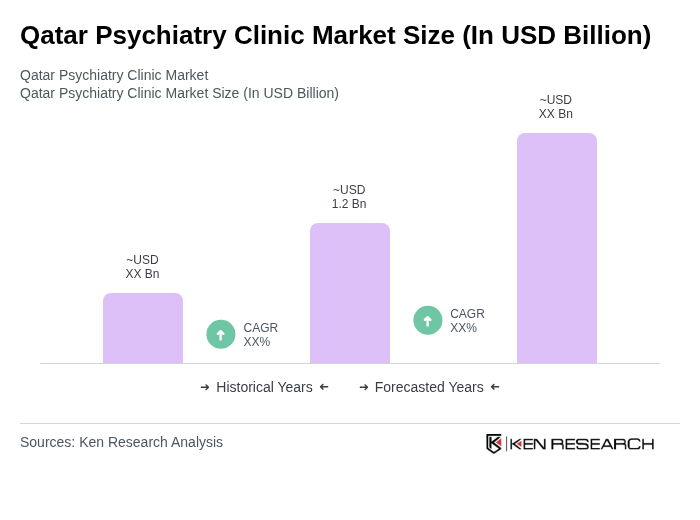
- The Qatar Psychiatry Clinic Market is valued at USD 1.2 billion, based on a five-year historical analysis. This growth is primarily driven by increasing awareness of mental health issues, rising demand for psychiatric services, and government initiatives aimed at improving mental health care accessibility. The expansion of healthcare facilities and the integration of mental health services into primary care have also contributed significantly to market growth.
- Doha is the dominant city in the Qatar Psychiatry Clinic Market due to its status as the capital and largest city, housing a majority of healthcare facilities and professionals. The concentration of population and resources in Doha facilitates better access to psychiatric services. Other notable areas include Al Rayyan and Al Wakrah, which are experiencing growth in mental health services due to urbanization and increased healthcare investments.
- In 2023, the Qatari government implemented a national mental health strategy aimed at enhancing mental health services across the country. This strategy includes a budget allocation of USD 100 million for the development of mental health facilities and training programs for healthcare professionals, ensuring that mental health care is prioritized and integrated into the overall healthcare system.
Qatar Psychiatry Clinic Market Segmentation
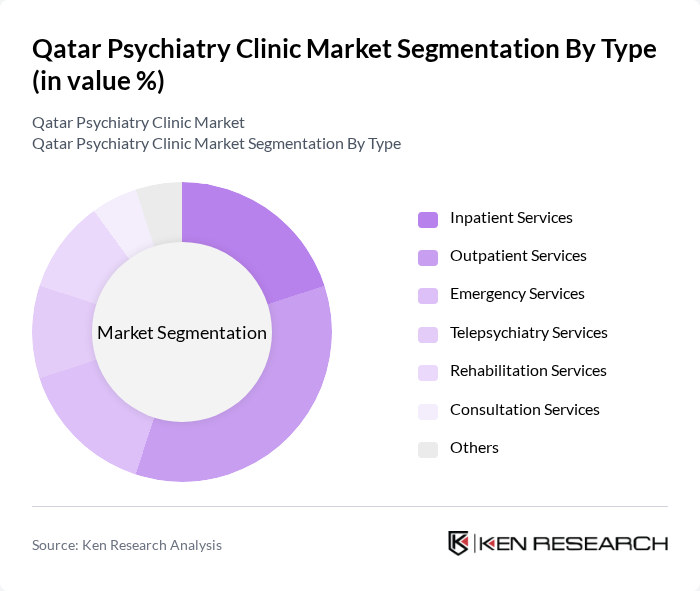
By Type:The market is segmented into various types of psychiatric services, including inpatient services, outpatient services, emergency services, telepsychiatry services, rehabilitation services, consultation services, and others. Among these, outpatient services are currently dominating the market due to the increasing preference for less intensive treatment options and the convenience they offer to patients. The rise of telepsychiatry services is also notable, as it provides accessible care to those in remote areas.
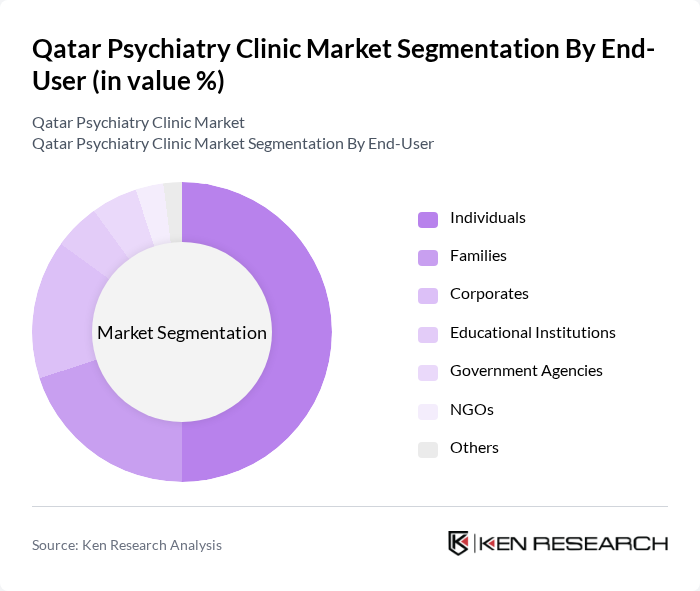
By End-User:The end-user segmentation includes individuals, families, corporates, educational institutions, government agencies, NGOs, and others. Individuals represent the largest segment, driven by the increasing recognition of mental health issues and the need for personal mental health care. Corporates are also emerging as significant users of psychiatric services, particularly in employee wellness programs, which are gaining traction in the workplace.
Qatar Psychiatry Clinic Market Competitive Landscape
The Qatar Psychiatry Clinic Market is characterized by a dynamic mix of regional and international players. Leading participants such as Hamad Medical Corporation, Qatar University Clinic, Doha Clinic Hospital, Al Ahli Hospital, American Hospital Doha, Qatar Behavioral Health Center, Al Emadi Hospital, The Psychiatric Hospital, Dr. Khalid Al-Mansoori Clinic, Qatar Medical Center, Doha Mental Health Center, Al Jazeera Hospital, The Wellness Clinic, Qatar Rehabilitation Institute, The Family Clinic contribute to innovation, geographic expansion, and service delivery in this space.
Qatar Psychiatry Clinic Market Industry Analysis
Growth Drivers
- Increasing Awareness of Mental Health Issues:The growing recognition of mental health as a critical component of overall well-being is driving demand for psychiatric services in Qatar. According to the Qatar National Mental Health Strategy 2013-2023, approximately 20% of the population experiences mental health issues, highlighting the need for accessible treatment. Public campaigns and educational programs have increased awareness, leading to a reported 30% rise in clinic visits over the past two years, indicating a shift towards prioritizing mental health care.
- Government Initiatives for Mental Health Support:The Qatari government has committed significant resources to enhance mental health services, allocating over QAR 100 million (approximately USD 27.5 million) in the future for mental health programs. This funding supports the establishment of new clinics and the training of mental health professionals. Additionally, the National Health Strategy emphasizes mental health integration into primary care, which is expected to improve access and reduce treatment gaps, further stimulating market growth.
- Rising Prevalence of Mental Health Disorders:The prevalence of mental health disorders in Qatar is increasing, with estimates suggesting that around 15% of the population suffers from anxiety or depression. The World Health Organization reported that mental health disorders are projected to be the leading cause of disability in the future. This rising demand for psychiatric services is prompting clinics to expand their offerings, thereby driving growth in the sector and necessitating more comprehensive treatment options.
Market Challenges
- Stigma Associated with Mental Health Treatment:Despite increasing awareness, stigma surrounding mental health issues remains a significant barrier in Qatar. A study by the Qatar University found that 40% of respondents expressed reluctance to seek help due to fear of judgment. This stigma can deter individuals from accessing necessary psychiatric services, limiting the market's potential growth and affecting overall treatment rates within the population.
- Limited Availability of Specialized Professionals:The shortage of qualified mental health professionals in Qatar poses a challenge to the psychiatry clinic market. Currently, there are only about 200 licensed psychiatrists for a population of over 2.8 million, resulting in a ratio of approximately 1 psychiatrist per 14,000 people. This scarcity leads to long wait times for patients and can hinder the effective delivery of mental health services, impacting overall market growth.
Qatar Psychiatry Clinic Market Future Outlook
The future of the Qatar psychiatry clinic market appears promising, driven by ongoing government support and increasing public awareness of mental health issues. As the stigma surrounding mental health continues to diminish, more individuals are likely to seek treatment. Additionally, the integration of technology in mental health services, such as telepsychiatry, is expected to enhance accessibility and convenience for patients, further expanding the market. The focus on personalized care will also shape service offerings in the coming years.
Market Opportunities
- Telepsychiatry Services Expansion:The rise of telehealth presents a significant opportunity for psychiatry clinics in Qatar. With over 90% of the population having internet access, clinics can leverage telepsychiatry to reach underserved areas, providing essential services to those unable to visit in person. This approach can enhance patient engagement and treatment adherence, ultimately improving mental health outcomes.
- Development of Community Mental Health Programs:There is a growing opportunity for clinics to collaborate with local organizations to develop community mental health programs. By focusing on preventive care and early intervention, these programs can address mental health issues before they escalate. Such initiatives can foster a supportive environment, reduce stigma, and improve overall community well-being, benefiting both patients and healthcare providers.
Scope of the Report
| Segment | Sub-Segments |
|---|---|
| By Type | Inpatient Services Outpatient Services Emergency Services Telepsychiatry Services Rehabilitation Services Consultation Services Others |
| By End-User | Individuals Families Corporates Educational Institutions Government Agencies NGOs Others |
| By Patient Demographics | Children and Adolescents Adults Elderly Gender-specific Services Others |
| By Treatment Type | Psychotherapy Pharmacotherapy Cognitive Behavioral Therapy Group Therapy Family Therapy Others |
| By Insurance Coverage | Private Insurance Public Insurance Out-of-Pocket Payments Others |
| By Geographic Distribution | Doha Al Rayyan Al Wakrah Al Khor Others |
| By Service Delivery Model | Private Clinics Public Hospitals Community Health Centers Mobile Clinics Others |
Key Target Audience
Investors and Venture Capitalist Firms
Government and Regulatory Bodies (e.g., Ministry of Public Health, Qatar Medical Commission)
Healthcare Providers and Psychiatric Clinics
Pharmaceutical Companies
Insurance Companies and Health Insurers
Non-Governmental Organizations (NGOs) focused on mental health
Medical Equipment Suppliers
Health Technology Startups
Players Mentioned in the Report:
Hamad Medical Corporation
Qatar University Clinic
Doha Clinic Hospital
Al Ahli Hospital
American Hospital Doha
Qatar Behavioral Health Center
Al Emadi Hospital
The Psychiatric Hospital
Dr. Khalid Al-Mansoori Clinic
Qatar Medical Center
Doha Mental Health Center
Al Jazeera Hospital
The Wellness Clinic
Qatar Rehabilitation Institute
The Family Clinic
Table of Contents
Market Assessment Phase
1. Executive Summary and Approach
2. Qatar Psychiatry Clinic Market Overview
2.1 Key Insights and Strategic Recommendations
2.2 Qatar Psychiatry Clinic Market Overview
2.3 Definition and Scope
2.4 Evolution of Market Ecosystem
2.5 Timeline of Key Regulatory Milestones
2.6 Value Chain & Stakeholder Mapping
2.7 Business Cycle Analysis
2.8 Policy & Incentive Landscape
3. Qatar Psychiatry Clinic Market Analysis
3.1 Growth Drivers
3.1.1 Increasing awareness of mental health issues
3.1.2 Government initiatives for mental health support
3.1.3 Rising prevalence of mental health disorders
3.1.4 Expansion of private healthcare facilities
3.2 Market Challenges
3.2.1 Stigma associated with mental health treatment
3.2.2 Limited availability of specialized professionals
3.2.3 High treatment costs
3.2.4 Regulatory hurdles in establishing clinics
3.3 Market Opportunities
3.3.1 Telepsychiatry services expansion
3.3.2 Collaborations with educational institutions
3.3.3 Development of community mental health programs
3.3.4 Increased funding for mental health research
3.4 Market Trends
3.4.1 Integration of technology in treatment
3.4.2 Focus on holistic and personalized care
3.4.3 Growth of outpatient services
3.4.4 Rising demand for mental health awareness campaigns
3.5 Government Regulation
3.5.1 Licensing requirements for mental health professionals
3.5.2 Regulations on telehealth services
3.5.3 Standards for clinic operations
3.5.4 Policies promoting mental health education
4. SWOT Analysis
5. Stakeholder Analysis
6. Porter's Five Forces Analysis
7. Qatar Psychiatry Clinic Market Market Size, 2019-2024
7.1 By Value
7.2 By Volume
7.3 By Average Selling Price
8. Qatar Psychiatry Clinic Market Segmentation
8.1 By Type
8.1.1 Inpatient Services
8.1.2 Outpatient Services
8.1.3 Emergency Services
8.1.4 Telepsychiatry Services
8.1.5 Rehabilitation Services
8.1.6 Consultation Services
8.1.7 Others
8.2 By End-User
8.2.1 Individuals
8.2.2 Families
8.2.3 Corporates
8.2.4 Educational Institutions
8.2.5 Government Agencies
8.2.6 NGOs
8.2.7 Others
8.3 By Patient Demographics
8.3.1 Children and Adolescents
8.3.2 Adults
8.3.3 Elderly
8.3.4 Gender-specific Services
8.3.5 Others
8.4 By Treatment Type
8.4.1 Psychotherapy
8.4.2 Pharmacotherapy
8.4.3 Cognitive Behavioral Therapy
8.4.4 Group Therapy
8.4.5 Family Therapy
8.4.6 Others
8.5 By Insurance Coverage
8.5.1 Private Insurance
8.5.2 Public Insurance
8.5.3 Out-of-Pocket Payments
8.5.4 Others
8.6 By Geographic Distribution
8.6.1 Doha
8.6.2 Al Rayyan
8.6.3 Al Wakrah
8.6.4 Al Khor
8.6.5 Others
8.7 By Service Delivery Model
8.7.1 Private Clinics
8.7.2 Public Hospitals
8.7.3 Community Health Centers
8.7.4 Mobile Clinics
8.7.5 Others
9. Qatar Psychiatry Clinic Market Competitive Analysis
9.1 Market Share of Key Players
9.2 Cross Comparison of Key Players
9.2.1 Company Name.
9.2.2 Group Size (Large, Medium, or Small as per industry convention).
9.2.3 Patient Satisfaction Rate
9.2.4 Treatment Success Rate
9.2.5 Average Treatment Cost
9.2.6 Market Penetration Rate
9.2.7 Pricing Strategy
9.2.8 Referral Rate
9.2.9 Staff-to-Patient Ratio
9.2.10 Service Diversification Index
9.3 SWOT Analysis of Top Players
9.4 Pricing Analysis
9.5 Detailed Profile of Major Companies
9.5.1 Hamad Medical Corporation
9.5.2 Qatar University Clinic
9.5.3 Doha Clinic Hospital
9.5.4 Al Ahli Hospital
9.5.5 American Hospital Doha
9.5.6 Qatar Behavioral Health Center
9.5.7 Al Emadi Hospital
9.5.8 The Psychiatric Hospital
9.5.9 Dr. Khalid Al-Mansoori Clinic
9.5.10 Qatar Medical Center
9.5.11 Doha Mental Health Center
9.5.12 Al Jazeera Hospital
9.5.13 The Wellness Clinic
9.5.14 Qatar Rehabilitation Institute
9.5.15 The Family Clinic
10. Qatar Psychiatry Clinic Market End-User Analysis
10.1 Procurement Behavior of Key Ministries
10.1.1 Ministry of Public Health
10.1.2 Ministry of Education
10.1.3 Ministry of Social Development
10.1.4 Ministry of Interior
10.1.5 Others
10.2 Corporate Spend on Infrastructure & Energy
10.2.1 Corporate Mental Health Programs
10.2.2 Employee Assistance Programs
10.2.3 Training and Development for Mental Health
10.2.4 Others
10.3 Pain Point Analysis by End-User Category
10.3.1 Individuals
10.3.2 Corporates
10.3.3 Educational Institutions
10.3.4 Government Agencies
10.3.5 Others
10.4 User Readiness for Adoption
10.4.1 Awareness Levels
10.4.2 Accessibility of Services
10.4.3 Affordability of Treatment
10.4.4 Others
10.5 Post-Deployment ROI and Use Case Expansion
10.5.1 Improvement in Employee Productivity
10.5.2 Reduction in Absenteeism
10.5.3 Enhanced Employee Satisfaction
10.5.4 Others
11. Qatar Psychiatry Clinic Market Future Size, 2025-2030
11.1 By Value
11.2 By Volume
11.3 By Average Selling Price
Go-To-Market Strategy Phase
1. Whitespace Analysis + Business Model Canvas
1.1 Market Gaps Identification
1.2 Business Model Development
2. Marketing and Positioning Recommendations
2.1 Branding Strategies
2.2 Product USPs
3. Distribution Plan
3.1 Urban Retail vs Rural NGO Tie-ups
4. Channel & Pricing Gaps
4.1 Underserved Routes
4.2 Pricing Bands
5. Unmet Demand & Latent Needs
5.1 Category Gaps
5.2 Consumer Segments
6. Customer Relationship
6.1 Loyalty Programs
6.2 After-sales Service
7. Value Proposition
7.1 Sustainability
7.2 Integrated Supply Chains
8. Key Activities
8.1 Regulatory Compliance
8.2 Branding
8.3 Distribution Setup
9. Entry Strategy Evaluation
9.1 Domestic Market Entry Strategy
9.1.1 Product Mix
9.1.2 Pricing Band
9.1.3 Packaging
9.2 Export Entry Strategy
9.2.1 Target Countries
9.2.2 Compliance Roadmap
10. Entry Mode Assessment
10.1 JV
10.2 Greenfield
10.3 M&A
10.4 Distributor Model
11. Capital and Timeline Estimation
11.1 Capital Requirements
11.2 Timelines
12. Control vs Risk Trade-Off
12.1 Ownership vs Partnerships
13. Profitability Outlook
13.1 Breakeven Analysis
13.2 Long-term Sustainability
14. Potential Partner List
14.1 Distributors
14.2 JVs
14.3 Acquisition Targets
15. Execution Roadmap
15.1 Phased Plan for Market Entry
15.1.1 Market Setup
15.1.2 Market Entry
15.1.3 Growth Acceleration
15.1.4 Scale & Stabilize
15.2 Key Activities and Milestones
15.2.1 Activity Planning
15.2.2 Milestone Tracking
Research Methodology
Phase 1: Approach1
Desk Research
- Analysis of government health statistics and reports from the Ministry of Public Health in Qatar
- Review of academic journals and publications focusing on mental health trends in the Middle East
- Examination of market reports from healthcare consulting firms specific to psychiatric services
Primary Research
- Interviews with psychiatrists and mental health professionals practicing in Qatar
- Surveys conducted with patients to understand their experiences and satisfaction levels with psychiatric services
- Focus groups with healthcare administrators to gather insights on service delivery and operational challenges
Validation & Triangulation
- Cross-validation of findings through multiple data sources, including patient demographics and service utilization rates
- Triangulation of qualitative insights from interviews with quantitative data from surveys
- Sanity checks through expert panel reviews comprising mental health advocates and policy makers
Phase 2: Market Size Estimation1
Top-down Assessment
- Estimation of the total addressable market based on national healthcare expenditure allocated to mental health
- Segmentation of the market by service type, including outpatient, inpatient, and telepsychiatry services
- Incorporation of demographic trends, such as population growth and increasing mental health awareness
Bottom-up Modeling
- Collection of service utilization data from leading psychiatric clinics in Qatar
- Operational cost analysis based on pricing models for various psychiatric services
- Volume x cost calculations to derive revenue estimates for different service segments
Forecasting & Scenario Analysis
- Multi-factor regression analysis incorporating factors such as economic growth, healthcare policy changes, and societal attitudes towards mental health
- Scenario modeling based on potential shifts in insurance coverage and public funding for mental health services
- Development of baseline, optimistic, and pessimistic forecasts through 2030
Phase 3: CATI Sample Composition1
| Scope Item/Segment | Sample Size | Target Respondent Profiles |
|---|---|---|
| Outpatient Psychiatric Services | 150 | Psychiatrists, Clinical Psychologists |
| Inpatient Mental Health Facilities | 100 | Hospital Administrators, Psychiatric Nurses |
| Telepsychiatry Services | 80 | Telehealth Coordinators, IT Managers |
| Patient Experience and Satisfaction | 120 | Current and Former Patients, Caregivers |
| Policy and Regulation Insights | 60 | Health Policy Makers, Mental Health Advocates |
Frequently Asked Questions
What is the current value of the Qatar Psychiatry Clinic Market?
The Qatar Psychiatry Clinic Market is valued at approximately USD 1.2 billion, reflecting significant growth driven by increased awareness of mental health issues and government initiatives aimed at improving mental health care accessibility.
Which city dominates the Qatar Psychiatry Clinic Market?
What are the key drivers of growth in the Qatar Psychiatry Clinic Market?
What types of psychiatric services are offered in Qatar?
Other Regional/Country Reports
Other Adjacent Reports
Japan Behavioral Health Market
Qatar Mental Health Rehabilitation Market
Vietnam Counseling Services Market
KSA Psychiatric Pharmaceutical Market
Oman Healthcare Training Market
Qatar Employee Wellness Market
Qatar Digital Health Market Size, Share & Forecast, By Product Type, Care Setting & Technology, 2026-2032Indonesia Primary Care Market
KSA Hospital Services Market
Why Buy From Us?

What makes us stand out is that our consultants follow Robust, Refine and Result (RRR) methodology. Robust for clear definitions, approaches and sanity checking, Refine for differentiating respondents' facts and opinions, and Result for presenting data with story.

We have set a benchmark in the industry by offering our clients with syndicated and customized market research reports featuring coverage of entire market as well as meticulous research and analyst insights.

While we don't replace traditional research, we flip the method upside down. Our dual approach of Top Bottom & Bottom Top ensures quality deliverable by not just verifying company fundamentals but also looking at the sector and macroeconomic factors.

With one step in the future, our research team constantly tries to show you the bigger picture. We help with some of the tough questions you may encounter along the way: How is the industry positioned? Best marketing channel? KPI's of competitors? By aligning every element, we help maximize success.

Our report gives you instant access to the answers and sources that other companies might choose to hide. We elaborate each steps of research methodology we have used and showcase you the sample size to earn your trust.

If you need any support, we are here! We pride ourselves on universe strength, data quality, and quick, friendly, and professional service.