About the Report
Base Year 2024Qatar Smart Toys Market Overview
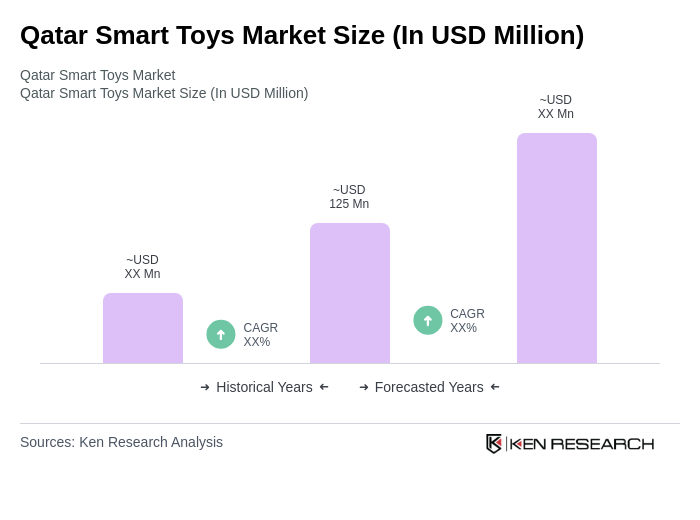
- The Qatar Smart Toys Market is valued at USD 125 million, based on a five-year historical analysis. This valuation aligns with the latest available data for the broader toys market in Qatar, which reached USD 126.4 million, with smart toys comprising a significant and growing segment driven by rising imports, digitalization, and consumer preference for educational and interactive products. Key growth drivers include increasing disposable incomes, a growing population of tech-savvy children, and heightened demand for toys that promote learning through play. The market continues to shift toward digital and smart toys integrating technology, enhancing children's learning experiences and engagement .
- Doha remains the dominant city in the Qatar Smart Toys Market, attributed to its role as the capital and largest urban center, where a substantial portion of the population resides. The concentration of affluent families, robust educational infrastructure, and strong emphasis on child development in urban areas contribute to market growth. The presence of international retailers and the rapid expansion of e-commerce platforms in Doha further facilitate access to a diverse range of smart toys, supporting market penetration and consumer choice .
- In 2023, the Qatari government strengthened regulations to ensure the safety and quality of toys sold in the market. The “Qatar Toys Safety Technical Regulation” issued by the Qatar General Organization for Standards and Metrology (QS) in 2023 mandates compliance with international safety standards such as EN 71 and ISO 8124. Manufacturers and importers are required to provide certification for their products, ensure labeling in Arabic, and demonstrate the use of non-hazardous, eco-friendly materials. These measures are designed to protect children from hazardous substances and promote sustainable practices in toy production, thereby enhancing consumer confidence and market integrity .
Qatar Smart Toys Market Segmentation
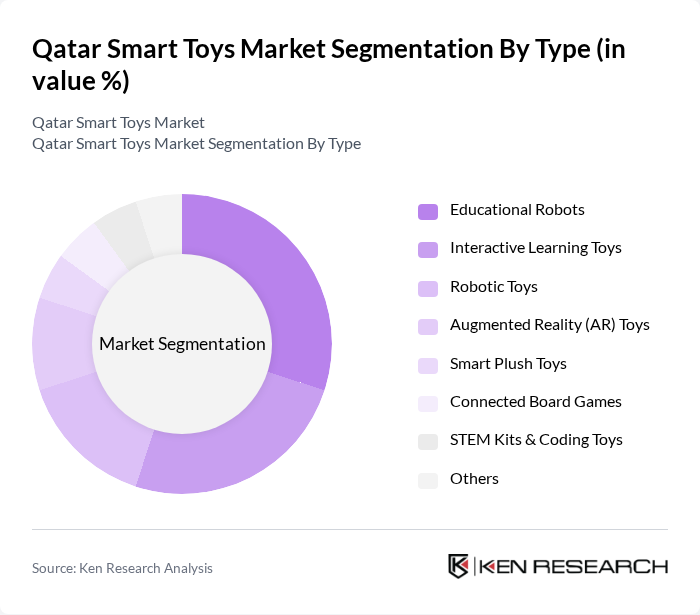
By Type:The smart toys market is segmented into educational robots, interactive learning toys, robotic toys, augmented reality (AR) toys, smart plush toys, connected board games, STEM kits & coding toys, and others. Educational robots and interactive learning toys are experiencing the highest traction, driven by their ability to engage children in immersive learning activities while providing entertainment. Parents increasingly seek products that enhance educational experiences, foster creativity, and support cognitive development through innovative play. The market also reflects a rising preference for STEM kits and coding toys, as well as AR-enabled products, in response to global trends in digital education and technology integration .
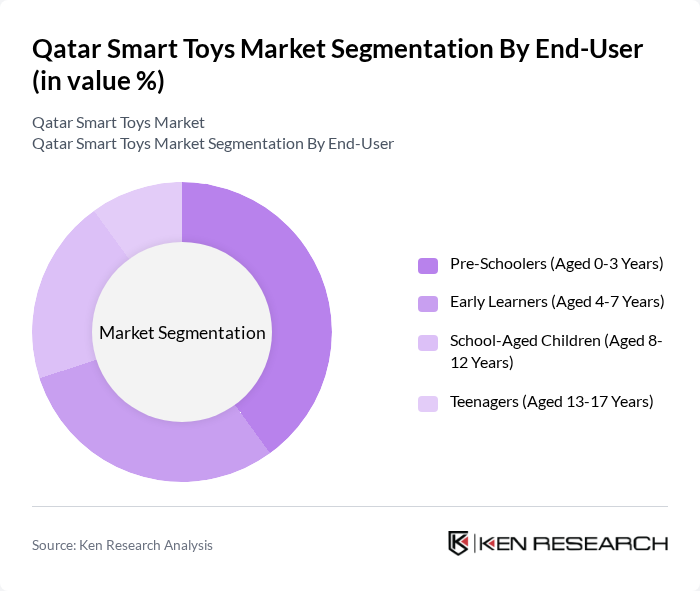
By End-User:The end-user segmentation includes pre-schoolers (aged 0-3 years), early learners (aged 4-7 years), school-aged children (aged 8-12 years), and teenagers (aged 13-17 years). The pre-schoolers segment leads the market, reflecting strong parental demand for toys that support early learning, sensory development, and foundational cognitive skills. Educational initiatives and increased awareness of the role of play in early childhood development further reinforce this trend. Early learners and school-aged children also represent substantial market shares, with growing interest in products that combine entertainment with educational value and digital interactivity .
Qatar Smart Toys Market Competitive Landscape
The Qatar Smart Toys Market is characterized by a dynamic mix of regional and international players. Leading participants such as LEGO Group, Mattel, Inc., Hasbro, Inc., VTech Holdings Limited, Spin Master Corp., Fisher-Price, Inc., Ravensburger AG, Bandai Namco Holdings Inc., Goliath Games, WowWee Group Limited, LeapFrog Enterprises, Inc., Playmobil GmbH, ZURU Inc., TOMY Company, Ltd., KidKraft, Inc., Clementoni S.p.A., Silverlit Toys Manufactory Ltd., Makeblock Co., Ltd., Sphero, Inc., Xiaomi Corporation (Mi Bunny, MITU) contribute to innovation, geographic expansion, and service delivery in this space.
Qatar Smart Toys Market Industry Analysis
Growth Drivers
- Increasing Adoption of Technology in Education:The integration of technology in educational settings is accelerating in Qatar, with over 90% of schools implementing digital learning tools in future. This shift is supported by the Qatar National Vision 2030, which emphasizes educational reform. The Ministry of Education reported a 20% increase in technology-based learning resources, driving demand for smart toys that enhance interactive learning experiences for children, thus fostering cognitive development.
- Rising Disposable Income of Families:Qatar's GDP per capita is approximately USD 83,000 in future, according to the World Bank, which is among the highest globally and reflects strong economic conditions. This economic strength translates into higher disposable incomes for families, enabling them to invest in premium educational products. As parents prioritize quality learning tools, the demand for smart toys that combine entertainment with education is expected to rise significantly, enhancing market potential.
- Growing Demand for Interactive Learning Tools:The global market for interactive learning tools is anticipated to exceed $250 billion in future, with Qatar mirroring this trend. Local educational institutions are increasingly adopting smart toys that promote engagement and critical thinking. A recent survey indicated that 75% of parents prefer toys that offer educational value, driving manufacturers to innovate and expand their product lines to meet this growing demand.
Market Challenges
- High Initial Investment Costs:The development and production of smart toys require significant capital investment, often exceeding $1.5 million for initial prototypes and technology integration. This financial barrier can deter new entrants and limit competition in the market. Additionally, the high costs associated with research and development can lead to increased retail prices, potentially alienating price-sensitive consumers in Qatar's competitive toy market.
- Rapid Technological Changes:The fast-paced evolution of technology poses a significant challenge for smart toy manufacturers. With new advancements emerging regularly, companies must continuously innovate to stay relevant. This rapid change can lead to obsolescence of existing products within a short timeframe, necessitating ongoing investment in product updates and new features, which can strain resources and impact profitability.
Qatar Smart Toys Market Future Outlook
The Qatar smart toys market is poised for significant growth as educational institutions increasingly embrace technology-driven learning solutions. With a projected increase in government funding for educational technology initiatives in future, manufacturers are likely to see enhanced opportunities for collaboration. Additionally, the trend towards eco-friendly products is expected to gain traction, prompting companies to innovate sustainably. As parents become more involved in their children's education, the demand for smart toys that facilitate learning through play will continue to rise, shaping the market's future landscape.
Market Opportunities
- Development of Eco-friendly Smart Toys:As environmental awareness grows, there is a rising demand for eco-friendly smart toys. Companies that invest in sustainable materials and production processes can tap into this market segment, appealing to environmentally conscious consumers. This shift not only enhances brand reputation but also aligns with global sustainability trends, potentially increasing market share.
- Collaborations with Educational Institutions:Forming partnerships with schools and educational organizations presents a lucrative opportunity for smart toy manufacturers. By collaborating on curriculum development and product testing, companies can ensure their toys meet educational standards while gaining direct access to their target market. Such collaborations can enhance product credibility and foster long-term customer loyalty.
Scope of the Report
| Segment | Sub-Segments |
|---|---|
| By Type | Educational Robots Interactive Learning Toys Robotic Toys Augmented Reality (AR) Toys Smart Plush Toys Connected Board Games STEM Kits & Coding Toys Others |
| By End-User | Pre-Schoolers (Aged 0-3 Years) Early Learners (Aged 4-7 Years) School-Aged Children (Aged 8-12 Years) Teenagers (Aged 13-17 Years) |
| By Sales Channel | Online Retail (E-commerce Platforms) Offline Retail (Toy Stores, Hypermarkets, Department Stores) Direct Sales (Distributors, Educational Institutions) |
| By Price Range | Economy (Low-End) Mid-Range Premium (High-End) |
| By Material | Plastic Wood Fabric Recycled/Eco-friendly Materials |
| By Age Group | Toddlers Preschoolers School-Aged Children Teenagers |
| By Brand | International Brands Regional/MENA Brands Private Labels |
Key Target Audience
Investors and Venture Capitalist Firms
Government and Regulatory Bodies (e.g., Ministry of Education and Higher Education, Qatar National Research Fund)
Manufacturers and Producers
Distributors and Retailers
Technology Providers
Industry Associations (e.g., Qatar Chamber of Commerce)
Financial Institutions
Importers and Exporters
Players Mentioned in the Report:
LEGO Group
Mattel, Inc.
Hasbro, Inc.
VTech Holdings Limited
Spin Master Corp.
Fisher-Price, Inc.
Ravensburger AG
Bandai Namco Holdings Inc.
Goliath Games
WowWee Group Limited
LeapFrog Enterprises, Inc.
Playmobil GmbH
ZURU Inc.
TOMY Company, Ltd.
KidKraft, Inc.
Clementoni S.p.A.
Silverlit Toys Manufactory Ltd.
Makeblock Co., Ltd.
Sphero, Inc.
Xiaomi Corporation (Mi Bunny, MITU)
Table of Contents
Market Assessment Phase
1. Executive Summary and Approach
2. Qatar Smart Toys Market Overview
2.1 Key Insights and Strategic Recommendations
2.2 Qatar Smart Toys Market Overview
2.3 Definition and Scope
2.4 Evolution of Market Ecosystem
2.5 Timeline of Key Regulatory Milestones
2.6 Value Chain & Stakeholder Mapping
2.7 Business Cycle Analysis
2.8 Policy & Incentive Landscape
3. Qatar Smart Toys Market Analysis
3.1 Growth Drivers
3.1.1 Increasing Adoption of Technology in Education
3.1.2 Rising Disposable Income of Families
3.1.3 Growing Demand for Interactive Learning Tools
3.1.4 Expansion of E-commerce Platforms
3.2 Market Challenges
3.2.1 High Initial Investment Costs
3.2.2 Rapid Technological Changes
3.2.3 Regulatory Compliance Issues
3.2.4 Competition from Traditional Toys
3.3 Market Opportunities
3.3.1 Development of Eco-friendly Smart Toys
3.3.2 Collaborations with Educational Institutions
3.3.3 Customization and Personalization Trends
3.3.4 Expansion into Emerging Markets
3.4 Market Trends
3.4.1 Integration of AI and Machine Learning
3.4.2 Focus on STEM Education
3.4.3 Rise of Subscription-based Toy Services
3.4.4 Increased Parental Involvement in Toy Selection
3.5 Government Regulation
3.5.1 Safety Standards for Children's Products
3.5.2 Import Regulations on Electronic Toys
3.5.3 Tax Incentives for Educational Products
3.5.4 Environmental Regulations on Toy Manufacturing
4. SWOT Analysis
5. Stakeholder Analysis
6. Porter's Five Forces Analysis
7. Qatar Smart Toys Market Market Size, 2019-2024
7.1 By Value
7.2 By Volume
7.3 By Average Selling Price
8. Qatar Smart Toys Market Segmentation
8.1 By Type
8.1.1 Educational Robots
8.1.2 Interactive Learning Toys
8.1.3 Robotic Toys
8.1.4 Augmented Reality (AR) Toys
8.1.5 Smart Plush Toys
8.1.6 Connected Board Games
8.1.7 STEM Kits & Coding Toys
8.1.8 Others
8.2 By End-User
8.2.1 Pre-Schoolers (Aged 0-3 Years)
8.2.2 Early Learners (Aged 4-7 Years)
8.2.3 School-Aged Children (Aged 8-12 Years)
8.2.4 Teenagers (Aged 13-17 Years)
8.3 By Sales Channel
8.3.1 Online Retail (E-commerce Platforms)
8.3.2 Offline Retail (Toy Stores, Hypermarkets, Department Stores)
8.3.3 Direct Sales (Distributors, Educational Institutions)
8.4 By Price Range
8.4.1 Economy (Low-End)
8.4.2 Mid-Range
8.4.3 Premium (High-End)
8.5 By Material
8.5.1 Plastic
8.5.2 Wood
8.5.3 Fabric
8.5.4 Recycled/Eco-friendly Materials
8.6 By Age Group
8.6.1 Toddlers
8.6.2 Preschoolers
8.6.3 School-Aged Children
8.6.4 Teenagers
8.7 By Brand
8.7.1 International Brands
8.7.2 Regional/MENA Brands
8.7.3 Private Labels
9. Qatar Smart Toys Market Competitive Analysis
9.1 Market Share of Key Players
9.2 Cross Comparison of Key Players
9.2.1 Company Name
9.2.2 Group Size (Large, Medium, or Small as per industry convention)
9.2.3 Revenue Growth Rate (Qatar Smart Toys Segment)
9.2.4 Market Penetration Rate (Share in Qatar Smart Toys Market)
9.2.5 Product Portfolio Breadth (Number of Smart Toy SKUs)
9.2.6 R&D/Innovation Spend (% of Revenue)
9.2.7 Distribution Network Coverage (Retail/E-commerce Presence in Qatar)
9.2.8 Brand Awareness Index (Qatar)
9.2.9 Customer Satisfaction Score (Qatar Market)
9.2.10 Local Partnerships/Collaborations (with Qatari Distributors or Schools)
9.3 SWOT Analysis of Top Players
9.4 Pricing Analysis
9.5 Detailed Profile of Major Companies
9.5.1 LEGO Group
9.5.2 Mattel, Inc.
9.5.3 Hasbro, Inc.
9.5.4 VTech Holdings Limited
9.5.5 Spin Master Corp.
9.5.6 Fisher-Price, Inc.
9.5.7 Ravensburger AG
9.5.8 Bandai Namco Holdings Inc.
9.5.9 Goliath Games
9.5.10 WowWee Group Limited
9.5.11 LeapFrog Enterprises, Inc.
9.5.12 Playmobil GmbH
9.5.13 ZURU Inc.
9.5.14 TOMY Company, Ltd.
9.5.15 KidKraft, Inc.
9.5.16 Clementoni S.p.A.
9.5.17 Silverlit Toys Manufactory Ltd.
9.5.18 Makeblock Co., Ltd.
9.5.19 Sphero, Inc.
9.5.20 Xiaomi Corporation (Mi Bunny, MITU)
10. Qatar Smart Toys Market End-User Analysis
10.1 Procurement Behavior of Key Ministries
10.1.1 Ministry of Education
10.1.2 Ministry of Commerce and Industry
10.1.3 Ministry of Culture and Sports
10.2 Corporate Spend on Infrastructure & Energy
10.2.1 Investment in Educational Infrastructure
10.2.2 Funding for Child Development Programs
10.3 Pain Point Analysis by End-User Category
10.3.1 Budget Constraints
10.3.2 Quality Assurance Concerns
10.4 User Readiness for Adoption
10.4.1 Awareness of Smart Toys
10.4.2 Willingness to Invest
10.5 Post-Deployment ROI and Use Case Expansion
10.5.1 Evaluation of Educational Outcomes
10.5.2 Feedback Mechanisms for Improvement
11. Qatar Smart Toys Market Future Size, 2025-2030
11.1 By Value
11.2 By Volume
11.3 By Average Selling Price
Go-To-Market Strategy Phase
1. Whitespace Analysis + Business Model Canvas
1.1 Market Gaps Identification
1.2 Value Proposition Development
1.3 Revenue Streams Analysis
1.4 Key Partnerships Exploration
1.5 Cost Structure Assessment
1.6 Customer Segmentation
1.7 Channels of Distribution
2. Marketing and Positioning Recommendations
2.1 Branding Strategies
2.2 Product USPs
2.3 Target Audience Identification
2.4 Communication Strategy
2.5 Digital Marketing Tactics
3. Distribution Plan
3.1 Urban Retail Strategies
3.2 Rural NGO Tie-ups
3.3 E-commerce Integration
3.4 Logistics and Supply Chain Management
4. Channel & Pricing Gaps
4.1 Underserved Routes
4.2 Pricing Bands Analysis
4.3 Competitor Pricing Strategies
5. Unmet Demand & Latent Needs
5.1 Category Gaps Identification
5.2 Consumer Segments Analysis
5.3 Emerging Trends Exploration
6. Customer Relationship
6.1 Loyalty Programs Development
6.2 After-sales Service Strategies
6.3 Customer Feedback Mechanisms
7. Value Proposition
7.1 Sustainability Initiatives
7.2 Integrated Supply Chains
7.3 Unique Selling Points
8. Key Activities
8.1 Regulatory Compliance
8.2 Branding Initiatives
8.3 Distribution Setup
9. Entry Strategy Evaluation
9.1 Domestic Market Entry Strategy
9.1.1 Product Mix Considerations
9.1.2 Pricing Band Strategy
9.1.3 Packaging Innovations
9.2 Export Entry Strategy
9.2.1 Target Countries Identification
9.2.2 Compliance Roadmap Development
10. Entry Mode Assessment
10.1 Joint Ventures
10.2 Greenfield Investments
10.3 Mergers & Acquisitions
10.4 Distributor Model Evaluation
11. Capital and Timeline Estimation
11.1 Capital Requirements Analysis
11.2 Timelines for Market Entry
12. Control vs Risk Trade-Off
12.1 Ownership vs Partnerships
13. Profitability Outlook
13.1 Breakeven Analysis
13.2 Long-term Sustainability Strategies
14. Potential Partner List
14.1 Distributors Identification
14.2 Joint Ventures Opportunities
14.3 Acquisition Targets
15. Execution Roadmap
15.1 Phased Plan for Market Entry
15.1.1 Market Setup
15.1.2 Market Entry
15.1.3 Growth Acceleration
15.1.4 Scale & Stabilize
15.2 Key Activities and Milestones
15.2.1 Milestone Planning
15.2.2 Activity Tracking
Research Methodology
Phase 1: Approach1
Desk Research
- Analysis of market reports from local and international toy industry associations
- Review of government publications on consumer spending trends in Qatar
- Examination of academic journals focusing on child development and educational toys
Primary Research
- Interviews with key stakeholders in the toy retail sector, including store owners and managers
- Surveys conducted with parents to understand preferences and purchasing behavior
- Focus groups with educators and child psychologists to assess the impact of smart toys
Validation & Triangulation
- Cross-validation of findings through multiple data sources, including sales data and consumer feedback
- Triangulation of insights from primary interviews with secondary data trends
- Sanity checks through expert panel reviews comprising industry veterans and market analysts
Phase 2: Market Size Estimation1
Top-down Assessment
- Estimation of total market size based on national toy sales data and growth rates
- Segmentation of the market by product type, including educational, interactive, and traditional toys
- Incorporation of demographic data to assess potential market reach among families with children
Bottom-up Modeling
- Collection of sales data from major retailers and e-commerce platforms in Qatar
- Estimation of average selling prices for various categories of smart toys
- Calculation of market size based on unit sales and revenue generation from identified segments
Forecasting & Scenario Analysis
- Development of growth projections based on historical sales trends and market dynamics
- Scenario analysis considering factors such as economic conditions and technological advancements
- Creation of baseline, optimistic, and pessimistic forecasts through 2028
Phase 3: CATI Sample Composition1
| Scope Item/Segment | Sample Size | Target Respondent Profiles |
|---|---|---|
| Retail Toy Outlets | 100 | Store Managers, Sales Representatives |
| Online Toy Retailers | 60 | E-commerce Managers, Digital Marketing Specialists |
| Parents of Children Aged 3-10 | 120 | Parents, Guardians |
| Educational Institutions | 50 | Teachers, School Administrators |
| Child Development Experts | 40 | Child Psychologists, Pediatricians |
Frequently Asked Questions
What is the current value of the Qatar Smart Toys Market?
The Qatar Smart Toys Market is valued at approximately USD 125 million, reflecting a significant segment of the broader toys market in Qatar, which reached USD 126.4 million. This growth is driven by rising imports and consumer preferences for educational and interactive products.
What factors are driving the growth of the Qatar Smart Toys Market?
Which city dominates the Qatar Smart Toys Market?
What regulations govern the safety of toys in Qatar?
Other Regional/Country Reports
Indonesia Smart Toys Market
Malaysia Smart Toys Market
APAC Smart Toys Market
Other Adjacent Reports
Germany Educational Toys Market
Thailand Interactive Learning Devices Market
Singapore Childrens Robotics Market
Belgium Augmented Reality Toys Market
Egypt STEM Kits Market
Oman Coding Toys Market
Malaysia Smart Plush Toys Market
Brazil Connected Board Games Market
Kuwait EdTech Solutions Market
Bahrain Toy Manufacturing Market
Why Buy From Us?

What makes us stand out is that our consultants follow Robust, Refine and Result (RRR) methodology. Robust for clear definitions, approaches and sanity checking, Refine for differentiating respondents' facts and opinions, and Result for presenting data with story.

We have set a benchmark in the industry by offering our clients with syndicated and customized market research reports featuring coverage of entire market as well as meticulous research and analyst insights.

While we don't replace traditional research, we flip the method upside down. Our dual approach of Top Bottom & Bottom Top ensures quality deliverable by not just verifying company fundamentals but also looking at the sector and macroeconomic factors.

With one step in the future, our research team constantly tries to show you the bigger picture. We help with some of the tough questions you may encounter along the way: How is the industry positioned? Best marketing channel? KPI's of competitors? By aligning every element, we help maximize success.

Our report gives you instant access to the answers and sources that other companies might choose to hide. We elaborate each steps of research methodology we have used and showcase you the sample size to earn your trust.

If you need any support, we are here! We pride ourselves on universe strength, data quality, and quick, friendly, and professional service.