About the Report
Base Year 2024Qatar Solar Hybrid Inverter Market Overview
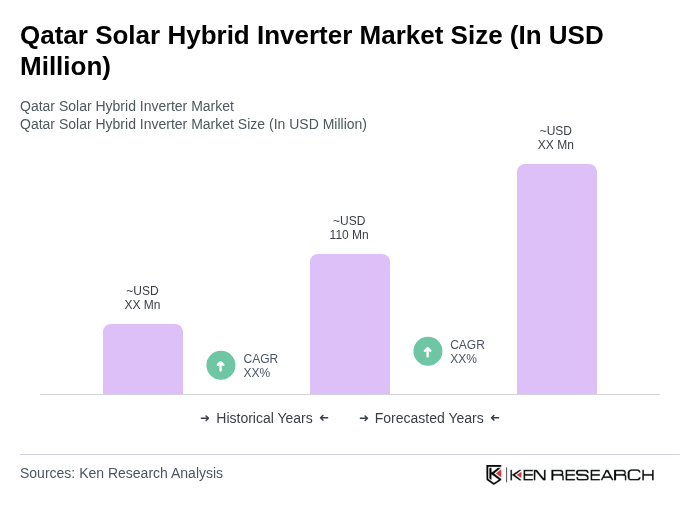
- The Qatar Solar Hybrid Inverter Market is valued at USD 110 million, based on a five-year historical analysis. This growth is primarily driven by the increasing demand for renewable energy solutions, government initiatives promoting solar energy, and heightened awareness of energy efficiency among consumers and businesses. The market has experienced a notable increase in investments, particularly in solar hybrid technologies that integrate solar power with traditional energy sources, reflecting Qatar’s broader push for sustainable infrastructure and energy diversification .
- Key players in this market include Doha, Al Rayyan, and Lusail, which lead due to strategic investments in solar infrastructure and supportive government policies. These cities are central to Qatar's energy transition, benefiting from high solar irradiance and a strong governmental drive toward sustainable energy solutions, making them prime locations for solar hybrid inverter installations .
- The Qatar Construction Specifications (QCS) 2014, issued by the Ministry of Municipality and Environment and the Public Works Authority (Ashghal), mandates the integration of renewable energy systems in new government and large commercial buildings. This regulatory framework requires that solar photovoltaic systems, including hybrid inverters, be incorporated into the design and construction of qualifying projects to support Qatar’s National Vision 2030 sustainability targets. Compliance includes minimum solar capacity thresholds, energy efficiency standards, and periodic reporting to authorities .
Qatar Solar Hybrid Inverter Market Segmentation
By Type:The market is segmented into various types of hybrid inverters, including Grid-Tied Hybrid Inverters, Off-Grid Hybrid Inverters, Three-Phase Hybrid Inverters, and Single-Phase Hybrid Inverters. Each type addresses specific consumer needs and applications, with grid-tied inverters being especially popular due to their efficiency, seamless integration with the national grid, and suitability for both residential and commercial projects. Off-grid and three-phase solutions are increasingly adopted for industrial and remote applications, while single-phase inverters primarily serve smaller residential installations .

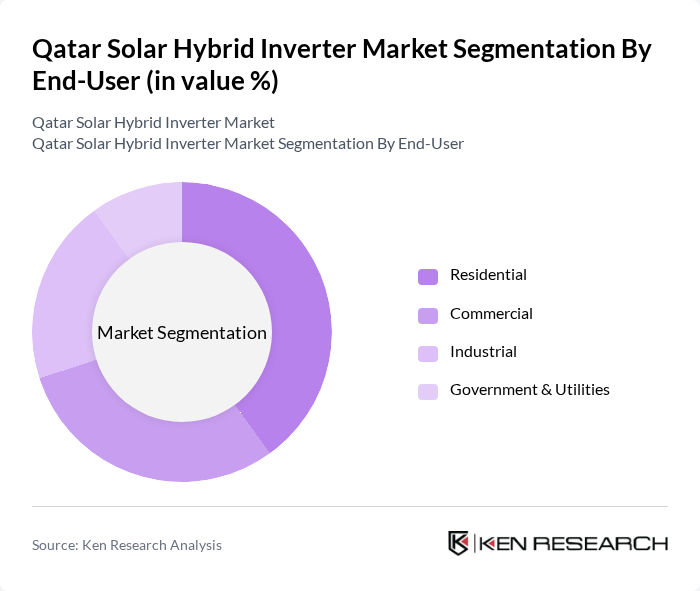
By End-User:The end-user segmentation includes Residential, Commercial, Industrial, and Government & Utilities sectors. Each sector has distinct requirements for solar hybrid inverters: residential users prioritize energy savings and backup power, commercial entities focus on operational cost reduction and sustainability, industrial users require robust solutions for continuous operations, and government & utilities emphasize large-scale deployment for grid stability and decarbonization .
Qatar Solar Hybrid Inverter Market Competitive Landscape
The Qatar Solar Hybrid Inverter Market is characterized by a dynamic mix of regional and international players. Leading participants such as Siemens AG, Schneider Electric SE, ABB Ltd., SMA Solar Technology AG, Huawei Technologies Co., Ltd., Fronius International GmbH, Enphase Energy, Inc., SolarEdge Technologies, Inc., Victron Energy B.V., OutBack Power Technologies, Inc., Canadian Solar Inc., JinkoSolar Holding Co., Ltd., Trina Solar Co., Ltd., LONGi Green Energy Technology Co., Ltd., Risen Energy Co., Ltd., Sungrow Power Supply Co., Ltd., GoodWe Technologies Co., Ltd., Delta Electronics, Inc., Hitachi Energy Ltd., and Qatar Solar Technologies (QSTec) contribute to innovation, geographic expansion, and service delivery in this space .
Qatar Solar Hybrid Inverter Market Industry Analysis
Growth Drivers
- Increasing Demand for Renewable Energy Sources:Qatar's commitment to diversifying its energy portfolio is evident, with renewable energy sources projected to contribute 20% of the total energy mix in future. The country aims to generate approximately 1.8 GW of solar power, reflecting a significant shift towards sustainable energy. This transition is driven by global trends favoring clean energy, as evidenced by the 15% increase in solar installations in the region from 2022 to 2023, highlighting the growing demand for solar hybrid inverters.
- Government Incentives for Solar Energy Adoption:The Qatari government has implemented various incentives to promote solar energy, including tax exemptions and subsidies for solar projects. In future, the government allocated QAR 500 million for renewable energy initiatives, which is expected to boost solar hybrid inverter installations. Additionally, the introduction of feed-in tariffs has encouraged private investments, leading to a 25% increase in solar capacity installations in the past year, further driving market growth.
- Technological Advancements in Inverter Efficiency:The solar hybrid inverter market is benefiting from rapid technological advancements, with efficiency rates improving significantly. In future, the average efficiency of solar inverters reached 98%, up from 95%. This increase is attributed to innovations in inverter design and materials, which enhance performance and reduce energy losses. As a result, consumers are more inclined to invest in high-efficiency solar hybrid inverters, propelling market growth in Qatar.
Market Challenges
- High Initial Investment Costs:One of the primary challenges facing the solar hybrid inverter market in Qatar is the high initial investment required for installation. The average cost of a solar hybrid system can exceed QAR 30,000, which poses a barrier for many potential consumers. Despite long-term savings on electricity bills, the upfront costs deter adoption, particularly among residential users, limiting market penetration and growth potential in the short term.
- Limited Consumer Awareness:Consumer awareness regarding the benefits and functionalities of solar hybrid inverters remains low in Qatar. A survey indicated that only 40% of residents are familiar with solar technology, which hampers market growth. This lack of knowledge leads to misconceptions about costs and benefits, resulting in hesitance to invest in solar solutions. Educational initiatives are crucial to overcoming this challenge and fostering a more informed consumer base.
Qatar Solar Hybrid Inverter Market Future Outlook
The future of the Qatar solar hybrid inverter market appears promising, driven by increasing government support and technological advancements. As Qatar continues to invest in renewable energy infrastructure, the market is expected to witness a surge in hybrid system installations. Additionally, the integration of smart technologies will enhance energy management, making solar solutions more appealing to consumers. With rising electricity costs and a growing emphasis on sustainability, the demand for solar hybrid inverters is likely to increase significantly in the coming years.
Market Opportunities
- Expansion of Solar Energy Projects:The ongoing expansion of solar energy projects in Qatar presents a significant opportunity for the hybrid inverter market. With the government planning to develop multiple large-scale solar farms, the demand for efficient hybrid inverters is expected to rise. This growth could lead to an estimated increase of QAR 1 billion in investments in solar technologies over the next five years.
- Development of Smart Grid Technologies:The advancement of smart grid technologies offers a unique opportunity for the solar hybrid inverter market. As Qatar invests in modernizing its energy infrastructure, integrating smart grids will enhance energy distribution and management. This shift is projected to create a demand for advanced hybrid inverters capable of interfacing with smart grid systems, potentially increasing market revenues by QAR 200 million in future.
Scope of the Report
| Segment | Sub-Segments |
|---|---|
| By Type | Grid-Tied Hybrid Inverters Off-Grid Hybrid Inverters Three-Phase Hybrid Inverters Single-Phase Hybrid Inverters |
| By End-User | Residential Commercial Industrial Government & Utilities |
| By Application | Rooftop Solar Installations Ground-Mounted Solar Installations Microgrid and Off-grid Solutions Utility-Scale Solar Projects Energy Storage Integration |
| By Investment Source | Domestic Investment Foreign Direct Investment (FDI) Public-Private Partnerships (PPP) Government Schemes |
| By Policy Support | Subsidies Tax Exemptions Renewable Energy Certificates (RECs) Net Metering Policies |
| By Technology | Photovoltaic (PV) Technology Concentrated Solar Power (CSP) Battery Energy Storage Systems (BESS) Smart Inverter Technology |
| By Market Segment | New Installations Retrofit/Replacement Market EPC (Engineering, Procurement, Construction) Segment O&M (Operations & Maintenance) Segment |
Key Target Audience
Investors and Venture Capitalist Firms
Government and Regulatory Bodies (e.g., Qatar Ministry of Energy and Industry)
Manufacturers and Producers
Distributors and Retailers
Energy Utility Companies
Project Developers and Contractors
Renewable Energy Associations
Financial Institutions
Players Mentioned in the Report:
Siemens AG
Schneider Electric SE
ABB Ltd.
SMA Solar Technology AG
Huawei Technologies Co., Ltd.
Fronius International GmbH
Enphase Energy, Inc.
SolarEdge Technologies, Inc.
Victron Energy B.V.
OutBack Power Technologies, Inc.
Canadian Solar Inc.
JinkoSolar Holding Co., Ltd.
Trina Solar Co., Ltd.
LONGi Green Energy Technology Co., Ltd.
Risen Energy Co., Ltd.
Sungrow Power Supply Co., Ltd.
GoodWe Technologies Co., Ltd.
Delta Electronics, Inc.
Hitachi Energy Ltd.
Qatar Solar Technologies (QSTec)
Table of Contents
Market Assessment Phase
1. Executive Summary and Approach
2. Qatar Solar Hybrid Inverter Market Overview
2.1 Key Insights and Strategic Recommendations
2.2 Qatar Solar Hybrid Inverter Market Overview
2.3 Definition and Scope
2.4 Evolution of Market Ecosystem
2.5 Timeline of Key Regulatory Milestones
2.6 Value Chain & Stakeholder Mapping
2.7 Business Cycle Analysis
2.8 Policy & Incentive Landscape
3. Qatar Solar Hybrid Inverter Market Analysis
3.1 Growth Drivers
3.1.1 Increasing demand for renewable energy sources
3.1.2 Government incentives for solar energy adoption
3.1.3 Rising electricity costs
3.1.4 Technological advancements in inverter efficiency
3.2 Market Challenges
3.2.1 High initial investment costs
3.2.2 Limited consumer awareness
3.2.3 Regulatory hurdles
3.2.4 Competition from traditional energy sources
3.3 Market Opportunities
3.3.1 Expansion of solar energy projects
3.3.2 Development of smart grid technologies
3.3.3 Partnerships with local businesses
3.3.4 Increasing interest in energy storage solutions
3.4 Market Trends
3.4.1 Growing adoption of hybrid systems
3.4.2 Integration of IoT in energy management
3.4.3 Shift towards sustainable energy practices
3.4.4 Rise in consumer demand for energy independence
3.5 Government Regulation
3.5.1 Renewable energy targets
3.5.2 Feed-in tariffs for solar energy
3.5.3 Building codes promoting solar installations
3.5.4 Environmental impact assessments
4. SWOT Analysis
5. Stakeholder Analysis
6. Porter's Five Forces Analysis
7. Qatar Solar Hybrid Inverter Market Market Size, 2019-2024
7.1 By Value
7.2 By Volume
7.3 By Average Selling Price
8. Qatar Solar Hybrid Inverter Market Segmentation
8.1 By Type
8.1.1 Grid-Tied Hybrid Inverters
8.1.2 Off-Grid Hybrid Inverters
8.1.3 Three-Phase Hybrid Inverters
8.1.4 Single-Phase Hybrid Inverters
8.2 By End-User
8.2.1 Residential
8.2.2 Commercial
8.2.3 Industrial
8.2.4 Government & Utilities
8.3 By Application
8.3.1 Rooftop Solar Installations
8.3.2 Ground-Mounted Solar Installations
8.3.3 Microgrid and Off-grid Solutions
8.3.4 Utility-Scale Solar Projects
8.3.5 Energy Storage Integration
8.4 By Investment Source
8.4.1 Domestic Investment
8.4.2 Foreign Direct Investment (FDI)
8.4.3 Public-Private Partnerships (PPP)
8.4.4 Government Schemes
8.5 By Policy Support
8.5.1 Subsidies
8.5.2 Tax Exemptions
8.5.3 Renewable Energy Certificates (RECs)
8.5.4 Net Metering Policies
8.6 By Technology
8.6.1 Photovoltaic (PV) Technology
8.6.2 Concentrated Solar Power (CSP)
8.6.3 Battery Energy Storage Systems (BESS)
8.6.4 Smart Inverter Technology
8.7 By Market Segment
8.7.1 New Installations
8.7.2 Retrofit/Replacement Market
8.7.3 EPC (Engineering, Procurement, Construction) Segment
8.7.4 O&M (Operations & Maintenance) Segment
9. Qatar Solar Hybrid Inverter Market Competitive Analysis
9.1 Market Share of Key Players
9.2 Cross Comparison of Key Players
9.2.1 Company Name
9.2.2 Company Headquarters/Regional Presence
9.2.3 Group Size (Large, Medium, or Small as per industry convention)
9.2.4 Revenue from Solar Hybrid Inverter Segment (USD/QAR)
9.2.5 Market Share in Qatar Solar Hybrid Inverter Market (%)
9.2.6 Installed Capacity Supplied (MW)
9.2.7 Number of Projects/Installations in Qatar
9.2.8 Product Portfolio Breadth (Hybrid, Grid-tied, Off-grid, etc.)
9.2.9 R&D Investment as % of Revenue
9.2.10 Local Partnerships/Distribution Network Strength
9.2.11 After-Sales Service Coverage in Qatar
9.2.12 Certifications & Compliance (IEC, ISO, KAHRAMAA, etc.)
9.2.13 Pricing Strategy
9.2.14 Product Innovation Rate
9.2.15 Brand Recognition in Qatar
9.3 SWOT Analysis of Top Players
9.4 Pricing Analysis
9.5 Detailed Profile of Major Companies
9.5.1 Siemens AG
9.5.2 Schneider Electric SE
9.5.3 ABB Ltd.
9.5.4 SMA Solar Technology AG
9.5.5 Huawei Technologies Co., Ltd.
9.5.6 Fronius International GmbH
9.5.7 Enphase Energy, Inc.
9.5.8 SolarEdge Technologies, Inc.
9.5.9 Victron Energy B.V.
9.5.10 OutBack Power Technologies, Inc.
9.5.11 Canadian Solar Inc.
9.5.12 JinkoSolar Holding Co., Ltd.
9.5.13 Trina Solar Co., Ltd.
9.5.14 LONGi Green Energy Technology Co., Ltd.
9.5.15 Risen Energy Co., Ltd.
9.5.16 Sungrow Power Supply Co., Ltd.
9.5.17 GoodWe Technologies Co., Ltd.
9.5.18 Delta Electronics, Inc.
9.5.19 Hitachi Energy Ltd.
9.5.20 Qatar Solar Technologies (QSTec)
10. Qatar Solar Hybrid Inverter Market End-User Analysis
10.1 Procurement Behavior of Key Ministries
10.1.1 Key Ministries Involved
10.1.2 Procurement Processes
10.1.3 Budget Allocations
10.1.4 Decision-Making Criteria
10.2 Corporate Spend on Infrastructure & Energy
10.2.1 Investment Trends
10.2.2 Budget Priorities
10.2.3 Energy Efficiency Initiatives
10.2.4 Future Spending Projections
10.3 Pain Point Analysis by End-User Category
10.3.1 Residential Users
10.3.2 Commercial Users
10.3.3 Industrial Users
10.3.4 Government Users
10.4 User Readiness for Adoption
10.4.1 Awareness Levels
10.4.2 Adoption Barriers
10.4.3 Training Needs
10.4.4 Support Requirements
10.5 Post-Deployment ROI and Use Case Expansion
10.5.1 ROI Measurement Criteria
10.5.2 Use Case Scenarios
10.5.3 Long-term Benefits
10.5.4 Expansion Opportunities
11. Qatar Solar Hybrid Inverter Market Future Size, 2025-2030
11.1 By Value
11.2 By Volume
11.3 By Average Selling Price
Go-To-Market Strategy Phase
1. Whitespace Analysis + Business Model Canvas
1.1 Market Gaps Identification
1.2 Business Model Components
1.3 Value Proposition Development
1.4 Revenue Streams
1.5 Cost Structure Analysis
2. Marketing and Positioning Recommendations
2.1 Branding Strategies
2.2 Product USPs
2.3 Target Market Segmentation
2.4 Communication Strategies
2.5 Digital Marketing Approaches
3. Distribution Plan
3.1 Urban Retail Strategies
3.2 Rural NGO Tie-ups
3.3 Online Distribution Channels
3.4 Partnership Opportunities
3.5 Logistics and Supply Chain Management
4. Channel & Pricing Gaps
4.1 Underserved Routes
4.2 Pricing Bands Analysis
4.3 Competitor Pricing Strategies
4.4 Consumer Price Sensitivity
4.5 Recommendations for Pricing Adjustments
5. Unmet Demand & Latent Needs
5.1 Category Gaps
5.2 Consumer Segments Analysis
5.3 Emerging Trends
5.4 Recommendations for Product Development
6. Customer Relationship
6.1 Loyalty Programs
6.2 After-sales Service Strategies
6.3 Customer Feedback Mechanisms
6.4 Community Engagement Initiatives
6.5 Customer Education Programs
7. Value Proposition
7.1 Sustainability Initiatives
7.2 Integrated Supply Chains
7.3 Competitive Advantages
7.4 Customer-Centric Innovations
7.5 Long-term Value Creation
8. Key Activities
8.1 Regulatory Compliance
8.2 Branding Initiatives
8.3 Distribution Setup
8.4 Training and Development
8.5 Performance Monitoring
9. Entry Strategy Evaluation
9.1 Domestic Market Entry Strategy
9.1.1 Product Mix Considerations
9.1.2 Pricing Band Strategies
9.1.3 Packaging Innovations
9.2 Export Entry Strategy
9.2.1 Target Countries Analysis
9.2.2 Compliance Roadmap
10. Entry Mode Assessment
10.1 Joint Ventures
10.2 Greenfield Investments
10.3 Mergers & Acquisitions
10.4 Distributor Model Evaluation
10.5 Risk Assessment
11. Capital and Timeline Estimation
11.1 Capital Requirements
11.2 Timelines for Implementation
11.3 Financial Projections
11.4 Funding Sources
11.5 Milestone Tracking
12. Control vs Risk Trade-Off
12.1 Ownership Considerations
12.2 Partnership Dynamics
12.3 Risk Mitigation Strategies
12.4 Control Mechanisms
12.5 Long-term Strategic Planning
13. Profitability Outlook
13.1 Breakeven Analysis
13.2 Long-term Sustainability Strategies
13.3 Profit Margin Projections
13.4 Cost Management Approaches
13.5 Revenue Growth Strategies
14. Potential Partner List
14.1 Distributors
14.2 Joint Ventures
14.3 Acquisition Targets
14.4 Strategic Alliances
14.5 Collaboration Opportunities
15. Execution Roadmap
15.1 Phased Plan for Market Entry
15.1.1 Market Setup
15.1.2 Market Entry
15.1.3 Growth Acceleration
15.1.4 Scale & Stabilize
15.2 Key Activities and Milestones
15.2.1 Activity Tracking
15.2.2 Milestone Achievements
15.2.3 Performance Evaluation
15.2.4 Adjustments and Iterations
Research Methodology
Phase 1: Approach1
Desk Research
- Industry reports from renewable energy associations and government publications
- Market analysis from energy consultancy firms focusing on solar technologies
- Statistical data from Qatar's Ministry of Energy and Industry regarding solar energy initiatives
Primary Research
- Interviews with key stakeholders in the solar inverter manufacturing sector
- Surveys with installation companies and solar energy service providers in Qatar
- Field interviews with energy policy experts and regulatory bodies
Validation & Triangulation
- Cross-validation of data through multiple industry reports and expert opinions
- Triangulation of market trends using sales data and policy frameworks
- Sanity checks through feedback from industry panels and focus groups
Phase 2: Market Size Estimation1
Top-down Assessment
- Analysis of national energy consumption patterns and solar energy adoption rates
- Segmentation of the market by residential, commercial, and industrial applications
- Incorporation of government incentives and subsidies for solar energy projects
Bottom-up Modeling
- Volume estimates based on installed capacity of solar hybrid inverters in Qatar
- Cost analysis derived from pricing models of leading inverter manufacturers
- Estimation of market share based on sales data from local distributors
Forecasting & Scenario Analysis
- Multi-variable regression analysis considering economic growth and energy policy changes
- Scenario modeling based on potential shifts in consumer preferences and technology advancements
- Baseline, optimistic, and pessimistic forecasts through 2030 based on market dynamics
Phase 3: CATI Sample Composition1
| Scope Item/Segment | Sample Size | Target Respondent Profiles |
|---|---|---|
| Residential Solar Inverter Users | 100 | Homeowners, Energy Managers |
| Commercial Solar Installations | 80 | Facility Managers, Procurement Officers |
| Industrial Energy Solutions | 60 | Operations Directors, Energy Consultants |
| Government Energy Policy Makers | 40 | Regulatory Officials, Policy Analysts |
| Solar Technology Innovators | 50 | R&D Managers, Product Development Engineers |
Frequently Asked Questions
What is the current value of the Qatar Solar Hybrid Inverter Market?
The Qatar Solar Hybrid Inverter Market is valued at approximately USD 110 million, reflecting a significant growth trend driven by increasing demand for renewable energy solutions and government initiatives promoting solar energy adoption.
What are the main drivers of growth in the Qatar Solar Hybrid Inverter Market?
Which cities in Qatar are leading in solar hybrid inverter installations?
What types of hybrid inverters are available in the Qatar market?
Other Regional/Country Reports
Indonesia Solar Hybrid Inverter Market
Malaysia Solar Hybrid Inverter Market
KSA Solar Hybrid Inverter Market
APAC Solar Hybrid Inverter Market
SEA Solar Hybrid Inverter Market
Other Adjacent Reports
Kuwait Solar Photovoltaic Panel Market
Malaysia Energy Storage System Market
Qatar Smart Grid Technology Market
KSA Europe Renewable Energy MarketEgypt Solar Battery Market
Vietnam Inverter Technology Market
Mexico Off-Grid Power System Market
Malaysia Hybrid Energy System Market
Oman Solar Power Generation Market
USA Energy Management System Market Outlook to 2030Why Buy From Us?

What makes us stand out is that our consultants follow Robust, Refine and Result (RRR) methodology. Robust for clear definitions, approaches and sanity checking, Refine for differentiating respondents' facts and opinions, and Result for presenting data with story.

We have set a benchmark in the industry by offering our clients with syndicated and customized market research reports featuring coverage of entire market as well as meticulous research and analyst insights.

While we don't replace traditional research, we flip the method upside down. Our dual approach of Top Bottom & Bottom Top ensures quality deliverable by not just verifying company fundamentals but also looking at the sector and macroeconomic factors.

With one step in the future, our research team constantly tries to show you the bigger picture. We help with some of the tough questions you may encounter along the way: How is the industry positioned? Best marketing channel? KPI's of competitors? By aligning every element, we help maximize success.

Our report gives you instant access to the answers and sources that other companies might choose to hide. We elaborate each steps of research methodology we have used and showcase you the sample size to earn your trust.

If you need any support, we are here! We pride ourselves on universe strength, data quality, and quick, friendly, and professional service.