Ksa 3D Printed Shoes Market Report Size, Share, Growth Drivers, Trends, Opportunities & Forecast 2025–2030

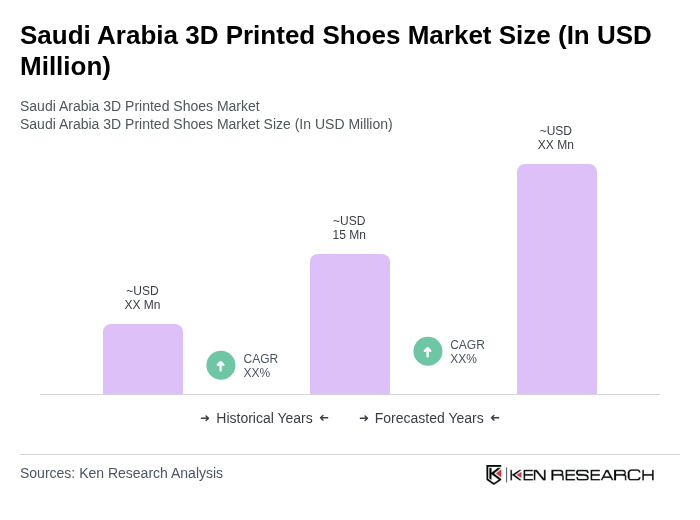
The Saudi Arabia 3D printed shoes market, valued at USD 15 million, is growing due to demand for customized footwear, sustainable manufacturing, and e-commerce expansion.

Region:Middle East

Author(s):Shubham

Product Code:KRAD3643

Pages:91

Published On:November 2025
About the Report

Base Year 2024

Saudi Arabia 3D Printed Shoes Market Overview

  • The Saudi Arabia 3D Printed Shoes Market is valued at USD 15 million, based on a five-year historical analysis. This growth is primarily driven by the increasing adoption of advanced manufacturing technologies, rising consumer demand for customized footwear, and the growing awareness of sustainability in the fashion industry. The market is also supported by the expansion of e-commerce platforms, which facilitate easier access to innovative products and personalized designs. Recent trends show a surge in digital foot scanning and on-demand production, further accelerating the adoption of 3D printed footwear among both mainstream and niche consumers .
  • Key cities dominating the market include Riyadh, Jeddah, and Dammam. Riyadh, as the capital, serves as a commercial hub with a high concentration of retail outlets and consumers interested in innovative products. Jeddah, with its vibrant fashion scene, and Dammam, being a significant industrial center, contribute to the overall growth and acceptance of 3D printed shoes in the region. These cities are also witnessing increased investments in local 3D printing startups and retail collaborations with global brands .
  • In 2023, the Saudi Arabian government implemented the National Additive Manufacturing Strategy, issued by the Ministry of Industry and Mineral Resources, to promote the use of 3D printing technologies in various sectors, including footwear. This initiative aims to enhance local manufacturing capabilities, reduce dependency on imports, and foster innovation in sustainable production. The government has allocated funding to support research and development, and established specialized zones for additive manufacturing to encourage businesses to adopt 3D printing technologies .
Saudi Arabia 3D Printed Shoes Market Size

Saudi Arabia 3D Printed Shoes Market Segmentation

By Technology:The technology segment of the market includes various methods of 3D printing, each with unique advantages. The leading technologies are Filament Extrusion, Vat Polymerization, Powder Bed Fusion, and Material Jetting. Filament Extrusion is particularly popular due to its cost-effectiveness and ease of use, making it accessible for both small and large manufacturers. Vat Polymerization is favored for its precision, especially in producing intricate designs. Powder Bed Fusion is gaining traction for its ability to create durable and complex geometries, while Material Jetting is recognized for its high-quality finishes and color capabilities.
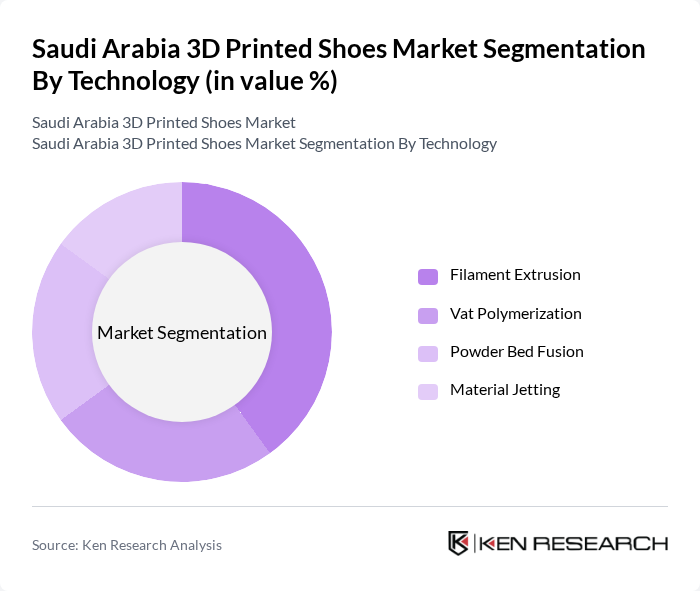
Saudi Arabia 3D Printed Shoes Market segmentation by Technology.

By Material:The material segment encompasses various types of polymers used in 3D printing shoes. Key materials include Thermoplastic Polyurethane (TPU), Ethylene Vinyl Acetate (EVA), Thermoplastic Elastomers (TPE), Biodegradable Polymers, and others. TPU is the most widely used material due to its flexibility and durability, making it ideal for footwear applications. EVA is also popular for its lightweight and cushioning properties, while TPE offers excellent elasticity. Biodegradable polymers are gaining attention as consumers become more environmentally conscious, driving demand for sustainable options.
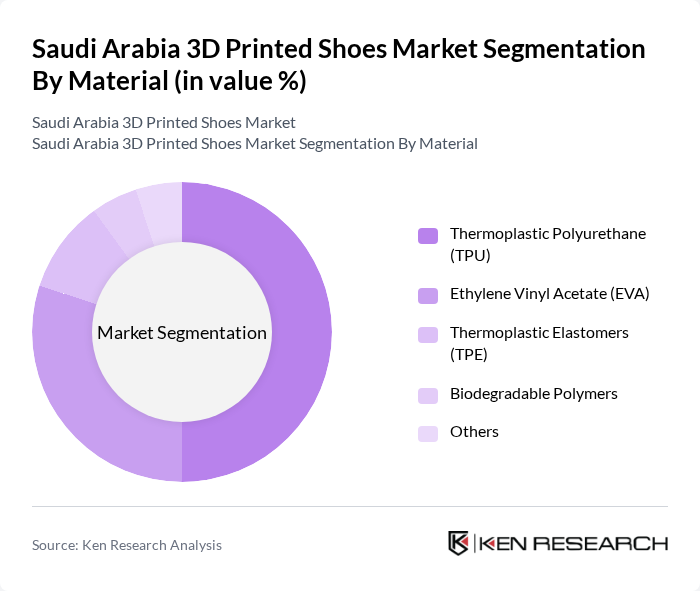
Saudi Arabia 3D Printed Shoes Market segmentation by Material.

Saudi Arabia 3D Printed Shoes Market Competitive Landscape

The Saudi Arabia 3D Printed Shoes Market is characterized by a dynamic mix of regional and international players. Leading participants such as Adidas AG, Nike Inc., Puma SE, New Balance Athletics Inc., ASICS Corporation, On Holding AG, Salomon SAS, Skechers USA Inc., Reebok International Ltd., Under Armour Inc., Hoka One One, Brooks Running, Mizuno Corporation, Altra Running, Vionic Group, Local Saudi Manufacturers and 3D Printing Specialists contribute to innovation, geographic expansion, and service delivery in this space.

Adidas AG

1949

Herzogenaurach, Germany

Nike Inc.

1964

Beaverton, Oregon, USA

Puma SE

1948

Herzogenaurach, Germany

New Balance Athletics Inc.

1906

Boston, Massachusetts, USA

ASICS Corporation

1949

Kobe, Japan

Company

Establishment Year

Headquarters

Company Size Classification (Large, Medium, Small)

Revenue Growth Rate (YoY %)

Market Penetration Rate in Saudi Arabia (%)

Customer Retention Rate (%)

Average Order Value (SAR)

Pricing Strategy (Premium/Mid-Market/Budget)

Saudi Arabia 3D Printed Shoes Market Industry Analysis

Growth Drivers

  • Increasing Demand for Customized Footwear:The Saudi Arabian footwear market is witnessing a surge in demand for customized products, with a reported 30% increase in consumer interest for personalized shoes in future. This trend is driven by a growing middle class, which is projected to reach 22 million in future, and a shift towards individual expression in fashion. The rise of social media platforms has further amplified this demand, as consumers seek unique designs that reflect their personal style.
  • Advancements in 3D Printing Technology:The 3D printing technology landscape is evolving rapidly, with the global market for 3D printing expected to reach $37 billion in future. In Saudi Arabia, local manufacturers are increasingly adopting advanced 3D printing techniques, which have improved production efficiency by 42%. This technological evolution allows for faster prototyping and reduced waste, making it an attractive option for both manufacturers and environmentally conscious consumers.
  • Rising Awareness of Sustainable Manufacturing:Sustainability is becoming a key focus in the Saudi Arabian market, with 62% of consumers expressing a preference for eco-friendly products in future. The government’s Vision 2030 initiative emphasizes sustainable practices, leading to increased investments in green technologies. As a result, companies that utilize 3D printing for shoes can significantly reduce material waste, aligning with consumer values and regulatory expectations, thus driving market growth.

Market Challenges

  • High Initial Investment Costs:The entry barriers for 3D printed shoe manufacturing in Saudi Arabia are significant, with initial setup costs averaging around $520,000. This includes expenses for advanced 3D printers, software, and skilled labor. Many small to medium enterprises (SMEs) struggle to secure funding, limiting their ability to compete in a market that requires substantial upfront investment to leverage the latest technologies effectively.
  • Limited Consumer Awareness:Despite the growing interest in 3D printed shoes, consumer awareness remains low, with only 27% of the population familiar with the technology's benefits. This lack of understanding hampers market penetration, as potential customers are hesitant to invest in unfamiliar products. Educational initiatives and marketing strategies are essential to bridge this gap and foster a more informed consumer base that appreciates the advantages of 3D printed footwear.

Saudi Arabia 3D Printed Shoes Market Future Outlook

The future of the 3D printed shoes market in Saudi Arabia appears promising, driven by technological advancements and a growing consumer base that values customization and sustainability. As the market matures, we can expect increased collaboration between manufacturers and fashion brands, leading to innovative designs and enhanced product offerings. Additionally, the integration of smart technology into footwear is likely to gain traction, further appealing to tech-savvy consumers and enhancing the overall market landscape.

Market Opportunities

  • Expansion into Niche Markets:There is a significant opportunity for 3D printed shoes to penetrate niche markets, such as orthopedic footwear, which is projected to grow by 17% annually. By catering to specific consumer needs, manufacturers can differentiate their products and capture a loyal customer base, enhancing profitability and market presence.
  • Collaborations with Fashion Brands:Collaborating with established fashion brands can open new avenues for 3D printed shoes, as these partnerships can leverage brand recognition and consumer trust. With the global fashion industry valued at $2.7 trillion, such collaborations can lead to innovative designs and increased market visibility, driving sales and consumer engagement.

Scope of the Report

SegmentSub-Segments
By Technology

Filament Extrusion

Vat Polymerization

Powder Bed Fusion

Material Jetting

By Material

Thermoplastic Polyurethane (TPU)

Ethylene Vinyl Acetate (EVA)

Thermoplastic Elastomers (TPE)

Biodegradable Polymers

Others

By Application

Insole

Midsole

Uppers

Full Shoe Assembly

By Product Type

Athletic Shoes

Casual Shoes

Orthopedic/Medical Shoes

Fashion/Designer Shoes

Others

By End-User

Men

Women

Children

By Distribution Channel

Online Retail

Offline Retail

Direct-to-Consumer

B2B Sales

By Price Range

Budget (Below SAR 300)

Mid-Range (SAR 300-800)

Premium (Above SAR 800)

By Region

Riyadh Metropolitan Area

Jeddah & Western Region

Eastern Region (Dammam, Khobar)

Central Region

Southern Region

Key Target Audience

Investors and Venture Capitalist Firms

Government and Regulatory Bodies (e.g., Saudi Arabian Standards Organization, Ministry of Commerce)

Manufacturers and Producers

Distributors and Retailers

Footwear Design and Technology Companies

Logistics and Supply Chain Firms

Industry Associations (e.g., Saudi Arabian Footwear Association)

Financial Institutions

Players Mentioned in the Report:

Adidas AG

Nike Inc.

Puma SE

New Balance Athletics Inc.

ASICS Corporation

On Holding AG

Salomon SAS

Skechers USA Inc.

Reebok International Ltd.

Under Armour Inc.

Hoka One One

Brooks Running

Mizuno Corporation

Altra Running

Vionic Group

Local Saudi Manufacturers and 3D Printing Specialists

Table of Contents

Market Assessment Phase

1. Executive Summary and Approach


2. Saudi Arabia 3D Printed Shoes Market Overview

2.1 Key Insights and Strategic Recommendations

2.2 Saudi Arabia 3D Printed Shoes Market Overview

2.3 Definition and Scope

2.4 Evolution of Market Ecosystem

2.5 Timeline of Key Regulatory Milestones

2.6 Value Chain & Stakeholder Mapping

2.7 Business Cycle Analysis

2.8 Policy & Incentive Landscape


3. Saudi Arabia 3D Printed Shoes Market Analysis

3.1 Growth Drivers

3.1.1 Increasing demand for customized footwear
3.1.2 Advancements in 3D printing technology
3.1.3 Rising awareness of sustainable manufacturing
3.1.4 Growth in e-commerce and online retail

3.2 Market Challenges

3.2.1 High initial investment costs
3.2.2 Limited consumer awareness
3.2.3 Regulatory hurdles
3.2.4 Competition from traditional shoe manufacturing

3.3 Market Opportunities

3.3.1 Expansion into niche markets
3.3.2 Collaborations with fashion brands
3.3.3 Development of eco-friendly materials
3.3.4 Increasing adoption in sports and performance footwear

3.4 Market Trends

3.4.1 Personalization and customization trends
3.4.2 Integration of smart technology in footwear
3.4.3 Growth of on-demand manufacturing
3.4.4 Shift towards sustainable practices

3.5 Government Regulation

3.5.1 Standards for 3D printing materials
3.5.2 Intellectual property regulations
3.5.3 Environmental compliance requirements
3.5.4 Import/export regulations for 3D printed goods

4. SWOT Analysis


5. Stakeholder Analysis


6. Porter's Five Forces Analysis


7. Saudi Arabia 3D Printed Shoes Market Market Size, 2019-2024

7.1 By Value

7.2 By Volume

7.3 By Average Selling Price


8. Saudi Arabia 3D Printed Shoes Market Segmentation

8.1 By Technology

8.1.1 Filament Extrusion
8.1.2 Vat Polymerization
8.1.3 Powder Bed Fusion
8.1.4 Material Jetting

8.2 By Material

8.2.1 Thermoplastic Polyurethane (TPU)
8.2.2 Ethylene Vinyl Acetate (EVA)
8.2.3 Thermoplastic Elastomers (TPE)
8.2.4 Biodegradable Polymers
8.2.5 Others

8.3 By Application

8.3.1 Insole
8.3.2 Midsole
8.3.3 Uppers
8.3.4 Full Shoe Assembly

8.4 By Product Type

8.4.1 Athletic Shoes
8.4.2 Casual Shoes
8.4.3 Orthopedic/Medical Shoes
8.4.4 Fashion/Designer Shoes
8.4.5 Others

8.5 By End-User

8.5.1 Men
8.5.2 Women
8.5.3 Children

8.6 By Distribution Channel

8.6.1 Online Retail
8.6.2 Offline Retail
8.6.3 Direct-to-Consumer
8.6.4 B2B Sales

8.7 By Price Range

8.7.1 Budget (Below SAR 300)
8.7.2 Mid-Range (SAR 300-800)
8.7.3 Premium (Above SAR 800)

8.8 By Region

8.8.1 Riyadh Metropolitan Area
8.8.2 Jeddah & Western Region
8.8.3 Eastern Region (Dammam, Khobar)
8.8.4 Central Region
8.8.5 Southern Region

9. Saudi Arabia 3D Printed Shoes Market Competitive Analysis

9.1 Market Share of Key Players

9.2 Cross Comparison of Key Players

9.2.1 Company Name
9.2.2 Company Size Classification (Large, Medium, Small)
9.2.3 Revenue Growth Rate (YoY %)
9.2.4 Market Penetration Rate in Saudi Arabia (%)
9.2.5 Customer Retention Rate (%)
9.2.6 Average Order Value (SAR)
9.2.7 Pricing Strategy (Premium/Mid-Market/Budget)
9.2.8 Product Return Rate (%)
9.2.9 Customer Satisfaction Score (NPS/CSAT)
9.2.10 Brand Awareness Level in Saudi Arabia (%)
9.2.11 3D Printing Technology Adoption Rate
9.2.12 Customization Capability Index

9.3 SWOT Analysis of Top Players

9.4 Pricing Analysis

9.5 Detailed Profile of Major Companies

9.5.1 Adidas AG
9.5.2 Nike Inc.
9.5.3 Puma SE
9.5.4 New Balance Athletics Inc.
9.5.5 ASICS Corporation
9.5.6 On Holding AG
9.5.7 Salomon SAS
9.5.8 Skechers USA Inc.
9.5.9 Reebok International Ltd.
9.5.10 Under Armour Inc.
9.5.11 Hoka One One
9.5.12 Brooks Running
9.5.13 Mizuno Corporation
9.5.14 Altra Running
9.5.15 Vionic Group
9.5.16 Local Saudi Manufacturers and 3D Printing Specialists

10. Saudi Arabia 3D Printed Shoes Market End-User Analysis

10.1 Procurement Behavior of Key Ministries

10.1.1 Ministry of Health
10.1.2 Ministry of Education
10.1.3 Ministry of Sports
10.1.4 Ministry of Defense

10.2 Corporate and Institutional Adoption

10.2.1 Corporate Investments in 3D Printing Technology
10.2.2 Budget Allocations for Customized Footwear
10.2.3 Partnerships with 3D Printing Firms
10.2.4 Healthcare and Orthopedic Institutions

10.3 Pain Point Analysis by End-User Category

10.3.1 Quality and Durability Concerns
10.3.2 Availability of Customization Options
10.3.3 Pricing and Affordability Issues
10.3.4 Lead Time and Delivery Speed

10.4 User Readiness for Adoption

10.4.1 Awareness Levels of 3D Printed Footwear
10.4.2 Technological Familiarity and Digital Literacy
10.4.3 Willingness to Pay Premium for Customization
10.4.4 Sustainability Consciousness

10.5 Post-Deployment ROI and Use Case Expansion

10.5.1 Performance Metrics and Satisfaction Levels
10.5.2 Customer Feedback and Testimonials
10.5.3 Market Expansion Opportunities
10.5.4 Repeat Purchase and Loyalty Metrics

11. Saudi Arabia 3D Printed Shoes Market Future Size, 2025-2030

11.1 By Value

11.2 By Volume

11.3 By Average Selling Price


Go-To-Market Strategy Phase

1. Whitespace Analysis + Business Model Canvas

1.1 Market Gaps Identification

1.2 Business Model Development


2. Marketing and Positioning Recommendations

2.1 Branding Strategies

2.2 Product USPs


3. Distribution Plan

3.1 Urban Retail Strategies

3.2 Rural NGO Tie-ups


4. Channel & Pricing Gaps

4.1 Underserved Routes

4.2 Pricing Bands


5. Unmet Demand & Latent Needs

5.1 Category Gaps

5.2 Consumer Segments


6. Customer Relationship

6.1 Loyalty Programs

6.2 After-sales Service


7. Value Proposition

7.1 Sustainability

7.2 Integrated Supply Chains


8. Key Activities

8.1 Regulatory Compliance

8.2 Branding

8.3 Distribution Setup


9. Entry Strategy Evaluation

9.1 Domestic Market Entry Strategy

9.1.1 Product Mix
9.1.2 Pricing Band
9.1.3 Packaging

9.2 Export Entry Strategy

9.2.1 Target Countries
9.2.2 Compliance Roadmap

10. Entry Mode Assessment

10.1 Joint Ventures

10.2 Greenfield Investments

10.3 Mergers & Acquisitions

10.4 Distributor Model


11. Capital and Timeline Estimation

11.1 Capital Requirements

11.2 Timelines


12. Control vs Risk Trade-Off

12.1 Ownership vs Partnerships


13. Profitability Outlook

13.1 Breakeven Analysis

13.2 Long-term Sustainability


14. Potential Partner List

14.1 Distributors

14.2 Joint Ventures

14.3 Acquisition Targets


15. Execution Roadmap

15.1 Phased Plan for Market Entry

15.1.1 Market Setup
15.1.2 Market Entry
15.1.3 Growth Acceleration

Research Methodology

ApproachModellingSample

Phase 1: Approach1

Desk Research

  • Analysis of market reports from industry associations and trade publications specific to 3D printing technology in footwear.
  • Review of government publications and regulations related to manufacturing and sustainability in Saudi Arabia.
  • Examination of academic journals and white papers focusing on advancements in 3D printing and its applications in the footwear sector.

Primary Research

  • Interviews with key stakeholders in the 3D printed shoes market, including manufacturers, retailers, and technology providers.
  • Surveys conducted with consumers to understand preferences, purchasing behavior, and awareness of 3D printed footwear.
  • Focus group discussions with fashion designers and industry experts to gather insights on trends and future directions in 3D printed shoes.

Validation & Triangulation

  • Cross-validation of findings through comparison with existing market data and trends from multiple sources.
  • Triangulation of insights from primary interviews, consumer surveys, and secondary research to ensure data reliability.
  • Sanity checks performed by consulting with a panel of experts in 3D printing and footwear manufacturing.

Phase 2: Market Size Estimation1

Top-down Assessment

  • Estimation of the overall footwear market size in Saudi Arabia and identification of the share attributed to 3D printed shoes.
  • Analysis of demographic trends and consumer spending patterns to project potential market growth.
  • Incorporation of insights from government initiatives promoting advanced manufacturing technologies.

Bottom-up Modeling

  • Collection of sales data from leading 3D printed shoe manufacturers and retailers in the region.
  • Estimation of production costs and pricing strategies based on material and technology inputs.
  • Volume projections based on consumer demand and market penetration rates of 3D printed footwear.

Forecasting & Scenario Analysis

  • Development of forecasting models using historical sales data and market growth indicators.
  • Scenario analysis based on varying levels of consumer adoption and technological advancements in 3D printing.
  • Creation of multiple market outlooks (baseline, optimistic, and pessimistic) through 2030 to account for uncertainties.

Phase 3: CATI Sample Composition1

Scope Item/SegmentSample SizeTarget Respondent Profiles
Consumer Preferences for 3D Printed Shoes120Fashion-conscious Consumers, Tech-savvy Shoppers
Retail Insights on 3D Footwear Sales60Store Managers, Retail Buyers
Manufacturing Perspectives on 3D Printing50Production Managers, R&D Directors
Market Trends from Industry Experts40Fashion Designers, Industry Analysts
Technology Adoption in Footwear Manufacturing45Technology Officers, Innovation Managers

Frequently Asked Questions

What is the current value of the Saudi Arabia 3D Printed Shoes Market?

The Saudi Arabia 3D Printed Shoes Market is valued at approximately USD 15 million, reflecting a growing interest in advanced manufacturing technologies and customized footwear among consumers.

What are the key drivers of growth in the Saudi Arabia 3D Printed Shoes Market?

Which cities are leading in the Saudi Arabia 3D Printed Shoes Market?

What technologies are used in 3D printed shoe manufacturing?

Other Regional/Country Reports

Indonesia 3D Printed Shoes Market

Malaysia 3D Printed Shoes Market

KSA 3D Printed Shoes Market

APAC 3D Printed Shoes Market

SEA 3D Printed Shoes Market

Vietnam 3D Printed Shoes Market

Other Adjacent Reports

Germany 3D Printing Technology Market

Thailand Customized Footwear Market

Bahrain Sustainable Fashion Market

Kuwait Additive Manufacturing Materials Market

Brazil Orthopedic Footwear Market

Germany Sports Apparel Market

Vietnam E-commerce Fashion Market

KSA Polymer Materials Market

South Korea Digital Design Software Market

Germany Wearable Technology Market

Why Buy From Us?

Refine Robust Result (RRR) Framework

What makes us stand out is that our consultants follow Robust, Refine and Result (RRR) methodology. Robust for clear definitions, approaches and sanity checking, Refine for differentiating respondents' facts and opinions, and Result for presenting data with story.

Our Reach Is Unmatched

We have set a benchmark in the industry by offering our clients with syndicated and customized market research reports featuring coverage of entire market as well as meticulous research and analyst insights.

Shifting the Research Paradigm

While we don't replace traditional research, we flip the method upside down. Our dual approach of Top Bottom & Bottom Top ensures quality deliverable by not just verifying company fundamentals but also looking at the sector and macroeconomic factors.

More Insights-Better Decisions

With one step in the future, our research team constantly tries to show you the bigger picture. We help with some of the tough questions you may encounter along the way: How is the industry positioned? Best marketing channel? KPI's of competitors? By aligning every element, we help maximize success.

Transparency and Trust

Our report gives you instant access to the answers and sources that other companies might choose to hide. We elaborate each steps of research methodology we have used and showcase you the sample size to earn your trust.

Round the Clock Support

If you need any support, we are here! We pride ourselves on universe strength, data quality, and quick, friendly, and professional service.

Why Clients Choose Us?

400000+
Reports in repository
150+
Consulting projects a year
100+
Analysts
8000+
Client Queries in 2022








