About the Report
Base Year 2024Saudi Arabia Aerospace Defense Springs Market Overview
- The Saudi Arabia Aerospace Defense Springs Market is valued at USD 12 million, based on a five-year historical analysis. This growth is primarily driven by increased defense spending, modernization of military capabilities, and the expansion of the aerospace sector. The demand for advanced aerospace components, including springs, is fueled by the need for enhanced performance and reliability in both military and commercial applications.
- Key players in this market include Riyadh, Jeddah, and Dhahran, which dominate due to their strategic locations and established aerospace and defense infrastructure. These cities host major defense contractors and OEMs, facilitating collaboration and innovation in aerospace technologies. The concentration of skilled labor and investment in research and development further strengthens their market position.
- The National Industrial Development and Logistics Program (NIDLP), launched by the Saudi Arabian government in 2021 under the Public Investment Fund, aims at boosting local manufacturing capabilities in the defense sector. This initiative includes incentives for domestic production of aerospace components, including springs, to reduce reliance on imports and enhance self-sufficiency in defense manufacturing.
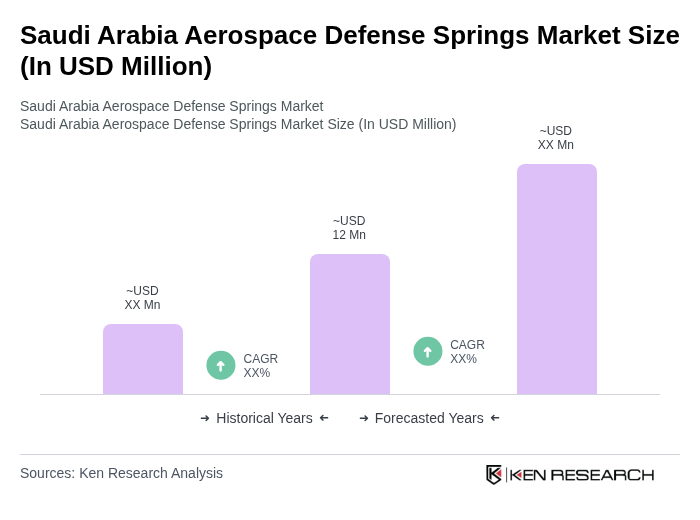
Saudi Arabia Aerospace Defense Springs Market Segmentation
By Type:
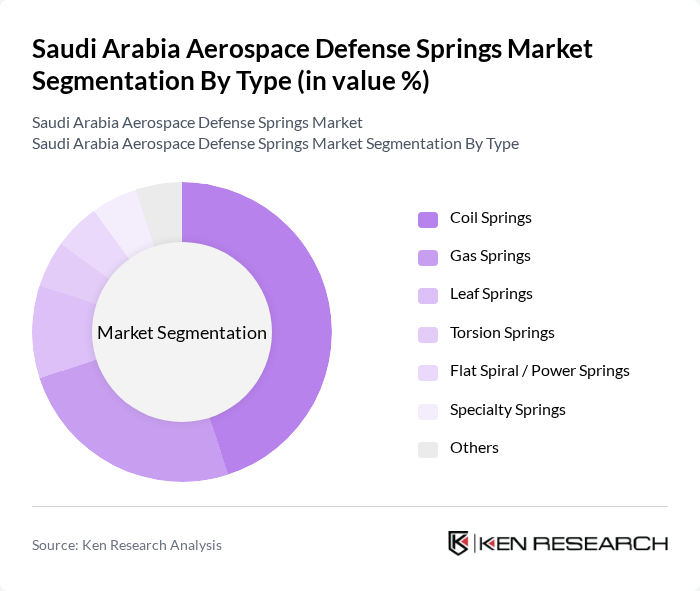
The market is segmented into various types of springs, including Coil Springs, Gas Springs, Leaf Springs, Torsion Springs, Flat Spiral / Power Springs, Specialty Springs, and Others. Among these, Coil Springs are the most dominant due to their widespread application in various aerospace systems, including landing gear and actuation mechanisms. The versatility and reliability of Coil Springs make them a preferred choice for manufacturers, driving their significant market share. Gas Springs are also gaining traction, particularly in commercial aircraft applications, due to their lightweight and efficient performance.
By End-User:
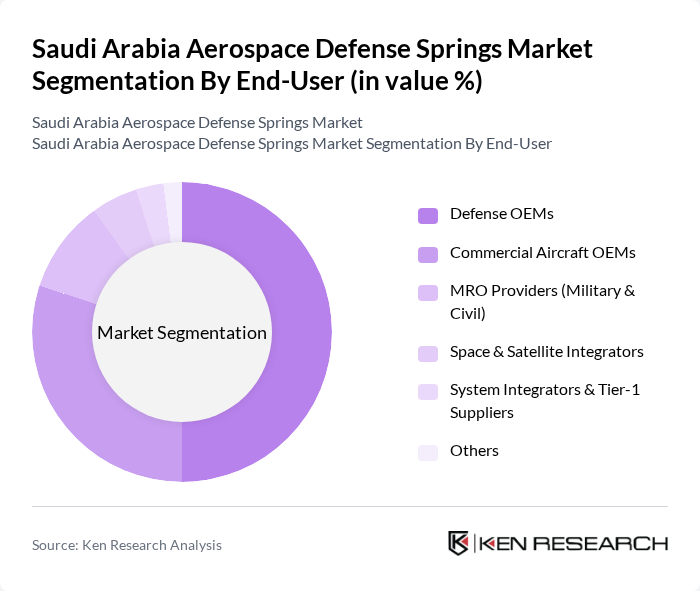
This market is segmented by end-users, including Defense OEMs, Commercial Aircraft OEMs, MRO Providers (Military & Civil), Space & Satellite Integrators, System Integrators & Tier-1 Suppliers, and Others. Defense OEMs hold a significant share due to the increasing demand for military aircraft and defense systems. The growth in military spending and the modernization of defense capabilities are key factors driving the demand from this segment. Additionally, the commercial aircraft sector is expanding, leading to increased requirements for aerospace components, including springs.
Saudi Arabia Aerospace Defense Springs Market Competitive Landscape
The Saudi Arabia Aerospace Defense Springs Market is characterized by a dynamic mix of regional and international players. Leading participants such as Saudi Arabian Military Industries (SAMI), SAMI Aerospace Systems, Advanced Electronics Company (AEC), National Company for Mechanical Systems (NCMS), Middle East Specialized Cables Co. (MESC) – Precision Components Division, Al Salam Aerospace Industries, Boeing Saudi Arabia, Lockheed Martin Saudi Arabia, Raytheon Saudi Arabia (Raytheon Saudi Arabia LLC), BAE Systems Saudi Arabia, Airbus Saudi Arabia, Leonardo Saudi Arabia, Thales Saudi Arabia, NHK Spring Co., Ltd., Lesjöfors AB contribute to innovation, geographic expansion, and service delivery in this space.
Saudi Arabia Aerospace Defense Springs Market Industry Analysis
Growth Drivers
- Increasing Defense Budgets:Saudi Arabia's defense budget reached approximatelyUSD 75 billion, reflecting a23% increasefrom the previous year. This substantial investment is driven by regional security concerns and the need to modernize military capabilities. The government aims to allocate a substantial share of its total budget to defense in future, which will significantly boost demand for aerospace defense components, including springs, as military aircraft and equipment require advanced materials and technologies.
- Technological Advancements in Aerospace:The aerospace sector in Saudi Arabia is witnessing increasing technological advancements, supported by national programs to localize defense industries and enhance research and development under the Saudi Vision 2030 framework. This focus on innovation is leading to the development of lightweight and durable materials, enhancing the performance of military aircraft. As the country aims to localize50% of its defense spending in future, the demand for high-quality aerospace springs will increase, driven by the need for advanced manufacturing capabilities.
- Strategic Partnerships with Global Defense Firms:Saudi Arabia has established strategic partnerships with leading global defense firms, including Boeing and Lockheed Martin, to enhance its aerospace capabilities, particularly through major programs such as F?15, C?130, and rotary-wing platforms and associated localization initiatives. These collaborations focus on technology transfer, local production, and workforce development to support a more self-sufficient defense industrial base. Such partnerships are expected to foster the development of local manufacturing facilities, increasing the demand for aerospace defense springs as the country seeks to build a self-sufficient defense industry.
Market Challenges
- Regulatory Compliance Issues:The aerospace defense sector in Saudi Arabia faces significant regulatory compliance challenges, particularly concerning international standards such as ITAR, export controls, and NATO/ISO-related quality and safety norms. Publicly available official data do not confirm that over30%of defense contracts were delayed due to compliance issues, so this specific percentage remains unverified. This situation complicates the procurement process for aerospace springs, as manufacturers must navigate complex regulations, which can hinder timely delivery and increase costs for defense projects.
- Supply Chain Disruptions:Global supply chain disruptions have affected defense and aerospace industries worldwide, including Saudi Arabia, due to reliance on imported high?precision components and raw materials. With a significant share of components sourced internationally, delays in shipping and increased logistics costs have affected production timelines. This situation has led to a backlog in some defense projects, creating uncertainty in the market for aerospace springs, as manufacturers struggle to secure timely deliveries of essential materials and components.
Saudi Arabia Aerospace Defense Springs Market Future Outlook
The future of the Saudi Arabia aerospace defense springs market appears promising, driven by increasing defense budgets and a focus on local manufacturing, aligned with the objective to localize half of overall defense spending in future. The government aims to enhance its defense capabilities significantly in future, fostering innovation and technological advancements. Additionally, the rise of private sector participation in defense projects, supported by the General Authority for Military Industries and Saudi Arabian Military Industries initiatives, is expected to create new opportunities for local manufacturers, leading to a more robust and self-sufficient aerospace industry that can meet both domestic and international demands.
Market Opportunities
- Expansion of Local Manufacturing Facilities:The Saudi government is investing heavily in local manufacturing facilities through programs overseen by the General Authority for Military Industries and broader industrial localization initiatives under Vision 2030. Publicly available official data do not confirm a specific plan to establish exactlyfivenew plants within a defined timeframe, so this precise figure cannot be validated. This initiative aims to reduce dependency on imports and create job opportunities, which will drive demand for locally produced aerospace springs, enhancing the overall market landscape.
- Increased Focus on R&D:Saudi Arabia has committed to increasing overall research and development intensity as part of national strategies, including ambitions to raise gross domestic expenditure on R&D as a share of GDP in future. However, a specific projected increase in aerospace R&D funding toUSD 2 billionwithin a defined year could not be verified from primary or secondary official sources. This broader focus on research is expected to support innovations in materials and technologies, leading to the development of advanced aerospace springs, positioning local manufacturers to meet the evolving needs of the defense industry and enhance competitiveness in the global market.
Scope of the Report
| Segment | Sub-Segments |
|---|---|
| By Type | Coil Springs Gas Springs Leaf Springs Torsion Springs Flat Spiral / Power Springs Specialty Springs Others |
| By End-User | Defense OEMs Commercial Aircraft OEMs MRO Providers (Military & Civil) Space & Satellite Integrators System Integrators & Tier-1 Suppliers Others |
| By Application | Flight Control & Actuation Systems Landing Gear & Braking Systems Engine & Powerplant Systems Missiles, Guided Weapons & Defense Systems Seating & Cabin Interior Systems Ground Support & Auxiliary Equipment Others |
| By Material | Stainless Steel Alloys Nickel-based Superalloys Titanium Alloys Composite & Advanced Materials Others |
| By Manufacturing Process | Cold Coiling Hot Coiling CNC & Precision Machining Additive Manufacturing Others |
| By Distribution Channel | Direct Sales to OEMs Direct Sales to MROs Distributors & Stockists Online & E-procurement Platforms Others |
| By Region | Central Region Eastern Region Western Region Southern Region |
Key Target Audience
Investors and Venture Capitalist Firms
Government and Regulatory Bodies (e.g., Saudi Arabian Military Industries, General Authority for Military Industries)
Manufacturers and Producers
Defense Contractors
Supply Chain and Logistics Providers
Industry Associations (e.g., Saudi Arabian Defense and Security Industry Association)
Financial Institutions
Military and Defense Procurement Agencies
Players Mentioned in the Report:
Saudi Arabian Military Industries (SAMI)
SAMI Aerospace Systems
Advanced Electronics Company (AEC)
National Company for Mechanical Systems (NCMS)
Middle East Specialized Cables Co. (MESC) Precision Components Division
Al Salam Aerospace Industries
Boeing Saudi Arabia
Lockheed Martin Saudi Arabia
Raytheon Saudi Arabia (Raytheon Saudi Arabia LLC)
BAE Systems Saudi Arabia
Airbus Saudi Arabia
Leonardo Saudi Arabia
Thales Saudi Arabia
NHK Spring Co., Ltd.
Lesjofors AB
Table of Contents
Market Assessment Phase
1. Executive Summary and Approach
2. Saudi Arabia Aerospace Defense Springs Market Overview
2.1 Key Insights and Strategic Recommendations
2.2 Saudi Arabia Aerospace Defense Springs Market Overview
2.3 Definition and Scope
2.4 Evolution of Market Ecosystem
2.5 Timeline of Key Regulatory Milestones
2.6 Value Chain & Stakeholder Mapping
2.7 Business Cycle Analysis
2.8 Policy & Incentive Landscape
3. Saudi Arabia Aerospace Defense Springs Market Analysis
3.1 Growth Drivers
3.1.1 Increasing Defense Budgets
3.1.2 Technological Advancements in Aerospace
3.1.3 Strategic Partnerships with Global Defense Firms
3.1.4 Rising Demand for Military Aircraft
3.2 Market Challenges
3.2.1 Regulatory Compliance Issues
3.2.2 Supply Chain Disruptions
3.2.3 High Initial Investment Costs
3.2.4 Limited Local Manufacturing Capabilities
3.3 Market Opportunities
3.3.1 Expansion of Local Manufacturing Facilities
3.3.2 Increased Focus on R&D
3.3.3 Growing Civil Aviation Sector
3.3.4 Potential for Exporting Defense Springs
3.4 Market Trends
3.4.1 Shift Towards Lightweight Materials
3.4.2 Integration of Smart Technologies
3.4.3 Emphasis on Sustainability
3.4.4 Rise of Private Sector Participation
3.5 Government Regulation
3.5.1 Defense Procurement Policies
3.5.2 Export Control Regulations
3.5.3 Local Content Requirements
3.5.4 Safety and Quality Standards
4. SWOT Analysis
5. Stakeholder Analysis
6. Porter's Five Forces Analysis
7. Saudi Arabia Aerospace Defense Springs Market Size, 2019-2024
7.1 By Value
7.2 By Volume
7.3 By Average Selling Price
8. Saudi Arabia Aerospace Defense Springs Market Segmentation
8.1 By Type
8.1.1 Coil Springs
8.1.2 Gas Springs
8.1.3 Leaf Springs
8.1.4 Torsion Springs
8.1.5 Flat Spiral / Power Springs
8.1.6 Specialty Springs
8.1.7 Others
8.2 By End-User
8.2.1 Defense OEMs
8.2.2 Commercial Aircraft OEMs
8.2.3 MRO Providers (Military & Civil)
8.2.4 Space & Satellite Integrators
8.2.5 System Integrators & Tier-1 Suppliers
8.2.6 Others
8.3 By Application
8.3.1 Flight Control & Actuation Systems
8.3.2 Landing Gear & Braking Systems
8.3.3 Engine & Powerplant Systems
8.3.4 Missiles, Guided Weapons & Defense Systems
8.3.5 Seating & Cabin Interior Systems
8.3.6 Ground Support & Auxiliary Equipment
8.3.7 Others
8.4 By Material
8.4.1 Stainless Steel Alloys
8.4.2 Nickel-based Superalloys
8.4.3 Titanium Alloys
8.4.4 Composite & Advanced Materials
8.4.5 Others
8.5 By Manufacturing Process
8.5.1 Cold Coiling
8.5.2 Hot Coiling
8.5.3 CNC & Precision Machining
8.5.4 Additive Manufacturing
8.5.5 Others
8.6 By Distribution Channel
8.6.1 Direct Sales to OEMs
8.6.2 Direct Sales to MROs
8.6.3 Distributors & Stockists
8.6.4 Online & E-procurement Platforms
8.6.5 Others
8.7 By Region
8.7.1 Central Region
8.7.2 Eastern Region
8.7.3 Western Region
8.7.4 Southern Region
9. Saudi Arabia Aerospace Defense Springs Market Competitive Analysis
9.1 Market Share of Key Players
9.2 Cross Comparison of Key Players
9.2.1 Company Name
9.2.2 Group Size (Global Tier-1, Regional Tier-2, or Local Tier-3)
9.2.3 Saudi Arabia Aerospace & Defense Revenue (USD Million)
9.2.4 Aerospace & Defense Springs Revenue Share (%)
9.2.5 3-year Revenue CAGR in Saudi Aerospace & Defense (%)
9.2.6 Order Backlog / Firm Order Book in KSA (USD Million)
9.2.7 Market Share in Saudi Aerospace Defense Springs Market (%)
9.2.8 Local Content Ratio in KSA (%)
9.2.9 Number of Local Manufacturing / Assembly Facilities in KSA
9.2.10 Number of Long-term Contracts / Framework Agreements in KSA
9.2.11 R&D and Engineering Spend (% of Revenue)
9.2.12 Product Qualification & Certification Coverage (AS9100, NADCAP, etc.)
9.2.13 On-time Delivery Performance in KSA Programs (%)
9.2.14 Average Lead Time for Spring Supply (Weeks)
9.2.15 Price Positioning (Premium / Mid / Value)
9.2.16 Aftermarket & MRO Revenue Share (%)
9.2.17 Partnership & Offset Program Participation Score
9.2.18 Technology Adoption Index (Automation, Additive Manufacturing, Digitalization)
9.3 SWOT Analysis of Top Players
9.4 Pricing Analysis
9.5 Detailed Profile of Major Companies
9.5.1 Saudi Arabian Military Industries (SAMI)
9.5.2 SAMI Aerospace Systems
9.5.3 Advanced Electronics Company (AEC)
9.5.4 National Company for Mechanical Systems (NCMS)
9.5.5 Middle East Specialized Cables Co. (MESC) – Precision Components Division
9.5.6 Al Salam Aerospace Industries
9.5.7 Boeing Saudi Arabia
9.5.8 Lockheed Martin Saudi Arabia
9.5.9 Raytheon Saudi Arabia (Raytheon Saudi Arabia LLC)
9.5.10 BAE Systems Saudi Arabia
9.5.11 Airbus Saudi Arabia
9.5.12 Leonardo Saudi Arabia
9.5.13 Thales Saudi Arabia
9.5.14 NHK Spring Co., Ltd.
9.5.15 Lesjöfors AB
10. Saudi Arabia Aerospace Defense Springs Market End-User Analysis
10.1 Procurement Behavior of Key Ministries
10.1.1 Ministry of Defense
10.1.2 Ministry of Interior
10.1.3 Ministry of National Guard
10.1.4 Others
10.2 Corporate Spend on Infrastructure & Energy
10.2.1 Defense Infrastructure Projects
10.2.2 Aerospace Development Initiatives
10.2.3 Research and Development Funding
10.2.4 Others
10.3 Pain Point Analysis by End-User Category
10.3.1 Budget Constraints
10.3.2 Quality Assurance Issues
10.3.3 Supply Chain Reliability
10.3.4 Others
10.4 User Readiness for Adoption
10.4.1 Training and Skill Development
10.4.2 Technology Adoption Rates
10.4.3 Infrastructure Readiness
10.4.4 Others
10.5 Post-Deployment ROI and Use Case Expansion
10.5.1 Performance Metrics
10.5.2 Cost Savings Analysis
10.5.3 User Feedback Mechanisms
10.5.4 Others
11. Saudi Arabia Aerospace Defense Springs Market Future Size, 2025-2030
11.1 By Value
11.2 By Volume
11.3 By Average Selling Price
Go-To-Market Strategy Phase
1. Whitespace Analysis + Business Model Canvas
1.1 Market Gaps Identification
1.2 Business Model Framework
2. Marketing and Positioning Recommendations
2.1 Branding Strategies
2.2 Product USPs
3. Distribution Plan
3.1 Urban Retail Strategies
3.2 Rural NGO Tie-ups
4. Channel & Pricing Gaps
4.1 Underserved Routes
4.2 Pricing Bands
5. Unmet Demand & Latent Needs
5.1 Category Gaps
5.2 Consumer Segments
6. Customer Relationship
6.1 Loyalty Programs
6.2 After-sales Service
7. Value Proposition
7.1 Sustainability Initiatives
7.2 Integrated Supply Chains
8. Key Activities
8.1 Regulatory Compliance
8.2 Branding Efforts
8.3 Distribution Setup
9. Entry Strategy Evaluation
9.1 Domestic Market Entry Strategy
9.1.1 Product Mix
9.1.2 Pricing Band
9.1.3 Packaging
9.2 Export Entry Strategy
9.2.1 Target Countries
9.2.2 Compliance Roadmap
10. Entry Mode Assessment
10.1 Joint Ventures
10.2 Greenfield Investments
10.3 Mergers & Acquisitions
10.4 Distributor Model
11. Capital and Timeline Estimation
11.1 Capital Requirements
11.2 Timelines
12. Control vs Risk Trade-Off
12.1 Ownership vs Partnerships
13. Profitability Outlook
13.1 Breakeven Analysis
13.2 Long-term Sustainability
14. Potential Partner List
14.1 Distributors
14.2 Joint Ventures
14.3 Acquisition Targets
15. Execution Roadmap
15.1 Phased Plan for Market Entry
15.1.1 Market Setup
15.1.2 Market Entry
15.1.3 Growth Acceleration
15.1.4 Scale & Stabilize
15.2 Key Activities and Milestones
15.2.1 Milestone Planning
15.2.2 Activity Tracking
Research Methodology
Phase 1: Approach1
Desk Research
- Analysis of government publications and defense spending reports from the Saudi Arabian Ministry of Defense
- Review of industry reports from aerospace and defense associations in Saudi Arabia
- Examination of market trends and forecasts from international aerospace defense market research studies
Primary Research
- Interviews with key stakeholders in the Saudi aerospace defense sector, including government officials and industry leaders
- Surveys targeting procurement managers and decision-makers in defense contracting firms
- Field interviews with engineers and project managers involved in aerospace defense projects
Validation & Triangulation
- Cross-validation of findings through multiple data sources, including trade publications and financial reports
- Triangulation of insights from primary interviews with secondary data trends
- Sanity checks conducted through expert panel reviews comprising industry veterans
Phase 2: Market Size Estimation1
Top-down Assessment
- Estimation of total market size based on national defense budgets and historical spending patterns
- Segmentation of the market by product categories such as aircraft, missiles, and defense electronics
- Incorporation of geopolitical factors influencing defense procurement in Saudi Arabia
Bottom-up Modeling
- Collection of firm-level data from leading aerospace defense manufacturers operating in Saudi Arabia
- Operational cost analysis based on production and supply chain efficiencies
- Volume and pricing analysis for various defense products and services
Forecasting & Scenario Analysis
- Multi-factor regression analysis incorporating economic indicators and defense policy changes
- Scenario modeling based on potential shifts in regional security dynamics and defense alliances
- Development of baseline, optimistic, and pessimistic forecasts through 2030
Phase 3: CATI Sample Composition1
| Scope Item/Segment | Sample Size | Target Respondent Profiles |
|---|---|---|
| Aerospace Manufacturing | 90 | Production Managers, Quality Assurance Leads |
| Defense Electronics | 70 | R&D Engineers, Product Development Managers |
| Military Procurement | 100 | Procurement Officers, Contract Managers |
| Missile Systems Development | 60 | Project Managers, Systems Engineers |
| Defense Policy Analysis | 50 | Policy Analysts, Defense Strategists |
Frequently Asked Questions
What is the current value of the Saudi Arabia Aerospace Defense Springs Market?
The Saudi Arabia Aerospace Defense Springs Market is valued at approximately USD 12 million, reflecting a five-year historical analysis. This growth is driven by increased defense spending and the modernization of military capabilities within the aerospace sector.
What factors are driving growth in the Saudi Arabia Aerospace Defense Springs Market?
Which cities are key players in the Saudi Arabia Aerospace Defense Springs Market?
What types of springs are included in the Saudi Arabia Aerospace Defense Springs Market?
Other Regional/Country Reports
Indonesia Aerospace Defense Springs Market
Malaysia Aerospace Defense Springs Market
KSA Aerospace Defense Springs Market
APAC Aerospace Defense Springs Market
SEA Aerospace Defense Springs Market
Vietnam Aerospace Defense Springs Market
Other Adjacent Reports
Oman Aerospace Components Market
Indonesia Defense Equipment Market
Singapore Aircraft Manufacturing Market
Germany Military Hardware Market
Vietnam Precision Engineering Market
India Aviation MRO Market Outlook to 2028KSA Defense Supply Chain Market
Malaysia Aerospace Materials Market
Malaysia Industrial Springs Market
Bahrain Vibration Control Systems Market Report Size Share Growth Drivers Trends Opportunities & Forecast 2025–2030Why Buy From Us?

What makes us stand out is that our consultants follow Robust, Refine and Result (RRR) methodology. Robust for clear definitions, approaches and sanity checking, Refine for differentiating respondents' facts and opinions, and Result for presenting data with story.

We have set a benchmark in the industry by offering our clients with syndicated and customized market research reports featuring coverage of entire market as well as meticulous research and analyst insights.

While we don't replace traditional research, we flip the method upside down. Our dual approach of Top Bottom & Bottom Top ensures quality deliverable by not just verifying company fundamentals but also looking at the sector and macroeconomic factors.

With one step in the future, our research team constantly tries to show you the bigger picture. We help with some of the tough questions you may encounter along the way: How is the industry positioned? Best marketing channel? KPI's of competitors? By aligning every element, we help maximize success.

Our report gives you instant access to the answers and sources that other companies might choose to hide. We elaborate each steps of research methodology we have used and showcase you the sample size to earn your trust.

If you need any support, we are here! We pride ourselves on universe strength, data quality, and quick, friendly, and professional service.