Region:Middle East
Author(s):Dev
Product Code:KRAD1706
Pages:88
Published On:November 2025
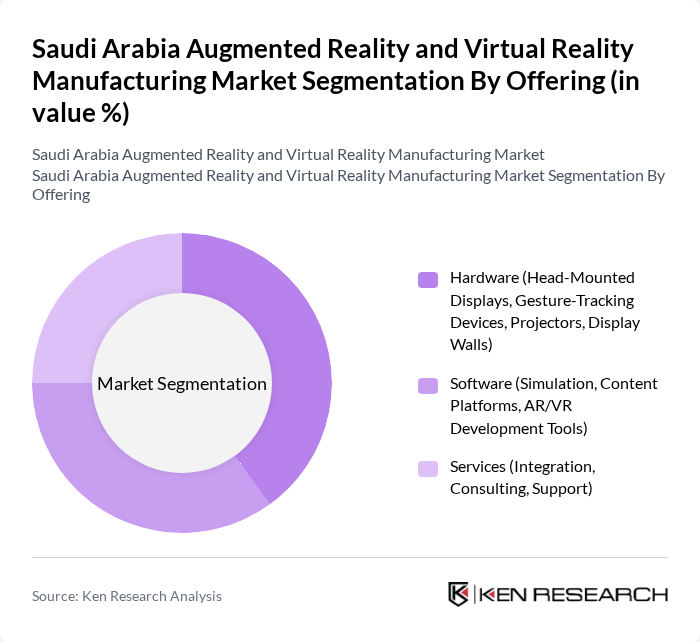
By Offering:The market is segmented into Hardware, Software, and Services. Hardware includes devices such as Head-Mounted Displays, Gesture-Tracking Devices, Projectors, and Display Walls. Software encompasses Simulation, Content Platforms, and AR/VR Development Tools, while Services cover Integration, Consulting, and Support. The hardware segment is gaining traction due to the introduction of advanced mixed-reality devices and strong demand for immersive training and operational solutions in manufacturing. Software is witnessing rapid growth, driven by the national-level metaverse integration and demand for interactive applications in education, healthcare, and industrial settings .
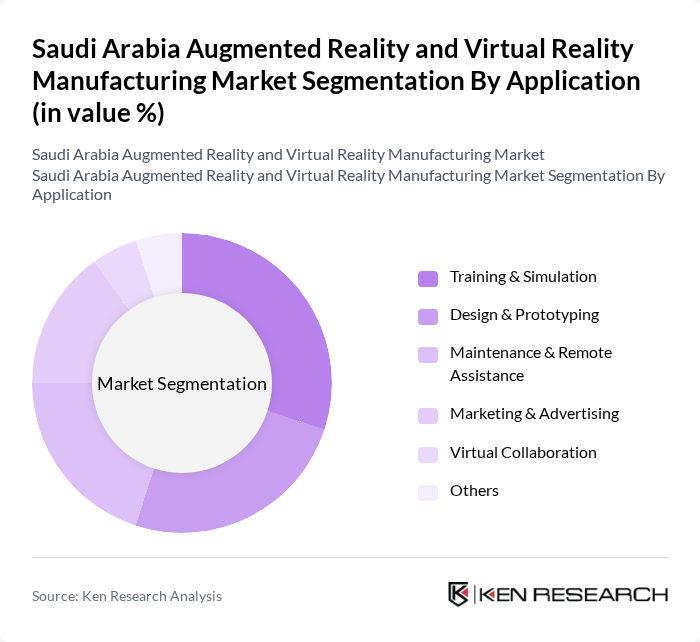
By Application:The applications of AR and VR in the manufacturing sector include Training & Simulation, Design & Prototyping, Maintenance & Remote Assistance, Marketing & Advertising, Virtual Collaboration, and Others. Training & Simulation is a key application, enabling immersive workforce development and safety training. Design & Prototyping leverages AR/VR for rapid visualization and iteration, while Maintenance & Remote Assistance uses these technologies to enhance operational uptime and remote troubleshooting. Marketing & Advertising, Virtual Collaboration, and other applications further support digital transformation and customer engagement .
The Saudi Arabia Augmented Reality and Virtual Reality Manufacturing Market is characterized by a dynamic mix of regional and international players. Leading participants such as STC Group, Saudi Telecom Company, Atheeb Group, MBC Group, Al-Falak Electronic Equipment & Supplies, Al-Muhaidib Group, Al-Jazira Capital, Al-Rajhi Bank, Saudi Aramco, King Abdulaziz City for Science and Technology (KACST), Saudi Arabian General Investment Authority (SAGIA), Mobily, Zain KSA, NEOM Tech & Digital Company, Elm Company, Advanced Electronics Company (AEC), Solutions by STC, VirtuPort, Digico, Accenture Saudi Arabia contribute to innovation, geographic expansion, and service delivery in this space .
The future of the AR/VR manufacturing market in Saudi Arabia appears promising, driven by ongoing technological advancements and government support. As 5G technology becomes more widespread, it will enhance AR/VR experiences, making them more accessible and effective. Additionally, the integration of artificial intelligence with AR/VR applications is expected to create innovative solutions across various sectors, including healthcare and education, further propelling market growth and adoption in the coming years.
| Segment | Sub-Segments |
|---|---|
| By Offering | Hardware (Head-Mounted Displays, Gesture-Tracking Devices, Projectors, Display Walls) Software (Simulation, Content Platforms, AR/VR Development Tools) Services (Integration, Consulting, Support) |
| By Application | Training & Simulation Design & Prototyping Maintenance & Remote Assistance Marketing & Advertising Virtual Collaboration Others |
| By End-User Industry | Automotive Manufacturing Electronics & Electrical Manufacturing Food & Beverage Manufacturing Healthcare Manufacturing Aerospace & Defense Manufacturing Others |
| By Technology | Augmented Reality (AR) Virtual Reality (VR) Mixed Reality (MR) Others |
| By Deployment Model | On-Premises Cloud-Based Hybrid |
| By Region | Central Region Eastern Region Western Region Southern Region |
| Scope Item/Segment | Sample Size | Target Respondent Profiles |
|---|---|---|
| Automotive Manufacturing Sector | 60 | Production Managers, Technology Officers |
| Aerospace Manufacturing Sector | 40 | Engineering Managers, R&D Directors |
| Consumer Electronics Manufacturing | 50 | Operations Managers, Supply Chain Analysts |
| Pharmaceutical Manufacturing | 40 | Quality Assurance Managers, IT Managers |
| Construction and Heavy Machinery | 40 | Project Managers, Equipment Managers |
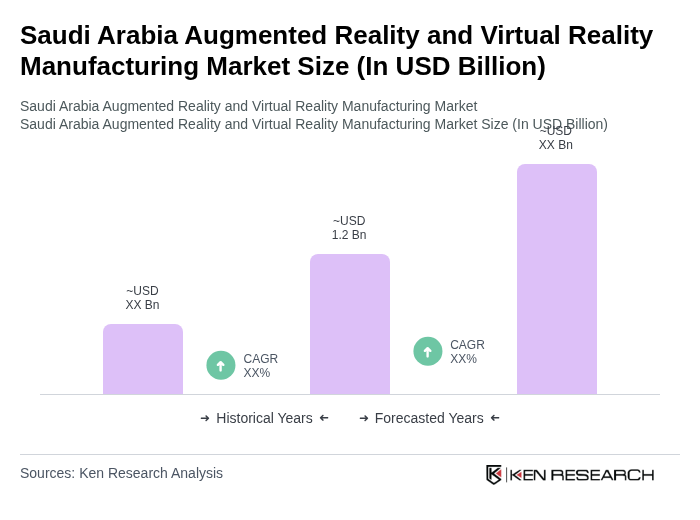
The Saudi Arabia Augmented Reality and Virtual Reality Manufacturing Market is valued at approximately USD 1.2 billion, reflecting significant growth driven by the expansion of the extended reality ecosystem and government support through initiatives like Vision 2030.

What makes us stand out is that our consultants follow Robust, Refine and Result (RRR) methodology. Robust for clear definitions, approaches and sanity checking, Refine for differentiating respondents' facts and opinions, and Result for presenting data with story.

We have set a benchmark in the industry by offering our clients with syndicated and customized market research reports featuring coverage of entire market as well as meticulous research and analyst insights.

While we don't replace traditional research, we flip the method upside down. Our dual approach of Top Bottom & Bottom Top ensures quality deliverable by not just verifying company fundamentals but also looking at the sector and macroeconomic factors.

With one step in the future, our research team constantly tries to show you the bigger picture. We help with some of the tough questions you may encounter along the way: How is the industry positioned? Best marketing channel? KPI's of competitors? By aligning every element, we help maximize success.

Our report gives you instant access to the answers and sources that other companies might choose to hide. We elaborate each steps of research methodology we have used and showcase you the sample size to earn your trust.

If you need any support, we are here! We pride ourselves on universe strength, data quality, and quick, friendly, and professional service.













