About the Report
Base Year 2024Saudi Arabia Back to College Market Overview
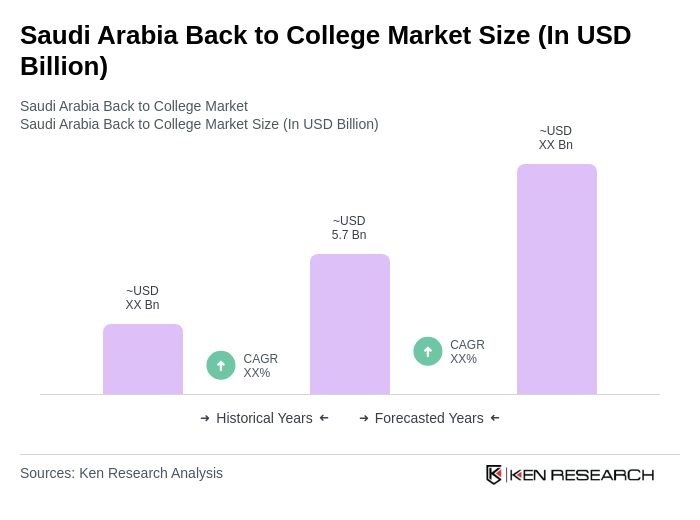
- The Saudi Arabia Back to College Market is valued at USD 5.7 billion, based on a five-year historical analysis. This growth is primarily driven by increasing enrollment rates in higher education institutions, robust government investments in educational infrastructure, and a rising focus on vocational training and skill development among the youth. The market is further propelled by digital transformation initiatives, including the rapid adoption of online learning platforms and AI-powered educational tools, which have expanded access and improved learning outcomes for students across the country .
- Key cities such as Riyadh, Jeddah, and Dammam dominate the market due to their concentration of educational institutions, advanced infrastructure, and proximity to major industries. These urban centers attract both local and international students, fostering a competitive educational environment that supports innovation and enhances overall market growth. The high urbanization rate, with over 80% of the population residing in urban areas, further amplifies the demand for higher education in these cities .
- In 2023, the Saudi government enacted the Human Capability Development Program under Vision 2030, issued by the Ministry of Education, which introduced expanded scholarships and financial aid programs for underprivileged students. This regulation mandates increased accessibility to higher education through targeted funding, compliance with eligibility criteria, and transparent allocation processes. The initiative aims to promote inclusivity and ensure that a broader segment of the population can pursue higher education, thereby contributing to the overall growth of the market .
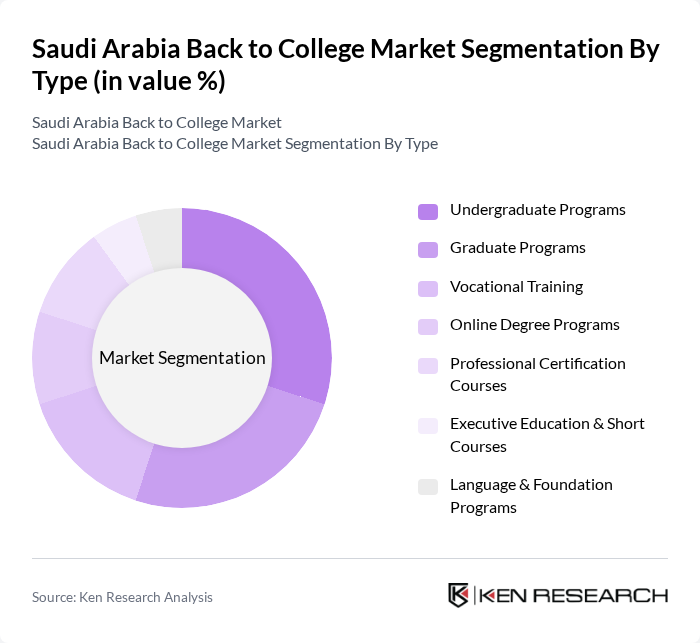
Saudi Arabia Back to College Market Segmentation
By Type:The market is segmented into diverse educational offerings, including Undergraduate Programs, Graduate Programs, Vocational Training, Online Degree Programs, Professional Certification Courses, Executive Education & Short Courses, and Language & Foundation Programs. Undergraduate and graduate programs remain the largest segments, reflecting strong demand for academic credentials among Saudi youth and professionals. Vocational training and professional certification courses are experiencing accelerated growth due to industry partnerships and government initiatives aimed at workforce development. Online degree programs and executive education are expanding rapidly, driven by digital transformation and flexible learning preferences .
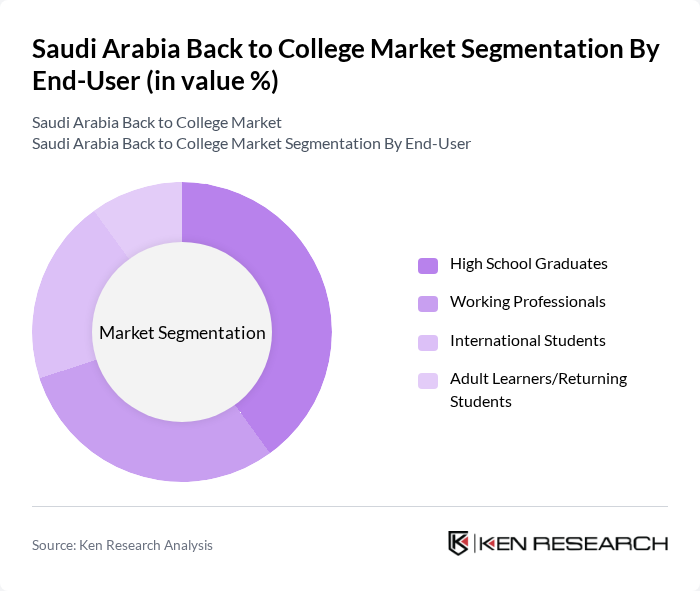
By End-User:The end-user segmentation includes High School Graduates, Working Professionals, International Students, and Adult Learners/Returning Students. High school graduates represent the largest share, driven by the demographic youth bulge and increasing transition rates to higher education. Working professionals and adult learners are increasingly pursuing upskilling and reskilling opportunities, while international students are attracted by Saudi Arabia’s expanding academic offerings and scholarship programs .
Saudi Arabia Back to College Market Competitive Landscape
The Saudi Arabia Back to College Market is characterized by a dynamic mix of regional and international players. Leading participants such as King Saud University, King Abdulaziz University, Prince Sultan University, Alfaisal University, University of Jeddah, Imam Abdulrahman Bin Faisal University, Dar Al-Hekma University, Effat University, Al Yamamah University, Imam Mohammad Ibn Saud Islamic University, AlMaarefa University, Jouf University, Taif University, Najran University, Qassim University contribute to innovation, geographic expansion, and service delivery in this space.
Saudi Arabia Back to College Market Industry Analysis
Growth Drivers
- Increasing Enrollment Rates:In Saudi Arabia, enrollment in higher education institutions is approximately1.6 million students, reflecting a steady increase from1.3 million. This growth is driven by a national focus on education as a key pillar of Vision 2030, which aims to enhance educational access and quality. The government’s commitment to increasing the number of universities and colleges supports this trend, fostering a more educated workforce to meet future economic demands.
- Government Initiatives for Education:The Saudi government allocatedapproximately USD 51 billionfor education, emphasizing its commitment to improving educational infrastructure and resources. Initiatives such as the National Transformation Program aim to enhance educational quality and accessibility, particularly in underserved regions. These investments are expected to significantly boost enrollment rates and improve the overall educational landscape, aligning with the country’s long-term economic goals.
- Rising Demand for Higher Education:The demand for higher education in Saudi Arabia continues to grow, with an estimatedover 60% of the population under 30 years old. This demographic shift is driving the need for advanced educational opportunities, particularly in fields like engineering and healthcare. The labor market increasingly requires skilled professionals, prompting more students to pursue higher education to enhance their employability and meet industry demands, thus fueling market growth.
Market Challenges
- Limited Access to Resources:Despite government efforts, many regions in Saudi Arabia still face significant challenges regarding access to educational resources.Approximately 30% of students in rural areas lack access to quality educational facilities and trained educators. This disparity creates barriers to higher education, limiting opportunities for many potential students and hindering overall market growth. Addressing these resource gaps is crucial for achieving equitable educational outcomes across the country.
- High Competition Among Institutions:The increasing number of higher education institutions in Saudi Arabia has led to intense competition, withover 30 universitiesvying for student enrollment. This competition can dilute the quality of education as institutions may prioritize enrollment numbers over educational standards. Additionally, the pressure to attract students can lead to unsustainable practices, impacting the long-term viability of some institutions and creating challenges for maintaining educational quality.
Saudi Arabia Back to College Market Future Outlook
The future of the Saudi Arabia back to college market appears promising, driven by ongoing government investments and a growing emphasis on educational quality. As the demand for skilled professionals continues to rise, institutions are likely to adapt by enhancing their curricula and adopting innovative teaching methods. Furthermore, the integration of technology in education will play a pivotal role in shaping learning experiences, making education more accessible and tailored to individual needs, thus fostering a more skilled workforce.
Market Opportunities
- Growth of Online Learning Platforms:The online education sector in Saudi Arabia is expanding rapidly, withover 1 million students enrolled in online courses. This growth presents significant opportunities for educational institutions to develop and offer flexible learning options, catering to diverse student needs and preferences, ultimately enhancing educational access and engagement.
- Partnerships with International Institutions:Collaborations with international universities are on the rise, withover 50 partnershipsestablished. These partnerships enhance the quality of education and provide students with global exposure, improving their employability. Such initiatives can also attract foreign investment and expertise, further enriching the educational landscape in Saudi Arabia.
Scope of the Report
| Segment | Sub-Segments |
|---|---|
| By Type | Undergraduate Programs Graduate Programs Vocational Training Online Degree Programs Professional Certification Courses Executive Education & Short Courses Language & Foundation Programs |
| By End-User | High School Graduates Working Professionals International Students Adult Learners/Returning Students |
| By Application | Academic Advancement Skill Development & Upskilling Career Change/Professional Certification |
| By Sales Channel | Direct Institutional Enrollment Online Education Platforms Education Agents & Consultants |
| By Distribution Mode | On-Campus (In-Person) Learning Online/Distance Learning Blended/Hybrid Learning |
| By Price Range | Budget Programs Mid-Tier Programs Premium Programs |
| By Policy Support | Government Scholarships & Subsidies Tax Incentives for Education Providers Student Loan & Grant Programs |
Key Target Audience
Investors and Venture Capitalist Firms
Government and Regulatory Bodies (e.g., Ministry of Education, Saudi Arabian General Investment Authority)
Manufacturers and Producers of Educational Materials
Distributors and Retailers of Educational Supplies
Technology Providers for Educational Solutions
Industry Associations related to Education and Training
Financial Institutions offering Student Loans and Educational Financing
Corporate Sponsors and Philanthropic Organizations
Players Mentioned in the Report:
King Saud University
King Abdulaziz University
Prince Sultan University
Alfaisal University
University of Jeddah
Imam Abdulrahman Bin Faisal University
Dar Al-Hekma University
Effat University
Al Yamamah University
Imam Mohammad Ibn Saud Islamic University
AlMaarefa University
Jouf University
Taif University
Najran University
Qassim University
Table of Contents
Market Assessment Phase
1. Executive Summary and Approach
2. Saudi Arabia Back to College Market Overview
2.1 Key Insights and Strategic Recommendations
2.2 Saudi Arabia Back to College Market Overview
2.3 Definition and Scope
2.4 Evolution of Market Ecosystem
2.5 Timeline of Key Regulatory Milestones
2.6 Value Chain & Stakeholder Mapping
2.7 Business Cycle Analysis
2.8 Policy & Incentive Landscape
3. Saudi Arabia Back to College Market Analysis
3.1 Growth Drivers
3.1.1 Increasing Enrollment Rates
3.1.2 Government Initiatives for Education
3.1.3 Rising Demand for Higher Education
3.1.4 Technological Advancements in Learning
3.2 Market Challenges
3.2.1 Limited Access to Resources
3.2.2 High Competition Among Institutions
3.2.3 Economic Fluctuations
3.2.4 Cultural Barriers to Education
3.3 Market Opportunities
3.3.1 Growth of Online Learning Platforms
3.3.2 Partnerships with International Institutions
3.3.3 Expansion of Vocational Training Programs
3.3.4 Increased Investment in Educational Technology
3.4 Market Trends
3.4.1 Shift Towards Hybrid Learning Models
3.4.2 Emphasis on STEM Education
3.4.3 Rise of Student-Centric Learning Approaches
3.4.4 Growing Importance of Soft Skills Development
3.5 Government Regulation
3.5.1 Education Quality Assurance Framework
3.5.2 Accreditation Standards for Institutions
3.5.3 Funding and Grants for Educational Programs
3.5.4 Policies Supporting Female Education
4. SWOT Analysis
5. Stakeholder Analysis
6. Porter's Five Forces Analysis
7. Saudi Arabia Back to College Market Market Size, 2019-2024
7.1 By Value
7.2 By Volume
7.3 By Average Selling Price
8. Saudi Arabia Back to College Market Segmentation
8.1 By Type
8.1.1 Undergraduate Programs
8.1.2 Graduate Programs
8.1.3 Vocational Training
8.1.4 Online Degree Programs
8.1.5 Professional Certification Courses
8.1.6 Executive Education & Short Courses
8.1.7 Language & Foundation Programs
8.2 By End-User
8.2.1 High School Graduates
8.2.2 Working Professionals
8.2.3 International Students
8.2.4 Adult Learners/Returning Students
8.3 By Application
8.3.1 Academic Advancement
8.3.2 Skill Development & Upskilling
8.3.3 Career Change/Professional Certification
8.4 By Sales Channel
8.4.1 Direct Institutional Enrollment
8.4.2 Online Education Platforms
8.4.3 Education Agents & Consultants
8.5 By Distribution Mode
8.5.1 On-Campus (In-Person) Learning
8.5.2 Online/Distance Learning
8.5.3 Blended/Hybrid Learning
8.6 By Price Range
8.6.1 Budget Programs
8.6.2 Mid-Tier Programs
8.6.3 Premium Programs
8.7 By Policy Support
8.7.1 Government Scholarships & Subsidies
8.7.2 Tax Incentives for Education Providers
8.7.3 Student Loan & Grant Programs
9. Saudi Arabia Back to College Market Competitive Analysis
9.1 Market Share of Key Players
9.2 Cross Comparison of Key Players
9.2.1 Company Name
9.2.2 Institution Type (Public/Private/International/EdTech)
9.2.3 Total Enrollment
9.2.4 Enrollment Growth Rate (YoY %)
9.2.5 Graduation/Completion Rate (%)
9.2.6 Student Satisfaction Index (Survey Score)
9.2.7 Market Penetration (Share of Target Segment)
9.2.8 Average Tuition Fee (SAR/USD)
9.2.9 Scholarship/Financial Aid Coverage (%)
9.2.10 Digital Engagement (Active Online Learners, App Usage, Social Media Reach)
9.2.11 Industry Partnerships/Placement Rate (%)
9.2.12 Return on Investment (Graduate Employability/Starting Salary)
9.3 SWOT Analysis of Top Players
9.4 Pricing Analysis
9.5 Detailed Profile of Major Companies
9.5.1 King Saud University
9.5.2 King Abdulaziz University
9.5.3 Prince Sultan University
9.5.4 Alfaisal University
9.5.5 University of Jeddah
9.5.6 Imam Abdulrahman Bin Faisal University
9.5.7 Dar Al-Hekma University
9.5.8 Effat University
9.5.9 Al Yamamah University
9.5.10 Imam Mohammad Ibn Saud Islamic University
9.5.11 AlMaarefa University
9.5.12 Jouf University
9.5.13 Taif University
9.5.14 Najran University
9.5.15 Qassim University
10. Saudi Arabia Back to College Market End-User Analysis
10.1 Procurement Behavior of Key Ministries
10.1.1 Ministry of Education
10.1.2 Ministry of Finance
10.1.3 Ministry of Labor
10.2 Corporate Spend on Infrastructure & Energy
10.2.1 Investment in Educational Facilities
10.2.2 Funding for Technology Integration
10.3 Pain Point Analysis by End-User Category
10.3.1 Accessibility Issues
10.3.2 Quality of Education Concerns
10.4 User Readiness for Adoption
10.4.1 Technology Adoption Rates
10.4.2 Willingness to Pay for Quality Education
10.5 Post-Deployment ROI and Use Case Expansion
10.5.1 Long-term Career Benefits
10.5.2 Alumni Engagement Strategies
11. Saudi Arabia Back to College Market Future Size, 2025-2030
11.1 By Value
11.2 By Volume
11.3 By Average Selling Price
Go-To-Market Strategy Phase
1. Whitespace Analysis + Business Model Canvas
1.1 Market Gaps Identification
1.2 Value Proposition Development
1.3 Revenue Streams Analysis
1.4 Cost Structure Evaluation
1.5 Key Partnerships Exploration
1.6 Customer Segmentation
1.7 Channels of Distribution
2. Marketing and Positioning Recommendations
2.1 Branding Strategies
2.2 Product USPs
3. Distribution Plan
3.1 Urban Retail Strategies
3.2 Rural NGO Tie-ups
4. Channel & Pricing Gaps
4.1 Underserved Routes
4.2 Pricing Bands
5. Unmet Demand & Latent Needs
5.1 Category Gaps
5.2 Consumer Segments
6. Customer Relationship
6.1 Loyalty Programs
6.2 After-sales Service
7. Value Proposition
7.1 Sustainability
7.2 Integrated Supply Chains
8. Key Activities
8.1 Regulatory Compliance
8.2 Branding
8.3 Distribution Setup
9. Entry Strategy Evaluation
9.1 Domestic Market Entry Strategy
9.1.1 Product Mix
9.1.2 Pricing Band
9.1.3 Packaging
9.2 Export Entry Strategy
9.2.1 Target Countries
9.2.2 Compliance Roadmap
10. Entry Mode Assessment
10.1 Joint Ventures
10.2 Greenfield Investments
10.3 Mergers & Acquisitions
10.4 Distributor Model
11. Capital and Timeline Estimation
11.1 Capital Requirements
11.2 Timelines
12. Control vs Risk Trade-Off
12.1 Ownership vs Partnerships
13. Profitability Outlook
13.1 Breakeven Analysis
13.2 Long-term Sustainability
14. Potential Partner List
14.1 Distributors
14.2 Joint Ventures
14.3 Acquisition Targets
15. Execution Roadmap
15.1 Phased Plan for Market Entry
15.1.1 Market Setup
15.1.2 Market Entry
15.1.3 Growth Acceleration
15.1.4 Scale & Stabilize
15.2 Key Activities and Milestones
15.2.1 Milestone Planning
15.2.2 Activity Scheduling
Research Methodology
Phase 1: Approach1
Desk Research
- Analysis of government education statistics and enrollment data from the Ministry of Education
- Review of academic publications and reports on higher education trends in Saudi Arabia
- Examination of market reports from educational institutions and consultancy firms focusing on the back-to-college segment
Primary Research
- Interviews with university administrators and academic advisors to understand enrollment strategies
- Surveys with students returning to college to gauge motivations and challenges
- Focus groups with parents of college students to explore financial and emotional support dynamics
Validation & Triangulation
- Cross-validation of findings through comparison with international education trends
- Triangulation of data from government sources, educational institutions, and student feedback
- Sanity check through expert panel reviews including educators and market analysts
Phase 2: Market Size Estimation1
Top-down Assessment
- Estimation of total addressable market based on national higher education enrollment figures
- Segmentation by field of study and demographic profiles of returning students
- Incorporation of government initiatives aimed at increasing college enrollment rates
Bottom-up Modeling
- Data collection from universities regarding average tuition fees and associated costs
- Analysis of student spending patterns on educational materials and living expenses
- Volume x cost basis for various educational services and products utilized by returning students
Forecasting & Scenario Analysis
- Multi-factor regression analysis incorporating economic indicators and demographic shifts
- Scenarios based on changes in government policy and funding for higher education
- Baseline, optimistic, and pessimistic projections through 2030 based on enrollment trends
Phase 3: CATI Sample Composition1
| Scope Item/Segment | Sample Size | Target Respondent Profiles |
|---|---|---|
| Undergraduate Student Enrollment | 120 | Current Students, Prospective Students |
| Graduate Program Interest | 60 | Working Professionals, Recent Graduates |
| Parental Support Dynamics | 50 | Parents of College Students, Guardians |
| Financial Aid Awareness | 40 | Students Seeking Financial Assistance, Financial Aid Officers |
| Online Learning Preferences | 45 | Students Interested in Online Courses, Educational Technology Users |
Frequently Asked Questions
What is the current value of the Saudi Arabia Back to College Market?
The Saudi Arabia Back to College Market is valued at approximately USD 5.7 billion, reflecting significant growth driven by increased enrollment rates, government investments in education, and a focus on vocational training and digital learning initiatives.
What factors are driving growth in the Saudi Arabia Back to College Market?
How has the Saudi government supported higher education?
Which cities are the main hubs for higher education in Saudi Arabia?
Other Regional/Country Reports
Indonesia Back to College Market Report
Malaysia Back to College Market Report
KSA Back to College Market Report
APAC Back to College Market Report
SEA Back to College Market Report
Vietnam Back to College Market Report
Other Adjacent Reports
Philippines Educational Technology Market
UAE Online Learning Platforms Market
Mexico Vocational Training Market
Singapore Student Housing Market
Germany Textbook Publishing Market
KSA Career Counseling Market
Mexico International Education Market
Belgium Scholarship Services Market
Vietnam E-Learning Software Market
Oman Higher Education Consulting Market
Why Buy From Us?

What makes us stand out is that our consultants follow Robust, Refine and Result (RRR) methodology. Robust for clear definitions, approaches and sanity checking, Refine for differentiating respondents' facts and opinions, and Result for presenting data with story.

We have set a benchmark in the industry by offering our clients with syndicated and customized market research reports featuring coverage of entire market as well as meticulous research and analyst insights.

While we don't replace traditional research, we flip the method upside down. Our dual approach of Top Bottom & Bottom Top ensures quality deliverable by not just verifying company fundamentals but also looking at the sector and macroeconomic factors.

With one step in the future, our research team constantly tries to show you the bigger picture. We help with some of the tough questions you may encounter along the way: How is the industry positioned? Best marketing channel? KPI's of competitors? By aligning every element, we help maximize success.

Our report gives you instant access to the answers and sources that other companies might choose to hide. We elaborate each steps of research methodology we have used and showcase you the sample size to earn your trust.

If you need any support, we are here! We pride ourselves on universe strength, data quality, and quick, friendly, and professional service.