Ken Research Logo

KSA blood collection market size, share, growth drivers, trends, opportunities & forecast 2025–2030

The Saudi Arabia blood collection market, valued at USD 60 million, grows due to rising disease prevalence, donation awareness, and regulatory standards.

Region:Middle East

Author(s):Shubham

Product Code:KRAA8872

Pages:99

Published On:November 2025

About the Report

Base Year 2024

Saudi Arabia Blood Collection Market Overview

  • The Saudi Arabia Blood Collection Market is valued at USD 60 million, based on a five-year historical analysis. This growth is primarily driven by the increasing prevalence of chronic and infectious diseases, rising awareness about blood donation, and advancements in blood collection technologies. The market is further supported by government initiatives, such as national blood donation campaigns and investments in plasma collection centers, aimed at improving healthcare infrastructure and ensuring the availability of safe blood products.
  • Key cities such as Riyadh, Jeddah, and Dammam dominate the Saudi Arabia Blood Collection Market due to their advanced healthcare facilities and higher population density. These urban centers are equipped with state-of-the-art medical infrastructure, which facilitates efficient blood collection and storage, thereby enhancing the overall healthcare delivery system in the region.
  • In 2023, the Saudi Arabian government implemented the "Blood and Blood Components Regulation, 2023" issued by the Saudi Food and Drug Authority (SFDA). This binding regulation mandates that all blood collection centers comply with stringent safety and quality standards, including donor eligibility criteria, traceability, and mandatory SFDA licensing. The regulation aims to ensure the safety of blood products and improve the overall efficiency of blood collection processes across the country.
Saudi Arabia Blood Collection Market Size

Saudi Arabia Blood Collection Market Segmentation

By Product:The product segmentation includes various items essential for blood collection. The subsegments are Blood Collection Needles and Syringes, Blood Collection Tubes, Blood Lancets, Blood Bags, and Other Products. Among these, Blood Collection Needles and Syringes are the most widely used due to their critical role in the blood collection process, ensuring safety and efficiency. The increasing number of diagnostic tests and procedures requiring blood samples has further propelled the demand for these products.
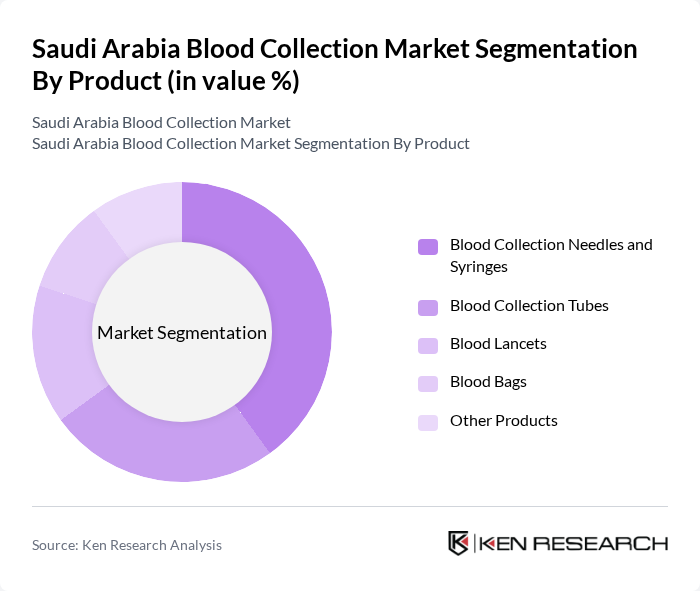
Saudi Arabia Blood Collection Market segmentation by Product.

By Application:The application segmentation encompasses Diagnostics and Therapeutic uses of blood collection. Diagnostics is the leading application segment, driven by the rising demand for laboratory tests and the need for timely disease diagnosis. The increasing prevalence of infectious diseases and the growing emphasis on preventive healthcare have significantly contributed to the expansion of this segment.

Saudi Arabia Blood Collection Market segmentation by Application.

Saudi Arabia Blood Collection Market Competitive Landscape

The Saudi Arabia Blood Collection Market is characterized by a dynamic mix of regional and international players. Leading participants such as Saudi Red Crescent Authority, King Faisal Specialist Hospital & Research Centre, National Guard Health Affairs, Ministry of Health, Saudi Arabia, Al Nahdi Medical Company, Al-Dawaa Pharmacies, Saudi Pharmaceutical Industries and Medical Appliances Corporation (SPIMACO), Becton, Dickinson and Company (BD), Terumo Corporation, Grifols S.A., Fresenius Kabi AG, Haemonetics Corporation, Bio-Rad Laboratories, Inc., Medtronic plc, Siemens Healthineers, Abbott Laboratories, Nipro Corporation, Greiner Bio-One GmbH, FL Medical, Qiagen N.V. contribute to innovation, geographic expansion, and service delivery in this space.

Saudi Red Crescent Authority

1963

Riyadh, Saudi Arabia

King Faisal Specialist Hospital & Research Centre

1975

Riyadh, Saudi Arabia

National Guard Health Affairs

1983

Riyadh, Saudi Arabia

Becton, Dickinson and Company (BD)

1897

Franklin Lakes, New Jersey, USA

Terumo Corporation

1921

Tokyo, Japan

Company

Establishment Year

Headquarters

Market Share (%)

CAGR (2022-2030, Saudi Arabia)

Number of Blood Collection Centers/Units in Saudi Arabia

Product Portfolio Breadth (Number of SKUs or Product Types)

Regulatory Compliance (e.g., SFDA Approvals)

Local Partnerships or Joint Ventures

Saudi Arabia Blood Collection Market Industry Analysis

Growth Drivers

  • Increasing Demand for Blood Transfusions:The demand for blood transfusions in Saudi Arabia is projected to reach approximately 1.5 million units in future, driven by rising incidences of chronic diseases and surgical procedures. The World Health Organization reports that the country has seen a 20% increase in blood transfusion needs over the past five years. This growing demand necessitates enhanced blood collection capabilities, thereby propelling market growth significantly.
  • Advancements in Blood Collection Technologies:Technological innovations in blood collection, such as automated blood collection systems and mobile blood donation units, are transforming the landscape. The Saudi Ministry of Health has invested over SAR 200 million in modernizing blood collection facilities, which has improved efficiency and safety. These advancements are expected to enhance donor experiences and increase overall blood donation rates, further driving market growth.
  • Government Initiatives to Enhance Healthcare Services:The Saudi government has committed to improving healthcare services, with a budget allocation of SAR 180 billion for the health sector in future. Initiatives include public awareness campaigns and the establishment of new blood donation centers. These efforts aim to increase blood donation rates by 30% in future, significantly impacting the blood collection market positively.

Market Challenges

  • Limited Public Awareness about Blood Donation:Despite government efforts, public awareness regarding the importance of blood donation remains low, with only 15% of the population actively participating in donation drives. This lack of awareness poses a significant challenge to increasing blood supply. Educational campaigns are essential to address this issue, as the country aims to boost donor participation by 25% in future.
  • Shortage of Trained Professionals:The blood collection sector faces a critical shortage of trained professionals, with an estimated deficit of 1,000 skilled personnel in future. This shortage hampers the efficiency of blood collection processes and affects the overall quality of services. The Saudi government is working to address this gap through training programs, but immediate solutions are necessary to meet growing demands.

Saudi Arabia Blood Collection Market Future Outlook

The Saudi Arabia blood collection market is poised for significant growth, driven by increasing demand for blood transfusions and advancements in technology. The government's commitment to enhancing healthcare services will likely lead to improved infrastructure and public awareness initiatives. As mobile blood collection units become more prevalent, accessibility will increase, encouraging higher donor participation. Overall, the market is expected to evolve rapidly, adapting to the needs of a growing population and advancing healthcare standards.

Market Opportunities

  • Expansion of Healthcare Facilities:The establishment of new healthcare facilities across Saudi Arabia presents a significant opportunity for the blood collection market. With over 50 new hospitals planned in future, the demand for blood collection services will increase, providing a platform for growth and improved access to blood donation.
  • Collaborations with NGOs for Awareness Campaigns:Partnering with non-governmental organizations to conduct awareness campaigns can significantly enhance public knowledge about blood donation. Such collaborations can lead to a projected 40% increase in donor turnout, addressing the current challenges of low participation rates and ensuring a stable blood supply.

Scope of the Report

SegmentSub-Segments
By Product

Blood Collection Needles and Syringes

Blood Collection Tubes

Blood Lancets

Blood Bags

Other Products

By Application

Diagnostics

Therapeutic

By End-User

Hospitals and Diagnostic Centres

Blood Banks

Other End Users

By Collection Site

Venous

Capillary

By Collection Method

Manual Collection

Automated Collection

By Region

Central Region

Eastern Region

Western Region

Southern Region

Key Target Audience

Investors and Venture Capitalist Firms

Government and Regulatory Bodies (e.g., Saudi Food and Drug Authority, Ministry of Health)

Blood Collection Equipment Manufacturers

Healthcare Providers and Hospitals

Blood Banks and Donation Centers

Logistics and Supply Chain Companies

Pharmaceutical Companies

Healthcare Technology Firms

Players Mentioned in the Report:

Saudi Red Crescent Authority

King Faisal Specialist Hospital & Research Centre

National Guard Health Affairs

Ministry of Health, Saudi Arabia

Al Nahdi Medical Company

Al-Dawaa Pharmacies

Saudi Pharmaceutical Industries and Medical Appliances Corporation (SPIMACO)

Becton, Dickinson and Company (BD)

Terumo Corporation

Grifols S.A.

Fresenius Kabi AG

Haemonetics Corporation

Bio-Rad Laboratories, Inc.

Medtronic plc

Siemens Healthineers

Abbott Laboratories

Nipro Corporation

Greiner Bio-One GmbH

FL Medical

Qiagen N.V.

Table of Contents

Market Assessment Phase

1. Executive Summary and Approach


2. Saudi Arabia Blood Collection Market Overview

2.1 Key Insights and Strategic Recommendations

2.2 Saudi Arabia Blood Collection Market Overview

2.3 Definition and Scope

2.4 Evolution of Market Ecosystem

2.5 Timeline of Key Regulatory Milestones

2.6 Value Chain & Stakeholder Mapping

2.7 Business Cycle Analysis

2.8 Policy & Incentive Landscape


3. Saudi Arabia Blood Collection Market Analysis

3.1 Growth Drivers

3.1.1 Increasing demand for blood transfusions
3.1.2 Advancements in blood collection technologies
3.1.3 Rising awareness about blood donation
3.1.4 Government initiatives to enhance healthcare services

3.2 Market Challenges

3.2.1 Limited public awareness about blood donation
3.2.2 Regulatory hurdles in blood collection processes
3.2.3 Shortage of trained professionals
3.2.4 Infrastructure limitations in remote areas

3.3 Market Opportunities

3.3.1 Expansion of healthcare facilities
3.3.2 Collaborations with NGOs for awareness campaigns
3.3.3 Technological innovations in blood collection
3.3.4 Increasing investments in healthcare sector

3.4 Market Trends

3.4.1 Growth of mobile blood collection units
3.4.2 Integration of digital technologies in blood management
3.4.3 Focus on donor retention strategies
3.4.4 Rise in corporate blood donation drives

3.5 Government Regulation

3.5.1 National Blood Transfusion Guidelines
3.5.2 Licensing requirements for blood collection centers
3.5.3 Safety standards for blood collection and storage
3.5.4 Regulations on donor eligibility and screening

4. SWOT Analysis


5. Stakeholder Analysis


6. Porter's Five Forces Analysis


7. Saudi Arabia Blood Collection Market Market Size, 2019-2024

7.1 By Value

7.2 By Volume

7.3 By Average Selling Price


8. Saudi Arabia Blood Collection Market Segmentation

8.1 By Product

8.1.1 Blood Collection Needles and Syringes
8.1.2 Blood Collection Tubes
8.1.3 Blood Lancets
8.1.4 Blood Bags
8.1.5 Other Products

8.2 By Application

8.2.1 Diagnostics
8.2.2 Therapeutic

8.3 By End-User

8.3.1 Hospitals and Diagnostic Centres
8.3.2 Blood Banks
8.3.3 Other End Users

8.4 By Collection Site

8.4.1 Venous
8.4.2 Capillary

8.5 By Collection Method

8.5.1 Manual Collection
8.5.2 Automated Collection

8.6 By Region

8.6.1 Central Region
8.6.2 Eastern Region
8.6.3 Western Region
8.6.4 Southern Region

9. Saudi Arabia Blood Collection Market Competitive Analysis

9.1 Market Share of Key Players

9.2 KPIs for Cross Comparison of Key Players

9.2.1 Revenue (USD Million, Saudi Arabia)
9.2.2 Market Share (%)
9.2.3 CAGR (2022-2030, Saudi Arabia)
9.2.4 Number of Blood Collection Centers/Units in Saudi Arabia
9.2.5 Product Portfolio Breadth (Number of SKUs or Product Types)
9.2.6 Regulatory Compliance (e.g., SFDA Approvals)
9.2.7 Local Partnerships or Joint Ventures
9.2.8 Distribution Network Coverage (Regions/Number of Hospitals Served)
9.2.9 R&D Investment (% of Revenue)
9.2.10 Customer Satisfaction/Net Promoter Score (NPS)

9.3 SWOT Analysis of Top Players

9.4 Pricing Analysis

9.5 Detailed Profile of Major Companies

9.5.1 Saudi Red Crescent Authority
9.5.2 King Faisal Specialist Hospital & Research Centre
9.5.3 National Guard Health Affairs
9.5.4 Ministry of Health, Saudi Arabia
9.5.5 Al Nahdi Medical Company
9.5.6 Al-Dawaa Pharmacies
9.5.7 Saudi Pharmaceutical Industries and Medical Appliances Corporation (SPIMACO)
9.5.8 Becton, Dickinson and Company (BD)
9.5.9 Terumo Corporation
9.5.10 Grifols S.A.
9.5.11 Fresenius Kabi AG
9.5.12 Haemonetics Corporation
9.5.13 Bio-Rad Laboratories, Inc.
9.5.14 Medtronic plc
9.5.15 Siemens Healthineers
9.5.16 Abbott Laboratories
9.5.17 Nipro Corporation
9.5.18 Greiner Bio-One GmbH
9.5.19 FL Medical
9.5.20 Qiagen N.V.

10. Saudi Arabia Blood Collection Market End-User Analysis

10.1 Procurement Behavior of Key Ministries

10.1.1 Ministry of Health Procurement Policies
10.1.2 Budget Allocation for Blood Services
10.1.3 Supplier Selection Criteria
10.1.4 Contract Management Practices

10.2 Corporate Spend on Infrastructure & Energy

10.2.1 Investment in Blood Collection Infrastructure
10.2.2 Spending on Technology Upgrades
10.2.3 Budget for Training and Development
10.2.4 Corporate Social Responsibility Initiatives

10.3 Pain Point Analysis by End-User Category

10.3.1 Challenges Faced by Hospitals
10.3.2 Issues in Blood Banks
10.3.3 Concerns of Diagnostic Laboratories
10.3.4 Needs of Research Institutions

10.4 User Readiness for Adoption

10.4.1 Awareness Levels Among Healthcare Providers
10.4.2 Training Needs Assessment
10.4.3 Technology Acceptance Levels
10.4.4 Feedback Mechanisms

10.5 Post-Deployment ROI and Use Case Expansion

10.5.1 Evaluation of Blood Collection Programs
10.5.2 Metrics for Success
10.5.3 Case Studies of Successful Implementations
10.5.4 Future Expansion Plans

11. Saudi Arabia Blood Collection Market Future Size, 2025-2030

11.1 By Value

11.2 By Volume

11.3 By Average Selling Price


Go-To-Market Strategy Phase

1. Whitespace Analysis + Business Model Canvas

1.1 Market Gaps Identification

1.2 Business Model Development


2. Marketing and Positioning Recommendations

2.1 Branding Strategies

2.2 Product USPs


3. Distribution Plan

3.1 Urban Retail vs Rural NGO Tie-ups


4. Channel & Pricing Gaps

4.1 Underserved Routes

4.2 Pricing Bands


5. Unmet Demand & Latent Needs

5.1 Category Gaps

5.2 Consumer Segments


6. Customer Relationship

6.1 Loyalty Programs

6.2 After-sales Service


7. Value Proposition

7.1 Sustainability

7.2 Integrated Supply Chains


8. Key Activities

8.1 Regulatory Compliance

8.2 Branding

8.3 Distribution Setup


9. Entry Strategy Evaluation

9.1 Domestic Market Entry Strategy

9.1.1 Product Mix
9.1.2 Pricing Band
9.1.3 Packaging

9.2 Export Entry Strategy

9.2.1 Target Countries
9.2.2 Compliance Roadmap

10. Entry Mode Assessment

10.1 JV

10.2 Greenfield

10.3 M&A

10.4 Distributor Model


11. Capital and Timeline Estimation

11.1 Capital Requirements

11.2 Timelines


12. Control vs Risk Trade-Off

12.1 Ownership vs Partnerships


13. Profitability Outlook

13.1 Breakeven Analysis

13.2 Long-term Sustainability


14. Potential Partner List

14.1 Distributors

14.2 JVs

14.3 Acquisition Targets


15. Execution Roadmap

15.1 Phased Plan for Market Entry

15.1.1 Market Setup
15.1.2 Market Entry
15.1.3 Growth Acceleration
15.1.4 Scale & Stabilize

15.2 Key Activities and Milestones

15.2.1 Milestone Planning
15.2.2 Activity Tracking

Research Methodology

ApproachModellingSample

Phase 1: Approach1

Desk Research

  • Analysis of government health reports and statistics on blood collection in Saudi Arabia
  • Review of industry publications and white papers from healthcare organizations
  • Examination of market trends and forecasts from reputable healthcare market research firms

Primary Research

  • Interviews with key stakeholders in blood collection agencies and hospitals
  • Surveys conducted with healthcare professionals involved in blood donation and transfusion
  • Focus group discussions with donors to understand motivations and barriers

Validation & Triangulation

  • Cross-validation of findings through multiple data sources including government and NGO reports
  • Triangulation of qualitative insights from interviews with quantitative data from surveys
  • Sanity checks through expert panel reviews comprising healthcare analysts and practitioners

Phase 2: Market Size Estimation1

Top-down Assessment

  • Estimation of total blood collection volume based on national health expenditure data
  • Segmentation of the market by blood type and collection method (e.g., whole blood, plasma)
  • Incorporation of demographic data to assess potential donor population growth

Bottom-up Modeling

  • Collection volume estimates derived from major blood banks and hospitals
  • Operational cost analysis based on equipment, staffing, and logistics
  • Revenue projections based on pricing models for blood products and services

Forecasting & Scenario Analysis

  • Multi-factor regression analysis incorporating population growth and healthcare access
  • Scenario modeling based on potential changes in regulations and public health initiatives
  • Baseline, optimistic, and pessimistic forecasts through 2030 based on historical trends

Phase 3: CATI Sample Composition1

Scope Item/SegmentSample SizeTarget Respondent Profiles
Hospital Blood Collection Practices100Blood Bank Managers, Transfusion Medicine Specialists
Community Blood Donation Drives60Event Coordinators, Volunteer Organizers
Public Awareness Campaigns50Healthcare Marketers, Public Health Officials
Regulatory Compliance in Blood Collection40Compliance Officers, Quality Assurance Managers
Donor Experience and Feedback70Blood Donors, Healthcare Survey Respondents

Frequently Asked Questions

What is the current value of the Saudi Arabia Blood Collection Market?

The Saudi Arabia Blood Collection Market is valued at approximately USD 60 million, reflecting a five-year historical analysis. This growth is driven by the rising prevalence of chronic diseases, increased awareness of blood donation, and advancements in blood collection technologies.

Which cities dominate the Saudi Arabia Blood Collection Market?

What recent regulations have impacted blood collection in Saudi Arabia?

What are the main products used in blood collection?

Other Regional/Country Reports

Indonesia Blood Collection Market

Malaysia Blood Collection Market

KSA Blood Collection Market

APAC Blood Collection Market

SEA Blood Collection Market

Vietnam Blood Collection Market

Other Adjacent Reports

Oman Blood Screening Market

Kuwait Blood Storage and Transportation Market

Belgium Blood Transfusion Devices Market

Brazil Plasma Fractionation Market

Thailand Hematology Diagnostics Market

Germany Medical Laboratory Equipment Market

South Africa Diagnostic Imaging Market

Qatar Healthcare Infrastructure Development Market

Oman Pharmaceutical Manufacturing Market

UAE Biotechnology Research Market

Why Buy From Us?

Refine Robust Result (RRR) Framework

What makes us stand out is that our consultants follow Robust, Refine and Result (RRR) methodology. Robust for clear definitions, approaches and sanity checking, Refine for differentiating respondents' facts and opinions, and Result for presenting data with story.

Our Reach Is Unmatched

We have set a benchmark in the industry by offering our clients with syndicated and customized market research reports featuring coverage of entire market as well as meticulous research and analyst insights.

Shifting the Research Paradigm

While we don't replace traditional research, we flip the method upside down. Our dual approach of Top Bottom & Bottom Top ensures quality deliverable by not just verifying company fundamentals but also looking at the sector and macroeconomic factors.

More Insights-Better Decisions

With one step in the future, our research team constantly tries to show you the bigger picture. We help with some of the tough questions you may encounter along the way: How is the industry positioned? Best marketing channel? KPI's of competitors? By aligning every element, we help maximize success.

Transparency and Trust

Our report gives you instant access to the answers and sources that other companies might choose to hide. We elaborate each steps of research methodology we have used and showcase you the sample size to earn your trust.

Round the Clock Support

If you need any support, we are here! We pride ourselves on universe strength, data quality, and quick, friendly, and professional service.

Why Clients Choose Us?

400000+
Reports in repository
150+
Consulting projects a year
100+
Analysts
8000+
Client Queries in 2022








