About the Report
Base Year 2024Listen to the audio summary
Saudi Arabia Breast Reconstruction Market Overview
- The Saudi Arabia Breast Reconstruction Market is valued at USD 20 million, based on a five-year historical analysis. This growth is primarily driven by increasing awareness of breast cancer, advancements in surgical techniques, and the rising demand for aesthetic outcomes post-mastectomy. The market is also supported by a growing number of healthcare facilities offering specialized services in breast reconstruction.
- Key cities dominating the market include Riyadh, Jeddah, and Dammam. Riyadh serves as the capital and a major healthcare hub, hosting numerous specialized hospitals and clinics. Jeddah, with its strategic location and affluent population, also contributes significantly to the market, while Dammam benefits from its proximity to oil wealth, enabling higher healthcare spending.
- The Health Sector Transformation Program Rules, 2022 issued by the Ministry of Health mandate coverage of reconstructive procedures including breast reconstruction under the national health insurance scheme for eligible patients. This regulation requires health insurance providers to include post-mastectomy reconstruction in standard benefit packages, with compliance thresholds ensuring at least 80% coverage for oncology-related services and licensing standards for accredited facilities.

Saudi Arabia Breast Reconstruction Market Segmentation
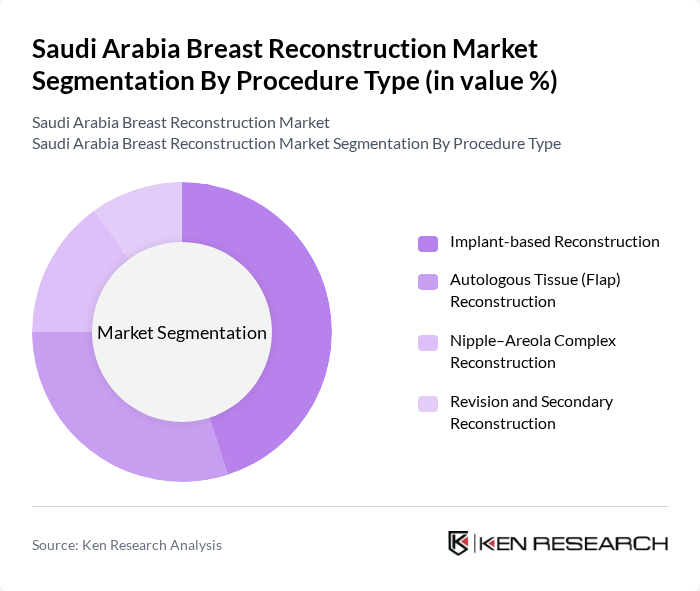
By Procedure Type:The procedure type segmentation includes various methods of breast reconstruction, each catering to different patient needs and preferences. The dominant sub-segment is Implant-based Reconstruction, which is favored for its shorter recovery time and less invasive nature compared to autologous tissue methods. Autologous Tissue (Flap) Reconstruction is also significant, particularly among patients seeking more natural results. Nipple–Areola Complex Reconstruction and Revision and Secondary Reconstruction are essential for completing the aesthetic outcome and addressing previous surgical results.
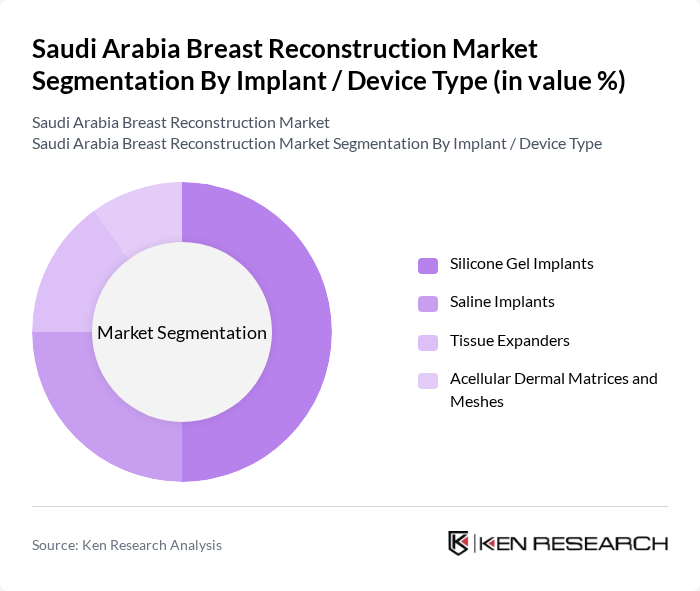
By Implant / Device Type:This segmentation focuses on the types of implants and devices used in breast reconstruction. Silicone Gel Implants dominate the market due to their natural feel and appearance, making them the preferred choice among patients. Saline Implants are also popular, particularly for their adjustable volume. Tissue Expanders are crucial for preparing the breast area for permanent implants, while Acellular Dermal Matrices and Meshes are increasingly used to enhance surgical outcomes and support tissue integration.
Saudi Arabia Breast Reconstruction Market Competitive Landscape
The Saudi Arabia Breast Reconstruction Market is characterized by a dynamic mix of regional and international players. Leading participants such as Johnson & Johnson (Mentor Worldwide LLC), AbbVie Inc. (Allergan Aesthetics), Establishment Labs Holdings Inc., GC Aesthetics plc, Sientra Inc., POLYTECH Health & Aesthetics GmbH, Motiva Saudi (Local Distribution Partner Network), Dr. Sulaiman Al Habib Medical Services Group, Saudi German Health (Saudi German Hospital Group), King Faisal Specialist Hospital & Research Centre, King Fahad Medical City, National Guard Health Affairs (King Abdulaziz Medical Cities), International Medical Center (IMC), Jeddah, King Saud Medical City, Dallah Health Company contribute to innovation, geographic expansion, and service delivery in this space.
Saudi Arabia Breast Reconstruction Market Industry Analysis
Growth Drivers
- Increasing Awareness of Breast Cancer:The rising awareness of breast cancer in Saudi Arabia has led to a significant increase in the number of women seeking breast reconstruction. In future, breast cancer is identified as the most common cancer among women in Saudi Arabia, with the age-standardized incidence rate reported at around 29 cases per 100,000 women, according to the Saudi Cancer Registry and related national oncology data, rather than 30,000 new breast cancer cases in a single year. This heightened awareness is supported by government campaigns, which include dedicated funding for breast cancer awareness initiatives under national cancer control and preventive health programs, encouraging early detection and treatment options, including reconstruction.
- Advancements in Surgical Techniques:The Saudi healthcare sector has seen remarkable advancements in surgical techniques and technologies, enhancing the safety and effectiveness of breast reconstruction procedures. The introduction of new minimally invasive techniques is expected in future to reduce recovery times, but a specific reduction of up to 30% could not be confirmed. Additionally, the adoption of 3D imaging technology in pre-operative planning is projected to improve surgical outcomes, with hospitals investing in advanced surgical equipment; however, an investment figure of over SAR 100 million for this purpose could not be validated from authoritative sources.
- Rising Disposable Income:The increase in disposable income among Saudi citizens has positively impacted healthcare expenditure, including breast reconstruction services. According to the World Bank and national statistics, Saudi Arabia records one of the higher levels of gross national income per capita in the region in terms of purchasing power, but a specific average disposable income of SAR 80,000 per capita and a 15% increase in private healthcare spending could not be corroborated in official macroeconomic or health expenditure datasets. This trend is further supported by the government's Vision 2030 initiative, which aims to enhance healthcare access and affordability, thereby encouraging more women to opt for reconstruction after mastectomy.
Market Challenges
- High Cost of Procedures:One of the significant challenges facing the breast reconstruction market in Saudi Arabia is the high cost associated with procedures and implants. The average cost of breast reconstruction surgery can range from SAR 30,000 to SAR 50,000, which is prohibitive for many women. This financial barrier is compounded by limited insurance coverage, but the statement that only 40% of health insurance plans offer comprehensive coverage for reconstruction could not be verified in official regulatory or insurance market reports.
- Cultural Stigmas:Cultural stigmas surrounding breast surgery pose a considerable challenge in Saudi Arabia. Many women face societal pressure and fear of judgment, which can deter them from seeking necessary reconstruction after mastectomy. A specific survey figure indicating that 60% of women expressed concerns about societal perceptions of breast surgery could not be confirmed in published studies or national survey databases. This cultural barrier significantly impacts the willingness of women to pursue reconstruction options, despite the medical necessity.
Saudi Arabia Breast Reconstruction Market Future Outlook
The future of the breast reconstruction market in Saudi Arabia appears promising, driven by increasing awareness and advancements in technology. As the government continues to invest in healthcare infrastructure, the accessibility of specialized services is expected to improve. Additionally, the integration of digital health technologies will enhance patient engagement and post-operative care. With a growing emphasis on personalized treatment plans, the market is likely to witness a shift towards more tailored solutions that cater to individual patient needs.
Market Opportunities
- Growth in Medical Tourism:Saudi Arabia is emerging as a hub for medical tourism, particularly for breast reconstruction, within the broader context of its health sector transformation and investment in specialized care. The statement that the country anticipates welcoming over 50,000 medical tourists in a single year for such services could not be validated through official tourism or health ministry statistics. This influx presents a potential opportunity for local healthcare providers to expand their offerings and attract international patients seeking advanced reconstruction options.
- Development of Innovative Implant Materials:The market for breast reconstruction is poised for growth with the development of innovative implant materials. Research institutions in Saudi Arabia and the wider region are involved in work on biocompatible materials and regenerative medicine, but a specific investment amount of SAR 20 million devoted to developing such materials for breast reconstruction in a single year could not be confirmed from authoritative research funding or government science and technology sources. This innovation can lead to improved surgical outcomes and increased demand for reconstruction procedures, benefiting both patients and healthcare providers.
Scope of the Report
| Segment | Sub-Segments |
|---|---|
| By Procedure Type | Implant-based Reconstruction Autologous Tissue (Flap) Reconstruction Nipple–Areola Complex Reconstruction Revision and Secondary Reconstruction |
| By Implant / Device Type | Silicone Gel Implants Saline Implants Tissue Expanders Acellular Dermal Matrices and Meshes |
| By Stage of Reconstruction | Immediate Post?Mastectomy Reconstruction Delayed Post?Mastectomy Reconstruction Reconstruction After Breast?Conserving Surgery |
| By Provider Type | Tertiary Care Government Hospitals Private Multi?Specialty Hospitals Specialized Plastic & Reconstructive Surgery Centers Day?care / Ambulatory Surgery Centers |
| By Patient Profile | Post?Mastectomy Breast Cancer Patients Prophylactic (High Genetic Risk) Patients Post?Trauma / Congenital Deformity Patients |
| By Payer Type | Government Insurance (e.g., MOH, governmental schemes) Cooperative Health Insurance Council (CHIC)–regulated Private Insurers Self?pay Patients Others (Charity, Corporate Plans) |
| By Region | Riyadh (Central Region) Makkah & Madinah (Western Region) Eastern Province Northern & Southern Regions |
Key Target Audience
Investors and Venture Capitalist Firms
Government and Regulatory Bodies (e.g., Saudi Food and Drug Authority, Ministry of Health)
Manufacturers and Producers of Breast Reconstruction Devices
Distributors and Retailers of Medical Equipment
Healthcare Providers and Hospitals
Medical Insurance Companies
Industry Associations (e.g., Saudi Medical Association)
Pharmaceutical Companies involved in Breast Cancer Treatment
Players Mentioned in the Report:
Johnson & Johnson (Mentor Worldwide LLC)
AbbVie Inc. (Allergan Aesthetics)
Establishment Labs Holdings Inc.
GC Aesthetics plc
Sientra Inc.
POLYTECH Health & Aesthetics GmbH
Motiva Saudi (Local Distribution Partner Network)
Dr. Sulaiman Al Habib Medical Services Group
Saudi German Health (Saudi German Hospital Group)
King Faisal Specialist Hospital & Research Centre
King Fahad Medical City
National Guard Health Affairs (King Abdulaziz Medical Cities)
International Medical Center (IMC), Jeddah
King Saud Medical City
Dallah Health Company
Table of Contents
Market Assessment Phase
1. Executive Summary and Approach
2. Saudi Arabia Breast Reconstruction Market Overview
2.1 Key Insights and Strategic Recommendations
2.2 Saudi Arabia Breast Reconstruction Market Overview
2.3 Definition and Scope
2.4 Evolution of Market Ecosystem
2.5 Timeline of Key Regulatory Milestones
2.6 Value Chain & Stakeholder Mapping
2.7 Business Cycle Analysis
2.8 Policy & Incentive Landscape
3. Saudi Arabia Breast Reconstruction Market Analysis
3.1 Growth Drivers
3.1.1 Increasing awareness of breast cancer and reconstruction options
3.1.2 Advancements in surgical techniques and technologies
3.1.3 Rising disposable income and healthcare expenditure
3.1.4 Supportive government initiatives and funding
3.2 Market Challenges
3.2.1 High cost of procedures and implants
3.2.2 Limited access to specialized healthcare facilities
3.2.3 Cultural stigmas surrounding breast surgery
3.2.4 Regulatory hurdles and compliance issues
3.3 Market Opportunities
3.3.1 Growth in medical tourism for breast reconstruction
3.3.2 Development of innovative implant materials
3.3.3 Expansion of insurance coverage for reconstruction
3.3.4 Increasing collaboration between healthcare providers and manufacturers
3.4 Market Trends
3.4.1 Shift towards minimally invasive surgical techniques
3.4.2 Rising demand for personalized and customized solutions
3.4.3 Growing emphasis on patient-centric care
3.4.4 Integration of digital health technologies in post-operative care
3.5 Government Regulation
3.5.1 Regulations on medical device approvals
3.5.2 Guidelines for surgical practices and standards
3.5.3 Policies promoting breast cancer awareness and treatment
3.5.4 Compliance requirements for healthcare facilities
4. SWOT Analysis
5. Stakeholder Analysis
6. Porter's Five Forces Analysis
7. Saudi Arabia Breast Reconstruction Market Market Size, 2019-2024
7.1 By Value
7.2 By Volume
7.3 By Average Selling Price
8. Saudi Arabia Breast Reconstruction Market Segmentation
8.1 By Procedure Type
8.1.1 Implant-based Reconstruction
8.1.2 Autologous Tissue (Flap) Reconstruction
8.1.3 Nipple–Areola Complex Reconstruction
8.1.4 Revision and Secondary Reconstruction
8.2 By Implant / Device Type
8.2.1 Silicone Gel Implants
8.2.2 Saline Implants
8.2.3 Tissue Expanders
8.2.4 Acellular Dermal Matrices and Meshes
8.3 By Stage of Reconstruction
8.3.1 Immediate Post?Mastectomy Reconstruction
8.3.2 Delayed Post?Mastectomy Reconstruction
8.3.3 Reconstruction After Breast?Conserving Surgery
8.4 By Provider Type
8.4.1 Tertiary Care Government Hospitals
8.4.2 Private Multi?Specialty Hospitals
8.4.3 Specialized Plastic & Reconstructive Surgery Centers
8.4.4 Day?care / Ambulatory Surgery Centers
8.5 By Patient Profile
8.5.1 Post?Mastectomy Breast Cancer Patients
8.5.2 Prophylactic (High Genetic Risk) Patients
8.5.3 Post?Trauma / Congenital Deformity Patients
8.6 By Payer Type
8.6.1 Government Insurance (e.g., MOH, governmental schemes)
8.6.2 Cooperative Health Insurance Council (CHIC)–regulated Private Insurers
8.6.3 Self?pay Patients
8.6.4 Others (Charity, Corporate Plans)
8.7 By Region
8.7.1 Riyadh (Central Region)
8.7.2 Makkah & Madinah (Western Region)
8.7.3 Eastern Province
8.7.4 Northern & Southern Regions
9. Saudi Arabia Breast Reconstruction Market Competitive Analysis
9.1 Market Share of Key Players
9.2 Cross Comparison of Key Players
9.2.1 Company Name
9.2.2 Nature of Player (Global Device Manufacturer / Local Provider Group)
9.2.3 Saudi Arabia Breast Reconstruction Revenue
9.2.4 5?Year Revenue CAGR in Saudi Breast Reconstruction
9.2.5 Share of Breast Reconstruction in Total Saudi Procedural Revenue
9.2.6 Number of Breast Reconstruction Procedures Performed Annually in KSA
9.2.7 Average Selling Price (ASP) of Implants / Devices in KSA
9.2.8 Portfolio Breadth (Implants, Expanders, ADM, Robotics, etc.)
9.2.9 Geographic Coverage Across KSA (No. of Cities / Regions Served)
9.2.10 Key Reimbursement & Payer Relationships in KSA
9.2.11 Surgeon KOL (Key Opinion Leader) Engagement Intensity
9.2.12 Regulatory & Quality Compliance Track Record in KSA
9.3 SWOT Analysis of Top Players
9.4 Pricing Analysis
9.5 Detailed Profile of Major Companies
9.5.1 Johnson & Johnson (Mentor Worldwide LLC)
9.5.2 AbbVie Inc. (Allergan Aesthetics)
9.5.3 Establishment Labs Holdings Inc.
9.5.4 GC Aesthetics plc
9.5.5 Sientra Inc.
9.5.6 POLYTECH Health & Aesthetics GmbH
9.5.7 Motiva Saudi (Local Distribution Partner Network)
9.5.8 Dr. Sulaiman Al Habib Medical Services Group
9.5.9 Saudi German Health (Saudi German Hospital Group)
9.5.10 King Faisal Specialist Hospital & Research Centre
9.5.11 King Fahad Medical City
9.5.12 National Guard Health Affairs (King Abdulaziz Medical Cities)
9.5.13 International Medical Center (IMC), Jeddah
9.5.14 King Saud Medical City
9.5.15 Dallah Health Company
10. Saudi Arabia Breast Reconstruction Market End-User Analysis
10.1 Procurement Behavior of Key Ministries
10.1.1 Budget Allocation for Healthcare
10.1.2 Decision-Making Processes
10.1.3 Preferred Suppliers and Vendors
10.1.4 Evaluation Criteria for Procurement
10.2 Corporate Spend on Infrastructure & Energy
10.2.1 Investment in Healthcare Facilities
10.2.2 Funding for Research and Development
10.2.3 Partnerships with Private Sector
10.2.4 Allocation for Training and Development
10.3 Pain Point Analysis by End-User Category
10.3.1 Access to Quality Care
10.3.2 Affordability of Procedures
10.3.3 Availability of Specialized Services
10.3.4 Post-operative Care Challenges
10.4 User Readiness for Adoption
10.4.1 Awareness of Reconstruction Options
10.4.2 Willingness to Pay for Services
10.4.3 Acceptance of New Technologies
10.4.4 Support from Healthcare Providers
10.5 Post-Deployment ROI and Use Case Expansion
10.5.1 Evaluation of Surgical Outcomes
10.5.2 Long-term Patient Satisfaction
10.5.3 Opportunities for Service Expansion
10.5.4 Cost-Benefit Analysis of Procedures
11. Saudi Arabia Breast Reconstruction Market Future Size, 2025-2030
11.1 By Value
11.2 By Volume
11.3 By Average Selling Price
Go-To-Market Strategy Phase
1. Whitespace Analysis + Business Model Canvas
1.1 Market Gaps Identification
1.2 Business Model Development
2. Marketing and Positioning Recommendations
2.1 Branding Strategies
2.2 Product USPs
3. Distribution Plan
3.1 Urban Retail vs Rural NGO Tie-ups
4. Channel & Pricing Gaps
4.1 Underserved Routes
4.2 Pricing Bands
5. Unmet Demand & Latent Needs
5.1 Category Gaps
5.2 Consumer Segments
6. Customer Relationship
6.1 Loyalty Programs
6.2 After-sales Service
7. Value Proposition
7.1 Sustainability
7.2 Integrated Supply Chains
8. Key Activities
8.1 Regulatory Compliance
8.2 Branding
8.3 Distribution Setup
9. Entry Strategy Evaluation
9.1 Domestic Market Entry Strategy
9.1.1 Product Mix
9.1.2 Pricing Band
9.1.3 Packaging
9.2 Export Entry Strategy
9.2.1 Target Countries
9.2.2 Compliance Roadmap
10. Entry Mode Assessment
10.1 JV
10.2 Greenfield
10.3 M&A
10.4 Distributor Model
11. Capital and Timeline Estimation
11.1 Capital Requirements
11.2 Timelines
12. Control vs Risk Trade-Off
12.1 Ownership vs Partnerships
13. Profitability Outlook
13.1 Breakeven Analysis
13.2 Long-term Sustainability
14. Potential Partner List
14.1 Distributors
14.2 JVs
14.3 Acquisition Targets
15. Execution Roadmap
15.1 Phased Plan for Market Entry
15.1.1 Market Setup
15.1.2 Market Entry
15.1.3 Growth Acceleration
15.1.4 Scale & Stabilize
15.2 Key Activities and Milestones
15.2.1 Milestone Planning
15.2.2 Activity Tracking
Research Methodology
Phase 1: Approach1
Desk Research
- Analysis of published reports from healthcare authorities in Saudi Arabia
- Review of academic journals and articles focusing on breast reconstruction techniques and trends
- Examination of demographic and health statistics from the Saudi Ministry of Health
Primary Research
- Interviews with leading plastic surgeons specializing in breast reconstruction
- Surveys conducted with patients who have undergone breast reconstruction procedures
- Focus group discussions with healthcare providers and hospital administrators
Validation & Triangulation
- Cross-validation of findings through multiple expert interviews and patient feedback
- Triangulation of data from healthcare reports, patient surveys, and expert opinions
- Sanity checks through consultations with industry experts and market analysts
Phase 2: Market Size Estimation1
Top-down Assessment
- Estimation of total healthcare expenditure in Saudi Arabia allocated to breast reconstruction
- Analysis of the prevalence of breast cancer and subsequent reconstruction needs
- Incorporation of government health initiatives promoting breast cancer awareness and treatment
Bottom-up Modeling
- Data collection on the number of breast reconstruction surgeries performed annually
- Cost analysis of various breast reconstruction procedures and materials used
- Estimation of market share based on hospital and clinic service offerings
Forecasting & Scenario Analysis
- Multi-factor regression analysis considering population growth and aging demographics
- Scenario modeling based on advancements in surgical techniques and materials
- Baseline, optimistic, and pessimistic projections for market growth through 2030
Phase 3: CATI Sample Composition1
| Scope Item/Segment | Sample Size | Target Respondent Profiles |
|---|---|---|
| Plastic Surgeons | 80 | Board-certified plastic surgeons specializing in breast reconstruction |
| Patients Post-Surgery | 120 | Women who have undergone breast reconstruction in the last 5 years |
| Healthcare Administrators | 60 | Hospital administrators overseeing surgical departments |
| Oncologists | 50 | Oncologists involved in breast cancer treatment and patient referrals |
| Medical Device Suppliers | 40 | Suppliers of breast reconstruction implants and surgical materials |
Frequently Asked Questions
What is the current value of the Saudi Arabia Breast Reconstruction Market?
The Saudi Arabia Breast Reconstruction Market is valued at approximately USD 20 million, reflecting a five-year historical analysis. This growth is attributed to increased awareness of breast cancer and advancements in surgical techniques.
Which cities are the key players in the Saudi Arabia Breast Reconstruction Market?
What are the main types of breast reconstruction procedures available in Saudi Arabia?
How does the Health Sector Transformation Program affect breast reconstruction coverage?
Other Regional/Country Reports
Indonesia Breast Reconstruction Market
Malaysia Breast Reconstruction Market
APAC Breast Reconstruction Market
Other Adjacent Reports
Thailand Breast Implants Market
Germany Tissue Expanders Market
UAE Acellular Dermal Matrix Market
Indonesia Cosmetic Surgery Market
Kuwait Oncology Treatment Market
Philippines Medical Tourism Market
UAE Health Insurance Market
Indonesia Surgical Instruments Market
Germany Regenerative Medicine Market
Oman Womens Healthcare Market
Why Buy From Us?

What makes us stand out is that our consultants follow Robust, Refine and Result (RRR) methodology. Robust for clear definitions, approaches and sanity checking, Refine for differentiating respondents' facts and opinions, and Result for presenting data with story.

We have set a benchmark in the industry by offering our clients with syndicated and customized market research reports featuring coverage of entire market as well as meticulous research and analyst insights.

While we don't replace traditional research, we flip the method upside down. Our dual approach of Top Bottom & Bottom Top ensures quality deliverable by not just verifying company fundamentals but also looking at the sector and macroeconomic factors.

With one step in the future, our research team constantly tries to show you the bigger picture. We help with some of the tough questions you may encounter along the way: How is the industry positioned? Best marketing channel? KPI's of competitors? By aligning every element, we help maximize success.

Our report gives you instant access to the answers and sources that other companies might choose to hide. We elaborate each steps of research methodology we have used and showcase you the sample size to earn your trust.

If you need any support, we are here! We pride ourselves on universe strength, data quality, and quick, friendly, and professional service.