About the Report
Base Year 2024Saudi Arabia Delivery Drones Market Overview
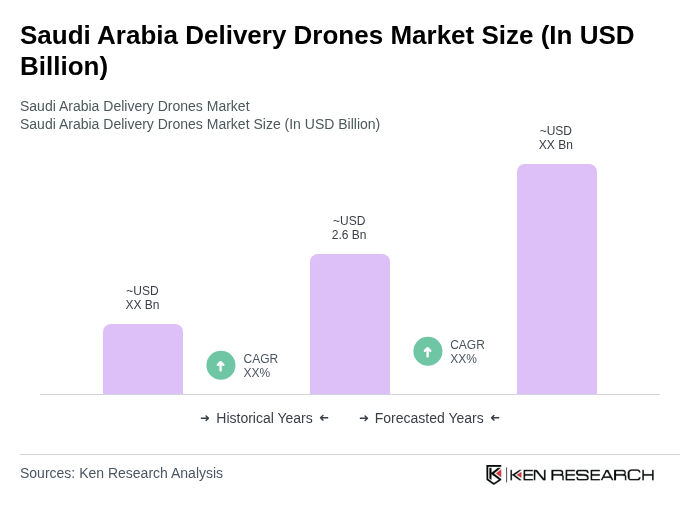
- The Saudi Arabia Delivery Drones Market is valued at USD 2.6 billion, based on a five-year historical analysis. This growth is primarily driven by the increasing demand for efficient logistics solutions, advancements in drone technology, and the rising popularity of e-commerce, supported by broader commercial drone adoption in logistics and smart-city applications under Vision 2030. The market is also supported by government initiatives aimed at integrating drone technology into various sectors, enhancing delivery efficiency, reducing operational costs, and enabling autonomous last-mile delivery in both urban and remote areas.
- Key cities such as Riyadh, Jeddah, and Dammam dominate the market due to their strategic locations, robust infrastructure, and high population density. These urban centers are witnessing a surge in e-commerce activities and logistics operations, making them ideal for drone delivery services, particularly within smart-city corridors and large-scale giga-projects. The concentration of businesses and consumers in these areas, combined with digital infrastructure and 5G deployment, further accelerates the adoption of delivery drones for time?critical and on?demand deliveries.
- In 2023, the Saudi Arabian government implemented regulations to facilitate the use of delivery drones, including the issuance of licenses for commercial drone operations. This regulatory framework builds on the Civil Aviation Law and the General Authority of Civil Aviation’s “GACA Drone Regulations and Requirements for Unmanned Aircraft Systems Operations, 2023” issued by the General Authority of Civil Aviation, which define registration, operator licensing, operational approvals, and airspace integration for commercial drone activities. The regulations also include guidelines for drone manufacturers and operators to comply with airspace management protocols, safety standards, and designated drone corridors to support scalable urban and inter?city delivery use cases.
Saudi Arabia Delivery Drones Market Segmentation
By Type:
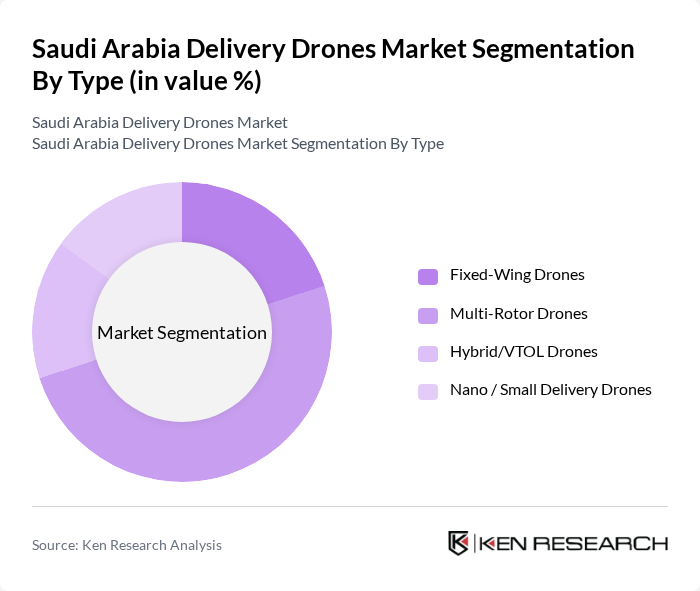
The market is segmented into four types: Fixed-Wing Drones, Multi-Rotor Drones, Hybrid/VTOL Drones, and Nano/Small Delivery Drones. Among these, Multi-Rotor Drones are leading the market due to their versatility, ease of use, vertical take?off and landing capability, and ability to operate in dense urban environments and short?range delivery corridors. They are particularly favored for last-mile deliveries, where agility, precise hovering, and quick turnaround times are essential. The growing trend of e-commerce, on?demand food and grocery delivery, and the need for rapid, contactless delivery solutions have further propelled the demand for Multi-Rotor Drones, making them the preferred choice for many logistics and retail companies piloting autonomous last?mile services.
By End-User:
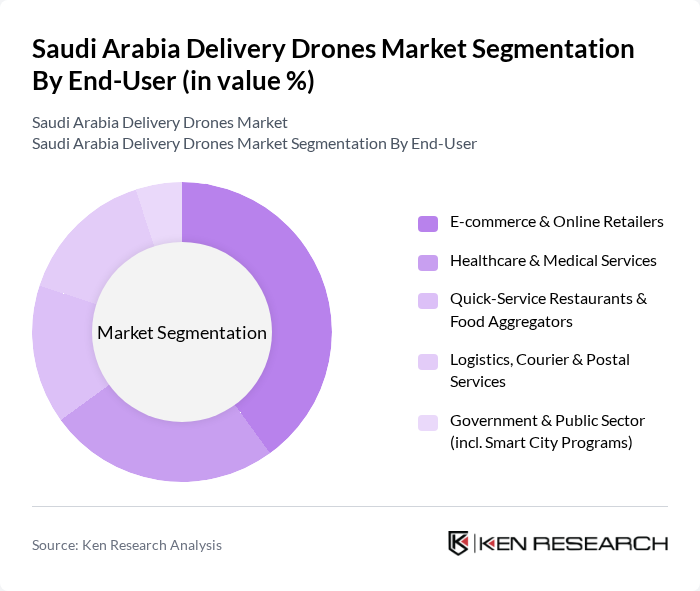
The end-user segmentation includes E-commerce & Online Retailers, Healthcare & Medical Services, Quick-Service Restaurants & Food Aggregators, Logistics, Courier & Postal Services, and Government & Public Sector. The E-commerce & Online Retailers segment is currently the dominant player, driven by the rapid growth of online shopping and consumer demand for fast, reliable last?mile delivery services. This segment's growth is further supported by partnerships between e-commerce platforms and drone delivery companies, as well as pilot projects with logistics providers and quick-commerce operators, enhancing overall logistics efficiency and enabling same?day and on?demand delivery models.
Saudi Arabia Delivery Drones Market Competitive Landscape
The Saudi Arabia Delivery Drones Market is characterized by a dynamic mix of regional and international players. Leading participants such as Saudi Post (SPL – Saudi Post & Logistics), Saudi Arabian Airlines Cargo (Saudia Cargo), NEOM (Drone Delivery & Autonomous Mobility Programs), Saudi Aramco (Aramco – Drone Logistics & Inspection Programs), Elm Company, STC Group (Saudi Telecom Company), Zain KSA, Mobily (Etihad Etisalat Company), Terra Drone Corporation, Skyports Drone Services, Zipline, Wing (Alphabet Inc.), Amazon Prime Air, Matternet, Flytrex contribute to innovation, geographic expansion, and service delivery in this space.
Saudi Arabia Delivery Drones Market Industry Analysis
Growth Drivers
- Increasing Demand for Last-Mile Delivery Solutions:The demand for last-mile delivery solutions in Saudi Arabia is projected to reach 1.5 million deliveries per day in future, driven by urbanization and a growing population. The rise in online shopping, with e-commerce sales expected to hit SAR 60 billion, is pushing logistics companies to adopt drones for efficient delivery. This shift is further supported by the need for faster delivery times, which drones can provide, enhancing customer satisfaction and operational efficiency.
- Government Support for Drone Technology:The Saudi government has allocated SAR 2 billion towards the development of drone technology as part of its Vision 2030 initiative. This funding aims to foster innovation and create a regulatory framework that encourages the use of drones in various sectors, including logistics. The establishment of the Saudi Arabian General Authority of Civil Aviation (GACA) has also streamlined the approval process for drone operations, facilitating market entry for new players and enhancing industry growth.
- Advancements in Drone Technology and Capabilities:Technological advancements have significantly improved drone capabilities, with payload capacities increasing to 10 kilograms and flight ranges extending up to 150 kilometers. These enhancements enable drones to handle a wider variety of delivery tasks, including food and medical supplies. The integration of AI and machine learning in drone operations is expected to optimize delivery routes, reduce operational costs, and improve delivery times, making drones a viable alternative to traditional delivery methods.
Market Challenges
- Regulatory Hurdles and Compliance Issues:The regulatory landscape for drone operations in Saudi Arabia remains complex, with stringent compliance requirements. In future, GACA mandates that all drone operators obtain specific licenses, which can take up to six months to secure. This lengthy approval process can deter potential entrants and slow down the adoption of drone technology in the delivery sector, limiting market growth and innovation.
- High Initial Investment Costs:The initial investment required for drone technology can be substantial, with costs for advanced delivery drones ranging from SAR 150,000 to SAR 600,000. This financial barrier can hinder small and medium-sized enterprises from entering the market. Additionally, ongoing maintenance and operational costs can further strain budgets, making it challenging for companies to justify the investment in drone delivery systems compared to traditional methods.
Saudi Arabia Delivery Drones Market Future Outlook
The future of the delivery drones market in Saudi Arabia appears promising, driven by technological advancements and increasing demand for efficient logistics solutions. As urban areas expand and e-commerce continues to grow, the integration of drones into delivery systems is expected to become more prevalent. Furthermore, collaboration between government entities and private companies will likely enhance regulatory frameworks, fostering innovation and encouraging investment in drone technology, ultimately transforming the logistics landscape in the region.
Market Opportunities
- Expansion into Remote and Underserved Areas:There is a significant opportunity for delivery drones to serve remote and underserved regions in Saudi Arabia, where traditional logistics face challenges. In future, approximately 25% of the population resides in rural areas, making drone delivery a viable solution to bridge the logistics gap and improve access to essential goods and services.
- Partnerships with Logistics and E-commerce Companies:Collaborations between drone manufacturers and logistics or e-commerce companies can create synergies that enhance service offerings. With e-commerce projected to grow by 35% annually, partnerships can facilitate the development of tailored drone solutions, improving delivery efficiency and expanding market reach, ultimately benefiting both parties involved.
Scope of the Report
| Segment | Sub-Segments |
|---|---|
| By Type | Fixed-Wing Drones Multi-Rotor Drones Hybrid/VTOL Drones Nano / Small Delivery Drones |
| By End-User | E-commerce & Online Retailers Healthcare & Medical Services Quick-Service Restaurants & Food Aggregators Logistics, Courier & Postal Services Government & Public Sector (incl. Smart City Programs) |
| By Region | Central Region (incl. Riyadh) Western Region (incl. Makkah & Madinah) Eastern Region (incl. Dammam & Dhahran) Southern & Northern Regions |
| By Application | Parcel & Consumer Goods Delivery Medical & Pharmaceutical Delivery Food & Grocery Delivery Intra-logistics (Warehouse / Campus / Industrial Sites) |
| By Payload Capacity | Less than 2 kg kg to 5 kg kg to 20 kg Above 20 kg |
| By Delivery Range | Short Range (up to 5 km) Medium Range (5 km to 20 km) Long Range (20 km to 100 km) Beyond Visual Line of Sight (BVLOS) Operations |
| By Technology | GPS / GNSS Navigation Computer Vision & Obstacle Avoidance Autonomous Flight & Fleet Management Systems UTM / Airspace Management & Connectivity (4G/5G) |
Key Target Audience
Investors and Venture Capitalist Firms
Government and Regulatory Bodies (e.g., Saudi Arabian General Authority of Civil Aviation)
Manufacturers and Producers of Delivery Drones
Logistics and Supply Chain Companies
Telecommunications Providers
Aerospace and Defense Contractors
Urban Planning and Smart City Development Agencies
Insurance Companies and Risk Assessment Firms
Players Mentioned in the Report:
Saudi Post (SPL Saudi Post & Logistics)
Saudi Arabian Airlines Cargo (Saudia Cargo)
NEOM (Drone Delivery & Autonomous Mobility Programs)
Saudi Aramco (Aramco Drone Logistics & Inspection Programs)
Elm Company
STC Group (Saudi Telecom Company)
Zain KSA
Mobily (Etihad Etisalat Company)
Terra Drone Corporation
Skyports Drone Services
Zipline
Wing (Alphabet Inc.)
Amazon Prime Air
Matternet
Flytrex
Table of Contents
Market Assessment Phase
1. Executive Summary and Approach
2. Saudi Arabia Delivery Drones Market Overview
2.1 Key Insights and Strategic Recommendations
2.2 Saudi Arabia Delivery Drones Market Overview
2.3 Definition and Scope
2.4 Evolution of Market Ecosystem
2.5 Timeline of Key Regulatory Milestones
2.6 Value Chain & Stakeholder Mapping
2.7 Business Cycle Analysis
2.8 Policy & Incentive Landscape
3. Saudi Arabia Delivery Drones Market Analysis
3.1 Growth Drivers
3.1.1 Increasing demand for last-mile delivery solutions
3.1.2 Government support for drone technology
3.1.3 Advancements in drone technology and capabilities
3.1.4 Rising e-commerce penetration in Saudi Arabia
3.2 Market Challenges
3.2.1 Regulatory hurdles and compliance issues
3.2.2 High initial investment costs
3.2.3 Limited public awareness and acceptance
3.2.4 Competition from traditional delivery methods
3.3 Market Opportunities
3.3.1 Expansion into remote and underserved areas
3.3.2 Partnerships with logistics and e-commerce companies
3.3.3 Development of specialized delivery drones
3.3.4 Integration with smart city initiatives
3.4 Market Trends
3.4.1 Increasing use of AI and automation in drone operations
3.4.2 Growth of drone delivery services in urban areas
3.4.3 Focus on sustainability and eco-friendly solutions
3.4.4 Rise of drone delivery in healthcare and emergency services
3.5 Government Regulation
3.5.1 Implementation of drone operation guidelines
3.5.2 Licensing requirements for drone operators
3.5.3 Airspace management regulations
3.5.4 Safety and security compliance measures
4. SWOT Analysis
5. Stakeholder Analysis
6. Porter's Five Forces Analysis
7. Saudi Arabia Delivery Drones Market Market Size, 2019-2024
7.1 By Value
7.2 By Volume
7.3 By Average Selling Price
8. Saudi Arabia Delivery Drones Market Segmentation
8.1 By Type
8.1.1 Fixed-Wing Drones
8.1.2 Multi-Rotor Drones
8.1.3 Hybrid/VTOL Drones
8.1.4 Nano / Small Delivery Drones
8.2 By End-User
8.2.1 E-commerce & Online Retailers
8.2.2 Healthcare & Medical Services
8.2.3 Quick-Service Restaurants & Food Aggregators
8.2.4 Logistics, Courier & Postal Services
8.2.5 Government & Public Sector (incl. Smart City Programs)
8.3 By Region
8.3.1 Central Region (incl. Riyadh)
8.3.2 Western Region (incl. Makkah & Madinah)
8.3.3 Eastern Region (incl. Dammam & Dhahran)
8.3.4 Southern & Northern Regions
8.4 By Application
8.4.1 Parcel & Consumer Goods Delivery
8.4.2 Medical & Pharmaceutical Delivery
8.4.3 Food & Grocery Delivery
8.4.4 Intra-logistics (Warehouse / Campus / Industrial Sites)
8.5 By Payload Capacity
8.5.1 Less than 2 kg
8.5.2 2 kg to 5 kg
8.5.3 5 kg to 20 kg
8.5.4 Above 20 kg
8.6 By Delivery Range
8.6.1 Short Range (up to 5 km)
8.6.2 Medium Range (5 km to 20 km)
8.6.3 Long Range (20 km to 100 km)
8.6.4 Beyond Visual Line of Sight (BVLOS) Operations
8.7 By Technology
8.7.1 GPS / GNSS Navigation
8.7.2 Computer Vision & Obstacle Avoidance
8.7.3 Autonomous Flight & Fleet Management Systems
8.7.4 UTM / Airspace Management & Connectivity (4G/5G)
9. Saudi Arabia Delivery Drones Market Competitive Analysis
9.1 Market Share of Key Players
9.2 Cross Comparison of Key Players
9.2.1 Company Name
9.2.2 Type of Player (Global OEM, Local Operator, or Integrator)
9.2.3 Estimated Revenue from Delivery Drones in Saudi Arabia
9.2.4 Number of Active Delivery Drones in Fleet (Saudi Arabia)
9.2.5 Number of Operational Routes / Service Locations
9.2.6 Average Delivery Time per Order (Door-to-Door)
9.2.7 Average Payload Capacity Utilization (%)
9.2.8 Share of BVLOS Missions in Total Flights (%)
9.2.9 Regulatory Certification Status (GACA Approvals, Trials)
9.2.10 On-time Delivery Rate (%)
9.2.11 Safety Incident Rate (per 10,000 Flights)
9.2.12 R&D / Technology Investment Intensity (% of Revenue)
9.3 SWOT Analysis of Top Players
9.4 Pricing Analysis
9.5 Detailed Profile of Major Companies
9.5.1 Saudi Post (SPL – Saudi Post & Logistics)
9.5.2 Saudi Arabian Airlines Cargo (Saudia Cargo)
9.5.3 NEOM (Drone Delivery & Autonomous Mobility Programs)
9.5.4 Saudi Aramco (Aramco – Drone Logistics & Inspection Programs)
9.5.5 Elm Company
9.5.6 STC Group (Saudi Telecom Company)
9.5.7 Zain KSA
9.5.8 Mobily (Etihad Etisalat Company)
9.5.9 Terra Drone Corporation
9.5.10 Skyports Drone Services
9.5.11 Zipline
9.5.12 Wing (Alphabet Inc.)
9.5.13 Amazon Prime Air
9.5.14 Matternet
9.5.15 Flytrex
10. Saudi Arabia Delivery Drones Market End-User Analysis
10.1 Procurement Behavior of Key Ministries
10.1.1 Ministry of Health
10.1.2 Ministry of Transport
10.1.3 Ministry of Interior
10.1.4 Ministry of Commerce
10.2 Corporate Spend on Infrastructure & Energy
10.2.1 Investment in Drone Infrastructure
10.2.2 Budget Allocation for Technology Adoption
10.2.3 Partnerships with Tech Firms
10.2.4 Others
10.3 Pain Point Analysis by End-User Category
10.3.1 E-commerce Challenges
10.3.2 Healthcare Delivery Issues
10.3.3 Logistics and Supply Chain Bottlenecks
10.3.4 Others
10.4 User Readiness for Adoption
10.4.1 Awareness Levels
10.4.2 Training and Support Needs
10.4.3 Infrastructure Readiness
10.4.4 Others
10.5 Post-Deployment ROI and Use Case Expansion
10.5.1 Cost Savings Analysis
10.5.2 Efficiency Gains
10.5.3 Customer Feedback and Adaptation
10.5.4 Others
11. Saudi Arabia Delivery Drones Market Future Size, 2025-2030
11.1 By Value
11.2 By Volume
11.3 By Average Selling Price
Go-To-Market Strategy Phase
1. Whitespace Analysis + Business Model Canvas
1.1 Market Gaps Identification
1.2 Value Proposition Development
1.3 Revenue Streams Analysis
1.4 Key Partnerships
1.5 Customer Segmentation
1.6 Cost Structure
1.7 Channels of Distribution
2. Marketing and Positioning Recommendations
2.1 Branding Strategies
2.2 Product USPs
3. Distribution Plan
3.1 Urban Retail vs Rural NGO Tie-ups
4. Channel & Pricing Gaps
4.1 Underserved Routes
4.2 Pricing Bands
5. Unmet Demand & Latent Needs
5.1 Category Gaps
5.2 Consumer Segments
6. Customer Relationship
6.1 Loyalty Programs
6.2 After-sales Service
7. Value Proposition
7.1 Sustainability
7.2 Integrated Supply Chains
8. Key Activities
8.1 Regulatory Compliance
8.2 Branding
8.3 Distribution Setup
9. Entry Strategy Evaluation
9.1 Domestic Market Entry Strategy
9.1.1 Product Mix
9.1.2 Pricing Band
9.1.3 Packaging
9.2 Export Entry Strategy
9.2.1 Target Countries
9.2.2 Compliance Roadmap
10. Entry Mode Assessment
10.1 JV
10.2 Greenfield
10.3 M&A
10.4 Distributor Model
11. Capital and Timeline Estimation
11.1 Capital Requirements
11.2 Timelines
12. Control vs Risk Trade-Off
12.1 Ownership vs Partnerships
13. Profitability Outlook
13.1 Breakeven Analysis
13.2 Long-term Sustainability
14. Potential Partner List
14.1 Distributors
14.2 JVs
14.3 Acquisition Targets
15. Execution Roadmap
15.1 Phased Plan for Market Entry
15.1.1 Market Setup
15.1.2 Market Entry
15.1.3 Growth Acceleration
15.1.4 Scale & Stabilize
15.2 Key Activities and Milestones
Research Methodology
Phase 1: Approach1
Desk Research
- Analysis of government reports on drone regulations and policies in Saudi Arabia
- Review of industry publications and market reports on drone technology adoption
- Examination of logistics and delivery trends from local and international sources
Primary Research
- Interviews with logistics managers at major e-commerce platforms operating in Saudi Arabia
- Surveys with drone manufacturers and service providers in the region
- Field interviews with regulatory bodies overseeing drone operations
Validation & Triangulation
- Cross-validation of findings through multiple data sources including trade associations
- Triangulation of market insights from primary interviews and secondary data
- Sanity checks conducted through expert panels comprising industry veterans
Phase 2: Market Size Estimation1
Top-down Assessment
- Estimation of market size based on national logistics expenditure and growth rates
- Segmentation of the market by application areas such as healthcare, retail, and food delivery
- Incorporation of government initiatives promoting drone technology in urban planning
Bottom-up Modeling
- Collection of operational data from leading drone service providers in Saudi Arabia
- Cost analysis based on service pricing models and operational efficiencies
- Volume estimates derived from projected delivery frequencies and service areas
Forecasting & Scenario Analysis
- Multi-variable regression analysis incorporating factors like urbanization and e-commerce growth
- Scenario modeling based on potential regulatory changes and technological advancements
- Development of baseline, optimistic, and pessimistic forecasts through 2030
Phase 3: CATI Sample Composition1
| Scope Item/Segment | Sample Size | Target Respondent Profiles |
|---|---|---|
| E-commerce Delivery Services | 120 | Logistics Managers, Operations Directors |
| Healthcare Drone Deliveries | 90 | Pharmacy Managers, Healthcare Logistics Coordinators |
| Food Delivery Sector | 70 | Restaurant Owners, Delivery Service Managers |
| Government Regulatory Bodies | 40 | Policy Makers, Aviation Safety Inspectors |
| Drone Technology Providers | 60 | Product Managers, Technical Directors |
Frequently Asked Questions
What is the current value of the Saudi Arabia Delivery Drones Market?
The Saudi Arabia Delivery Drones Market is valued at approximately USD 2.6 billion, driven by the increasing demand for efficient logistics solutions, advancements in drone technology, and the growth of e-commerce, particularly under the Vision 2030 initiative.
What are the key drivers of growth in the Saudi Arabia Delivery Drones Market?
Which cities in Saudi Arabia are leading in the delivery drones market?
What types of drones are used in the Saudi Arabia Delivery Drones Market?
Other Adjacent Reports
UAE Last-Mile Delivery Market
Singapore E-Commerce Logistics Market
Brazil Commercial Drones Market
Japan Autonomous Vehicles Market
Malaysia Urban Air Mobility Market
Malaysia Supply Chain Automation Market
Mexico Drone Manufacturing Market
Kuwait AI in Logistics Market
Singapore Smart City Infrastructure Market
South Korea Robotics Delivery Market
Why Buy From Us?

What makes us stand out is that our consultants follow Robust, Refine and Result (RRR) methodology. Robust for clear definitions, approaches and sanity checking, Refine for differentiating respondents' facts and opinions, and Result for presenting data with story.

We have set a benchmark in the industry by offering our clients with syndicated and customized market research reports featuring coverage of entire market as well as meticulous research and analyst insights.

While we don't replace traditional research, we flip the method upside down. Our dual approach of Top Bottom & Bottom Top ensures quality deliverable by not just verifying company fundamentals but also looking at the sector and macroeconomic factors.

With one step in the future, our research team constantly tries to show you the bigger picture. We help with some of the tough questions you may encounter along the way: How is the industry positioned? Best marketing channel? KPI's of competitors? By aligning every element, we help maximize success.

Our report gives you instant access to the answers and sources that other companies might choose to hide. We elaborate each steps of research methodology we have used and showcase you the sample size to earn your trust.

If you need any support, we are here! We pride ourselves on universe strength, data quality, and quick, friendly, and professional service.