About the Report
Base Year 2024Saudi Arabia EdTech and K-12 Digital Learning Market Overview
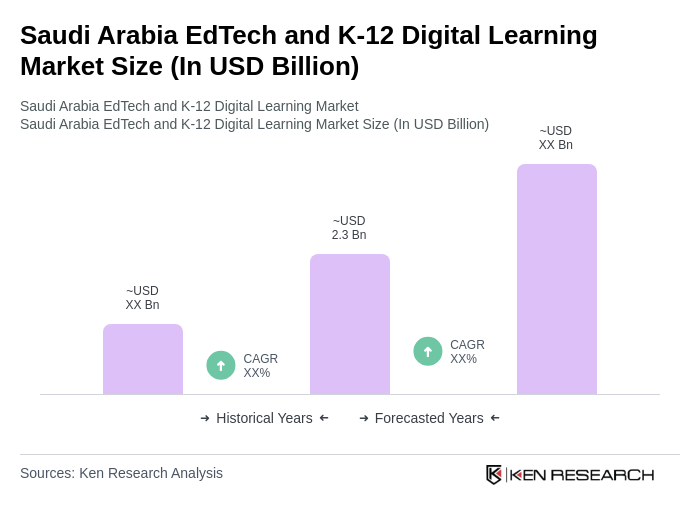
- The Saudi Arabia EdTech and K-12 Digital Learning Market is valued at USD 2.3 billion, based on a five-year analysis. This growth is primarily driven by the rapid adoption of digital learning solutions, robust government initiatives to enhance educational technology, and a surging demand for personalized and flexible learning experiences among students and educators. The market’s expansion is further supported by increased internet penetration, widespread use of smartphones, and a strong focus on digital literacy and technology skills development .
- Key cities such as Riyadh, Jeddah, and Dammam dominate the market due to their advanced educational infrastructure, high internet penetration rates, and significant investments in technology from both public and private sectors. These urban centers host numerous educational institutions that are integrating digital learning tools, such as learning management systems, virtual classrooms, and AI-based tutoring platforms, into their curricula to improve learning outcomes and operational efficiency .
- In 2023, the Saudi government implemented the National Strategy for Digital Transformation in Education, issued by the Ministry of Education. This strategy aims to integrate advanced technologies—including artificial intelligence, cloud computing, and data analytics—into the educational system. The initiative includes a budget allocation of USD 1 billion to enhance digital learning platforms, content development, and teacher training, ensuring students have access to high-quality educational resources and tools .
Saudi Arabia EdTech and K-12 Digital Learning Market Segmentation
By Type:The market is segmented into various types, including Learning Management Systems (LMS), Virtual Classrooms, Mobile Learning Applications, Content Development Tools, Assessment and Evaluation Tools, and Others. Among these, Learning Management Systems (LMS) are leading the market due to their ability to streamline educational processes, support remote and blended learning models, and enhance student engagement through interactive content and analytics .

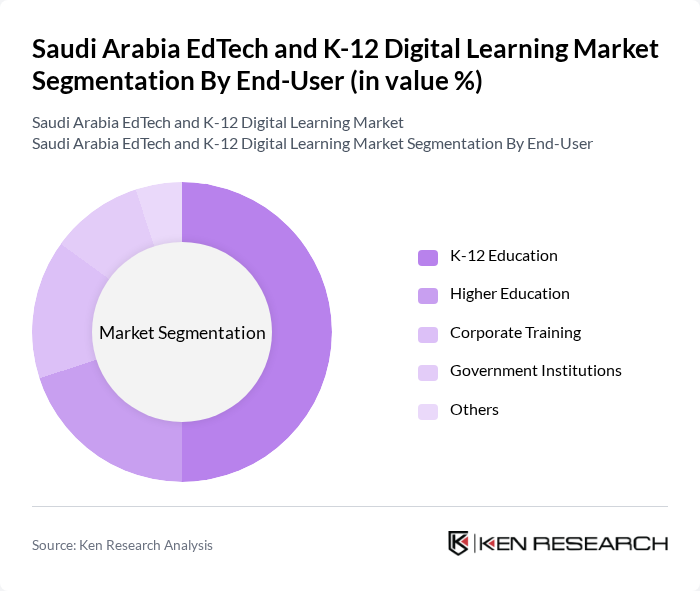
By End-User:The market is categorized by end-users, including K-12 Education, Higher Education, Corporate Training, Government Institutions, and Others. The K-12 Education segment is the most significant contributor, driven by the increasing integration of technology in schools, the expansion of digital literacy programs, and the Ministry of Education’s focus on modernizing curricula to prepare students for a digital economy .
Saudi Arabia EdTech and K-12 Digital Learning Market Competitive Landscape
The Saudi Arabia EdTech and K-12 Digital Learning Market is characterized by a dynamic mix of regional and international players. Leading participants such as Almentor, Edraak, Noon Academy, Rwaq, Qiyas, Skill Academy, Tadarab, Future Academy, Maktabati, Taalam, Learn Arabia, Mena School, Al-Faisal University, Saudi Digital Academy, and Knowledge City contribute to innovation, geographic expansion, and service delivery in this space.
Saudi Arabia EdTech and K-12 Digital Learning Market Industry Analysis
Growth Drivers
- Increasing Government Investment in Education Technology:The Saudi government allocated approximately SAR 189 billion (USD 50.4 billion) for education in its most recent budget, emphasizing the integration of technology in classrooms. This investment aims to enhance educational outcomes and support the Vision 2030 initiative, which seeks to diversify the economy and improve the quality of education. The focus on digital learning tools is expected to significantly boost the EdTech sector, fostering innovation and accessibility across the nation.
- Rising Demand for Remote Learning Solutions:The COVID-19 pandemic accelerated the adoption of remote learning solutions, with over 1.5 million students in Saudi Arabia utilizing online platforms. This shift has created a sustained demand for digital learning tools, as parents and educators recognize the benefits of flexible learning environments. The Ministry of Education's support for remote learning initiatives further solidifies this trend, driving investment in EdTech solutions that cater to diverse learning needs.
- Growing Internet Penetration and Smartphone Usage:Internet penetration in Saudi Arabia is among the highest globally, reaching approximately 99%, with over 36 million active internet users. Smartphone usage is estimated to exceed 97% among the population. This widespread access to digital devices facilitates the adoption of EdTech solutions, enabling students to engage with educational content anytime and anywhere. The increasing connectivity supports the growth of online learning platforms and digital resources, enhancing educational accessibility.
Market Challenges
- Limited Digital Infrastructure in Rural Areas:Despite high national internet penetration, rural areas in Saudi Arabia face significant digital infrastructure challenges. Approximately 30% of rural schools lack reliable internet access, hindering the implementation of EdTech solutions. This disparity creates an educational divide, limiting opportunities for students in these regions. Addressing this challenge is crucial for ensuring equitable access to digital learning resources across the country.
- Resistance to Change from Traditional Teaching Methods:Many educators in Saudi Arabia remain hesitant to adopt new teaching methodologies, with about 40% preferring traditional classroom settings. This resistance stems from a lack of training and familiarity with digital tools. Overcoming this challenge requires targeted professional development programs to equip teachers with the necessary skills to integrate technology effectively into their teaching practices, fostering a more innovative educational environment.
Saudi Arabia EdTech and K-12 Digital Learning Market Future Outlook
The future of the Saudi Arabia EdTech and K-12 digital learning market appears promising, driven by ongoing government initiatives and technological advancements. As educational institutions increasingly embrace hybrid learning models, the demand for innovative digital solutions will continue to rise. Furthermore, the integration of artificial intelligence and data analytics into educational platforms is expected to enhance personalized learning experiences, catering to diverse student needs and improving overall educational outcomes in the region.
Market Opportunities
- Expansion of Online Learning Platforms:The growing acceptance of online education presents a significant opportunity for EdTech companies. With over 1.5 million students engaged in remote learning, there is a demand for diverse online courses and interactive platforms. Companies that can provide localized content and user-friendly interfaces are likely to capture a substantial share of this expanding market.
- Development of Localized Educational Content:As the Saudi population becomes more digitally savvy, there is a pressing need for localized educational content that resonates with cultural and linguistic contexts. Companies focusing on creating tailored educational materials can tap into this opportunity, enhancing student engagement and improving learning outcomes while aligning with national educational goals.
Scope of the Report
| Segment | Sub-Segments |
|---|---|
| By Type | Learning Management Systems (LMS) Virtual Classrooms Mobile Learning Applications Content Development Tools Assessment and Evaluation Tools Others |
| By End-User | K-12 Education Higher Education Corporate Training Government Institutions Others |
| By Application | Academic Learning Professional Development Skill Development Compliance Training Others |
| By Delivery Mode | Synchronous Learning Asynchronous Learning Blended Learning Others |
| By Pricing Model | Subscription-Based Pay-Per-Use Freemium Others |
| By Content Type | Video-Based Content Text-Based Content Interactive Content Others |
| By Region | Central Region Eastern Region Western Region Southern Region Others |
Key Target Audience
Investors and Venture Capitalist Firms
Government and Regulatory Bodies (e.g., Ministry of Education, Saudi Arabian General Investment Authority)
Technology Providers
Content Developers and Publishers
Telecommunications Companies
Corporate Training Providers
Non-Governmental Organizations (NGOs) focused on education
International Development Agencies
Players Mentioned in the Report:
Almentor
Edraak
Noon Academy
Rwaq
Qiyas
Skill Academy
Tadarab
Future Academy
Maktabati
Taalam
Learn Arabia
Mena School
Al-Faisal University
Saudi Digital Academy
Knowledge City
Table of Contents
Market Assessment Phase
1. Executive Summary and Approach
2. Saudi Arabia EdTech and K-12 Digital Learning Market Overview
2.1 Key Insights and Strategic Recommendations
2.2 Saudi Arabia EdTech and K-12 Digital Learning Market Overview
2.3 Definition and Scope
2.4 Evolution of Market Ecosystem
2.5 Timeline of Key Regulatory Milestones
2.6 Value Chain & Stakeholder Mapping
2.7 Business Cycle Analysis
2.8 Policy & Incentive Landscape
3. Saudi Arabia EdTech and K-12 Digital Learning Market Analysis
3.1 Growth Drivers
3.1.1 Increasing Government Investment in Education Technology
3.1.2 Rising Demand for Remote Learning Solutions
3.1.3 Growing Internet Penetration and Smartphone Usage
3.1.4 Shift Towards Personalized Learning Experiences
3.2 Market Challenges
3.2.1 Limited Digital Infrastructure in Rural Areas
3.2.2 Resistance to Change from Traditional Teaching Methods
3.2.3 High Initial Costs of EdTech Solutions
3.2.4 Regulatory Compliance and Bureaucratic Hurdles
3.3 Market Opportunities
3.3.1 Expansion of Online Learning Platforms
3.3.2 Development of Localized Educational Content
3.3.3 Partnerships with Educational Institutions
3.3.4 Integration of AI and Data Analytics in Learning
3.4 Market Trends
3.4.1 Increasing Adoption of Gamification in Learning
3.4.2 Growth of Hybrid Learning Models
3.4.3 Emphasis on STEM Education
3.4.4 Rise of Microlearning and Bite-Sized Content
3.5 Government Regulation
3.5.1 Implementation of National Digital Education Strategy
3.5.2 Regulations on Data Privacy and Security in EdTech
3.5.3 Standards for Digital Content Quality
3.5.4 Incentives for Local EdTech Startups
4. SWOT Analysis
5. Stakeholder Analysis
6. Porter's Five Forces Analysis
7. Saudi Arabia EdTech and K-12 Digital Learning Market Market Size, 2019-2024
7.1 By Value
7.2 By Volume
7.3 By Average Selling Price
8. Saudi Arabia EdTech and K-12 Digital Learning Market Segmentation
8.1 By Type
8.1.1 Learning Management Systems (LMS)
8.1.2 Virtual Classrooms
8.1.3 Mobile Learning Applications
8.1.4 Content Development Tools
8.1.5 Assessment and Evaluation Tools
8.1.6 Others
8.2 By End-User
8.2.1 K-12 Education
8.2.2 Higher Education
8.2.3 Corporate Training
8.2.4 Government Institutions
8.2.5 Others
8.3 By Application
8.3.1 Academic Learning
8.3.2 Professional Development
8.3.3 Skill Development
8.3.4 Compliance Training
8.3.5 Others
8.4 By Delivery Mode
8.4.1 Synchronous Learning
8.4.2 Asynchronous Learning
8.4.3 Blended Learning
8.4.4 Others
8.5 By Pricing Model
8.5.1 Subscription-Based
8.5.2 Pay-Per-Use
8.5.3 Freemium
8.5.4 Others
8.6 By Content Type
8.6.1 Video-Based Content
8.6.2 Text-Based Content
8.6.3 Interactive Content
8.6.4 Others
8.7 By Region
8.7.1 Central Region
8.7.2 Eastern Region
8.7.3 Western Region
8.7.4 Southern Region
8.7.5 Others
9. Saudi Arabia EdTech and K-12 Digital Learning Market Competitive Analysis
9.1 Market Share of Key Players
9.2 Cross Comparison of Key Players
9.2.1 Company Name
9.2.2 Market Share Percentage
9.2.3 Revenue Growth Rate (CAGR)
9.2.4 User Base Size
9.2.5 Platform Engagement Metrics
9.2.6 Content Library Size
9.2.7 Geographic Coverage
9.2.8 Technology Integration Level
9.2.9 Customer Satisfaction Score
9.2.10 Investment Funding Received
9.3 SWOT Analysis of Top Players
9.4 Pricing Analysis
9.5 Detailed Profile of Major Companies
9.5.1 Almentor
9.5.2 Edraak
9.5.3 Noon Academy
9.5.4 Rwaq
9.5.5 Qiyas
9.5.6 Skill Academy
9.5.7 Tadarab
9.5.8 Future Academy
9.5.9 Maktabati
9.5.10 Taalam
9.5.11 Learn Arabia
9.5.12 Mena School
9.5.13 Al-Faisal University
9.5.14 Saudi Digital Academy
9.5.15 Knowledge City
10. Saudi Arabia EdTech and K-12 Digital Learning Market End-User Analysis
10.1 Procurement Behavior of Key Ministries
10.1.1 Budget Allocation for EdTech
10.1.2 Decision-Making Process
10.1.3 Preferred Vendors
10.1.4 Evaluation Criteria
10.2 Corporate Spend on Infrastructure & Energy
10.2.1 Investment in Digital Infrastructure
10.2.2 Spending on Training and Development
10.2.3 Budget for EdTech Solutions
10.3 Pain Point Analysis by End-User Category
10.3.1 Challenges Faced by Schools
10.3.2 Issues for Educational Institutions
10.3.3 Concerns of Government Agencies
10.4 User Readiness for Adoption
10.4.1 Awareness of EdTech Solutions
10.4.2 Training Needs
10.4.3 Technological Proficiency
10.5 Post-Deployment ROI and Use Case Expansion
10.5.1 Measurement of Learning Outcomes
10.5.2 User Feedback and Iteration
10.5.3 Expansion into New Use Cases
11. Saudi Arabia EdTech and K-12 Digital Learning Market Future Size, 2025-2030
11.1 By Value
11.2 By Volume
11.3 By Average Selling Price
Go-To-Market Strategy Phase
1. Whitespace Analysis + Business Model Canvas
1.1 Market Gaps Identification
1.2 Business Model Framework
2. Marketing and Positioning Recommendations
2.1 Branding Strategies
2.2 Product USPs
3. Distribution Plan
3.1 Urban Retail vs Rural NGO Tie-Ups
4. Channel & Pricing Gaps
4.1 Underserved Routes
4.2 Pricing Bands
5. Unmet Demand & Latent Needs
5.1 Category Gaps
5.2 Consumer Segments
6. Customer Relationship
6.1 Loyalty Programs
6.2 After-Sales Service
7. Value Proposition
7.1 Sustainability
7.2 Integrated Supply Chains
8. Key Activities
8.1 Regulatory Compliance
8.2 Branding
8.3 Distribution Setup
9. Entry Strategy Evaluation
9.1 Domestic Market Entry Strategy
9.1.1 Product Mix
9.1.2 Pricing Band
9.1.3 Packaging
9.2 Export Entry Strategy
9.2.1 Target Countries
9.2.2 Compliance Roadmap
10. Entry Mode Assessment
10.1 JV
10.2 Greenfield
10.3 M&A
10.4 Distributor Model
11. Capital and Timeline Estimation
11.1 Capital Requirements
11.2 Timelines
12. Control vs Risk Trade-Off
12.1 Ownership vs Partnerships
13. Profitability Outlook
13.1 Breakeven Analysis
13.2 Long-Term Sustainability
14. Potential Partner List
14.1 Distributors
14.2 JVs
14.3 Acquisition Targets
15. Execution Roadmap
15.1 Phased Plan for Market Entry
15.1.1 Market Setup
15.1.2 Market Entry
15.1.3 Growth Acceleration
15.1.4 Scale & Stabilize
15.2 Key Activities and Milestones
15.2.1 Milestone Planning
15.2.2 Activity Tracking
Research Methodology
Phase 1: Approach1
Desk Research
- Analysis of government reports on K-12 education initiatives in Saudi Arabia
- Review of market studies and white papers from educational institutions and EdTech organizations
- Examination of demographic data and digital infrastructure reports from the Saudi Communications and Information Technology Commission
Primary Research
- Interviews with school administrators and educators to understand digital learning adoption
- Surveys targeting parents to gauge perceptions of EdTech tools and platforms
- Focus groups with students to assess user experience and engagement with digital learning resources
Validation & Triangulation
- Cross-validation of findings through multiple data sources, including academic publications and industry reports
- Triangulation of insights from educators, parents, and students to ensure comprehensive understanding
- Sanity checks through expert panel reviews consisting of EdTech specialists and educational policymakers
Phase 2: Market Size Estimation1
Top-down Assessment
- Estimation of total education expenditure in Saudi Arabia and its allocation to digital learning
- Analysis of government funding initiatives for K-12 digital education programs
- Segmentation of the market by type of digital learning tools and platforms used in schools
Bottom-up Modeling
- Collection of data on the number of K-12 institutions and their respective digital tool adoption rates
- Estimation of average spending per student on EdTech solutions
- Calculation of market size based on the aggregation of institutional and individual spending
Forecasting & Scenario Analysis
- Development of growth projections based on historical adoption rates and future trends in digital learning
- Scenario analysis considering potential impacts of regulatory changes and technological advancements
- Creation of baseline, optimistic, and pessimistic forecasts through 2030
Phase 3: CATI Sample Composition1
| Scope Item/Segment | Sample Size | Target Respondent Profiles |
|---|---|---|
| K-12 School Administrators | 100 | Principals, Vice Principals, IT Coordinators |
| Teachers and Educators | 150 | Subject Teachers, Digital Learning Specialists |
| Parents of K-12 Students | 120 | Parents, Guardians, Educational Advocates |
| EdTech Solution Providers | 80 | Product Managers, Sales Executives, Customer Success Managers |
| Students in K-12 Schools | 140 | High School Students, Middle School Students |
Frequently Asked Questions
What is the current value of the Saudi Arabia EdTech and K-12 Digital Learning Market?
The Saudi Arabia EdTech and K-12 Digital Learning Market is valued at approximately USD 2.3 billion, reflecting significant growth driven by the adoption of digital learning solutions and government initiatives aimed at enhancing educational technology.
What factors are driving the growth of the EdTech market in Saudi Arabia?
Which cities are leading in the EdTech market in Saudi Arabia?
What is the National Strategy for Digital Transformation in Education?
Other Regional/Country Reports
Indonesia EdTech and K-12 Digital Learning Market
Malaysia EdTech and K-12 Digital Learning Market
KSA EdTech and K-12 Digital Learning Market
APAC EdTech and K-12 Digital Learning Market
SEA EdTech and K-12 Digital Learning Market
Vietnam EdTech and K-12 Digital Learning Market
Other Adjacent Reports
KSA Learning Management Systems Market
Asia Pacific Online Tutoring Services Market Outlook to 2030: Size, Share, Growth and TrendsOman Educational Content Development Market
Germany Virtual Reality Education Market
Kuwait Artificial Intelligence Education Market
Germany Mobile Learning Applications MarketPhilippines Digital Assessment Tools Market
Kuwait E-Learning Hardware Market
Egypt Teacher Training Platforms Market
Japan Educational Data Analytics Market
Why Buy From Us?

What makes us stand out is that our consultants follow Robust, Refine and Result (RRR) methodology. Robust for clear definitions, approaches and sanity checking, Refine for differentiating respondents' facts and opinions, and Result for presenting data with story.

We have set a benchmark in the industry by offering our clients with syndicated and customized market research reports featuring coverage of entire market as well as meticulous research and analyst insights.

While we don't replace traditional research, we flip the method upside down. Our dual approach of Top Bottom & Bottom Top ensures quality deliverable by not just verifying company fundamentals but also looking at the sector and macroeconomic factors.

With one step in the future, our research team constantly tries to show you the bigger picture. We help with some of the tough questions you may encounter along the way: How is the industry positioned? Best marketing channel? KPI's of competitors? By aligning every element, we help maximize success.

Our report gives you instant access to the answers and sources that other companies might choose to hide. We elaborate each steps of research methodology we have used and showcase you the sample size to earn your trust.

If you need any support, we are here! We pride ourselves on universe strength, data quality, and quick, friendly, and professional service.